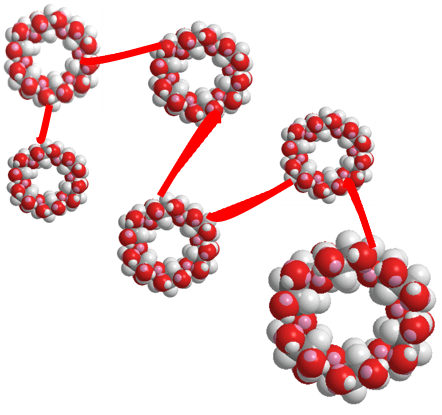
γCDP: Molecular-Cavity Nanofibers and Microspheres for Separation and Water Purification
キーワード / Keywords
-
γCDP / Gamma-Cyclodextrin Polymer
γ-シクロデキストリンを高分子ネットワークや粒子に組み込んだ材料です。大きめの空洞を利用し、分子の包接、吸着、分離に使えます。
EN: A polymer or particle material incorporating gamma-cyclodextrin. Its relatively large cavity supports inclusion, adsorption, and molecular separation. -
ポリシクロデキストリンナノファイバー / Polycyclodextrin Nanofiber
シクロデキストリンを含む細い繊維状材料です。表面積が大きく、分子を選んで捕まえる性質を活かし、ろ過や分離材料に応用できます。
EN: A fine fiber material containing cyclodextrins. Its high surface area and selective molecular capture make it useful for filtration and separation. -
包接複合体 / Inclusion Complex
CDの空洞に別の分子が入り込む状態です。分子の大きさや形により入りやすさが変わり、選択的な吸着や分子認識の基礎になります。
EN: A state in which a guest molecule enters a CD cavity. Fit depends on size and shape, forming the basis of selective adsorption and recognition. -
ESR分光 / ESR Spectroscopy
電子スピン共鳴を使い、分子がどのような環境にいるかを調べる方法です。CD空洞の中の疎水性や分子の動きを読む手がかりになります。
EN: Electron spin resonance spectroscopy probes the local environment of spin-labeled molecules, revealing hydrophobicity and dynamics inside CD cavities. -
染料除去 / Dye Removal
産業排水に含まれる色素を吸着材で取り除く技術です。γCDPを含むミクロスフェアは、包接、静電相互作用、孔への取り込みで働きます。
EN: A water-treatment approach that removes dyes from industrial wastewater. γCDP-containing microspheres work through inclusion, electrostatics, and pore filling.
採用した論文 / Selected Papers
-
ACS Applied Polymer Materials(2025 JIF: 5.2)
Hectorite-Modified Sodium Alginate/γ-Cyclodextrin Microspheres with Tunable Interlayers for Dye Removal
DOI: 10.1021/acsapm.5c02644 -
Journal of Physical Chemistry B(2024-2025 Impact Score: 2.83)
Probing Inclusion Complexation Mechanisms in Polycyclodextrin Nanofibers via ESR Spectroscopy
DOI: 10.1021/acs.jpcb.6c02249
日本語版
1. γ-CDポリマー入りミクロスフェアで、染料排水をきれいにする
論文: Hectorite-Modified Sodium Alginate/γ-Cyclodextrin Microspheres with Tunable Interlayers for Dye Removal
掲載誌: ACS Applied Polymer Materials
DOI: 10.1021/acsapm.5c02644
- この研究は、染料を含む廃水からメチレンブルーやローダミンBを取り除くための、ゲル状ミクロスフェア吸着材を作ったものです。
- 材料は、アルギン酸ナトリウム、エピクロロヒドリン架橋γ-シクロデキストリンポリマー、そしてカチオン性界面活性剤で修飾したヘクトライトを組み合わせています。
- γ-CDポリマーは、染料分子を空洞に取り込むホスト–ゲスト包接に関わります。
- ヘクトライトは層状の粘土鉱物で、層間距離や表面状態を調整することで吸着の場を増やします。
- 最適化材料は高い比表面積を示し、メチレンブルーとローダミンBをよく吸着しました。
- 吸着には、水素結合、静電相互作用、ホスト–ゲスト包接、孔への取り込みが複合的に関わります。
- 一般向けに言えば、「海藻由来のゲル、粘土、γ-CDの小さな空洞を組み合わせ、水の中の色を持つ汚れを捕まえる」研究です。
2. ESR分光で、ポリシクロデキストリンナノファイバーの“包み込み”を分子レベルで見る
論文: Probing Inclusion Complexation Mechanisms in Polycyclodextrin Nanofibers via ESR Spectroscopy
掲載誌: Journal of Physical Chemistry B
DOI: 10.1021/acs.jpcb.6c02249
- この研究は、ポリシクロデキストリンナノファイバーが分子をどのように包み込むかを、ESR分光で調べたものです。
- CDナノファイバーは、分子サイズを見分ける吸着材や分離用の界面として期待されていますが、分子レベルの仕組みは十分に分かっていませんでした。
- 研究では、TEMPOとDTBNというスピンラベル分子を使い、CD空洞の大きさが包接にどう影響するかを比較しています。
- HP-α-CD、HP-β-CD、HP-γ-CDを含むナノファイバーを比べることで、空洞サイズと分子の入りやすさ、保持されやすさの関係を調べました。
- 結果として、HP-β-CD系がTEMPOとDTBNの両方に最も適した空洞環境を示し、HP-γ-CD系はそれに続く挙動を示しました。
- ESRスペクトルの解析により、空洞内の疎水性、ラジカル同士の近さ、分子運動の違いが読み取れました。
- 一般向けに言えば、「CDナノファイバーの中で分子がどこに入り、どれくらい動けるのかを、分子のスピンを使って観察した」研究です。
まとめ
今回の2本は、gamma_CDP関連材料が「分子を包む」性質を、実際の環境浄化や分離材料へどうつなげるかを示しています。1本目は、γ-CDポリマーを含むゲル粒子で染料を吸着する応用研究です。2本目は、ポリシクロデキストリンナノファイバーの包接機構をESR分光で理解する基礎研究です。応用と基礎の両面から、CD空洞と高分子構造を組み合わせる重要性が見えてきます。
English Version
1. γ-CD polymer microspheres for removing dyes from wastewater
Paper: Hectorite-Modified Sodium Alginate/γ-Cyclodextrin Microspheres with Tunable Interlayers for Dye Removal
Journal: ACS Applied Polymer Materials
DOI: 10.1021/acsapm.5c02644
- This study develops gel microsphere adsorbents for removing methylene blue and rhodamine B from dye-contaminated water.
- The material combines sodium alginate, epichlorohydrin-crosslinked gamma-cyclodextrin polymer, and surfactant-modified hectorite.
- The γ-CD polymer contributes host-guest inclusion sites that can capture dye molecules.
- Hectorite, a layered clay, provides tunable interlayers and additional adsorption sites.
- The optimized material shows high surface area and strong dye adsorption capacity.
- Dye capture is governed by hydrogen bonding, electrostatic interactions, host-guest encapsulation, and pore filling.
- In simple terms, this material combines seaweed-derived gel chemistry, clay, and γ-CD cavities to capture colored pollutants from water.
2. Seeing molecular inclusion in polycyclodextrin nanofibers with ESR spectroscopy
Paper: Probing Inclusion Complexation Mechanisms in Polycyclodextrin Nanofibers via ESR Spectroscopy
Journal: Journal of Physical Chemistry B
DOI: 10.1021/acs.jpcb.6c02249
- This study investigates how polycyclodextrin nanofibers include guest molecules at the molecular level using ESR spectroscopy.
- Poly-CD nanofibers are promising as size-selective sorbents and separation interfaces, but their detailed inclusion mechanisms have not been well understood.
- TEMPO and DTBN spin-labeled probes were used to test how cyclodextrin cavity size affects guest inclusion.
- Nanofibers based on HP-α-CD, HP-β-CD, and HP-γ-CD were compared.
- The HP-β-CD system best fit both probes, while the HP-γ-CD system showed the next strongest inclusion behavior.
- ESR spectral parameters revealed local hydrophobicity, radical proximity, and molecular mobility inside the polymer network.
- For general readers, this is a study that uses molecular “spin signals” to see how guest molecules sit and move inside CD nanofibers.
Overall Takeaway
The two selected papers show how gamma_CDP-related materials connect molecular inclusion with practical function. One study applies γ-CD polymer microspheres to dye removal from water, while the other uses ESR spectroscopy to clarify how polycyclodextrin nanofibers capture molecules. Together, they show that combining CD cavities with polymer structures can support both environmental applications and precise molecular design.
文献 / References
- Chen, J.; Li, X.; Lv, X.; Xu, W.; Ma, Y.; Yang, X.; Jia, H.; Yi, S.; Fang, D. Hectorite-Modified Sodium Alginate/γ-Cyclodextrin Microspheres with Tunable Interlayers for Dye Removal. ACS Applied Polymer Materials 7 (2025), 13743-13754. DOI: 10.1021/acsapm.5c02644.
- Aboelkheir, M.; Dzikovski, B.; Uyar, T. Probing Inclusion Complexation Mechanisms in Polycyclodextrin Nanofibers via ESR Spectroscopy. Journal of Physical Chemistry B 130 (2026), 6996-7007. DOI: 10.1021/acs.jpcb.6c02249.
選定メモ / Selection Note
- ACS Applied Polymer Materials:2025 JIF 5.2。
- Journal of Physical Chemistry B:2024-2025 Impact Score 2.83。
- 添付ファイル内で確認できたgamma_CDP関連論文は2本のみでした。そのため、論文数を無理に3本へ増やさず、添付ファイル内限定という条件を優先しました。