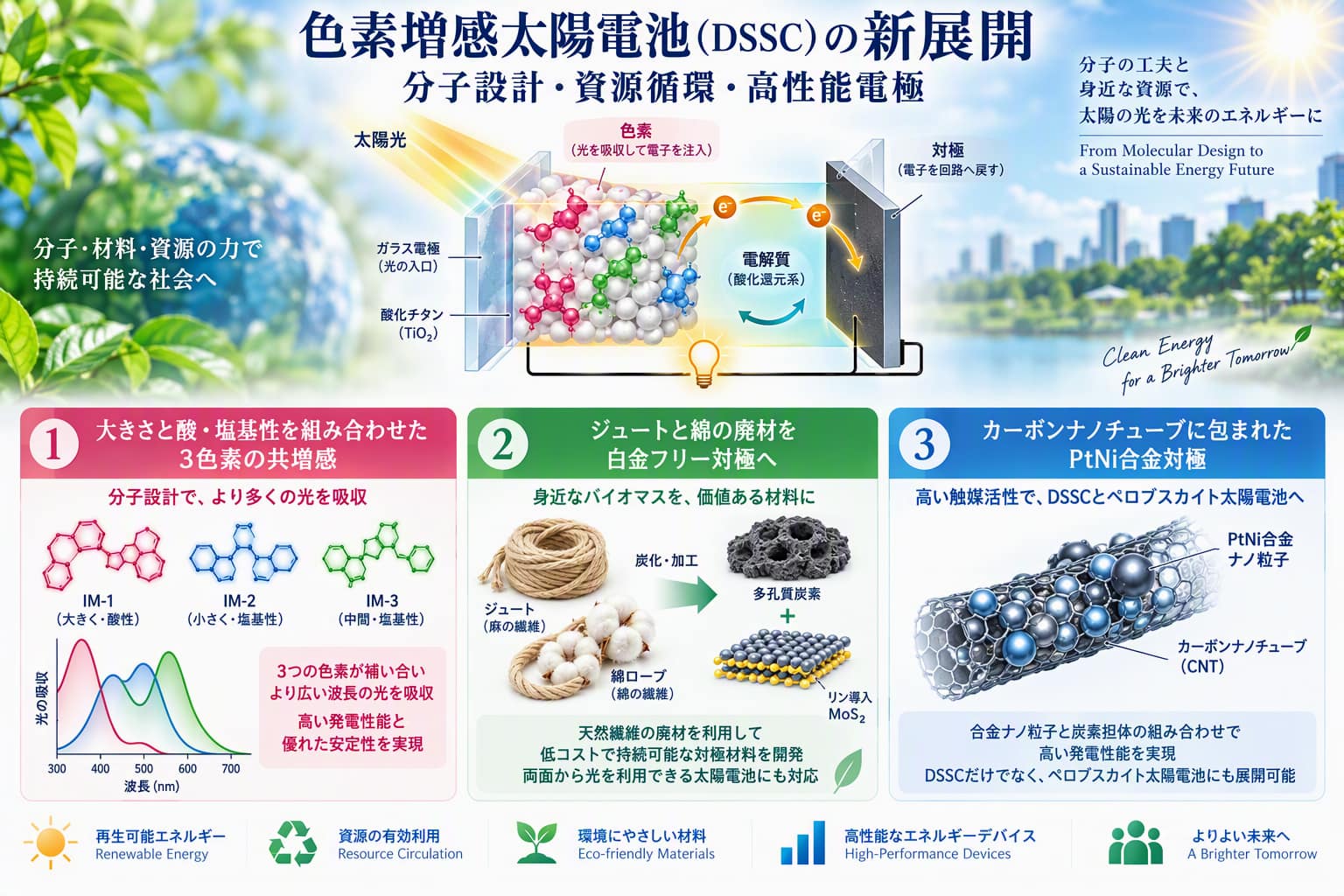
色素増感太陽電池(DSSC)の新展開:分子設計・資源循環・高性能電極
キーワード / Keywords
-
色素増感太陽電池(Dye-sensitized solar cell, DSSC)
日本語: 色素が光を吸収して電子を生み、その電子を電極へ渡して発電する太陽電池です。材料を溶液から作りやすく、色素や電極の工夫で性能を調整できます。
English: A solar cell in which a dye absorbs light and transfers electrons to an electrode. Its performance can be tuned through molecular dyes, interfaces, electrolytes, and electrode materials. -
共増感(Co-sensitization)
日本語: 複数の色素を同じ電極に組み合わせ、吸収できる光の範囲や表面の覆い方を補い合う方法です。色素の大きさや酸・塩基性の違いも性能に影響します。
English: A strategy that combines multiple dyes on one electrode so that their light absorption and surface coverage complement one another. Molecular size and acid–base character can also matter. -
対極(Counter electrode)
日本語: 太陽電池内部の酸化還元反応を助け、電子を回路へ戻す電極です。白金がよく使われますが、価格や資源面から炭素や合金を用いた代替材料が研究されています。
English: The electrode that catalyzes a redox reaction and completes electron circulation in the cell. Carbon materials and alloys are being studied as alternatives to conventional platinum. -
バイオマス由来炭素(Biomass-derived carbon)
日本語: 植物などの生物資源を熱処理して得る炭素材料です。多孔質で電気を流しやすい構造をつくれるため、廃材を高機能電極へ変える方法として注目されます。
English: Carbon produced by heat-treating biological resources. Its conductive and porous structure can convert discarded natural materials into useful electrode components. -
光電変換効率(Power conversion efficiency)
日本語: 入射した光エネルギーのうち、どれだけを電気エネルギーへ変換できたかを示す割合です。電流、電圧、曲線因子などを総合した太陽電池の代表的な指標です。
English: The percentage of incoming light energy converted into electrical energy. It is a central photovoltaic metric determined by current, voltage, and fill factor.
はじめに
色素増感太陽電池は、光を吸収する色素、電子を運ぶ電極、電荷を受け渡す酸化還元系などから構成されます。高性能化には、一つの材料だけでなく、色素が吸収する光の範囲、電極表面の覆われ方、電子の移動、電荷の再結合、対極の触媒作用を総合的に整える必要があります。
ここでは、複数色素の組み合わせ、天然繊維廃材から作る白金フリー対極、合金ナノ粒子を用いた高性能対極という三つの研究を紹介します。分子レベルの設計から資源循環、複数の太陽電池への応用まで、DSSC研究の広がりが見えてきます。
1. 大きさと酸・塩基性を組み合わせた3色素の共増感
Almosawyらは、カルバゾール・ベンズイミダゾール系色素を用い、分子の大きさと酸・塩基性を補い合わせる共増感法を検討しました。
- 研究のねらい: 一種類の色素では限界となりやすい光吸収範囲と電極表面の被覆を、三種類の色素の組み合わせで改善することを目指しました。
- 色素の設計: 大きく酸性のIM-1、小さい塩基性色素IM-2、中間的な大きさの塩基性色素IM-3を用いました。小さな色素が、電極上に吸着した大きなIM-1の間を埋める考え方です。
- 光吸収: IM-1、IM-2、IM-3の三成分系は、505 nmまで広がる分子内電荷移動吸収と、49,300 M⁻¹ cm⁻¹のモル吸光係数を示しました。
- 発電性能: 入射光電流変換効率は最大88%で、応答は512 nmまで広がりました。太陽電池の光電変換効率は6.00%となり、IM-1単独のセルより66%向上しました。
- 再結合の抑制: 三成分系では再結合抵抗63.7 Ω、電子寿命17.19 msが得られ、界面での電荷再結合が抑えられたことが示されました。
- 耐久性: 連続照射1000時間後にも初期効率の93%を維持しました。
- 研究の意義: 色素の吸収波長だけでなく、大きさと酸・塩基性を同時に設計することが、共増感DSSCの性能と安定性を整える手段になることを示しています。
2. ジュートと綿の廃材を白金フリー対極へ
UpadhyayとBalachandranは、ジュートと綿ロープから作った多孔質炭素に、リンを導入した二硫化モリブデンを組み合わせ、両面から光を利用できるDSSCの対極を作製しました。
- 研究のねらい: 高価な白金に代わる、低コストで持続可能な対極材料を、天然資源由来の廃材から開発することを目指しました。
- 材料の役割: ジュートまたは綿由来の炭素が、電気を流す多孔質の骨格になります。二硫化モリブデンは、電解質の酸化還元反応を進める触媒点を加えます。
- 評価方法: サイクリックボルタンメトリー、Tafel解析、インピーダンス分光、電流密度–電圧測定によって、触媒作用と太陽電池性能を評価しました。
- 透明性: 対極は550 nmで約65%の光透過率を示し、裏側から入る光も利用できる構成に適していました。
- 正面照射の性能: 最適化したジュート系セルは7.36%、綿系セルは7.27%の効率を示しました。比較に用いた白金対極は7.76%でした。
- 背面照射の性能: ジュート系は4.87%、綿系は3.93%の効率を示しました。
- 研究の意義: 廃棄される天然繊維を、導電性と触媒性をもつ太陽電池材料へ転換し、白金使用量と材料コストを抑える可能性を示しています。
3. カーボンナノチューブに包まれたPtNi合金対極
Sanjailukらは、イオン液体を利用した一段階の熱分解法により、多層カーボンナノチューブ上へ白金–ニッケル合金ナノ粒子を形成しました。
- 研究のねらい: ナノ粒子をカーボンナノチューブへ安定して担持し、DSSCとペロブスカイト太陽電池の両方で働く高性能対極を得ることを目指しました。
- 合成の特徴: ニッケル前駆体を含むイオン液体を用いることで、PtNiナノ粒子と多層カーボンナノチューブとの密着性を高めました。
- DSSCでの性能: PtNi/カーボンナノチューブ対極を用いたセルは、短絡電流密度21.1 mA cm⁻²、開放電圧0.73 V、曲線因子64%、光電変換効率9.79%を示しました。
- 比較結果: 市販白金対極を用いたDSSCの効率7.84%を上回りました。
- 別方式への展開: 同じ対極をペロブスカイト太陽電池へ用いると、最高効率15.3%を示しました。カーボンナノチューブのみの対極では12.0%でした。
- 研究の意義: 少なくとも一部の貴金属を合金化と炭素担体によって有効利用し、一つの対極材料を異なる太陽電池方式へ展開できる可能性を示しています。
研究全体から見えること
三つの研究は、DSSCの性能向上に異なる場所から取り組んでいます。共増感研究は光を受け取る色素層を整え、バイオマス炭素研究は資源循環を意識した対極を提案し、PtNi合金研究は触媒活性と電子移動を高めています。
重要なのは、単純に最高効率だけを比べるのではなく、材料価格、耐久性、透明性、照射方向、製造方法、ほかの太陽電池への応用可能性まで含めて評価することです。DSSCは、分子設計と材料工学を柔軟に組み合わせられるため、高性能化と持続可能性を同時に探る研究基盤になっています。
New Directions in Dye-Sensitized Solar Cells: Molecular Design, Resource Circulation, and High-Performance Electrodes
Introduction
A dye-sensitized solar cell consists of a light-absorbing dye, electron-conducting electrodes, and a redox system that transfers charge. Improving performance requires coordinated control of spectral absorption, surface coverage, electron transport, charge recombination, and catalytic reactions at the counter electrode.
The following studies present three complementary approaches: ternary dye co-sensitization, platinum-free counter electrodes derived from discarded natural fibers, and alloy nanoparticles designed for high-performance electrodes. Together, they connect molecular design, resource utilization, and applications across different photovoltaic systems.
1. Ternary Co-Sensitization Based on Molecular Size and Acid–Base Complementarity
Almosawy and colleagues investigated carbazole–benzimidazole dyes using a co-sensitization concept that combines differences in molecular size and acid–base character.
- Aim: To overcome the limited spectral coverage and incomplete surface occupation associated with a single sensitizer.
- Dye design: The system combined the bulky acidic dye IM-1, the smaller basic dye IM-2, and the intermediate-size basic dye IM-3. The smaller molecules were designed to occupy gaps between adsorbed IM-1 molecules.
- Optical response: The ternary combination produced broad intramolecular charge-transfer absorption extending to 505 nm and a molar extinction coefficient of 49,300 M⁻¹ cm⁻¹.
- Photovoltaic performance: The maximum incident photon-to-current efficiency was 88%, extending to 512 nm. The power conversion efficiency reached 6.00%, a 66% improvement over the IM-1-only device reported in the study.
- Reduced recombination: The ternary cell exhibited a recombination resistance of 63.7 Ω and an electron lifetime of 17.19 ms.
- Stability: It retained 93% of its original efficiency after 1000 hours of continuous illumination.
- Importance: The results indicate that molecular size and acid–base complementarity can be designed together to improve both surface organization and long-term DSSC performance.
2. Converting Jute and Cotton Waste into Platinum-Free Counter Electrodes
Upadhyay and Balachandran produced porous carbons from jute and cotton rope and combined them with phosphorus-doped molybdenum disulfide for bifacial DSSC counter electrodes.
- Aim: To develop a sustainable and economical alternative to platinum using discarded natural-fiber resources.
- Material roles: Jute- or cotton-derived carbon formed a conductive porous scaffold, while molybdenum disulfide added catalytic sites for electrolyte redox reactions.
- Evaluation: Cyclic voltammetry, Tafel analysis, impedance spectroscopy, and current density–voltage measurements were used to examine catalytic and photovoltaic behavior.
- Transparency: The counter electrode showed approximately 65% transmittance at 550 nm, supporting illumination through the rear side.
- Front illumination: Optimized jute- and cotton-based cells reached efficiencies of 7.36% and 7.27%, respectively, compared with 7.76% for the platinum reference.
- Rear illumination: Efficiencies were 4.87% for the jute-based cell and 3.93% for the cotton-based cell.
- Importance: The study demonstrates a route for turning waste natural fibers into conductive and catalytic photovoltaic components while reducing reliance on platinum.
3. PtNi Alloy Nanoparticles Encapsulated in Carbon Nanotubes
Sanjailuk and colleagues used an ionic-liquid-assisted one-pot pyrolysis method to form platinum–nickel alloy nanoparticles on multiwalled carbon nanotubes.
- Aim: To improve nanoparticle attachment to a conductive carbon support and create a counter electrode suitable for both DSSCs and perovskite solar cells.
- Synthesis concept: A nickel-containing ionic-liquid precursor enhanced adhesion between PtNi nanoparticles and the multiwalled carbon-nanotube substrate.
- DSSC performance: The device delivered a short-circuit current density of 21.1 mA cm⁻², an open-circuit voltage of 0.73 V, a fill factor of 64%, and a power conversion efficiency of 9.79%.
- Comparison: The efficiency exceeded the 7.84% obtained with a commercial platinum counter electrode.
- Extension to another photovoltaic system: In a perovskite solar cell, the same type of counter electrode achieved a champion efficiency of 15.3%, compared with 12.0% for a carbon-nanotube control electrode.
- Importance: Alloying and carbon-supported nanostructures may improve the effective use of noble metals while allowing one electrode platform to function in more than one solar-cell technology.
Overall Significance
The three studies improve different parts of the DSSC. Co-sensitization reorganizes the light-harvesting dye layer, biomass-derived carbon provides a resource-conscious counter electrode, and the PtNi alloy composite enhances catalytic and charge-transfer performance.
Performance should not be judged by efficiency alone. Material cost, operating stability, transparency, illumination direction, synthesis route, and compatibility with other photovoltaic systems are also important. DSSCs remain a flexible research platform in which molecular chemistry and materials engineering can be combined to pursue performance and sustainability together.
文献 / References
- Sanjailuk, T.; Pan, K.; Wang, X.; Yeh, C.-Y.; Kumnorkaew, P.; Kaewpraja, A.; Detralawichai, P.; Boonchun, A.; Chanlek, N.; Hasin, P. “Ionic liquid-derived PtNi alloy nanoparticles encapsulated in multiwalled carbon nanotubes as the versatile and high-performance counter electrodes for dye-sensitized and perovskite solar cells.” Solar Energy, 2026, 318, 115107. DOI: 10.1016/j.solener.2026.115107.
- Upadhyay, S.; Balachandran, M. “Jute/cotton derived carbon-MoS2 composites as counter electrode catalysts for bifacial DSSC.” Journal of Environmental Chemical Engineering, 2026, 14(5), 125165. DOI: 10.1016/j.jece.2026.125165.
- Almosawy, M. G. A. A.; Alharbi, N.; Abdullah, R. S.; Alraih, A. M.; Alshawi, E. A. A.; Fayzullaev, N.; Abdulkareem-Alsultan, G.; Nassar, M. F. “Synthesis of Carbazole-Benzimidazole Dyes with Size and Acid-Base Complementarity for High-Performance Ternary co-Sensitized Dye-Sensitized Solar Cells.” Polycyclic Aromatic Compounds, 2026, Early Access. DOI: 10.1080/10406638.2026.2735932.