キーワード / Keywords
1. γ-シクロデキストリンMOF(γ-CD-MOF)
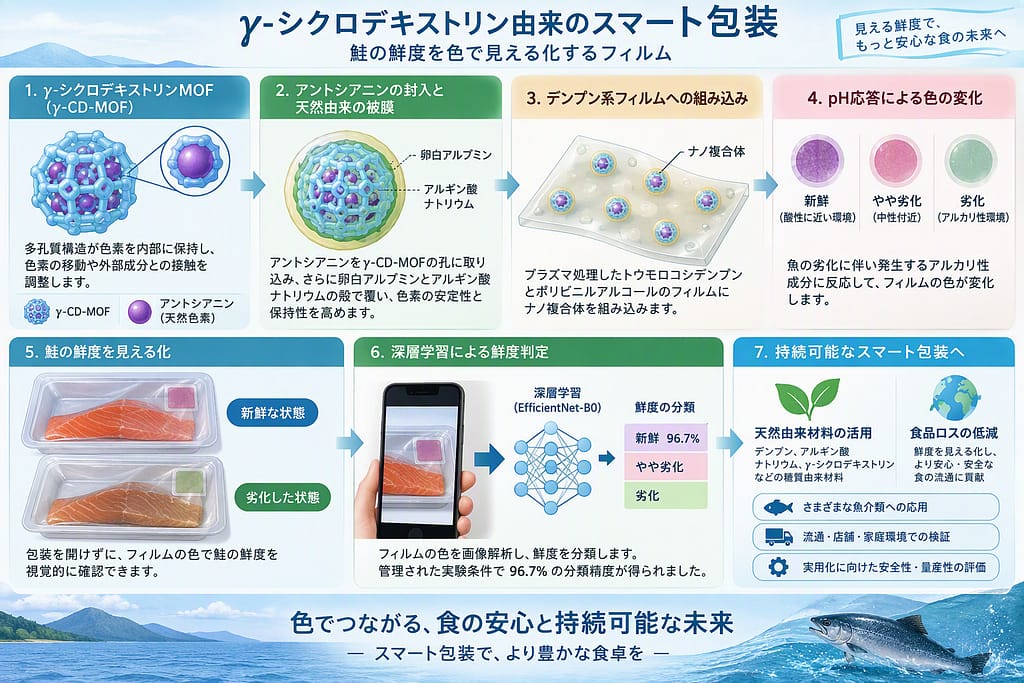
日本語: γ-シクロデキストリンから作られる多孔質構造です。内部の小さな空間に色素を保持し、色素の移動や外部成分との接触を調整できます。
English: A porous framework built from γ-cyclodextrin that confines pigments and regulates their migration and contact with surrounding compounds.
2. アントシアニン(Anthocyanin)
日本語: 植物に含まれる天然色素で、周囲の酸性・アルカリ性によって色が変わります。食品の劣化に伴う環境変化を知らせる指示薬として利用できます。
English: A natural plant pigment that changes color with acidity or alkalinity and can indicate chemical changes associated with food spoilage.
3. 鮮度インジケーターフィルム(Freshness Indicator Film)
日本語: 食品から発生する成分に反応し、色の変化で鮮度を知らせる包装材料です。包装を開封せず、食品の状態を視覚的に確認できます。
English: A packaging film that responds to compounds released from food and visually indicates freshness through a color change without opening the package.
4. pH応答(pH Responsiveness)
日本語: 周囲の酸性・アルカリ性の変化に応じて、材料の色や性質が変わる機能です。魚の劣化時に増える塩基性成分の検出に活用されます。
English: The ability of a material to change color or behavior with acidity and alkalinity, enabling detection of basic compounds generated during fish spoilage.
5. 深層学習(Deep Learning)
日本語: 多数の画像から色や模様の特徴を学習し、状態を分類する情報処理技術です。フィルムの色を鮮度判定へ結び付けるために使われました。
English: A computational method that learns visual patterns from images and links indicator-film colors with freshness classifications.
日本語版
導入
魚の鮮度を確認するには、におい、外観、化学分析などが用いられます。しかし、流通や家庭で食品包装を開けずに状態を確認できれば、品質管理や食品ロスの低減に役立つ可能性があります。そこで注目されているのが、食品の劣化に伴う化学変化を色で知らせる鮮度インジケーターフィルムです。
天然色素のアントシアニンはpHによって色が変わるため、鮮度表示に適しています。一方で、フィルム中では色素が不安定になったり、保存中に早く移動したりする課題があります。本研究では、γ-シクロデキストリン由来の多孔質材料へアントシアニンを保持し、さらに天然由来成分を含む被膜とデンプン系フィルムを組み合わせました。
研究内容
pH-responsive colorimetric indicator films based on plasma-modified starch/PVA incorporating ovalbumin-sodium alginate-coated γ-cyclodextrin-MOF nanocomposites for salmon freshness monitoring
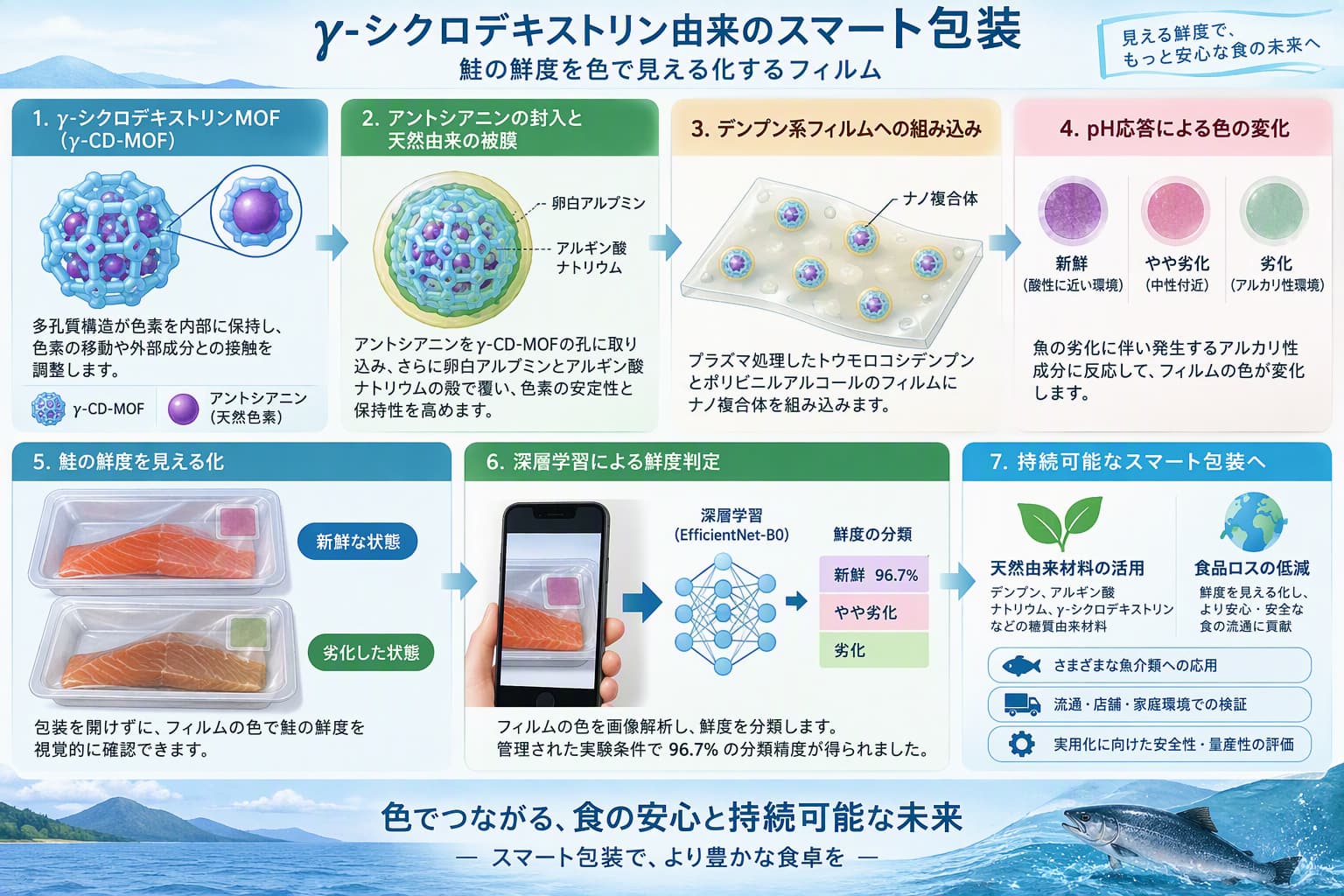
- アントシアニンをγ-シクロデキストリンMOFの孔へ取り込み、色素を保持する多孔質ホストとして利用しました。
- 分子モデリングと孔構造の解析から、空洞の大きさと非共有結合性相互作用により、色素を収容できることが示されました。
- 色素を含むγ-CD-MOFを、卵白アルブミンとアルギン酸ナトリウムからなる殻で覆いました。
- この殻は、色素の放出と、魚の劣化時に発生するアルカリ性揮発成分の接近を調整する役割を担いました。
- ナノ複合体を、プラズマ処理したトウモロコシデンプンとポリビニルアルコールのフィルムへ組み込みました。
- 完成したフィルムは、pHとアンモニアの変化に対して明瞭な色応答を示しました。
- 鮭の保存中におけるフィルムの色変化は、総揮発性塩基窒素の変化と強く関連しました。
- DPPHラジカル消去活性は74.8%で、生分解性と細胞適合性も確認されました。
- γ-CD-MOFと外側の被膜を組み合わせることで、アントシアニンの早すぎる放出が抑えられました。
- 画像分類モデルEfficientNet-B0は、管理された実験条件で96.7%の分類精度を示しました。
- 実際の流通環境や家庭での照明、撮影条件、温度変化に対する汎用性は、今後の外部検証が必要です。
研究の意義と期待される応用
この研究は、天然色素をフィルムへ直接混ぜるのではなく、γ-シクロデキストリンMOFの孔と、卵白アルブミン・アルギン酸ナトリウムの殻によって二段階で保護する材料設計を示しています。これにより、色素の安定性とフィルム内での保持性を高めながら、鮭の劣化に伴う化学変化を色として読み取れるようにしました。
デンプン、アルギン酸ナトリウム、γ-シクロデキストリンなどの糖質由来材料を組み合わせた点は、持続可能なスマート包装を考える上でも重要です。また、色の変化を深層学習で分類する仕組みは、目視だけに依存しない鮮度判定へつながる可能性があります。
今後は、異なる種類の魚介類、実際の輸送・店舗・家庭環境、さまざまな照明やカメラでの精度を確認する必要があります。フィルムの保存期間、製造の再現性、食品との接触安全性、量産性も、実用化に向けた重要な評価項目です。
English Version
Smart Packaging with γ-Cyclodextrin: A Color-Changing Film for Salmon Freshness
Introduction
Fish freshness is commonly assessed through odor, appearance, or chemical analysis. A packaging material that indicates food condition without opening the package could support quality control and reduce food waste. Freshness-indicator films address this need by translating chemical changes during spoilage into visible color signals.
Anthocyanins are natural pigments whose colors change with pH, making them useful as freshness indicators. However, they may be unstable or migrate prematurely when directly incorporated into films. The featured study confined anthocyanins within a porous γ-cyclodextrin framework and combined this host with a biopolymer shell and a starch-based film matrix.
Research Highlights
pH-responsive colorimetric indicator films based on plasma-modified starch/PVA incorporating ovalbumin-sodium alginate-coated γ-cyclodextrin-MOF nanocomposites for salmon freshness monitoring
- Anthocyanins were loaded into γ-cyclodextrin metal-organic-framework pores, which served as porous hosts for pigment confinement.
- Molecular modeling and pore analysis indicated that cavity-size matching and noncovalent interactions supported anthocyanin accommodation.
- The pigment-loaded γ-CD-MOF particles were coated with an ovalbumin-sodium alginate shell.
- This shell helped regulate pigment release and the access of alkaline volatile compounds generated during fish spoilage.
- The nanocomposites were incorporated into a plasma-modified corn-starch/polyvinyl-alcohol film.
- The resulting film displayed clear color responses to changes in pH and ammonia.
- During salmon storage, film-color evolution correlated strongly with total volatile basic nitrogen.
- DPPH radical-scavenging activity reached 74.8%, while biodegradability and cytocompatibility were also reported.
- Combining the γ-CD-MOF host with the outer shell reduced premature anthocyanin release.
- EfficientNet-B0 achieved 96.7% classification accuracy under controlled laboratory conditions.
- External validation is needed to establish generalizability under real distribution, household, lighting, imaging, and temperature conditions.
Overall Significance and Potential Applications
Rather than directly blending a natural pigment into a film, this study used two levels of protection: confinement within γ-cyclodextrin-MOF pores and coating with an ovalbumin-sodium alginate shell. This design improved pigment retention while preserving access to chemical signals associated with salmon spoilage.
The use of carbohydrate-derived components, including starch, sodium alginate, and γ-cyclodextrin, is relevant to the development of more sustainable smart packaging. Connecting film color with deep-learning classification may also enable freshness assessment that is less dependent on subjective visual judgment.
Further work should test different seafood products and realistic transportation, retail, and household environments. Performance under varied cameras and lighting conditions, film shelf life, manufacturing reproducibility, food-contact safety, and scalable production will also be important for practical use.
References / 文献
- Zou, F.; Yang, M.; Wang, W.; Wu, J.; Zuo, Y.; Wang, H. pH-responsive colorimetric indicator films based on plasma-modified starch/PVA incorporating ovalbumin-sodium alginate-coated γ-cyclodextrin-MOF nanocomposites for salmon freshness monitoring. Carbohydrate Polymers 391 (2026), 125793. DOI: 10.1016/j.carbpol.2026.125793