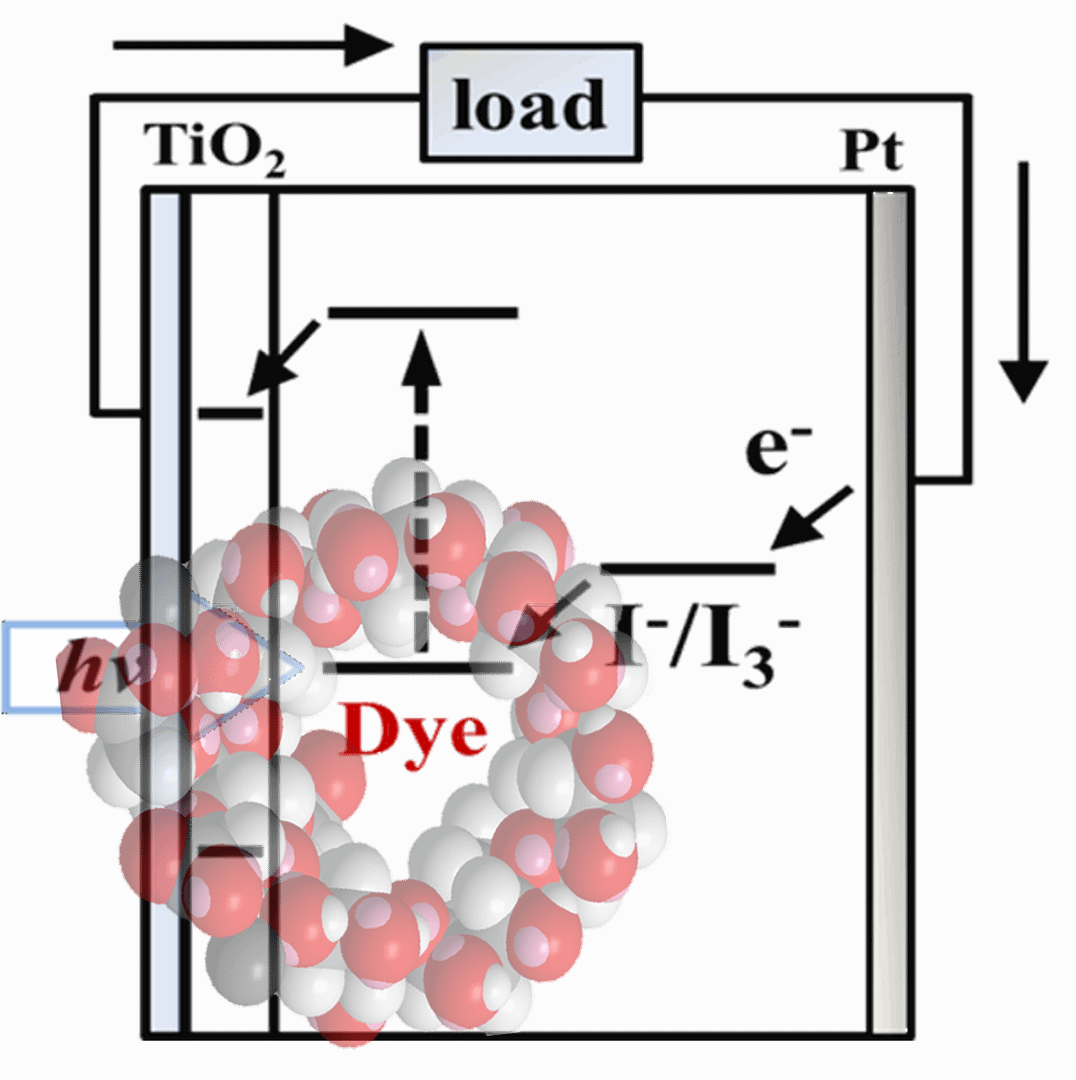
日本語版:環状デキストリンで広がるDSSCの世界
1. シクロデキストリンとは?
シクロデキストリン(cyclodextrin, CD)は、デンプンから作られる環状オリゴ糖です。
内側は油になじみやすく、外側は水になじみやすい「ドーナツ型」の分子で、
真ん中の空洞(キャビティ)に有機分子を取り込む「分子カプセル」として働きます。
DSSC(色素増感太陽電池)では、このCDの空洞に色素や機能性分子を取り込むことで、
- 電極表面での分子の並び方や距離をコントロールする
- 電荷移動や再結合のしやすさを調整する
- 新しい機能(蓄電・センサー・光応答性など)を付加する
といった工夫が可能になります。
2. CDを使ったDSSC研究の代表例
ここでは、DSSC_CD_6.txt に含まれている論文の中から、
シクロデキストリンの特徴がよくわかる6つの研究例を紹介します。
2-1. DSSCと高温スーパーキャパシタを一体化
Selvam et al., J. Mater. Chem. A, 2015
Selvam らは、硫酸化β-CD/PVP/MnCO₃ 複合体を用いて、
「高温スーパーキャパシタ」と「DSSCカウンター電極」を兼ねる電極を開発しました。
- β-CDをスルホン化してPVPと熱架橋し、その中にMnCO₃ナノ粒子を分散
- 同じ複合電極を、
- 並列接続スーパーキャパシタ
- DSSCのカウンター電極
として利用 - 電極は
- 比容量 202.6 F g⁻¹
- エネルギー密度 197.96 Wh kg⁻¹
- DSSC効率 5.57 %
を示し、[BMI][TFSI] 電解質中で 200 ℃まで性能の約70 %を維持しました。
ポイント:
CDを含む高分子複合体を使うことで、
「発電」と「蓄電」をつなぐ高温耐性の多機能電極が実現できることを示した研究です。
2-2. 分子レベルの「断熱材」で開放電圧アップ
Saleh et al., J. Fluoresc., 2015
Saleh らは、トリフェニルアミン系色素
5-[4-(diphenylamino)phenyl]thiophene-2-cyanoacrylic acid (L1) を
β-CDで包み込むことで、DSSCの性能変化を調べました。
- L1 と β-CD のホスト–ゲスト包接体を作製
- 固体および TiO₂上での構造を、
- 定常・時間分解蛍光測定
- TD-DFT 計算
などで解析 - 分子レベルの「絶縁・保護」により、DSSC のエネルギー変換性能がわずかに向上し、
開放電圧 Voc が 0.7 → 0.8 V に増加しました。
ポイント:
β-CDが色素のまわりに“クッション”を作ることで、
不要な電子移動や再結合を抑え、電圧を少し押し上げる効果があることを示しています。
2-3. フォトクロミック色素+CDによる光応答DSSC
Takeshita, Umeda, Hara, J. Photochem. Photobiol. A, 2017
福井工業大学のグループは、非カルボン酸型スピロピラン 1,3,3-トリメチルインドリノ-β-ナフトピリロスピラン(1)から生成する
フォトメロシアニン(PMC)と、カルボキシメチルβ-CDナトリウム塩(CM-β-CD)を組み合わせたDSSCを試作しました。
- 可視光照射でスピロピラン(SP)→ PMC へと光異性化
- TiO₂表面に
- PMC単独
- PMC/CM-β-CD 包接体
が吸着することを蛍光測定で確認 - 570 nm 光照射での IPCE(入射光子-電流変換効率)は
- PMCのみ:4.1 %
- PMC/CM-β-CD:最大 11.1 %
- CM-β-CD 層により、開放電圧とフィルファクターも向上
- 可視光照射処理により IPCE が減少し、PMCのさらなる異性化が影響していると考察
ポイント:
CDを用いた包接体により、光で応答するフォトクロミックDSSCを実現した例であり、
「光スイッチ付き太陽電池」のような機能性デバイスへの応用が期待されます。
2-4. 液晶パネル廃棄物から導電ガラスを再利用
Chen et al., Environ. Technol., 2015
Chen らは、廃棄TFT-LCDパネルから透明導電ガラスを回収し、
DSSCカソードとして再利用する研究を行いました。
- 廃LCDパネルからTFTアレイガラスやカラーフィルターガラスを分離・洗浄して導電ガラスを回収
- Ptの代わりに、Ni²⁺–CD複合体を 673 K, 2 h で炭化して得た
Ni@C(ニッケル核/カーボンシェル)ナノ粒子をカウンター電極触媒として利用 - Ni@C カソードを用いた DSSC は、
- 変換効率 2.54 %
- 材料コストを少なくとも 24 %削減
ポイント:
CDを利用したナノ粒子合成と廃LCDガラスの再利用を組み合わせることで、
電子ゴミの有効活用とDSSCコスト低減を同時に達成した、環境調和型の取り組みです。
2-5. β-CD共増感によるアントロン系色素DSSCの高効率化
Shahat et al., J. Inorg. Organomet. Polym. Mater., 2025
Shahat らは、アントロン誘導体と β-CD を組み合わせた
低コスト・白金フリーのカウンター電極/共増感系を構築しました。
- アントロン骨格と、
- 2-クロロアニリン@β-CD
- 2-アミノサリチル酸@β-CD
などのβ-CD包接共増感体を組み合わせて複合電極を作製 - 構造・光物性・電気特性を NMR, SEM, UV-Vis など多彩な手法で評価
- β-CDを加えることで、アントロン系DSSCの性能が向上し、
- PCE が 2.65 → 4.12 % に増加
- 電荷移動抵抗 R_ct が 30.26 → 27.81 Ω に減少
- 短絡電流密度 J_sc が 9.63 → 12.41 mA cm⁻² に増加
ポイント:
β-CDが共増感体として働き、電荷分離の効率化と再結合抑制に寄与することで、
比較的シンプルな有機色素系でも発電性能を大きく引き上げられることを示しています。
2-6. CDの空洞サイズでRu錯体DSSCの発電効率をチューニング
Hara, Takeshita, Umeda, J. Photonics Energy, 2020
同じく福井工業大学のグループは、非アンカー型 Ru(II)ポリピリジン錯体
tris(2,2′-bipyridyl)ruthenium(II), [Ru(bpy)₃]²⁺ を
各種CDの空洞に取り込んだ包接体 [Ru(bpy)₃]²⁺/CD を使い、DSSCの性能を比較しました。
- [Ru(bpy)₃]²⁺ を TiO₂ に「直接固定」せず、CDの空洞に包接させた状態で導入
- 460 nm での IPCE は
- Ru錯体のみ:8.1 %
- Ru/α-CD:8.8 %
- Ru/β-CD:8.9 %
- Ru/γ-CD:11.2 %
- γ-CD の大きなキャビティが、[Ru(bpy)₃]²⁺との相互作用や界面構造を最も有利にし、
光電変換効率を最大化することが示されました。
ポイント:
CDの空洞サイズを設計パラメータとして使うことで、
非平面構造の錯体色素でも、DSSCの発電特性を細かく調整できることを示した研究です。
3. 高校生・一般向けまとめ
- シクロデキストリンは、デンプン由来の「分子カプセル」で、
D S S C の中で色素や機能性分子の配置・動きを細かくコントロールできます。 - ここで紹介した研究では、CDを使うことで、
- 発電と蓄電をつなぐ高温対応ハイブリッド素子
- 分子の配置を工夫した電圧アップDSSC
- 光で応答するフォトクロミック太陽電池
- 電子ゴミ再利用による環境配慮型DSSC
- β-CD共増感による高効率有機色素DSSC
など、多彩な応用が実現されています。 - 今後も、CDのキャビティサイズ・置換基・組み合わせを工夫することで、
デザイン性・環境性・機能性を兼ね備えた次世代DSSCが生まれると期待されます。
English Version: Cyclodextrin-Based Innovations in DSSCs
1. Cyclodextrins as molecular capsules
Cyclodextrins (CDs) are cyclic oligosaccharides derived from starch.
Their torus-shaped structure provides a hydrophobic inner cavity and a hydrophilic outer surface,
allowing them to encapsulate organic guest molecules.
In dye-sensitized solar cells (DSSCs), CDs can:
- control the arrangement and distance of dyes and catalysts on the electrode,
- tune charge transfer and recombination processes,
- and introduce new functions such as energy storage, sensing, and light-responsiveness.
2. Highlights from selected CD–DSSC papers
2.1 High-temperature supercapacitor + DSSC counter electrode
Selvam et al., J. Mater. Chem. A, 2015
A sulfated β-CD/PVP/MnCO₃ composite was synthesized as a multifunctional electrode
for a parallel-connected supercapacitor and DSSC counter electrode.
- Sulfonated β-CD cross-linked with PVP and loaded with MnCO₃ nanoparticles
- The composite electrode showed:
- capacitance 202.6 F g⁻¹,
- energy density 197.96 Wh kg⁻¹,
- DSSC efficiency 5.57 %,
- and 70 % performance retention at 200 °C with a [BMI][TFSI] electrolyte.
CD-based polymer composites thus enable high-temperature, multifunctional energy devices.
2.2 Molecular-level insulation to increase open-circuit voltage
Saleh et al., J. Fluoresc., 2015
The group studied a triphenylamine-based dye
5-[4-(diphenylamino)phenyl]thiophene-2-cyanoacrylic acid (L1)
encapsulated in β-CD hosts.
- Host–guest complexes of L1 and β-CD were prepared in the solid state and on TiO₂.
- Their structures were characterized by steady-state and picosecond time-resolved fluorescence
together with TD-DFT calculations. - Molecular-level insulation slightly improved the cell performance,
increasing Voc from 0.7 to 0.8 V.
Here, β-CD acts like a nanoscale insulating shell,
reducing unwanted interactions and helping to raise the open-circuit voltage.
2.3 Photochromic DSSC using spiropyran and CM-β-CD
Takeshita, Umeda, Hara, J. Photochem. Photobiol. A, 2017
This work reports a DSSC containing a noncarboxylated spiropyran
1,3,3-trimethylindolino-β-naphthopyrylospiran (1) and
carboxymethyl-β-CD sodium salt (CM-β-CD).
- Visible light converts spiropyran (SP) into its photomerocyanine (PMC) form.
- PMC and its inclusion complex with CM-β-CD (PMC/CM-β-CD) are adsorbed on TiO₂.
- The formation of PMC/CM-β-CD was confirmed by fluorescence spectroscopy.
- Under 570 nm light, the IPCE was
- 4.1 % for the PMC-containing DSSC, and
- up to 11.1 % when CM-β-CD was introduced.
- The CM-β-CD layer also improved fill factor and open-circuit voltage.
- IPCE decreased after visible-light treatment, attributed to isomerization of PMC.
This demonstrates photoresponsive photovoltaic behavior enabled by a CD-based inclusion layer.
2.4 Reusing TFT-LCD waste glass and Ni@C cathodes
Chen et al., Environ. Technol., 2015
Chen and co-workers recovered transparent conductive glasses from TFT-LCD panel waste
and used them as DSSC electrodes.
- TFT array and color filter glasses were dismantled and sonically cleaned.
- Platinum was replaced with Ni@C nanoparticles,
prepared by carbonizing a Ni²⁺–cyclodextrin complex at 673 K for 2 h. - The DSSC with a Ni@C-coated cathode achieved 2.54 % efficiency,
and the total cost was reduced by at least 24 %.
This study illustrates how CD-assisted nanoparticle synthesis and e-waste recycling
can contribute to low-cost, environmentally friendly DSSCs.
2.5 β-CD co-sensitizers for anthrone-based DSSCs
Shahat et al., J. Inorg. Organomet. Polym. Mater., 2025
Shahat et al. developed low-cost, platinum-free counter electrodes and co-sensitizers
based on anthrone derivatives and β-CD.
- Anthrone-based composites involving 2-chloroaniline@β-CD,
2-aminosalicylic acid@β-CD, and other β-CD inclusion complexes were prepared. - Microstructure, morphology, optical and electrical properties were characterized
along with J–V curves of assembled DSSCs. - Adding β-CD to the anthrone@2-chloroaniline composite led to:
- PCE improvement from 2.65 to 4.12 %,
- charge transfer resistance R_ct decreasing from 30.26 to 27.81 Ω,
- J_sc increasing from 9.63 to 12.41 mA cm⁻².
β-CD enhances electron transfer and suppresses interfacial recombination,
resulting in higher performance anthrone-based DSSCs.
2.6 Tuning Ru(II) polypyridine DSSCs via CD cavity size
Hara, Takeshita, Umeda, J. Photonics Energy, 2020
This study examined the effect of CD cavity size on DSSCs containing
unanchored tris(2,2′-bipyridyl) ruthenium(II) ([Ru(bpy)₃]²⁺).
- Inclusion complexes [Ru(bpy)₃]²⁺/CD were formed with α-, β-, and γ-CD.
- At 460 nm, the IPCE values were:
- [Ru(bpy)₃]²⁺ only: 8.1 %,
- [Ru(bpy)₃]²⁺/α-CD: 8.8 %,
- [Ru(bpy)₃]²⁺/β-CD: 8.9 %,
- [Ru(bpy)₃]²⁺/γ-CD: 11.2 %.
- The γ-CD cavity provided the most favorable host–guest interaction,
leading to the highest photovoltaic conversion.
This shows that CD cavity size is a powerful design parameter
for optimizing DSSCs with unanchored, nonplanar photosensitizers.
3. Key takeaways
- Cyclodextrins act as molecular capsules and spacers,
allowing fine control of interfacial structure and charge-transfer pathways in DSSCs. - By using CDs, researchers have demonstrated:
- high-temperature hybrid supercapacitor–DSSCs,
- Voc enhancement via molecular insulation,
- photochromic and stimuli-responsive solar cells,
- low-cost devices using recycled substrates,
- and improved organic dye systems with reduced recombination.
- CD chemistry thus opens a versatile toolbox for designing DSSCs
that are more efficient, more sustainable, and more functionally diverse.
参考文献 / References
- Selvam, S.; Balamuralitharan, B.; Karthick, S. N.; Savariraj, A. D.; Hemalatha, K. V.; Kim, S.-K.; Kim, H.-J. Novel high-temperature supercapacitor combined dye sensitized solar cell from a sulfated β-cyclodextrin/PVP/MnCO₃ composite. Journal of Materials Chemistry A 2015, 3 (19), 10225–10232. DOI: 10.1039/c5ta01792k.
- Saleh, N.; Al-Trawneh, S.; Al-Dmour, H.; Al-Taweel, S.; Graham, J. P. Effect of Molecular-Level Insulation on the Performance of a Dye-Sensitized Solar Cell: Fluorescence Studies in Solid State. Journal of Fluorescence 2015, 25 (1), 59–68. DOI: 10.1007/s10895-014-1479-8.
- Takeshita, T.; Umeda, T.; Hara, M. Fabrication of a dye-sensitized solar cell containing a noncarboxylated spiropyran-derived photomerocyanine with cyclodextrin. Journal of Photochemistry and Photobiology A: Chemistry 2017, 333, 87–91. DOI: 10.1016/j.jphotochem.2016.10.017.
- Chen, C.-C.; Chang, F.-C.; Peng, C. Y.; Wang, H. P. Conducting glasses recovered from thin film transistor liquid crystal display wastes for dye-sensitized solar cell cathodes. Environmental Technology 2015, 36 (23), 3008–3012. DOI: 10.1080/09593330.2014.982206.
- Shahat, M. A.; Dardeer, H. M.; Rashwan, G. M.; Ghitas, A.; Taha, A. G. Unveiling the Synergistic Effects of Novel β-Cyclodextrin Co-sensitizers on Anthrone-Based Dye-Sensitized Solar Cells (DSSCs) with Microstructural Modifications. Journal of Inorganic and Organometallic Polymers and Materials 2025, Early Access. DOI: 10.1007/s10904-025-03944-9.
- Hara, M.; Takeshita, T.; Umeda, T. Effect of cyclodextrin cavity size on the photovoltaic performance of unanchored ruthenium(II) polypyridine complex-containing dye-sensitized solar cells. Journal of Photonics for Energy 2020, 10 (4), 045503. DOI: 10.1117/1.JPE.10.045503.