色素増感太陽電池(DSSC)と電子移動のはなし(日本語)
1. 色素増感太陽電池とは?
色素増感太陽電池(DSSC: Dye-Sensitized Solar Cell)は、「色素が光を吸収して電気をつくる」タイプの太陽電池です。
シリコン太陽電池とはちがい、ガラスやプラスチックの上に酸化チタン(TiO₂)のナノ粒子を塗り、その表面に色素分子(染料)を吸着させて作ります。
- 色付きのガラス窓のようにきれいなデザインにできる
- 弱い光(室内光)でも発電しやすい
- 材料コストが比較的安い
といった特徴から、「次世代のデザイン太陽電池」として世界中で研究されています。
このページでは、以下のレビュー論文をもとに、電子がどのように移動して発電しているかを、専門外の方にも分かりやすく紹介します。
- Sharma らによる DSSCの総合レビュー(材料から動作原理・安定性までの広い解説)
- Wu らによる 対極(カウンター電極) に焦点を当てたレビュー
- Ye らによる 光電極・色素・電解質・対極までを俯瞰した総説
2. DSSC の基本構造
典型的な DSSC は、つぎの4つの部分から成り立っています。
- 透明導電ガラス(ITO や FTO)
電気を取り出すための「ガラスの電極」です。 - 酸化チタン(TiO₂)ナノ粒子層:光電極(Photoanode)
表面積の大きなスポンジ状の TiO₂ に色素をしっかりくっつけます。 - 色素(Dye)
光を吸収して電子を励起し、TiO₂ に電子を渡す「光アンテナ」です。 - 電解質と対極(Counter Electrode)
I⁻/I₃⁻ などのレドックス電解質と、白金やカーボン材料などの対極で、回路を閉じます。
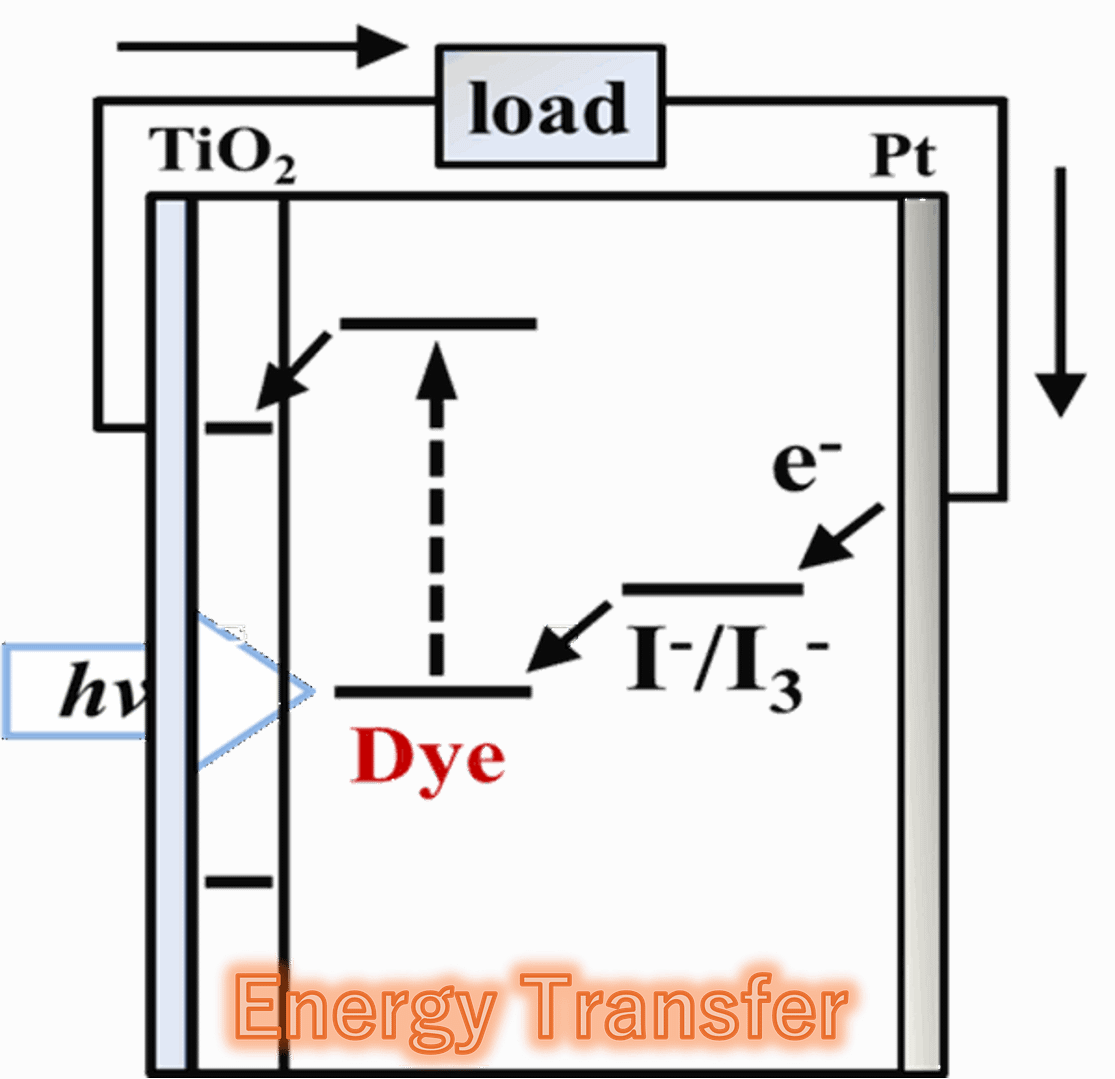
HP用のイラスト例:

3. 光が電気に変わる「電子移動」4ステップ
レビュー論文(Sharma ら、Ye ら)では、DSSC の動作が一連の電子移動プロセスとして整理されています。
- 光吸収 & 電子励起
色素分子が光(主に可視光)を吸収し、電子が基底状態から励起状態へジャンプします。 - 電子注入(Injection)
励起した電子が、すぐ隣にある TiO₂ の伝導帯に飛び込みます。
→ これが「電流のスタート地点」です。 - 電子の取り出し & 外部回路を通る電流
TiO₂ 内を移動した電子は、透明導電ガラス → 外部回路 → 対極へ流れていきます。
→ このとき、LED を光らせたり、電池を充電したりできます。 - 色素の「リサイクル」
電子を失って酸化された色素は、電解質(I⁻ など)から電子を受け取り、元の状態に戻ります。
対極側では I⁻/I₃⁻ の酸化還元反応が起こり、回路全体が閉じます。
このように、DSSC の発電は「色素 → TiO₂ → 外部回路 → 電解質 → 色素」という電子の循環によって支えられています。
4. どこを工夫して性能を上げているのか?
Sharma らや Ye らのレビューでは、DSSC の各構成要素を系統的に整理し、「どこをどう改良すれば効率が上がるか」がまとめられています。
4-1. 光電極(TiO₂ ナノ粒子・ナノ構造)
- 粒子をより細かく・多孔質にして色素をたくさん吸着させる
- ナノチューブやナノロッドなど、電子が通りやすい形にする
- 表面処理をして再結合を抑える(電子が無駄に戻ってしまうのを防ぐ)
4-2. 色素(Dye)
- 金属錯体色素(Ru錯体など)から、金属フリー有機色素へ多様化
- 太陽光スペクトルを広く吸収できるように分子設計
- 電子を TiO₂ に注入しやすく、かつ酸化還元サイクルを回しやすいようにエネルギー準位を調整
4-3. 電解質と対極(Counter Electrode)
Wu らの総説は、特に対極に注目しています。
- 従来は白金(Pt)が広く使われていたが、コストや希少性が課題
- 炭素材料(カーボンブラック、カーボンナノチューブ)、金属窒化物(TiN)などの
安価で高活性な代替材料が提案されています。 - 電解質自体も、ヨウ素系から固体電解質やイオン液体などへと広がっています。
これらの工夫により、変換効率だけでなく、長期安定性や低温での動作も改善されていることがレビューで紹介されています。
5. レビュー論文で何がわかるか(やさしいポイント)
Sharma ら(Nanoscale Research Letters, 2018)
- DSSC の基礎から最新動向までを1本で俯瞰できる総説
- 光電極・色素・電解質・対極といった各部品が、
発電効率・安定性にどう関わるかを整理 - 将来の課題として、材料の低コスト化・毒性低減・長寿命化が挙げられています。
Wu ら(Chemical Society Reviews, 2017)
- 対極材料だけを取り上げた専門レビュー
- 白金代替としての炭素材料や金属化合物の可能性が詳しく議論されています。
- 実験的な指標(過電圧・電荷移動抵抗など)と性能の関係も整理されており、
「対極を変えると DSSC のどこが良くなるのか」がイメージしやすくなります。
Ye ら(Materials Today, 2015)
- 光電極、色素、電解質、対極までをバランスよく概観したレビュー
- DSSC 全体の設計思想(材料選択の考え方)を学ぶのに適しています。
- 研究者にとっては「次にどこを改良すべきか」のヒントが、
一般の読者にとっては「DSSC の全体像」がつかみやすい構成です。
6. まとめ
- DSSC は、色素が光を吸収して電子を TiO₂ に渡すことで発電する太陽電池です。
- 電子の流れ(光吸収 → 電子注入 → 外部回路 → 電解質 → 色素の回復)が
スムーズに進むように、材料や構造が工夫されています。 - ここで紹介したレビュー論文は、
研究者だけでなく、再生可能エネルギーや新しい太陽電池に興味のある一般の方にも
入門書代わりとして役立つ内容になっています。
Dye-Sensitized Solar Cells and Electron Transfer (English)
1. What is a DSSC?
A dye-sensitized solar cell (DSSC) is a type of solar cell where dye molecules absorb sunlight and inject electrons into a wide-bandgap semiconductor, typically TiO₂.
Compared with conventional silicon solar cells, DSSCs are:
- Potentially low-cost, because they can be made at low temperature
- Colorful and design-friendly, like stained-glass windows
- Capable of working efficiently even under low-light conditions (indoor light, cloudy days)
In this page we briefly introduce the electron-transfer processes in DSSCs, based on several review papers:
- A comprehensive review by Sharma et al. on fundamentals and current status
- A focused review by Wu et al. on counter electrodes
- A global overview by Ye et al. covering photoanodes, sensitizers, electrolytes, and counter electrodes
2. Basic structure of a DSSC
A typical DSSC consists of:
- Transparent conducting glass (FTO/ITO)
To collect and transport electrons. - Nanocrystalline TiO₂ layer (photoanode)
A porous network with a very large surface area to anchor dye molecules. - Dye molecules (sensitizers)
They work as “light antennas” and inject electrons into TiO₂ after photoexcitation. - Electrolyte and counter electrode
A redox couple (e.g., I⁻/I₃⁻) and a catalytic counter electrode (Pt, carbon, etc.) to complete the circuit.
3. Four key electron-transfer steps
Following the description in the review articles (Sharma et al., Ye et al.), the operation of a DSSC can be summarized in four steps:
- Light absorption and excitation
The dye absorbs sunlight and an electron is promoted from the ground state to an excited state. - Electron injection into TiO₂
The excited electron is injected into the conduction band of TiO₂ within a very short time (typically femto- to picoseconds). - Electron transport and collection
The injected electron travels through the TiO₂ network, passes through the transparent conducting glass, and flows through the external circuit to the counter electrode, doing electrical work. - Dye regeneration and redox cycle
The oxidized dye accepts an electron from the redox couple in the electrolyte and returns to its original state.
At the counter electrode, the redox couple is regenerated, closing the electrical circuit.
All these steps must be well balanced to achieve high efficiency and long-term stability.
4. How to improve performance?
According to Sharma, Ye and Wu, key strategies for improving DSSCs include:
4-1. Photoanode engineering
- Increasing the surface area (smaller particles, mesoporous structures)
- Designing one-dimensional nanostructures (nanotubes, nanorods) to facilitate electron transport
- Surface treatments to suppress charge recombination
4-2. Dye design
- From Ru-based metal complexes to metal-free organic dyes
- Molecular design to broaden the absorption spectrum and adjust energy levels for efficient electron injection and regeneration
- Improving stability under continuous light soaking and thermal stress
4-3. Electrolyte and counter electrode
The review by Wu et al. focuses on counter electrodes:
- Replacement of platinum by carbon materials, metal nitrides, and other low-cost catalysts
- Optimization of the interface between electrolyte and counter electrode to enhance electrocatalytic activity
- Development of ionic liquids and solid-state electrolytes to improve durability and reduce volatility
These approaches contribute to higher power-conversion efficiency, better stability, and more practical DSSC modules.
5. What you can learn from these review papers
Sharma et al., Nanoscale Research Letters (2018)
- A broad overview of DSSCs: basic principles, materials, device structures, and stability issues
- Clear classification of photoanodes, dyes, electrolytes, and counter electrodes
- Discussion of challenges such as cost reduction, non-toxicity, and long-term operation
Wu et al., Chemical Society Reviews (2017)
- A specialized review on counter electrodes in DSSCs
- Systematic comparison of different counter-electrode materials (Pt, carbon, metal compounds, etc.)
- Correlation between electrocatalytic properties and practical device performance
Ye et al., Materials Today (2015)
- A concise summary of recent advances in all key components of DSSCs
- Helpful both for newcomers who want to see the full picture and for researchers looking for design guidelines for next-generation DSSCs
6. Concluding remarks
- DSSCs offer a unique combination of color, flexibility, and low-light performance.
- Their operation is governed by a chain of ultrafast and slow electron-transfer processes, each of which can be engineered by smart molecular and materials design.
- The classic review papers listed below provide an excellent starting point for anyone interested in learning or teaching about DSSCs.
7. 参考文献 / References
- Sharma, K.; Sharma, V.; Sharma, S. S.
Dye-Sensitized Solar Cells: Fundamentals and Current Status.
Nanoscale Research Letters, 13 (2018).
DOI: 10.1186/s11671-018-2760-6 - Wu, J. H.; Lan, Z.; Lin, J. M.; Huang, M. L.; Huang, Y. F.; Fan, L. Q.; Luo, G. G.; Lin, Y.; Xie, Y. M.; Wei, Y. L.
Counter electrodes in dye-sensitized solar cells.
Chemical Society Reviews, 46 (2017), 19, 5975–6023.
DOI: 10.1039/c6cs00752j - Ye, M. D.; Wen, X. R.; Wang, M. Y.; Iocozzia, J.; Zhang, N.; Lin, C. J.; Lin, Z. Q.
Recent advances in dye-sensitized solar cells: from photoanodes, sensitizers and electrolytes to counter electrodes.
Materials Today, 18 (2015), 3, 155–162.
DOI: 10.1016/j.mattod.2014.09.001