色素増感太陽電池(DSSC)のしくみとクラシック研究紹介
Basics and Classic Studies of Dye-Sensitized Solar Cells (DSSCs)
日本語版
1. 色素増感太陽電池(DSSC)とは?
色素増感太陽電池(Dye-Sensitized Solar Cell, DSSC)は、
- ガラスやフィルム上に作った 酸化チタン(TiO₂)のスポンジ状の膜
- 光を吸収する 色素分子
- イオンが動く 電解質
- 電子を受け取る 対極(カウンター電極)
からできている有機系太陽電池です。
ざっくり言うと、
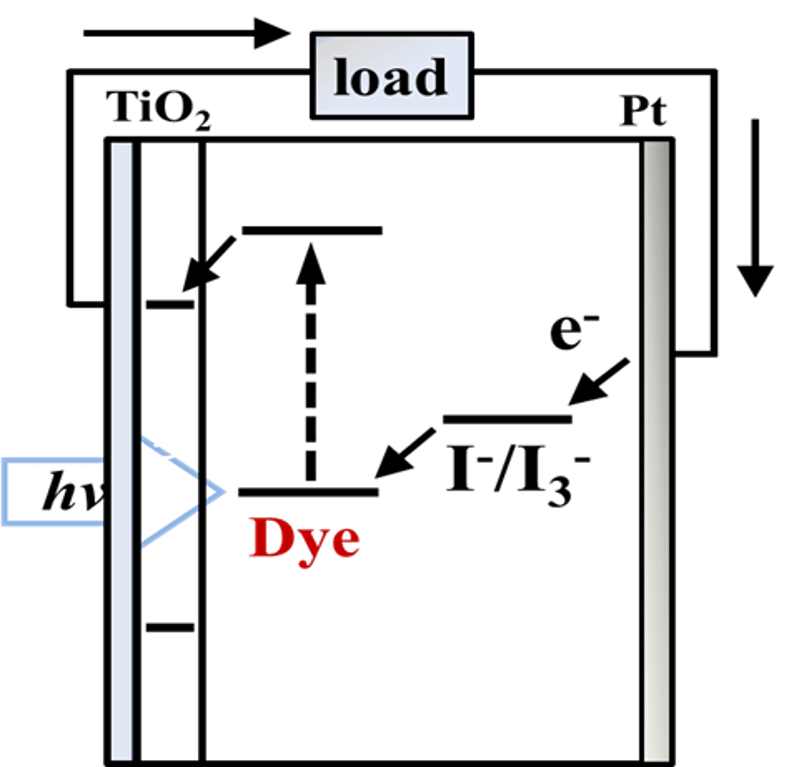
- 色素が光(主に可視光)を吸収して励起される
- 励起された電子が TiO₂ 側に流れ込み、外部回路へ流れて電流になる
- 電解質と対極が、失われた電子を色素へ戻して「元に戻す」役目をする
というサイクルで発電します。
シリコン太陽電池と比べて、
- 低照度(室内光など)でも働きやすい
- 透明・着色・模様入りなど デザインの自由度が高い
- 色素や電解質、電極材料を組み合わせて「機能を設計」しやすい
といった特徴があります。
2. DSSC のどこを工夫するのか?
研究者たちは、主に次の 3 つを工夫することで性能や安定性を高めようとしています。
- 色素(dye)
- 金属錯体色素、有機色素、天然色素(果物・花の色素)など
- 吸収できる波長・電子を渡しやすさ・安定性などがポイント
- 電解質・ホール輸送材料(HTM)
- 伝統的なヨウ素系電解質に加え、ゲルや高分子・固体材料も開発
- もれにくさ、安全性、寿命、温度安定性などが課題
- 電極(photoanode / counter electrode)
- 電子が流れやすい TiO₂ 構造(ナノ粒子、ナノワイヤーなど)
- 白金の代わりに炭素材料や導電性高分子を用いた低コスト対極
以下では、DSSC_Classic.txt に含まれる代表的な論文から、一般の方にもイメージしやすい「クラシック研究」をいくつか紹介します。
3. 有機材料で進化する DSSC(レビュー論文)
Lee, C.-P.; Li, C.-T.; Ho, K.-C., “Use of organic materials in dye-sensitized solar cells”, Materials Today.
このレビュー論文では、DSSC に用いられるさまざまな有機材料が整理されています。
- 有機色素(メタルフリー色素を含む)
- 高分子ゲル・全固体電解質
- 金属を使わないカウンター電極(炭素・導電性高分子など)
といった材料を組み合わせることで、
- 変換効率が、初期の約 7% から 14% 前後まで向上したこと
- 材料の自由度が高く、コストや環境負荷も下げられる可能性があること
などがまとめられています。
ポイント
- DSSC は「材料設計の余地」が大きく、
- 色素・電解質・電極を有機材料で置き換えることで、
高効率・長寿命・低コスト・環境配慮 を同時にねらえることが示されています。
4. フルーツの色で発電:ザクロとベリーの天然色素 DSSC
Ghann, W. et al., “Fabrication, Optimization and Characterization of Natural Dye Sensitized Solar Cell”, Scientific Reports.
この研究では、ザクロとベリーの果汁から抽出した色素を用いて、天然色素 DSSC(NDSSC)が作られています。
- ザクロの皮や果汁には、アントシアニンという赤〜紫の色素が含まれます
- これが TiO₂ 表面に吸着し、光を吸収して電子を放出する「色素」となります
- 電極や色素層の状態を、電子顕微鏡(FESEM, TEM)や AFM などで詳しく観察し、
形・粗さ・厚み・吸収スペクトルと性能の関係を解析しています
最適化した条件では、およそ 2% 程度の変換効率が得られています。
数値としてはシリコン電池より低いものの、
- 廃棄されてしまう果実由来の資源を利用できる
- 安全で身近な材料で作れる
という点で、環境調和型・教育向けの DSSC の良い例と言えます。
5. 廃棄果皮を「電極+色素」に:マンゴスチン皮 DSSC
Maiaugree, W. et al., “A dye sensitized solar cell using natural counter electrode and natural dye derived from mangosteen peel waste”, Scientific Reports.
こちらは、マンゴスチンという果物の食べられない皮をフル活用した DSSC です。
- マンゴスチン皮を炭化して カーボン電極(カウンター電極)として利用
- 同じ皮から抽出した色素を 天然色素として利用
という形で、「電極」と「色素」の両方を果皮から作っています。
- 炭化マンゴスチン皮は、ハニカム状のメソポーラス構造を持ち、表面が粗くて反応面積が大きい
- 有機ジスルフィド/チオレート電解質と組み合わせて、
約 2.6% 程度の変換効率を達成しています
ポイント
- 食品廃棄物から高機能材料を作る「アップサイクル」の一例
- 自然由来材料でも、電極として十分な性能を出せることを示した研究です。
6. 紙とグラフェンドットで作るフレキシブル電極
Lee, C.-P. et al., “A paper-based electrode using a graphene dot/PEDOT:PSS composite for flexible solar cells”, Nano Energy.
この研究では、紙の上に
- グラフェンドット(Graphene dots) と
- 導電性高分子 PEDOT:PSS
を含むインクを塗って、フレキシブルなカウンター電極を作成しています。
- 金属白金を使わない 金属フリー電極
- 紙なので、軽くて薄く、簡単に切ったり曲げたりできる
- 紙の細かい孔をインクが埋めて、電子が流れやすい経路をつくる
その結果、
- 同じ紙基板で白金をスパッタした電極と比べて、約 3 倍の効率
- 150 回曲げても性能低下がほとんどない 高い柔軟性
が報告されています。
応用イメージ
- 曲げられる太陽電池シート
- ウェアラブルセンサー用の電源
- 紙ベースの環境調和型デバイス
などへの展開が期待されます。
7. まとめ
DSSC_Classic.txt に含まれるこれらの論文から分かるように、色素増感太陽電池は
- 有機色素や天然色素
- 果物の皮・綿布・紙といった身近な材料
- リグニンや多糖類を用いたグリーンな電解質
など、多様な有機・自然由来材料との相性が非常に良い太陽電池です。
DSSC は、シリコン太陽電池をすぐに置き換える技術というよりは、
- 室内光駆動の小型デバイス
- IoT センサーの電源
- 教育・展示・デザイン性を重視した太陽電池パネル
など、「光とデザインと材料」を楽しみながら使う電池として、今も世界中で研究と応用が進んでいます。
English Version
1. What is a Dye-Sensitized Solar Cell (DSSC)?
A dye-sensitized solar cell (DSSC) is a photovoltaic device composed of
- a nanoporous TiO₂ film on glass or plastic,
- a dye that absorbs sunlight,
- an electrolyte that transports ions, and
- a counter electrode that completes the circuit.
The basic working principle is:
- The dye absorbs light and is excited.
- The excited dye injects an electron into the TiO₂, and the electron flows through an external circuit (electric power).
- The electrolyte and counter electrode regenerate the oxidized dye, closing the redox cycle.
Compared with conventional silicon solar cells, DSSCs offer:
- good performance under low light (indoor) conditions,
- high design freedom (color, transparency, patterns),
- large flexibility in materials choice (dyes, electrolytes, electrodes).
2. Where can we improve a DSSC?
Researchers mainly focus on three parts:
- Dyes
- metal-complex dyes, metal-free organic dyes, and natural dyes from fruits or flowers
- key properties: absorption spectrum, energy levels, and stability
- Electrolytes / Hole Transport Materials
- from liquid iodide/triiodide electrolytes to gels and solid-state materials
- key issues: leakage, safety, long-term stability, temperature tolerance
- Electrodes
- advanced TiO₂ structures (nanoparticles, nanowires, etc.) for the photoanode
- low-cost counter electrodes based on carbon materials or conducting polymers as Pt alternatives
Below we highlight several “classic-style” works from DSSC_Classic.txt that illustrate how diverse DSSC research can be.
3. Review on organic materials for DSSCs
Lee, C.-P.; Li, C.-T.; Ho, K.-C., “Use of organic materials in dye-sensitized solar cells”, Materials Today.
This review summarizes various organic materials used in DSSCs:
- metal-free organic dyes for photoanodes,
- polymer gel and all-solid-state electrolytes,
- metal-free counter electrodes based on carbon or conducting polymers.
Over about two decades, the record power conversion efficiency (PCE) of DSSCs has increased from roughly 7% to ~14%, thanks to such material innovations.
The review clearly shows that organic materials can help improve:
- efficiency,
- durability, and
- cost-effectiveness
at the same time.
4. Natural fruit dyes: pomegranate and berry
Ghann, W. et al., “Fabrication, Optimization and Characterization of Natural Dye Sensitized Solar Cell”, Scientific Reports.
In this work, the authors use dyes extracted from pomegranate and berry fruits to build natural dye-sensitized solar cells (NDSSCs).
- Pomegranate extracts contain anthocyanins, excellent light-harvesting pigments.
- The morphology and optical properties of the TiO₂/dye films are studied using FESEM, TEM, AFM, Raman, fluorescence and absorption spectroscopy.
- Under standard AM 1.5G illumination, an optimized device achieves a PCE of about 2%.
Although the efficiency is lower than state-of-the-art DSSCs, this study demonstrates that:
- fruit waste can be upcycled into functional photovoltaic materials, and
- such systems are attractive for eco-friendly and educational DSSCs.
5. Using mangosteen peel as both dye and counter electrode
Maiaugree, W. et al., “A dye sensitized solar cell using natural counter electrode and natural dye derived from mangosteen peel waste”, Scientific Reports.
Here, the inedible mangosteen peel is fully utilized in a DSSC:
- carbonized mangosteen peel serves as a carbon counter electrode,
- dye extracted from the same peel is used as a natural sensitizer.
The carbonized peel exhibits a honeycomb-like mesoporous structure with a rough nanoscale surface, which provides a large electrochemical area.
Combined with an organic disulfide/thiolate electrolyte, the cell reaches a PCE of about 2.6%.
This is a nice example of:
- turning agricultural waste into high-value functional materials, and
- designing truly green and low-cost DSSCs.
6. Paper-based flexible counter electrode with graphene dots
Lee, C.-P. et al., “A paper-based electrode using a graphene dot/PEDOT:PSS composite for flexible solar cells”, Nano Energy.
In this study, a metal-free composite ink containing graphene dots (GDs) and PEDOT:PSS is coated on paper to make a flexible counter electrode.
Key features:
- Pt-free, light-weight, and low-cost
- the GD/PEDOT:PSS ink efficiently fills the micro-pores of the paper,
improving carrier transport in the electrode - the DSSC with this paper-based GD/PEDOT:PSS electrode shows
- about 3 times higher efficiency than a paper electrode with sputtered Pt, and
- almost no performance degradation after 150 bending cycles.
Such paper-based electrodes are promising for:
- flexible solar cell sheets,
- wearable electronics, and
- environmentally friendly disposable devices.
7. Concluding remarks
From these selected papers in DSSC_Classic.txt, we can see that DSSCs form a highly versatile platform where:
- organic and natural dyes,
- paper, cotton fabrics, and biomass-derived polymers, and
- carbon-based or polymer-based electrodes
all play important roles.
Rather than competing head-on with crystalline silicon modules, DSSCs are particularly attractive for:
- small power sources under indoor or diffuse light,
- autonomous IoT sensor nodes,
- educational kits and aesthetically designed solar panels.
They are a good example of how chemistry, materials science, and environmental thinking come together to create new types of solar energy devices.
参考文献 / References
- Lee, C.-P.; Li, C.-T.; Ho, K.-C. “Use of organic materials in dye-sensitized solar cells.” Materials Today (review article on organic materials for DSSCs).
- Ghann, W.; Kang, H.; Sheikh, T.; Yadav, S.; Chavez-Gil, T.; Nesbitt, F.; Uddin, J. “Fabrication, Optimization and Characterization of Natural Dye Sensitized Solar Cell.” Scientific Reports.
- Maiaugree, W.; Lowpa, S.; Towannang, M.; Rutphonsan, P.; Tangtrakarn, A.; Pimanpang, S.; Maiaugree, P.; Ratchapolthavisin, N.; Sang-Aroon, W.; Jarernboon, W.; Amornkitbamrung, V. “A dye sensitized solar cell using natural counter electrode and natural dye derived from mangosteen peel waste.” Scientific Reports.
- Lee, C.-P.; Lai, K.-Y.; Lin, C.-A.; Li, C.-T.; Ho, K.-C.; Wu, C.-I.; Lau, S.-P.; He, J.-H. “A paper-based electrode using a graphene dot/PEDOT:PSS composite for flexible solar cells.” Nano Energy.