date: 2025-12-07
日本語版:色素増感太陽電池(DSSC)の基礎と最前線
1. 色素増感太陽電池とは?
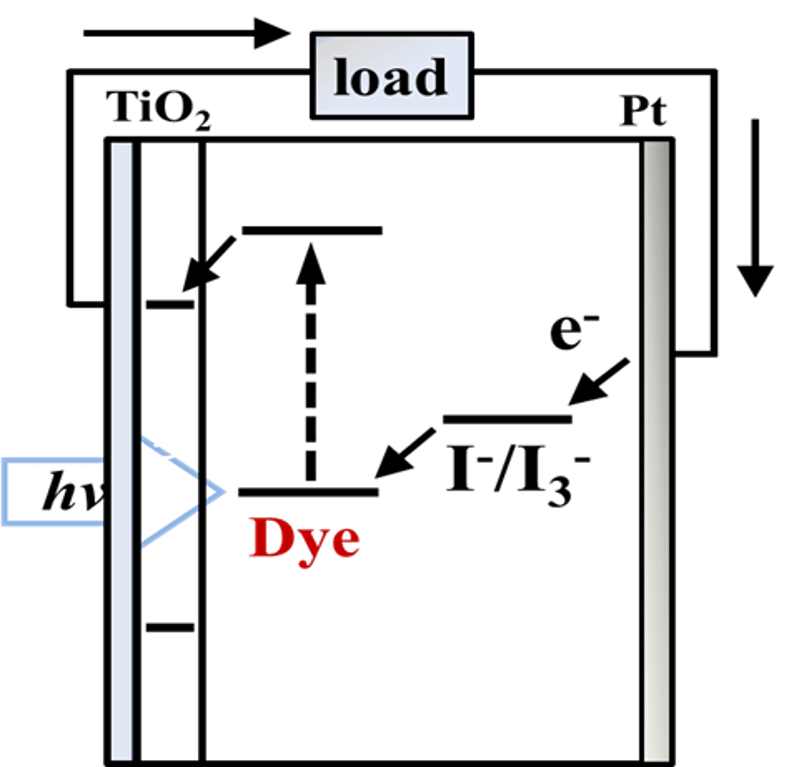
色素増感太陽電池(Dye-Sensitized Solar Cell, DSSC)は、「色素」が光を吸収して電気をつくるタイプの薄膜太陽電池です。シリコン太陽電池とちがい、透明でカラフルなセルや、やわらかいフレキシブル基板にも作ることができるのが特徴です。
イメージとしては、次のような“分業”で発電が行われます。
- 色素:太陽光を吸収するアンテナ
- TiO2 多孔質膜:電子が流れる“足場”となる半導体
- 電解質/ホール輸送層:色素と電極のあいだで電子(正孔)を運ぶシャトル
- 対向電極:電子を受け取り、電解質を元の状態に戻す場所
光があたると、色素が光を吸収して励起状態になり、TiO2 に電子を注入します。電子は外部回路を流れて電気として取り出され、いっぽう電解質(レドックス対)が色素から電子を受け取って、色素を元の状態に戻します。このサイクルがぐるぐる回ることで、連続的に発電が行われます。
2. Sharma らの総説がまとめた「DSSC の現在地」
Sharma らによる総説論文
K. Sharma, V. Sharma, S. S. Sharma, “Dye-Sensitized Solar Cells: Fundamentals and Current Status”, Nanoscale Research Letters(Review, Open Access)
では、DSSC の基本構造から材料、課題、商業化の展望までがコンパクトに整理されています。
この総説の内容を一般向けにかみ砕くと、主なポイントは次のようになります。
- DSSC は20年以上研究されている薄膜太陽電池で、
- 比較的低コスト
- 作製プロセスがシンプル
- 有害元素を避けた材料設計も可能
といった利点をもつ。 - 色素としては、ルテニウム錯体のような金属錯体色素に加え、金属を含まない有機色素も多数開発されている。
- 最適化された Ru(II) 色素を用いると、変換効率は約 12 % 程度まで到達しているが、シリコン太陽電池(20–30 % 程度)よりはまだ低い。
- 主な課題は
- 液体電解質による長期安定性(漏えい・蒸発、材料の分解)
- 大面積化・量産プロセスの確立
- ルテニウムなど高価・希少元素の代替
など。 - 一方で、DSSC は弱い光でもよく発電することや、色や透明性を自由にデザインできることから、
- 室内光発電(IoT センサー、ワイヤレスデバイス)
- 窓・壁・内装材と一体化した発電デザイン
といった分野での応用が期待されています。
3. ファイル内の代表的な研究例
ここでは、アップロードいただいたデータベースに含まれている論文から、一般の方にもイメージしやすい 3 件を例として紹介します。
3-1. 天然由来の色素を使った DSSC
Ammar ら, Journal of Nanomaterials
Ammar らは、身近な植物から抽出した天然由来の色素を使って DSSC を作製しています。
- ホウレンソウの葉からアセトンでクロロフィル色素を抽出
- 赤キャベツやタマネギの皮から水でアントシアニン色素を抽出
- これらの色素を TiO2 電極に吸着させて DSSC を作製
用いた色素は、UV–vis 吸収スペクトルや蛍光寿命測定などで丁寧に評価されています。また、作製した DSSC の効率が時間とともにどのように劣化するか、TiO2 層の厚さや構造がどのように影響するかも調べられています。
ポイント(一般向け)
- 食卓にあるような植物から色素を取り出し、太陽電池の「光を受ける部分」として利用できる。
- 効率や寿命の面では高性能色素に劣るものの、環境に優しく低コストな色素の候補として重要。
- 教育・体験実験に向いた、親しみやすい研究テーマでもある。
3-2. TiO2 の結晶面を制御して性能アップ
Chu ら, Scientific Reports
Chu らは、TiO2 の結晶面({001} 面)を選択的に露出させたナノ粒子を合成し、それを用いて DSSC を作製しています。
- Ti 粉末から NaOH 溶液中で H-titanate ナノワイヤを合成
- つぎに NH4F 溶液中で加熱処理し、{001} 面を多く露出したアナターゼ TiO2 ナノ粒子に変換
- この TiO2 を使った DSSC では、ランダムな形状の TiO2 を用いた場合に比べて約 2 倍の変換効率(7.06 % vs. 3.47 %)を達成
{001} 面を多く露出させた TiO2 は、表面積が大きく、色素をたくさん吸着できるうえ、電荷輸送にも有利であることが示されています。
ポイント(一般向け)
- 同じ材料でも、ナノレベルの形や結晶面を工夫するだけで性能が大きく変わる。
- 「どんな形のナノ粒子が、色素と光と電子にとって一番働きやすいか?」を探る研究といえる。
3-3. ドープ TiO2 と銀ナノ粒子による高効率化
Lim ら, Scientific Reports 7, 41470
Lim らは、窒素・硫黄を共ドープした TiO2 に銀ナノ粒子を装飾したコンポジット(N,S–TiO2@Ag)を光電極として用いることで、DSSC の性能を大きく向上させています。
- N,S 共ドープ TiO2 に Ag ナノ粒子を 20 wt% まで担持
- 代表的な Ru 色素 N719 を用いて DSSC を作製
- 改良前の TiO2 電極では変換効率 2.57 % だったものが、
N,S–TiO2@Ag 電極では 8.22 % まで向上
効率向上の要因として、論文では次の点が挙げられています。
- N,S ドープによるバンドギャップの縮小 → 可視光の利用拡大
- Ag ナノ粒子による界面電荷移動の改善と再結合の抑制
- 適切な Ag 含有量(20 wt%)で最もバランスよく働くこと
ポイント(一般向け)
- 「色素」だけでなく、TiO2 側や金属ナノ粒子を工夫することでも性能を大きく伸ばせる。
- ナノ材料設計によって、光と電子の動きをコントロールすることが DSSC 研究の重要なテーマになっている。
4. DSSC の強みとこれから
アップロードされた文献群から見えてくる DSSC の特徴と今後の方向性を、一般向けにまとめると次のようになります。
強み
- 材料・デザインの自由度が高い
色素や電極材料を選ぶことで、カラフル・透明・フレキシブルなど多様なデザインが可能。 - 弱い光に強い
室内光でも高い効率を出せるセルが報告されており、センサーや IoT デバイスの電源として有望。 - 比較的低コストな製造プロセス
低温プロセスや印刷技術に適しており、大量生産との相性がよい。
課題
- 長期安定性:液体電解質や有機材料の劣化をどう抑えるか。
- 高価な金属の代替:ルテニウムなどの希少元素から、銅や完全有機色素へのシフト。
- 大面積・モジュール化:実用的なサイズで均一な性能を出すための製造技術。
今後の展望
- 天然由来の色素や環境調和型材料の開発(Ammar らのようなアプローチ)
- TiO2 の結晶面制御やドーピング、ナノ粒子装飾による高効率化(Chu ら・Lim ら)
- 銅錯体などを用いた新しいレドックスメディエーターや、固体ホール輸送層の導入
- 室内光専用 DSSC など、「シリコンとは違う得意分野」に特化した応用
English Version: Fundamentals and Recent Progress of DSSCs
1. What is a Dye-Sensitized Solar Cell?
A dye-sensitized solar cell (DSSC) is a thin-film photovoltaic device in which dye molecules absorb light and generate electricity. Unlike conventional silicon solar cells, DSSCs can be made transparent, colored, and even flexible, which makes them attractive for building-integrated or indoor applications.
In a simplified picture, a DSSC consists of:
- A transparent conducting glass substrate
- A nanocrystalline, mesoporous TiO2 layer
- Light-absorbing dye molecules
- An electrolyte or hole-transport layer and a counter electrode
When light is absorbed, the dye is excited and injects an electron into the conduction band of TiO2. The electron flows through the external circuit, doing useful electrical work. The oxidized dye is regenerated by the redox couple in the electrolyte or by a solid-state hole-transport material, closing the cycle.
2. Overview based on the review by Sharma et al.
The review article
K. Sharma, V. Sharma, S. S. Sharma, “Dye-Sensitized Solar Cells: Fundamentals and Current Status”, Nanoscale Research Letters (Review, Open Access)
provides a concise overview of DSSC technology.
Key points, translated into non-specialist language, include:
- DSSCs have been studied for more than two decades as low-cost thin-film solar cells with relatively simple fabrication routes and the potential for low toxicity.
- Both metal-complex dyes (such as Ru(II) complexes) and metal-free organic dyes have been developed.
- Power conversion efficiencies up to around 12% have been achieved with optimized Ru(II) dyes, which is still below the 20–30% range of crystalline silicon and some other thin-film technologies.
- Major challenges are
- long-term stability (leakage/evaporation of liquid electrolyte, degradation of organic components),
- scalability to large-area modules, and
- cost and scarcity of certain elements.
- On the other hand, DSSCs work very well under low and diffuse light, and their color and transparency can be tuned, making them promising for:
- indoor power sources for IoT and sensor devices,
- aesthetically pleasing, building-integrated photovoltaic elements.
3. Example studies from the uploaded dataset
3.1. DSSCs based on natural dyes
Ammar et al., Journal of Nanomaterials
Ammar and co-workers extracted natural dyes from common plants and used them as sensitizers in DSSCs.
- Chlorophyll was extracted from spinach leaves using acetone.
- Anthocyanin pigments were extracted from red cabbage and onion peels using water.
- These natural dyes were adsorbed onto TiO2 electrodes to fabricate DSSCs.
They performed UV–vis absorption, FTIR, and steady-state/time-resolved photoluminescence measurements on the dyes, and examined how device efficiency degraded over one week and how the TiO2 mesoporous layers affected performance and interfacial properties.
Take-home message
- Pigments from everyday plants can serve as eco-friendly, low-cost light-harvesting dyes in DSSCs.
- Although efficiencies are lower than those of state-of-the-art metal-complex dyes, such systems are attractive for green technologies and educational demonstrations.
3.2. TiO2 facet engineering for higher efficiency
Chu et al., Scientific Reports
Chu et al. synthesized anatase TiO2 nanoparticles with exposed {001} facets via a two-step hydrothermal process starting from titanium powder. When applied as photoanodes in DSSCs, these particles led to:
- A power conversion efficiency of 7.06% (Voc ≈ 0.756 V, Jsc ≈ 14.8 mA/cm², FF ≈ 0.63)
- In contrast, randomly shaped TiO2 structures yielded only 3.47% efficiency.
The improved performance was attributed to the high activity and large surface area of the {001}-facet-exposed TiO2, which allows for excellent dye loading and favorable charge transport.
Take-home message
- Even with the same chemical composition, controlling the crystal facets and morphology at the nanoscale can dramatically change device performance.
3.3. N,S-co-doped TiO2 with Ag nanoparticles
Lim et al., Scientific Reports 7, 41470
Lim and co-workers prepared a silver nanoparticle-decorated N,S-co-doped TiO2 nanocomposite (N,S–TiO2@Ag) and used it as a high-performance photoanode with the standard N719 dye.
- The reference TiO2 photoanode delivered a power conversion efficiency of 2.57%.
- The optimized N,S–TiO2@Ag photoanode (20 wt% Ag) reached 8.22% efficiency.
According to their analysis, the enhancement is mainly due to:
- Reduced band gap energy by N,S-co-doping, increasing visible-light absorption.
- Improved interfacial charge transfer and suppressed recombination due to Ag nanoparticles.
Take-home message
- Beyond dye design, engineering the semiconductor and adding metal nanoparticles is a powerful way to enhance DSSC performance.
4. Outlook for DSSCs
From the collection of articles in your files, the future directions of DSSCs can be summarized as follows:
- Development of environmentally friendly and inexpensive dyes, including natural pigments and metal-free organic dyes.
- Nanostructuring and doping of TiO2 and other semiconductors to optimize light harvesting, charge transport, and interfacial kinetics.
- Introduction of new redox mediators (for example, copper complexes) and solid-state hole-transport materials to improve voltage, stability, and device lifetime.
- Focusing on application niches where DSSCs are particularly strong, such as:
- indoor/ambient light energy harvesting,
- aesthetically pleasing, semi-transparent modules for buildings and portable electronics.
DSSCs may not replace silicon in large-scale power plants, but they are excellent candidates for colorful, design-oriented and low-light photovoltaic applications.
参考文献 / References
- K. Sharma, V. Sharma, S. S. Sharma, “Dye-Sensitized Solar Cells: Fundamentals and Current Status”, Nanoscale Research Letters, Review, Open Access.
- A. M. Ammar, H. S. H. Mohamed, M. M. K. Yousef, G. M. Abdel-Hafez, A. S. Hassanien, A. S. G. Khalil, “Dye-Sensitized Solar Cells (DSSCs) Based on Extracted Natural Dyes”, Journal of Nanomaterials.
- S. P. Lim, A. Pandikumar, H. N. Lim, R. Ramaraj, N. M. Huang, “Boosting Photovoltaic Performance of Dye-Sensitized Solar Cells Using Silver Nanoparticle-Decorated N,S-Co-Doped-TiO2 Photoanode”, Scientific Reports 7, 41470.
- L. Chu, Z. F. Qin, J. P. Yang, X. A. Li, “Anatase TiO2 Nanoparticles with Exposed {001} Facets for Efficient Dye-Sensitized Solar Cells”, Scientific Reports.