“色素増感太陽電池(DSSC)入門:しくみと研究の広がり / Introduction to Dye-Sensitized Solar Cells”
date: 2025-12-06
[DSSC, dye-sensitized solar cell, solar, renewable-energy]
日本語版:色素増感太陽電池(DSSC)入門
1. 色素増感太陽電池とは?
色素増感太陽電池(DSSC: Dye-Sensitized Solar Cell)は、色素(染料)が光を吸収して電気を生み出す薄膜型太陽電池です。
シリコン結晶を使う従来型とは異なり、
- 低コストな材料を使いやすい
- 作り方が比較的シンプル
- 有害性の低い材料の組み合わせも可能
- 薄くて軽く、色付き・透明にもしやすい
といった特徴があり、20年以上にわたって活発に研究されていることが、Sharma らによるレビューで整理されています(2018 年の Nanoscale Research Letters 論文)。
既存の DSSC では、ルテニウム錯体色素を用いて最適化することで、変換効率はおよそ 12% 程度に達しています。一方で、他の薄膜太陽電池や Si 太陽電池では 20–30% 程度の効率が報告されており、DSSC にはまだ性能向上の余地があるとされています。
2. DSSC の基本構造(3 つのパーツ)
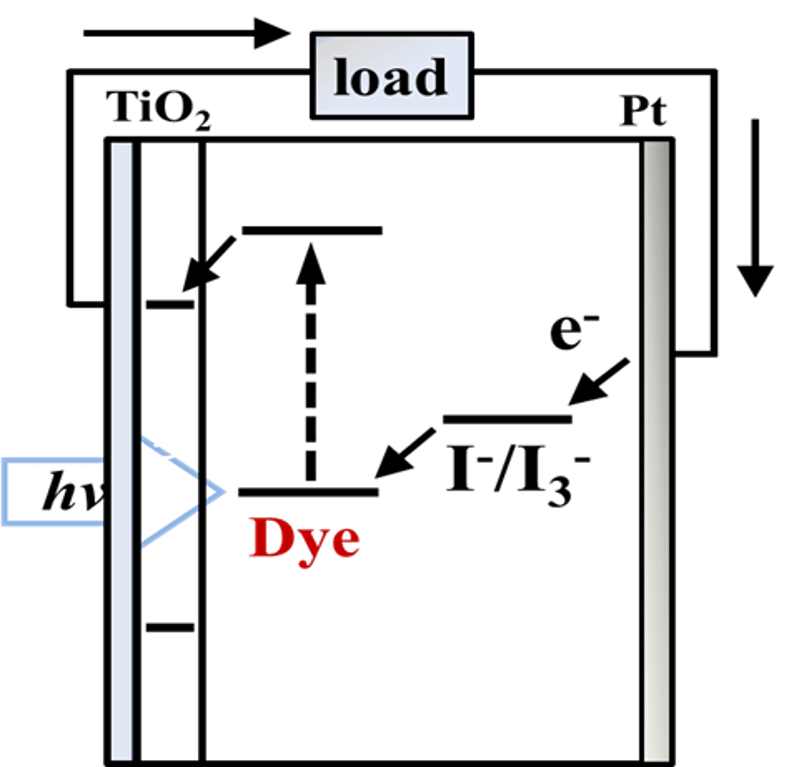
Sharma らのレビューでは、DSSC の「構造」と「作動原理」が丁寧にまとめられています。それをもとに、DSSC をシンプルに分解すると次の 3 部分になります。
- 色素で覆われた半導体電極(光を吸収する側)
- 透明な導電性ガラスの上に、多孔質の酸化チタン(TiO₂)ナノ粒子の層を形成
- その表面に、光を吸収する色素分子をびっしりと吸着させる
- 電解質(電子の“バトン渡し役”)
- 酸化・還元ができる「レドックス対」(ヨウ素系など)を含む液体やゲル
- 電子を失った色素を元に戻す役目を担う
- カウンター電極(対極)
- 外部回路から戻ってきた電子を受け取り、電解質中のレドックス対を還元する
- デバイスの効率・安定性・コストに大きく影響する重要な部位であり、Wu らの総説(2017 年 Chemical Society Reviews)では、このカウンター電極に焦点を当てた詳細なレビューが行われています。
3. 発電の流れ(やさしいイメージ)
DSSC の中では、光が当たると次のような流れで電気が生まれます。
- 色素が光を吸収する
- 色素分子が光を吸うと、電子が「高いエネルギー状態(励起状態)」になります。
- 電子が酸化チタンへ移動する
- 励起された電子は、すぐ隣の酸化チタンナノ粒子へ移動し、半導体の伝導帯に注入されます。
- 電子が外部回路を流れて仕事をする
- 電子は、透明電極 → 配線 → LED やセンサーなどの負荷 → カウンター電極
と流れ、電気エネルギーとして利用されます。
- 電解質が色素を“元に戻す”
- 電子を失った色素(酸化された色素)は、電解質中のレドックス対から電子を受け取り、元の状態に戻ります。
- カウンター電極で電解質を再生する
- 外部回路からカウンター電極に戻ってきた電子が、電解質中のレドックス対を再び還元し、サイクルが閉じます。
この「電子の一方通行のサイクル」が、光が当たっている間ずっと続いている状態が「発電している」状態です。
4. DSSC の強みと課題
Sharma らの論文では、DSSC の魅力と課題が次のような観点から整理されています。
4-1. 強み(メリット)
- 低コスト・簡便なプロセス
薄膜型であり、比較的低温プロセスで作製可能。素材も比較的安価なものが多く、将来的なコスト低減が期待されます。 - デザイン性・透明性
色素や構造を工夫することで、色付き・透明・模様入りなど「見せる太陽電池」として応用できます。 - 毒性の低い材料への展開が可能
有機色素や代替レドックス対など、環境負荷の小さい材料への置き換えが検討されています。
4-2. 課題
- 変換効率の限界
現状の最高効率はおよそ 12% 程度(Ru(II) 色素系)であり、Si や他の薄膜太陽電池に比べるとまだ低いレベルです。 - スケーラビリティ(大面積化)
小さなセルでは良好な性能が得られても、大きなモジュールにしたときに性能劣化や均一性の問題が出やすいことが指摘されています。 - 長期安定性
液体系電解質などに起因する長期安定性の問題があり、「材料選択」「封止技術」「固体・ゲル電解質への移行」などが課題になっています。
5. カウンター電極の重要性(Wu らの総説より)
Wu らは、DSSC におけるカウンター電極を体系的にレビューしています。
カウンター電極は、
- 外部回路から電子を集める
- 電解質中のレドックス種を効率よく還元する
という 2 つの役割を持ち、デバイスの効率・寿命・コストに直接関わる重要部位です。
彼らの総説では、カウンター電極が次のような材料群に分類されています。
- 金属・合金電極(白金、金属合金など)
- 炭素材料(カーボンブラック、グラファイト、カーボンナノチューブ、グラフェンなど)
- 導電性高分子
- 遷移金属化合物(硫化物・窒化物・カルコゲナイドなど)
- ハイブリッド材料(複数材料の複合体)
- 透明・フレキシブル電極(透明導電膜や柔軟基板上の電極)
それぞれについて、
- 触媒活性
- 電気伝導性
- 価格・入手性
- 長期安定性
- 透明性・柔軟性
といった点から、利点・欠点・代表的な作製法・評価方法・歴史的な開発の流れが整理されています。
高校生や一般の方にとってのポイントは、
「DSSC の性能は“色素だけ”で決まるわけではなく、
電極や電解質など“周りのパーツ”もかなり効いてくる」
ということです。
6. インピーダンス測定で内部の様子を「見る」(Laschuk らの総説より)
Laschuk らは、電気化学インピーダンス測定(EIS: Electrochemical Impedance Spectroscopy)という手法を、材料化学全般にわたって解説しています。その中には、DSSC のような電気化学デバイスも含まれます。
EIS は一言でいうと、
「ごく弱い交流信号を流して、応答の大きさや位相のずれを周波数ごとに調べることで、
デバイス内部の“抵抗”や“容量”などを分解して見る」
ための手法です。
Laschuk らの総説によると、EIS には次のような特徴があります。
- 非破壊・非侵襲的に材料や界面の状態を評価できる
- 単純な電流–電圧測定よりも高い「分解能」で、
どの部分で損失が起きているかを見分けやすい - 電荷移動速度や拡散過程、腐食状態など、幅広い現象の解析に使える
DSSC に対しては、
- 電子が酸化チタン内を流れる抵抗
- 電解質中でのイオンの拡散抵抗
- カウンター電極での電荷移動抵抗
などを EIS で分離・評価することで、「どこを改善すれば効率が上がるか?」を見極めることができます。
このように 「デバイスの内部を“覗き込む”道具」として、EIS は初心者にもぜひ使ってほしい手法として紹介されています。
7. まとめ:DSSC のこれから
アップロードされた 3 本の総説から見えてくる DSSC の姿を、最後に整理してみます。
- DSSC は、低コスト・簡便なプロセス・デザイン自由度を兼ね備えた薄膜太陽電池であり、第三世代の太陽電池の代表例として位置づけられている。
- 既存の DSSC の効率はおおよそ 12% 程度で、Si 太陽電池などの 20–30% には及ばないが、
材料・構造の工夫によって性能向上の余地が十分に残されている。 - カウンター電極や電解質など、「周辺部材」の改良によって、効率・安定性・コストのバランスを取る研究が進んでいる。
- EIS のような解析手法を活用することで、内部のボトルネックを見極めながら、より賢くデバイス改良を進めることができる。
高校生や一般の方には、
「色付きで透明な“窓の太陽電池”」
「室内の弱い光でも発電する“センサー用電源”」
といったイメージで捉えてもらうと、DSSC の面白さが伝わりやすいと思います。
English Version: Introduction to Dye-Sensitized Solar Cells (DSSCs)
1. What are DSSCs?
Dye-sensitized solar cells (DSSCs) are thin-film solar cells in which dye molecules absorb light and generate electricity.
According to the review by Sharma et al. (2018, Nanoscale Research Letters), DSSCs have attracted intensive research interest for more than two decades because they offer:
- relatively low cost
- simple preparation methods
- low toxicity potential
- ease of production and design flexibility
In state-of-the-art devices using Ru(II) dyes, the power conversion efficiency (PCE) reaches about 12%, while first- and second-generation solar cells (Si and other thin-film technologies) typically show 20–30% efficiency. This clearly indicates room for improvement, but also highlights DSSCs as a promising alternative in specific applications.
2. Basic structure
Following Sharma et al., a typical DSSC contains three key components:
- Dye-sensitized semiconductor photoanode
- Nanocrystalline TiO₂ film on transparent conductive glass
- Covered with a monolayer of light-absorbing dye molecules
- Electrolyte
- Contains a redox couple (e.g., iodide/triiodide) that regenerates the oxidized dye
- Counter electrode (CE)
- Collects electrons from the external circuit
- Catalyzes the reduction of the redox couple in the electrolyte
Wu et al. (2017, Chemical Society Reviews) emphasize that the CE plays a crucial role in determining the efficiency, long-term stability, and cost of DSSCs.
3. How a DSSC works
The operating principle can be summarized in five steps:
- Light absorption by the dye → the dye is excited to a higher energy state.
- Electron injection from the excited dye into the conduction band of TiO₂.
- Electron transport through the TiO₂ and transparent electrode to the external circuit, delivering power to a load.
- Dye regeneration by the redox couple in the electrolyte.
- Redox couple regeneration at the counter electrode by electrons returning from the external circuit.
This closed loop of electron transfer is the origin of the photocurrent in DSSCs.
4. Strengths and challenges
Based on Sharma et al.:
Strengths
- Cost and processing: thin-film structure and relatively simple fabrication routes
- Design freedom: colors, transparency, and flexible substrates are possible
- Potentially low toxicity: use of alternative dyes and redox couples is under investigation
Challenges
- Efficiency: PCEs of around 12% are still lower than those of mainstream Si and other thin-film solar cells (20–30%).
- Scalability: maintaining performance over large-area modules is non-trivial.
- Stability: long-term stability, especially for liquid electrolytes, remains a key issue.
5. Counter electrodes (Wu et al.)
Wu et al. provide a panoramic review of counter electrodes (CEs) in DSSCs. The CE:
- collects electrons from the external circuit
- catalyzes the reduction of the redox couple in the electrolyte
They classify CEs into several categories:
- metals and alloys
- carbon materials (graphite, CNTs, graphene, etc.)
- conductive polymers
- transition metal compounds
- hybrid materials
- transparent and flexible electrodes
For each category, they discuss special features, advantages and disadvantages, preparation methods, characterization techniques, and development history.
The key message is that the CE is not a passive “support” but an active component that strongly affects device performance, stability, and cost.
6. Probing DSSCs with impedance spectroscopy (Laschuk et al.)
Laschuk et al. (2021, RSC Advances) review electrochemical impedance spectroscopy (EIS) as a powerful and non-invasive technique for materials characterization. Among many applications (supercapacitors, conductive coatings, sensors, self-assembled monolayers, etc.), DSSCs are explicitly mentioned.
EIS allows researchers to:
- resolve different resistive and capacitive elements in a device
- study surface reaction mechanisms, charge-transfer kinetics, and mass transport
- quantify losses at specific interfaces (e.g., TiO₂/dye/electrolyte, electrolyte/CE)
For DSSCs, EIS helps identify bottlenecks such as:
- electron transport and recombination in TiO₂
- ion diffusion in the electrolyte
- charge-transfer resistance at the counter electrode
This makes EIS an essential tool for rationally improving cell design and materials.
7. Outlook
From the three reviews included in the uploaded document, we can summarize:
- DSSCs are a versatile thin-film solar cell technology with attractive features in terms of cost, fabrication, and design.
- Their current efficiency (≈12%) leaves room for improvement compared to Si and other thin-film cells (20–30%), but they are promising for niche applications such as colored/transparent solar windows and low-power indoor energy harvesting.
- Advances in counter electrode materials and electrolytes, guided by diagnostic tools such as EIS, are key to pushing DSSCs toward higher efficiency, better stability, and lower cost.
For students and non-specialists, it may be helpful to imagine DSSCs as:
“solar cells that can be built into colorful windows or indoor devices,
where not only the dye but also the electrodes and electrolyte work together
like a finely tuned team.”
参考文献 / References
(※以下は、アップロードされた DSSC_Review_OpenAccess.txt に含まれていた論文情報に基づいています)
- Laschuk, N. O.; Easton, E. B.; Zenkina, O. V.
Reducing the resistance for the use of electrochemical impedance spectroscopy analysis in materials chemistry.
RSC Advances 2021, 11(45), 27925–27936. DOI: 10.1039/d1ra03785d. - Sharma, K.; Sharma, V.; Sharma, S. S.
Dye-Sensitized Solar Cells: Fundamentals and Current Status.
Nanoscale Research Letters 2018, 13, Article 381. DOI: 10.1186/s11671-018-2760-6. - Wu, J.; Lan, Z.; Lin, J.; Huang, M.; Huang, Y.; Fan, L.; Luo, G.; Lin, Y.; Xie, Y.; Wei, Y.
Counter electrodes in dye-sensitized solar cells.
Chemical Society Reviews 2017, 46(19), 5975–6023. DOI: 10.1039/c6cs00752j.