色素増感太陽電池(DSSC)の基礎と最新研究
Open Access 総説論文にもとづくやさしい解説
1. DSSCとは?(やさしく一言で)
色素増感太陽電池(Dye-Sensitized Solar Cell, DSSC)は、色素が光を吸収して電気を作る「有機系・薄膜型」の太陽電池です。
シリコンを厚く使う従来型とは違い、
- 多孔質の酸化チタン(TiO₂)などの酸化物半導体
- その表面に吸着した色素分子
- ヨウ素系などの電解液
- 白金やカーボンなどのカウンター電極
といった材料を組み合わせて作られます。
Sharma らの総説によれば、DSSC は
- 低コスト
- 簡単な作製プロセス
- 比較的低毒性
- スケールアップしやすい
といった点から、20年以上にわたり精力的に研究が続けられてきた薄膜太陽電池です。一方で、材料コストや資源量、長期安定性など、まだ改善すべき点も多く残されています。
2. DSSCのしくみ(4つの基本部品)
Sharma らの「Dye-Sensitized Solar Cells: Fundamentals and Current Status」では、DSSC を構成する主要部品と動作原理が整理されています。
2.1 主な構成要素
- 透明導電性ガラス(FTO/ITO)
- 太陽光を通しつつ、電気を流すガラス電極です。
- 多孔質酸化物半導体(主に TiO₂)からなる光電極(フォトアノード)
- ナノサイズの粒子がスポンジ状に詰まっており、色素がたくさん吸着できる「足場」の役割を果たします。
- 色素(ルテニウム錯体や有機色素など)
- 光を吸収して電子を励起し、TiO₂ へ電子を注入する「アンテナ兼スイッチ」です。
- 電解質とカウンター電極
- ヨウ素/三ヨウ素(I⁻/I₃⁻)などのレドックス対を含む電解液
- それを還元する触媒としてのカウンター電極(従来は Pt、現在はカーボンや金属硫化物など多様化)
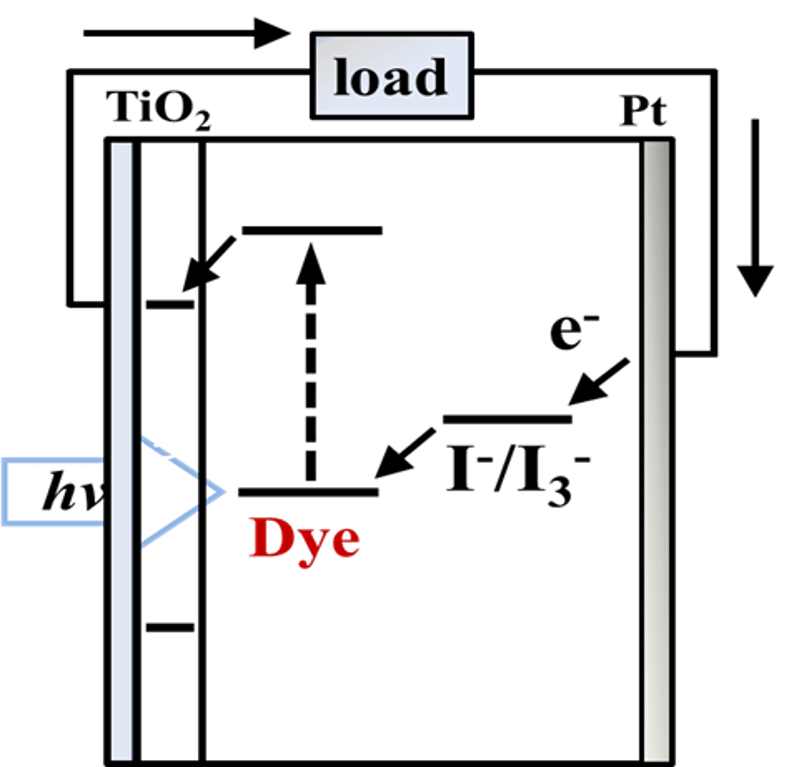
2.2 電気が生まれるまでの流れ(イメージ)
- 光が色素に当たる
- 色素分子の電子が励起され、TiO₂ の伝導帯へ移る
- TiO₂ 内を電子が流れ、外部回路(負荷)を通ってカウンター電極へ
- カウンター電極で、電解質中の I₃⁻ が還元され I⁻ に戻る
- 酸化された色素は、電解質中の I⁻ から電子を受け取り元の状態に戻る
この循環が続くことで、連続的に電流が取り出せます。
3. 性能と課題
Sharma らの総説によると、最適化された Ru(II) 色素と材料設計により、DSSC の変換効率は約 12% 程度に達しています。一方で、シリコン太陽電池や他の薄膜太陽電池では 20–30% の効率が報告されており、DSSC はまだ伸びしろが大きい段階にあります。
代表的な課題としては、
- 高価なルテニウム色素への依存
- 長期安定性(電解液の揮発や封止など)
- 大面積モジュール化時のスケーラビリティ
- 室外での耐候性
などが挙げられます。
4. 材料研究の広がり
4.1 全体像:フォトアノード・色素・電解質・カウンター電極
Sharma らは、DSSC の材料を
- 光電極(ナノ結晶 TiO₂ など)
- 金属錯体色素・金属フリー有機色素
- 液体・ゲル・固体電解質
- カウンター電極材料
という4つの観点から整理し、それぞれの効率・安定性・コストバランスをレビューしています。
さらに、Ye らによる総説「Recent advances in dye-sensitized solar cells: from photoanodes, sensitizers and electrolytes to counter electrodes」では、最新の高効率化・固体化・低コスト化の取り組みがまとめられており、DSSC の設計指針がより具体的に示されています。
4.2 カウンター電極の世界
Wu らの「Counter electrodes in dye-sensitized solar cells」は、DSSC におけるカウンター電極を徹底的にレビューした論文です。ここでは、カウンター電極が担う役割として、
- 外部回路から電子を集める
- 電解液中のレドックス対(I₃⁻ → I⁻ など)を素早く還元する
- デバイスの安定性・コスト・柔軟性に大きく影響する
ことが強調されています。
具体的な材料としては、
- 白金・金などの金属・合金
- カーボンブラック、カーボンナノチューブ、グラフェンなどの炭素材料
- PEDOT:PSS などの導電性高分子
- CoS などの遷移金属化合物
- これらを組み合わせたハイブリッド材料
などが紹介されており、「透明性」「フレキシブル性」「白金フリー」「低コスト」といったキーワードで分類・整理されています。
5. 「DSSCはまだ終わっていない」——最近の動向
Muñoz-García らの総説「Dye-sensitized solar cells strike back」では、DSSC は「誕生から約 30 年を迎えた技術」でありながら、近年ふたたび注目を集めていることが紹介されています。
DSSC の特徴として、
- 低コスト
- 毒性の低い材料で構成可能
- カラフルで透明なデバイスが作れる
- 室内の弱い光でも高い発電効率を示す
といった性質を活かし、
- 室内 IoT デバイス用電源
- デザイン性の高い窓や建材一体型太陽電池
- 太陽エネルギーを用いた化学反応(ソーラー燃料生成)
など、「ニッチだが DSSC が最も有利になる用途」に向けた応用研究が進んでいることが強調されています。
6. まとめ:高校生・一般の方へのメッセージ
- DSSC は「色素」と「ナノ材料」を組み合わせたユニークな太陽電池です。
- シリコン太陽電池より効率は低いものの、「カラフル・透明・室内光に強い」といった個性を活かせる場面が増えています。
- 材料化学・電気化学・分光・計算化学など、さまざまな分野の研究が統合される「総合科学の実験場」としても魅力的なテーマです。
研究室紹介や出前授業などで DSSC を取り上げると、
「身近な太陽光発電」と「最先端の材料研究」を同時に伝えられるコンテンツになります。
参考文献(本ページで紹介した主なオープンアクセス総説)
- Sharma, K.; Sharma, V; Sharma, S. S.
“Dye-Sensitized Solar Cells: Fundamentals and Current Status.”
Nanoscale Research Letters, Review article on DSSC construction, operating principle, key problems, and commercialization. - Wu, J.; Lan, Z.; Lin, J.; Huang, M.; Huang, Y.; Fan, L.; Luo, G.; Lin, Y.; Xie, Y.; Wei, Y.
“Counter electrodes in dye-sensitized solar cells.”
Chemical Society Reviews, Comprehensive review of DSSC counter electrodes (Pt、金属、カーボン、導電性高分子、金属化合物、ハイブリッドなど). - Muñoz-García, A. B.; Benesperi, I.; Boschloo, G.; Concepcion, J. J.; Delcamp, J. H.; Gibson, E. A.; Meyer, G. J.; Pavone, M.; Pettersson, H; Hagfeldt, A.; Freitag, M.
“Dye-sensitized solar cells strike back.”
Chemical Society Reviews, Review on recent advances, niche applications, and commercialization of DSSCs.
Dye-Sensitized Solar Cells (DSSCs): Basics and Recent Research
(A simple introduction based on open-access review articles)
1. What is a DSSC?
A dye-sensitized solar cell (DSSC) is a thin-film solar cell in which dye molecules absorb light and inject electrons into a nanostructured metal oxide, typically TiO₂.
Unlike conventional crystalline silicon cells, DSSCs use:
- A transparent conducting glass (FTO/ITO)
- A mesoporous TiO₂ photoanode
- A dye (ruthenium complex or metal-free organic dye)
- A redox electrolyte and a counter electrode
According to the review by Sharma et al., DSSCs have been intensively studied for more than two decades because they are:
- Potentially low-cost
- Simple to fabricate
- Based on relatively low-toxicity materials
- Easy to scale up
At the same time, issues such as material cost, resource availability, and especially long-term stability still remain challenging.
2. How does a DSSC work?
2.1 Key components
- Transparent conducting glass (FTO/ITO)
- Lets light pass while conducting electricity.
- Nanocrystalline TiO₂ photoanode
- Provides a large internal surface area where dye molecules can be anchored.
- Sensitizer dye
- Absorbs sunlight and injects electrons into the TiO₂ conduction band.
- Electrolyte and counter electrode
- A redox couple (often I⁻/I₃⁻) in the electrolyte
- A catalytic counter electrode (Pt, carbon, transition metal compounds, etc.) that regenerates the redox couple
2.2 Step-by-step picture of the energy conversion
- Sunlight excites the dye.
- The excited dye injects an electron into TiO₂.
- Electrons travel through the TiO₂ network and the external circuit, doing useful work.
- At the counter electrode, electrons reduce the oxidized species in the electrolyte (e.g., I₃⁻ → I⁻).
- The reduced electrolyte then regenerates the oxidized dye.
This cycle continues as long as light is available, generating a steady photocurrent.
3. Efficiency and challenges
Sharma et al. report that optimized DSSCs with Ru(II) dyes can reach power conversion efficiencies of about 12%, while typical silicon and other thin-film solar cells reach about 20–30%. Thus, DSSCs still have room for improvement.
Major challenges include:
- Dependence on expensive ruthenium-based dyes
- Long-term stability (electrolyte leakage, sealing, UV and thermal durability)
- Scale-up and module-level performance
- Outdoor durability in real environments
4. Materials research: from photoanodes to counter electrodes
4.1 Global view of DSSC components
Sharma et al. categorize DSSC research into four main components:
- Photoanodes: nanocrystalline TiO₂ and other oxides
- Sensitizers: metal complexes and metal-free organic dyes
- Electrolytes: liquid, gel, and solid-state systems
- Counter electrodes: Pt and various alternatives
The review by Ye et al. (“Recent advances in dye-sensitized solar cells: from photoanodes, sensitizers and electrolytes to counter electrodes”) further details how recent progress in each component contributes to higher efficiency, better stability, and lower cost.
4.2 Counter electrodes in detail
The review by Wu et al., “Counter electrodes in dye-sensitized solar cells,” focuses on the counter electrode as a crucial component that:
- Collects electrons from the external circuit
- Catalyzes the redox reaction in the electrolyte
- Strongly influences performance, durability, and cost
They systematically discuss counter electrodes based on:
- Metals and alloys
- Carbon materials (carbon black, CNTs, graphene, etc.)
- Conductive polymers (e.g., PEDOT:PSS)
- Transition metal compounds (e.g., CoS)
- Hybrid materials
Key design trends include Pt-free, transparent, and flexible electrodes for low-cost and wearable DSSCs.
5. “Dye-sensitized solar cells strike back”
In the review “Dye-sensitized solar cells strike back,” Muñoz-García et al. highlight that, although DSSCs are now about 30 years old, they are experiencing a renaissance.
Thanks to their unique combination of properties—low cost, non-toxic materials, colorful and transparent appearance, and excellent performance under low light—DSSCs are now considered especially promising for:
- Indoor power supplies for IoT devices and sensors
- Building-integrated photovoltaics (BIPV) and aesthetic solar windows
- Dye-sensitized photoelectrochemical cells for solar fuel production
The review covers advances in theory, characterization techniques, materials, applications, and commercialization efforts.
6. Take-home message for students and general readers
- DSSCs are a fascinating example of how chemistry, materials science, and device physics come together to harvest solar energy.
- Although their efficiency is lower than that of silicon cells, their design freedom, color, transparency, and indoor performance open up unique application fields.
- For high-school and university students, DSSCs offer an accessible hands-on platform to learn about nanomaterials, spectroscopy, electrochemistry, and renewable energy.
Using DSSCs in outreach activities or on a laboratory homepage is a great way to communicate both fundamental science and real-world applications of solar energy technologies.
References (Open-access reviews used in this page)
- Sharma, K.; Sharma, V; Sharma, S. S.
“Dye-Sensitized Solar Cells: Fundamentals and Current Status.”
Nanoscale Research Letters (Open-access review on DSSC fundamentals and current status). - Wu, J.; Lan, Z.; Lin, J.; Huang, M.; Huang, Y.; Fan, L.; Luo, G.; Lin, Y.; Xie, Y.; Wei, Y.
“Counter electrodes in dye-sensitized solar cells.”
Chemical Society Reviews (Comprehensive review on DSSC counter electrode materials and design). - Muñoz-García, A. B.; Benesperi, I.; Boschloo, G.; Concepcion, J. J.; Delcamp, J. H.; Gibson, E. A.; Meyer, G. J.; Pavone, M.; Pettersson, H; Hagfeldt, A.; Freitag, M.
“Dye-sensitized solar cells strike back.”
Chemical Society Reviews (Review on recent advances, niche applications, and commercialization of DSSCs).