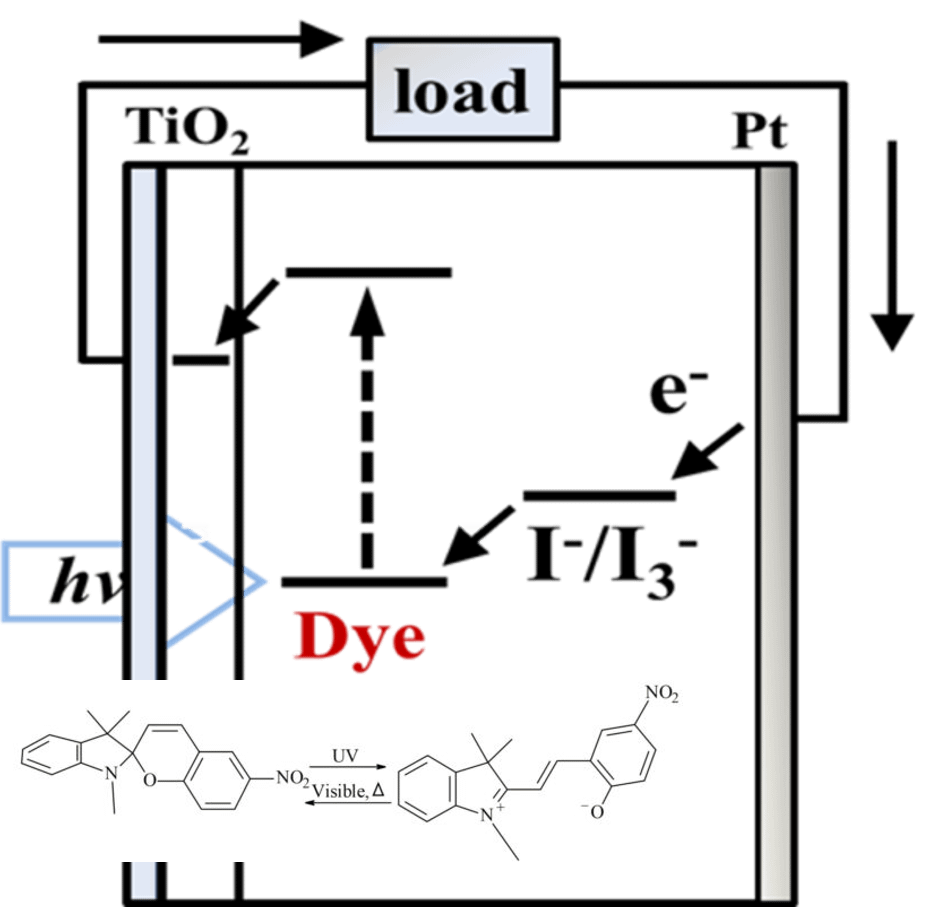
1. DSSCとフォトクロミック分子とは?
色素増感太陽電池(DSSC)は、色素が光を吸収して電子を半導体(多くは TiO₂)に渡し、
そこから外部回路へ電流を取り出すタイプの太陽電池です。
一方、スピロピラン(spiropyran)のような「フォトクロミック分子」は、
光を当てると無色 ⇔ 有色のように構造と色が変わる分子です。
この2つを組み合わせると、
- 光を当てた前後で、
- 吸収する波長や
- 電子の流れ方
が変わる - つまり、「光スイッチ付き」太陽電池や光センサーのような機能を持ったDSSCを作れる
という発想が生まれます。
2. スピロピラン由来フォトメロシアニン+シクロデキストリンDSSC
Takeshita, Umeda, Hara, J. Photochem. Photobiol. A, 2017
福井工業大学のグループは、
非カルボン酸型スピロピラン 1,3,3-trimethylindolino-β-naphthopyrylospiran(1)から
可視光で生成するフォトメロシアニン(PMC)を使ったDSSCを作製しました。fileciteturn23file0
2-1. 分子包接とTiO₂電極への固定
- スピロピラン (SP) に光を当てると、開環した有色の PMC になります。
- この PMC を
- そのまま TiO₂ に吸着させた場合と
- カルボキシメチルβ-シクロデキストリンナトリウム塩(CM-β-CD) との包接体(PMC/CM-β-CD)として吸着させた場合
を比較しました。 - 蛍光測定により、PMC/CM-β-CD 包接体が TiO₂ 表面に形成されていることを確認しています。
2-2. 発電性能と光応答
- 570 nm 光での IPCE(入射光子-電流変換効率)は
- PMC のみ:4.1 %
- PMC/CM-β-CD:最大 11.1 %
- CM-β-CD の層があることで、
- 開放電圧 Voc
- フィルファクター(太陽電池の「形の良さ」を表す指標)
も向上しました。 - 一方で、可視光処理を続けると IPCE が減少し、
PMC が別の異性体に変化してしまうことが原因と考察されています。
2-3. 一般向けイメージ
- スピロピランは 「光で形と色が変わるレゴブロック」 のような分子。
- シクロデキストリン(CD)は、そのレゴを包む 「分子カプセル」。
- この2つを組み合わせることで、
光のオン・オフに応じて発電効率が変わる光応答型DSSCが実現できる、ということを示した研究です。
3. ハロゲン置換インドリン型スピロピランの合成とDSSC応用
Pugachev et al., Russian Chemical Bulletin, 2023
Pugachev らは、インドリン骨格を持つスピロピランに
塩素(Cl)や臭素(Br)を導入した新規誘導体を合成し、その性質を詳しく調べています。fileciteturn23file0
3-1. どんなことをしている研究か?
- インドリン部位の 5位にハロゲンを導入した新しいスピロピランを合成。
- NMR・IR で構造を確認し、結晶構造解析と CrystalExplorer による結晶内相互作用の解析も実施。
- アセトニトリル溶液中でのフォトクロミック挙動(光で色が変わる速さ・戻りやすさなど)を測定。
- 合成した色素を用いた DSSC の光電気化学特性を、UV照射前後で比較評価。
3-2. 意味するところ
- ハロゲン置換により、
- 吸収波長や
- 光異性化の速度
が変わることで、太陽電池としての振る舞いも変化します。 - 「どの置換基なら、よく光を吸って、よく電流を流すか」を分子レベルで探る基礎研究として重要です。
高校生向けに言えば、
スピロピランの「着せ替え(置換基)」を変えながら、
どの服が太陽電池に一番向いているかをテストしている研究
とイメージしてもらうと分かりやすいと思います。
4. CdSナノワイヤに固定した蛍光ピリジン色素による光電変換
Mavazzan et al., Journal of Fluorescence, 2024
Mavazzan らは、やや広い意味での「DSSC」として、
カドミウムスルフィド(CdS)ナノワイヤに金属フリーの蛍光ピリジン色素を固定して
光電変換を評価しています。fileciteturn23file0
4-1. どんな材料か?
- D–π–A 型構造を持つカルコン(chalcone)骨格の有機色素を設計・合成。
- 溶液化学的な手法で、1次元 CdS ナノワイヤ(CdS NW)ネットワーク上に色素を固定。
- 吸収スペクトル・蛍光スペクトル・電気化学測定・DFT計算などで性質を評価。
4-2. 太陽電池としての結果
- ベースとなる CdS NW の光電変換効率は 0.112 %。
- ある色素(T4PC)を固定した素子では 0.487 % と、約 4.35 倍 に向上。
- 他の色素(T3PC, T2PC)でも、
- 0.338 %(約3倍)
- 0.273 %(約2.4倍)
と増加しています。
DSSCというより「色素増感型ナノワイヤ太陽電池」に近い構造ですが、
有機蛍光色素 × 半導体ナノ構造 の組み合わせで、光電変換を細かくチューニングできることを示す例です。
5. 高校生・一般向けまとめ
- DSSCは、光を吸う色素+電子を運ぶ半導体+電解質からなる太陽電池で、
色やデザインを自由にできるのが大きな魅力です。 - スピロピランのようなフォトクロミック分子を入れると、
光で色や構造が変わることを利用して、
光に応答して性質が変わる太陽電池や光センサーを作ることができます。 - シクロデキストリンなどの「分子カプセル」と組み合わせることで、
分子の配置や距離をナノレベルで調整し、 - 発電効率
- 安定性
- 光応答性
をデザインする研究が進んでいます。 - こうした研究は、
「見える光スイッチ」や「色と発電が一体化した窓」など、
デザイン性と機能性を両立した次世代デバイスへとつながっていきます。
English Version: Photochromic Spiropyran-Based DSSCs
1. DSSCs and photochromic molecules
A dye-sensitized solar cell (DSSC) uses a dye to absorb light and inject electrons into a wide-bandgap semiconductor such as TiO₂.
Electrons then travel through the external circuit and return via a redox electrolyte.
Spiropyrans are photochromic molecules: they can reversibly change their structure and color upon light irradiation
(e.g., from a colorless “closed” form to a colored “open” form).
Combining DSSCs with spiropyrans allows us to design devices where:
- the absorption band and charge transfer pathways change upon light exposure,
- enabling light-switchable solar cells and photoelectrochemical sensors.
2. Noncarboxylated spiropyran-derived photomerocyanine with cyclodextrin
Takeshita, Umeda, Hara, J. Photochem. Photobiol. A, 2017
Takeshita, Umeda, and Hara investigated a DSSC containing a
noncarboxylated spiropyran, 1,3,3-trimethylindolino-β-naphthopyrylospiran (1),
and carboxymethyl-β-cyclodextrin sodium salt (CM-β-CD).fileciteturn23file0
2-1. Photomerocyanine inclusion on TiO₂
- Visible light converts the spiropyran (SP) into its colored photomerocyanine (PMC) form.
- They found that both PMC and its inclusion complex with CM-β-CD (PMC/CM-β-CD) can be adsorbed on TiO₂.
- Fluorescence spectroscopy confirmed the formation of PMC/CM-β-CD on the TiO₂ surface.
2-2. Photovoltaic performance and photoresponse
- Under 570 nm light, the IPCE reached
- 4.1 % for the PMC-containing DSSC, and
- up to 11.1 % when CM-β-CD was introduced.
- The CM-β-CD layer also improved the open-circuit voltage and fill factor.
- After prolonged visible-light treatment, the IPCE of PMC/CM-β-CD DSSCs decreased,
attributed to the formation of another PMC isomer.
In short, this work demonstrates a photoresponsive DSSC
based on a noncarboxylated PMC stabilized and tuned via a cyclodextrin inclusion layer.
3. Halogen-substituted indoline spiropyrans for DSSCs
Pugachev et al., Russian Chemical Bulletin, 2023
Pugachev and co-workers synthesized new indoline spiropyrans
bearing chlorine or bromine atoms at the 5-position of the indoline fragment.fileciteturn23file0
3-1. What did they study?
- New chloro- and bromo-substituted spiropyrans were synthesized.
- Their structures were confirmed by NMR and IR spectroscopy,
and the crystal structure of the chloro derivative was solved by X-ray diffraction and CrystalExplorer analysis. - Spectral-kinetic measurements in acetonitrile revealed their photochromic properties.
- The photoelectrochemical characteristics of DSSCs based on these dyes were measured
before and after UV irradiation.
3-2. Why is it important?
Halogen substitution changes:
- the absorption spectrum,
- the rate of photoisomerization, and
- inter- and intramolecular interactions,
which in turn affect DSSC performance.
The study helps clarify which structural motifs in spiropyrans are more suitable
for efficient and stable dye-sensitized solar cells.
4. Metal-free fluorescent pyridine dyes on CdS nanowires
Mavazzan et al., Journal of Fluorescence, 2024
Mavazzan et al. designed metal-free organic D–π–A dyes of the chalcone family,
anchored onto one-dimensional CdS nanowires (CdS NWs) to build dye-sensitized solar cells.fileciteturn23file0
4-1. Materials and methods
- Three heterocyclic chalcone analogs were synthesized as fluorescent pyridine dyes.
- The dyes were anchored onto CdS NW networks by solution chemistry.
- Their sensitizing capabilities were probed via optical/electrochemical measurements,
DFT simulations, and photovoltaic tests.
4-2. Photovoltaic results
- Bare CdS NW devices showed a power conversion efficiency (PCE) of 0.112 %.
- Using dye T4PC increased the PCE to 0.487 % (about 4.35 times higher).
- Devices with T3PC and T2PC reached 0.338 % and 0.273 %, respectively.
Although this system is somewhat distinct from a classical TiO₂-based DSSC,
it follows the same principle of dye sensitization of a semiconductor nanostructure,
demonstrating how organic chalcone dyes can significantly enhance the external quantum efficiency.
5. Key takeaways (English)
- Spiropyrans are promising photochromic sensitizers for DSSCs,
enabling light-tunable optical and electronic properties. - Cyclodextrin inclusion layers can improve IPCE, open-circuit voltage,
and enable photoresponsive behavior in noncarboxylated dyes. - Halogen-substituted spiropyrans provide a structural playground to optimize
color, switching speed, and photovoltaic performance. - Metal-free D–π–A chalcone dyes anchored on CdS nanowires show that
organic fluorescent dyes + semiconductor nanostructures are a versatile route to new dye-sensitized devices.
参考文献 / References
- Takeshita, T.; Umeda, T.; Hara, M. Fabrication of a dye-sensitized solar cell containing a noncarboxylated spiropyran-derived photomerocyanine with cyclodextrin. Journal of Photochemistry and Photobiology A: Chemistry 2017, 333, 87–91. DOI: 10.1016/j.jphotochem.2016.10.017.
- Pugachev, A. D.; Rostovtseva, I. A.; Makarova, N. I.; Ievlev, M. Yu.; Dmitriev, V. S.; Ozhogin, I. V.; Tkachev, V. V.; Utenyshev, A. N.; Borodkina, I. G.; Metelitsa, A. V.; Aldoshin, S. M.; Minkin, V. I.; Luk’yanov, B. S. Synthesis and study of new photochromic halogen-substituted spiropyrans of the indoline series. Russian Chemical Bulletin 2023, 72 (11), 2637–2648. DOI: 10.1007/s11172-023-4068-7.
- Mavazzan, A.; Mendhe, A. C.; Bayannavar, P. K.; Sankapal, B. R.; Kamble, R. R.; Madar, S. F.; Pasha, K. M. M.; Bheemayya, L. Design of Metal Free Fluorescent Pyridine Dyes Anchored on Cadmium Sulfide Nanowires: Optical, Electrochemical and Photovoltaic Applications. Journal of Fluorescence 2024, 34 (5), 2405–2414. DOI: 10.1007/s10895-023-03457-z.