色素増感太陽電池(DSSC)と近赤外透明太陽電池
日本語版(Japanese)
1. 色素増感太陽電池(DSSC)とは?
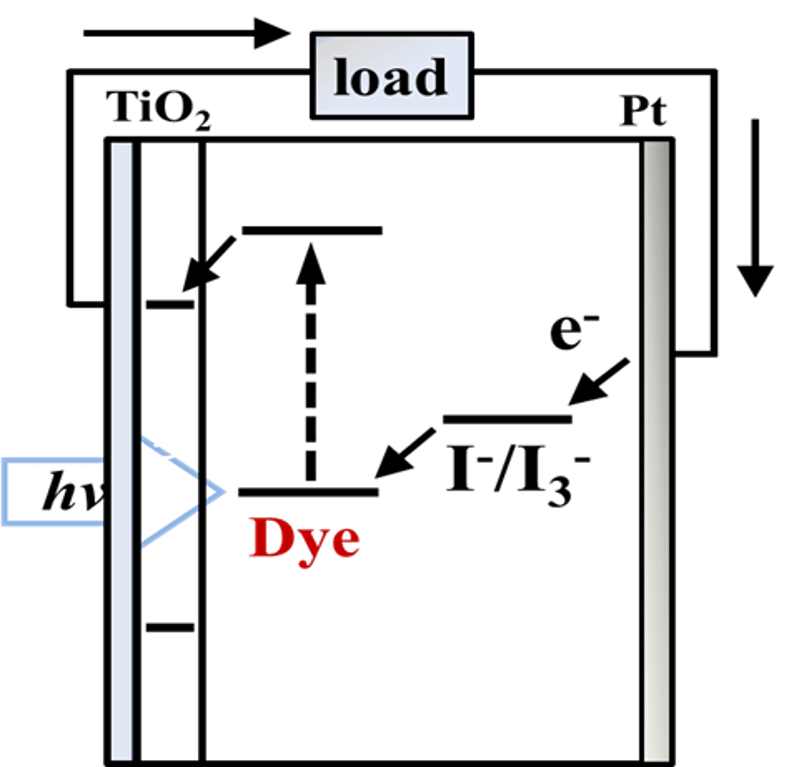
色素増感太陽電池(Dye-Sensitized Solar Cell, DSSC) は、シリコン太陽電池とは構造が異なる、有機・無機ハイブリッド型の太陽電池です。
主な構成要素は次のとおりです。
- 透明導電ガラス(電極)
- ナノ多孔質の酸化チタン(TiO₂)層
- 光を吸収する「色素」
- 電解質(電子を運ぶ溶液やゲル)
- 対向電極(カウンター電極)
色素が太陽光を吸収して励起されると、電子が TiO₂ に注入され、外部回路へ流れて電気になります。
色素や電解質の設計を工夫することで、
- カラフルな発電窓
- 室内光でも発電できるデバイス
- 曲げられるフレキシブル素子
など、従来のシリコン太陽電池とは違った応用が可能です。
2. 論文1:透明で色のつかないDSSCをめざして
Grifoni et al., Adv. Energy Mater. 2021
アップロードされた文献情報の中で、Grifoni らは「持続可能で、無色透明な太陽電池」として、選択的近赤外(NIR)吸収型DSSCの可能性を総説しています。fileciteturn13file0
2-1. 「近赤外だけを使う」という発想
- 太陽光の約45 %は、人の目では見えない 近赤外(NIR) 領域にあります。
- もし NIRだけを色素で吸収し、可視光はそのまま通せば、
- 見た目はほぼ無色透明
- それでも発電できる「透明太陽電池」
が実現できます。 - こうしたデバイスは、建物の窓ガラスやカーテンウォールに組み込める BIPV(建材一体型太陽電池) の有力候補になります。
2-2. 3つのキーパーツ
総説では、近赤外選択 DSSC のための 3 つの重要要素が整理されています。
- フォトアノード(光電極)
- ナノ結晶 TiO₂ の表面に、NIR を選択的に吸収する色素を吸着。
- 可視光はほぼそのまま透過し、NIR だけを電気に変えます。
- 電解質(レドックスカップル)
- 電解質が有色だと、セル全体が着色されてしまいます。
- そのため、無色に近いレドックス対(有機レドックスカップル等) が検討されています。
- 対向電極(カウンター電極)
- 白金などの金属電極は、光の反射や色味の原因となります。
- 透明導電性酸化物やナノ構造薄膜を使うことで、
透明性と触媒機能の両立が試みられています。
これら 3 要素のバランスをとることで、
発電効率と「見た目の透明さ」 を同時に達成する設計指針が示されています。
2-3. 建物への応用イメージ
この論文では、DSSC を使った 透明・無色に近い窓用太陽電池 が、将来の建物にどう組み込まれるかも議論されています。
- 南向きのガラスカーテンウォールに DSSC を導入
- 室内からは外が自然に見え、色味の変化は最小限
- 外観デザインを保ちつつ、照明や空調の一部電力をまかなう
といった 「エネルギーを生む窓」 の実現に向けて、材料・デバイス・評価指標の観点から課題と展望がまとめられています。
3. 論文2:金ナノクラスターで起電圧をブーストするDSSC
Choi et al., J. Phys. Chem. Lett. 2015
Choi らは、スクアリウム系色素と
グルタチオン保護金ナノクラスター(Auₓ–GSH) を同じ TiO₂ 電極上に共吸着させた DSSC を報告しています。fileciteturn13file0
- スクアリウム色素:可視〜近赤外の光をよく吸収する有機色素
- Au ナノクラスター:数十原子程度の極小サイズの金集合体で、量子ドットに似たエネルギー構造を持つ
この「色素 + ナノクラスター」の組み合わせにより、セルの光電変換効率が向上しました。
3-2. なぜ開放電圧が上がるのか?
重要なのは、単に光を吸う成分が増えたから効率が上がったわけではないという点です。
- Au ナノクラスターに電子がたまりやすくなることで、
TiO₂ の「準フェルミ準位」が伝導帯に近づきます。 - その結果、DSSC の 開放電圧(V_oc)が最大 0.24 V 向上 したことが報告されています。
- 効率向上は、色素とナノクラスターを別々に使った場合の単純な足し算以上でした。
つまり金ナノクラスターは、
- 「補助的な光吸収体」であるだけでなく、
- 電子のたまり場としてエネルギーレベルを制御する役割
をになっており、DSSC の電圧設計に新しい自由度を与えています。
4. 日本語まとめ
- DSSC は、色素で光を吸収して発電する有機ハイブリッド型太陽電池です。
- Grifoni らの総説では、近赤外だけを選択的に利用した透明 DSSC を目指し、
色素・電解質・対向電極の 3 要素の設計指針が示されています。 - Choi らの論文では、金ナノクラスターを共吸着させることで開放電圧を大きく向上させた DSSC が報告されており、
ナノ材料によるエネルギーレベル制御の可能性が示されています。 - これらの研究は、美観と機能性を両立した次世代の窓用太陽電池・BIPV の実現に向けた重要なステップです。
Dye-Sensitized Solar Cells and Near-Infrared Transparent Photovoltaics
English Version
1. What is a dye-sensitized solar cell?
A dye-sensitized solar cell (DSSC) is a hybrid photovoltaic device composed of
- a transparent conducting glass substrate,
- a nanocrystalline TiO₂ layer,
- a light-absorbing dye,
- a redox electrolyte,
- and a counter electrode.
The dye absorbs sunlight and injects an electron into the TiO₂ network, and the electrolyte plus counter electrode complete the circuit.
Compared to conventional silicon solar cells, DSSCs offer:
- tunable colors and semi-transparency,
- good performance under indoor or diffuse light,
- and the possibility of flexible, lightweight devices.
These features make DSSCs attractive for building-integrated photovoltaics (BIPV), such as power-generating windows.
2. Paper 1 – Toward sustainable, colorless, and transparent DSSCs
Grifoni et al., Adv. Energy Mater. 2021
According to the uploaded bibliographic record, Grifoni and co-workers review selective near-infrared (NIR) DSSCs aiming at colorless and transparent photovoltaics for BIPV applications.fileciteturn13file0
2-1. Using only the near-infrared part of sunlight
- Nearly 45 % of the solar power lies in the near-infrared region, invisible to the human eye.
- If a dye is designed to absorb only NIR light while transmitting visible light, a DSSC can generate electricity yet remain almost colorless.
- Such devices are ideal candidates for BIPV windows and façades, where aesthetics are crucial.
2-2. Three key components
The review highlights three key components that must be co-optimized:
- Photoanode (TiO₂ + NIR dye) – NIR-selective sensitizers on nanocrystalline TiO₂ harvest invisible photons while letting visible light pass.
- Electrolyte (redox mediator) – To avoid unwanted tint, nearly colorless redox couples, including organic mediators, are required.
- Counter electrode – Alternatives to conventional metal electrodes, such as transparent conductive oxides and nanostructured films, are explored to maintain catalytic activity without compromising transparency.
The interplay of these components determines the trade-off between power conversion efficiency and visual transparency, central to NIR-selective DSSCs for BIPV.
3. Paper 2 – Boosting photovoltage with thiolated gold nanoclusters
Choi et al., J. Phys. Chem. Lett. 2015
The second key paper in the uploaded file by Choi et al. investigates DSSCs where a squaraine dye is co-adsorbed with glutathione-capped gold nanoclusters (Auₓ–GSH) on a TiO₂ surface.fileciteturn13file0
- The squaraine dye efficiently absorbs visible to NIR light.
- Small gold nanoclusters, comprising only a few tens of atoms, exhibit discrete energy levels similar to quantum dots.
Together, they lead to a higher photovoltaic performance than either component alone.
3-2. Why does the open-circuit voltage increase?
A notable result is the increase in open-circuit voltage (V_oc):
- Electron accumulation in the Au nanoclusters shifts the quasi-Fermi level of TiO₂ closer to its conduction band edge.
- As a result, V_oc increases by up to 0.24 V, exceeding a simple additive effect of two separate sensitizers.
Thus, the gold nanoclusters act not only as auxiliary light absorbers but also as energy-level modulators that help raise the photovoltage of DSSCs.
4. Summary (English)
- DSSCs harvest light using molecular dyes and are promising for semi-transparent, visually appealing photovoltaic applications.
- Grifoni et al. reviewed NIR-selective, colorless DSSCs, emphasizing the joint optimization of dyes, electrolytes, and counter electrodes to achieve transparent photovoltaics for BIPV.
- Choi et al. showed that thiolated gold nanoclusters co-sensitized with a squaraine dye significantly enhance the open-circuit voltage of DSSCs, demonstrating the potential of nanocluster–dye combinations for energy-level engineering.
- Together, these studies illustrate how advanced dye design and nanostructured materials can drive the development of next-generation solar windows.
参考文献 / References
- Grifoni, F.; Bonomo, M.; Naim, W.; Barbero, N.; Alnasser, T.; Dzeba, I.; Giordano, M.; Tsaturyan, A.; Urbani, M.; Torres, T.; Barolo, C.; Sauvage, F.
“Toward Sustainable, Colorless, and Transparent Photovoltaics: State of the Art and Perspectives for the Development of Selective Near-Infrared Dye-Sensitized Solar Cells.”
Advanced Energy Materials 2021, 11 (43), 2101598. DOI: 10.1002/aenm.202101598. - Choi, H.; Chen, Y.-S.; Stamplecoskie, K. G.; Kamat, P. V.
“Boosting the Photovoltage of Dye-Sensitized Solar Cells with Thiolated Gold Nanoclusters.”
Journal of Physical Chemistry Letters 2015, 6 (1), 217–223. DOI: 10.1021/jz502485w.