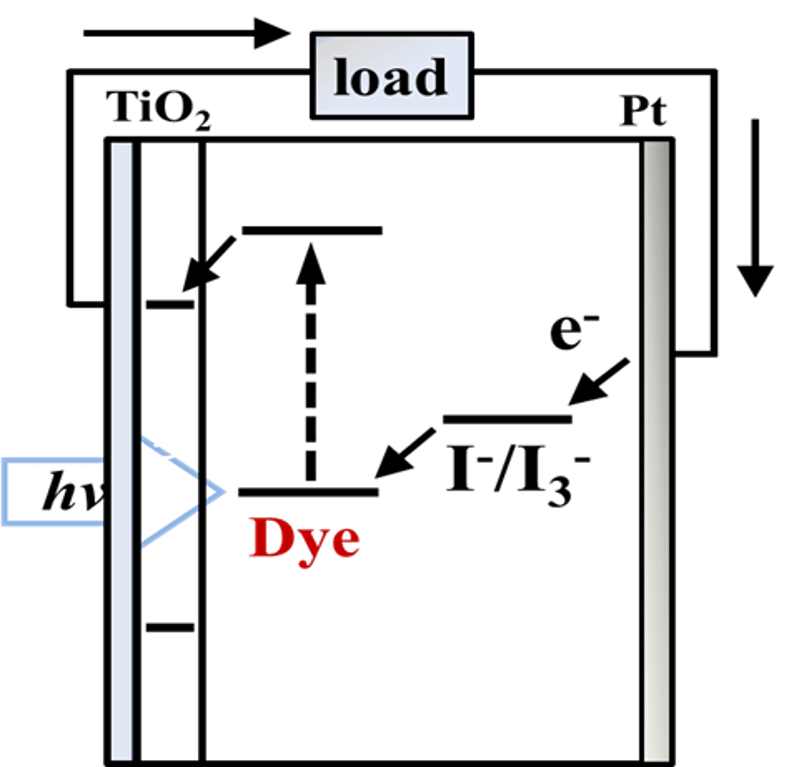
SQ(スクアリウム)色素を用いた最前線のDSSC研究を日本語と英語で紹介します。”
SQ系色素を用いた最新DSSC研究フロンティア
Frontier Studies on Squaraine-Dye-Based DSSCs
日本語版(Japanese)
1. 色素増感太陽電池(DSSC)とスクアリウム色素
色素増感太陽電池(DSSC) は、ナノ多孔質TiO₂の表面に色素を吸着させて光を集める、有機・無機ハイブリッド型の太陽電池です。
その中でも スクアリウム色素(Squaraine dyes) は、
- 赤色〜近赤外(NIR)まで強く光を吸収する
- 分子設計の自由度が高い
といった理由から、高効率DSSC用の有望な色素として世界中で研究が進められています。
ここでは、アップロードされた文献情報の中から、
スクアリウム色素を用いた 最前線の4つの研究 を分かりやすく紹介します。
2. 研究例1:超高速2次元分光で見る「光を吸った直後」のスクアリウム色素
Burigana et al., J. Am. Chem. Soc. 2025
2-1. 何をした研究?
Burigana らの研究は、赤色を吸収する代表的なスクアリウム色素について、
「光を吸収してから200フェムト秒以内に何が起きているか」 を、
2次元電子分光(2DES)と理論計算で詳しく調べたものです。
- 2DES:光を「縦と横の2方向の周波数」で分析する、超高速スペクトル技術
- ab initio計算:分子の形と電子状態を量子力学から計算する手法
その結果、この色素の励起状態が 「円錐交差(Conical Intersection)」 と呼ばれるエネルギーの分かれ道を通って、
200フェムト秒未満で素早く失活することが明らかになりました。
2-2. 円錐交差とは?
円錐交差は、ざっくり言うと
「上の滑り台(励起状態)と下の滑り台(基底状態)が立体交差している場所」
のようなものです。
分子がそこを通過すると、光で励起された電子エネルギーがすばやく熱などに変わってしまいます。
この研究では、
- 少なくとも2つの振動モードが電子状態と強く結合している
- それが円錐交差を通る超高速緩和の“スイッチ”になっている
ことが示され、スクアリウム色素の光物理が 予想以上に複雑であることが分かりました。
2-3. DSSC設計への示唆
この結果は一見、
「せっかく吸収した光エネルギーが、あっという間に失われてしまう」
というネガティブな話に見えますが、
どの構造・振動が損失の原因になっているか が分かれば、
- 分子を「少し固くする」「ねじれにくくする」
- 溶媒や周辺環境を工夫して、円錐交差への道を遠回りさせる
といった 分子設計・材料設計の指針 を与えてくれます。
3. 研究例2:アルキル鎖の工夫で集光と電荷注入を最適化
Alkabli et al., J. Power Sources 2025
3-1. 新しい「非対称」スクアリウム色素 USQI-1〜4
Alkabli らは、可視〜近赤外までをカバーする「非対称スクアリウム色素」USQI-1〜USQI-4 を設計・合成し、DSSCに適用しました。
分子設計のポイントは、
- sp³炭素やアルキル基を導入して「立体的なこぶ」をつくる
- 窒素上のアルキル鎖を変えることで、集合状態(凝集)と電荷注入挙動を制御する
というものです。
3-2. 凝集制御と高効率DSSC
光をよく吸う色素ほど、TiO₂表面で ベタッとくっつき過ぎて自己凝集しやすい という問題があります。
そこでこの研究では、
- 分子の立体構造を工夫して、無駄なπ–πスタッキングを抑える
- ドナー基・アクセプター基・アンカー部位を最適化して、HOMO/LUMO準位を揃える
- さらに、CDCA(chenodeoxycholic acid)を共吸着させて凝集を抑制
することで、USQI-4 色素において
- 開放電圧 約 0.74 V
- 短絡電流密度 約 13.1 mA/cm²
- 変換効率 約 7.1 %
という高い性能を達成しています。
3-3. 一般的なメッセージ
この研究が教えてくれるのは、
「高性能色素=強く吸収する分子」ではなく、
「適度に広がり、適度に離れた集合状態まで設計した分子」
が重要であるということです。
アルキル鎖や立体構造の工夫は、“光を吸う”と“電気を流す”のバランスをとる鍵になっています。
4. 研究例3:電子求引基でHOMO/LUMOを細かくチューニング
Alkabli et al., Applied Materials Today 2025
もう一つのAlkabliらの論文では、
USQ-H / USQ-NO₂ / USQ-CN の3種の非対称スクアリウム色素 が比較されています。
- USQ-H:基準となる構造
- USQ-NO₂:強い電子求引性を持つ NO₂ 基を導入
- USQ-CN:CN 基を導入した中程度の電子求引性
光物性・電気化学測定と DFT 計算から、
- 電子求引基を入れると HOMOエネルギーが下がる(酸化されにくくなる)
- それにより、TiO₂への電子注入や電解質による色素再生とのバランスが変わる
ことが示されています。
4-1. どの色素が一番よかったか?
興味深いことに、最もシンプルな USQ-H が
- Jsc ≈ 11.9 mA/cm²
- Voc ≈ 0.72 V
- 変換効率 η ≈ 6.5 %
と最も良い性能を示し、
CDCA共吸着によって η ≈ 7.1 % まで向上しました。
一方で、NO₂やCNを導入した色素は、
- エネルギー準位としては「教科書的にはよさそう」でも
- 実デバイスでは凝集や再結合、吸収強度などとの兼ね合いで性能が下がる
という結果となり、「エネルギー準位だけでは性能は決まらない」ことを教えてくれます。
5. 研究例4:アンカー基を変えて計算機でベスト色素を探す
Consiglio et al., RSC Adv. 2024
Consiglio らは、ペンタセンやアントラセンを導入したスクアリウム系色素について、
アンカー基(TiO₂への結合部位)を
- シアノアクリレート(A1)
- ホスホン酸(A2)
- ボロン酸(A3)
の3種類で比較する DFT/TD-DFT 計算研究 を行いました。
計算結果から、
- ペンタセン導入色素は、920 nmを超える広い波長域を吸収し、
- 特に A1 / A2 を組み合わせた色素では、
- 吸収強度の向上
- 励起状態寿命の大幅な延長(基準色素の約4倍)
- Jsc とPCEの50%以上の向上(理論予測)
などが期待できることが示されています。
アンカー基を変えるだけで、
- TiO₂との結合エネルギー
- 電子注入効率
- 開放電圧Voc
が変わりうることを示し、計算化学による“事前設計”の有効性を示した研究です。
6. 日本語まとめ
- スクアリウム色素は、赤〜近赤外を強く吸収するDSSC用色素として有望ですが、
超高速分光の研究から、円錐交差による超高速失活という課題も見えてきました。 - 一方で、アルキル鎖や電子求引基、アンカー基を巧みにデザインすることで、
- 凝集制御
- エネルギー準位チューニング
- 電荷注入・再結合の最適化
が可能であり、7 %クラスの高効率DSSCや、更なる高性能が期待される設計が報告されています。 - 実験と理論(DFT/TD-DFT)を組み合わせた研究により、
「どの部分をどう変えると、DSSCとしての性能がどう変わるか」 が、
分子レベルで見えるようになってきています。
English Version
1. DSSCs and squaraine dyes
Dye-sensitized solar cells (DSSCs) use molecular dyes adsorbed on nanocrystalline TiO₂ to harvest sunlight.
Among many dye families, squaraine dyes are particularly attractive because they:
- exhibit intense absorption in the red and near-infrared (NIR) region,
- offer rich opportunities for molecular engineering.
Based on the uploaded bibliographic data, we highlight four frontier studies on squaraine-based DSSCs.
2. Study 1 – Ultrafast 2D spectroscopy of a red-absorbing squaraine dye
Burigana et al., J. Am. Chem. Soc. 2025
Burigana and co-workers used two-dimensional electronic spectroscopy (2DES) combined with ab initio calculations to track how a prototypical red-absorbing squaraine dye evolves within less than 200 fs after photoexcitation.
Their work provides clear spectral signatures of a conical intersection (CI) that governs the excited-state relaxation pathway:
- at the CI, the excited and ground electronic states intersect,
- the molecule can rapidly funnel electronic energy into vibrational motion (heat).
The study reveals that at least two vibrational modes are strongly coupled to the electronic degrees of freedom,
and that passage through the CI is a key relaxation mechanism.
For DSSC design, this means that:
- understanding which structural motions drive CI-mediated decay
- can inspire more rigid or appropriately constrained dye structures and optimized environments
to suppress unwanted ultrafast deactivation and retain more of the absorbed energy for charge injection.
3. Study 2 – Alkyl-chain engineering for high-efficiency DSSCs
Alkabli et al., J. Power Sources 2025
In this work, Alkabli et al. designed and synthesized four far-red-active unsymmetrical squaraine dyes (USQI-1 to USQI-4) for DSSCs.
Key design elements include:
- sp³-hybridized carbon centers and nitrogen-alkyl functionalities,
- which help control aggregation and charge injection by introducing steric hindrance and tuning the dye environment on TiO₂.
Supported by photophysical, electrochemical, and DFT analyses, they demonstrate that:
- optimized HOMO–LUMO alignments facilitate efficient electron injection and dye regeneration,
- co-adsorption of chenodeoxycholic acid (CDCA) suppresses detrimental aggregation and recombination.
For the best-performing dye (USQI-4), they report:
- Voc ≈ 0.74 V,
- Jsc ≈ 13.1 mA cm⁻²,
- PCE ≈ 7.1 % (with CDCA co-adsorption),
highlighting how fine control of aggregation and interfacial energetics can boost squaraine-based DSSCs.
4. Study 3 – Tuning HOMO/LUMO via electron-withdrawing groups
Alkabli et al., Applied Materials Today 2025
In a companion paper, Alkabli and co-workers synthesized three unsymmetrical squaraine dyes (USQ-H, USQ-NO₂, USQ-CN) bearing different electron-withdrawing substituents:
- USQ-H: reference dye,
- USQ-NO₂: strongly electron-withdrawing NO₂ group,
- USQ-CN: moderately electron-withdrawing CN group.
Photophysical and electrochemical measurements, together with DFT calculations, show that:
- introducing electron-withdrawing groups lowers the HOMO energy,
which affects both charge injection into TiO₂ and dye regeneration by the I₃⁻/I⁻ redox couple, - however, performance is not determined by energy levels alone; aggregation, absorption strength, and recombination also play major roles.
Interestingly, the simplest dye USQ-H turned out to be the best performer, achieving:
- Jsc ≈ 11.9 mA cm⁻²,
- Voc ≈ 0.72 V,
- η ≈ 6.5 % (up to ≈ 7.1 % with CDCA).
This underlines that molecular architecture and interfacial aggregation must be co-optimized, rather than focusing only on frontier orbital energies.
5. Study 4 – Computational design of anchoring groups for squaraine dyes
Consiglio et al., RSC Adv. 2024
Consiglio et al. carried out a DFT/TD-DFT study on squaraine-based dyes featuring a 2-aminopyrrole donor and acene units such as anthracene and pentacene.
They compared three anchoring groups linking the dyes to TiO₂:
- cyanoacrylate (A1),
- phosphonate (A2),
- boronic acid (A3).
Their simulations suggest that:
- introducing pentacene dramatically enhances light-harvesting efficiency, extending absorption beyond 920 nm,
- dyes with pentacene plus cyanoacrylate (A1) or phosphonate (A2) exhibit:
- much longer excited-state lifetimes (about four times that of a reference squarylium dye),
- significantly improved short-circuit current density (Jsc) and power conversion efficiency (PCE),
- phosphonate derivatives show the highest adsorption energy on TiO₂ while maintaining favorable Voc and Jsc.
This work demonstrates that computational screening of donor units and anchoring groups can guide experimental efforts, helping to identify promising squaraine dyes before synthesis.
6. Summary (English)
From the uploaded frontier papers, we can draw several key messages:
- Ultrafast spectroscopy reveals that conical intersections can limit the excited-state lifetime of squaraine dyes, but also provide a roadmap for smarter molecular design.
- Alkyl-chain and substituent engineering enables control over aggregation and energy levels, leading to squaraine-based DSSCs with PCEs around 7 %.
- Computational studies of anchoring groups and acene extensions point toward dyes with broader absorption, longer lifetimes, and improved photovoltaic metrics.
- Together, these works illustrate how experiment and theory jointly advance the design of next-generation squaraine-sensitized DSSCs.
参考文献 / References
- Burigana, V.; Buttarazzi, E.; Toffoletti, F.; Fresch, E.; Tumbarello, F.; Petrone, A.; Collini, E.
“Signatures of a Conical Intersection in Two-Dimensional Spectra of a Red-Absorbing Squaraine Dye.”
Journal of the American Chemical Society 2025, 147 (36), 32994–33002. DOI: 10.1021/jacs.5c10393. - Alkabli, J.; Almulaiky, Y. Q.; Althumayri, K.; Al-horaibi, S. A.
“Tailored Unsymmetrical Squaraine Dyes for High-Efficiency DSSCs: Modulating Aggregation and Charge Injection via Alkyl Chain Engineering.”
Journal of Power Sources 2025, 656, 238021. DOI: 10.1016/j.jpowsour.2025.238021. - Alkabli, J.; Almulaiky, Y. Q.; Al-horaibi, S. A.
“Synthesis of Novel Advanced Squaraine Dyes for Improved Efficiency in Dye-Sensitized Solar Cells.”
Applied Materials Today 2025, 42, 102590. DOI: 10.1016/j.apmt.2025.102590. - Consiglio, G.; Gorczynski, A.; Spoto, G.; Petralia, S.; Forte, G.
“Optimizing Photovoltaic Performance of Squaraine Derivative Dyes: A DFT Study on Different Anchoring Groups.”
RSC Advances 2024, 14 (33), 24185–24195. DOI: 10.1039/d4ra05322b.