日本語版:レビュー論文から見る色素増感太陽電池(DSSC)
1. DSSC とは?やさしい全体像
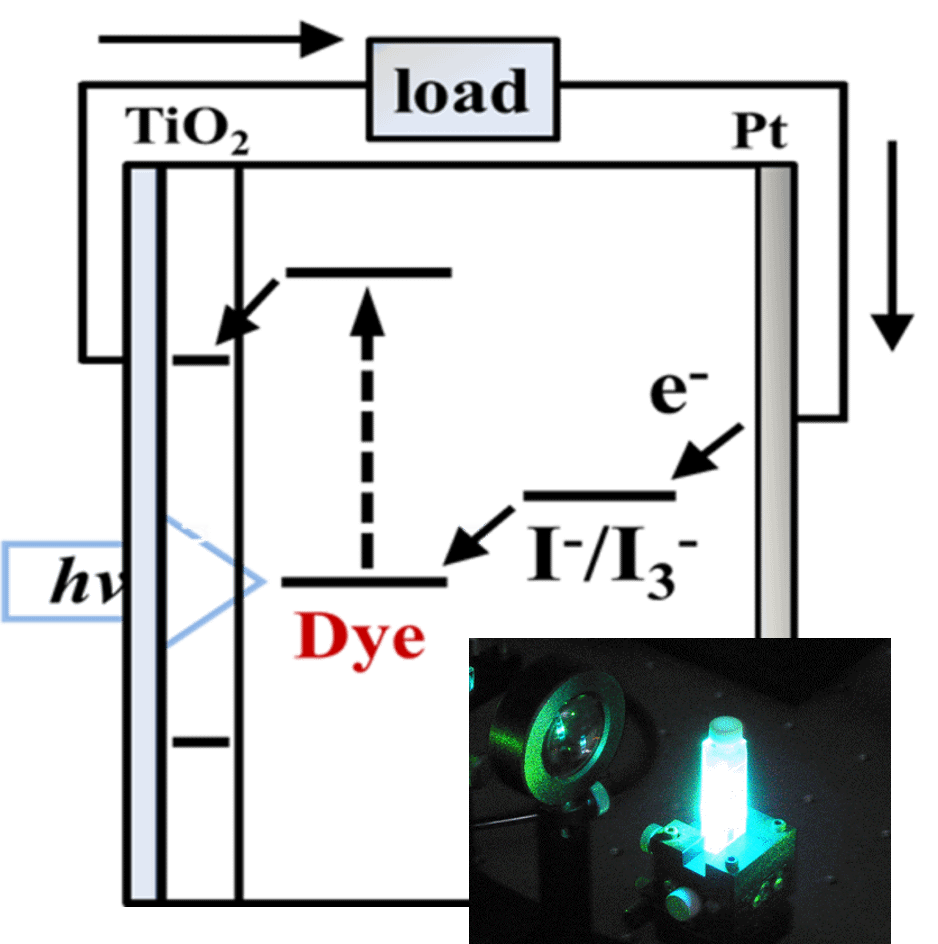
色素増感太陽電池(DSSC) は、色素が光を吸収して電子を半導体(多くは TiO₂)に渡し、
その電子を外部回路に流して発電する、薄膜タイプの太陽電池です。
特徴を一言でまとめると、
- カラフル・透明にもできる「デザイン性」
- シリコンより低温プロセス・安価材料による「低コスト性」
- 室内光など弱い光でも比較的高い「発電効率」
を併せ持つ太陽電池です。
2. DSSC の基本構造
代表的なレビュー論文では、DSSC の構造は次の4つに整理されています。
- 透明導電ガラス基板(FTO など)
光を通しながら電気を流す「窓兼配線」の役割。 - ナノ多孔質 TiO₂ 電極(アノード)+色素
スポンジ状の TiO₂ に、ルテニウム錯体や有機色素をびっしり吸着させ、
多くの光を吸収できるようにした部分。 - 電解質(レドックスシャトル)
I⁻/I₃⁻ や Cu(II/I) 錯体など、酸化還元反応で電子を仲介する溶液やゲル。
光で酸化された色素を「元の状態」に戻す役割を担います。 - カウンター電極(対極)
外部回路から戻ってきた電子を受け取り、電解質のレドックス反応を触媒する電極。
従来は Pt が主流ですが、炭素材料や金属化合物、導電性高分子など、
さまざまな代替材料が提案されています。
3. レビュー論文①:DSSC の「基礎と現状」
ある総説論文では、DSSC の基本と最新研究が次のように整理されています。
- DSSC の動作原理
光吸収 → 電子注入 → 電荷輸送 → 再結合 → 回路への出力 - 材料ごとの工夫
- フォトアノード:TiO₂ の粒径・膜厚・構造(ナノチューブ、ナノワイヤなど)
- 色素:Ru 錯体から金属フリー有機色素・ポルフィリン色素へ
- 電解質:ヨウ素系から固体・ゲル・新規レドックスシャトルへ
- 課題と方向性
- 変換効率(Ru系で 12% 前後)
- 長期安定性(溶媒蒸発・腐食・光劣化)
- 大面積化・量産プロセス・コスト
ポイントは、効率・安定性・環境負荷・コストのバランスをどうとるかが
今後の DSSC 実用化の鍵である、ということです。
4. レビュー論文②:カウンター電極の役割と新材料
別の総説は、DSSC の中でもカウンター電極(対極)だけに焦点を当てたレビューです。
- カウンター電極は「電解質の還元反応」を触媒する心臓部
- 触媒活性・電気伝導性・耐久性が、
- 開放電圧 Voc
- 短絡電流 Jsc
- フィルファクター FF
- 全体効率 η
に大きな影響を与えます。
レビューでは、以下のような材料が系統的に整理されています。
- 白金(Pt)金属・合金
- カーボン材料(カーボンブラック、グラフェン、カーボンナノチューブなど)
- 導電性高分子(PEDOT など)
- 金属硫化物・窒化物・カーバイドなどの無機材料
- それらを組み合わせたハイブリッド・ナノ複合体
「白金フリー」「低コスト」「透明・フレキシブル」といった条件を満たす
新しいカウンター電極の探索が、産業化の鍵とされています。
5. レビュー論文③:DSSC “strike back” – 応用と新展開
「Dye-sensitized solar cells strike back」というレビューでは、
DSSC が再び注目されている理由と今後の応用分野がまとめられています。
5-1. 応用ターゲット
- 室内光発電×IoT(Internet of Things)
室内の蛍光灯や LED 照明でも効率よく発電できるため、
電池交換不要のセンサー・ビーコン・小型デバイスの電源として有望です。 - 建材一体型・窓一体型太陽電池
カラフル・透明な DSSC モジュールを窓や外壁に組み込むことで、
デザイン性と発電を両立した建築が可能になります。 - 太陽燃料・光触媒
色素増感電極を用いた水分解や CO₂ 還元など、
「光で燃料を作る」デバイス(DSPEC)への展開も進んでいます。
5-2. 解析と設計ツールの進歩
このレビューでは、材料設計と並んで、
- 第一原理計算や分子軌道計算による励起状態解析
- フェムト秒〜マイクロ秒をカバーする時間分解分光(過渡吸収など)
が、高効率・高安定な DSSC 設計に不可欠なツールとして紹介されています。
6. 過渡吸収分光(TAS)で何が見えるか
レビュー群の共通したメッセージとして、
時間分解分光(Transient Absorption Spectroscopy, TAS) の重要性があります。
TAS では、超短パルスレーザーで色素を励起し、その後の吸収スペクトル変化を
- フェムト秒(10⁻¹⁵秒)
- ピコ秒(10⁻¹²秒)
- ナノ秒(10⁻⁹秒)
- マイクロ秒(10⁻⁶秒)〜ミリ秒
といった広い時間領域で追跡できます。
これにより、
- 電子注入の速さ(ピコ秒領域)
- 電子と正孔の再結合(ナノ秒〜マイクロ秒)
- 電解質による色素再生(マイクロ秒〜ミリ秒)
などを直接観測でき、どのプロセスがボトルネックかが見えてきます。
7. 高校生・一般向けまとめ
- DSSC は、「色素」と「ナノ構造半導体」を組み合わせた、
カラフルで柔軟な太陽電池です。 - レビュー論文では、材料開発・構造設計・解析技術のすべてが、
効率・安定性・コストの改善に向けて進化していることが示されています。 - 特に、過渡吸収分光をはじめとする時間分解測定は、
電子の動きをフェムト秒〜マイクロ秒のタイムスケールで「見る」ことを可能にし、
分子レベルでの設計指針を与えてくれます。 - 今後は、室内光発電、BIPV(建材一体型)、太陽燃料など、
「シリコンとは違うフィールド」で DSSC の真価が発揮されていくと期待されています。
English Version: DSSCs from Key Review Articles
1. Overview
This section summarizes the same content in English for international readers.
It is based only on the review papers listed in DSSC_TAS_Reviews.txt.
Dye-sensitized solar cells (DSSCs) are thin-film solar cells in which:
- Dye molecules absorb sunlight,
- Inject electrons into a nanostructured semiconductor (typically TiO₂),
- And a redox electrolyte regenerates the oxidized dye.
They are attractive because they can be:
- Colorful and semi-transparent, suitable for building integration,
- Low-cost, thanks to solution processing and abundant materials,
- Efficient under low or diffuse light, such as indoor illumination.
2. Basic device structure
According to the review articles, a typical DSSC consists of:
- Transparent conducting oxide (TCO) glass – e.g., FTO
- Nanoporous TiO₂ photoanode coated with dye molecules
- Redox electrolyte – I⁻/I₃⁻, cobalt or copper complexes, ionic liquids, gels, etc.
- Counter electrode – Pt, carbon materials, conducting polymers, metal compounds, or hybrids.
Each component can be engineered to improve the overall efficiency and stability.
3. Review 1: Fundamentals and current status
One comprehensive review summarizes:
- Device physics: light absorption, electron injection, transport, and recombination
- Design of photoanodes (nanoparticles, nanotubes, nanowires, hierarchical structures)
- Evolution of sensitizers: from ruthenium complexes to metal-free organic dyes and porphyrins
- Development of electrolytes and hole-transport materials
- Key challenges for commercialization: efficiency, long-term stability, large-area modules, and cost.
The main message is that no single parameter is enough;
future DSSCs must optimize performance, durability, and sustainability at the same time.
4. Review 2: Counter electrodes in DSSCs
A dedicated review focuses on counter electrodes:
- The counter electrode collects electrons from the external circuit and catalyzes the reduction of the redox couple.
- Its catalytic activity, conductivity, and stability directly affect Voc, Jsc, fill factor and lifetime.
The authors classify counter electrodes into several categories:
- Noble metals (Pt, alloys)
- Carbon-based materials (carbon black, CNTs, graphene, etc.)
- Conducting polymers (PEDOT, polyaniline, etc.)
- Transition-metal compounds (sulfides, nitrides, carbides, etc.)
- Hybrid and composite materials.
Developing Pt-free, low-cost, transparent, and flexible counter electrodes is identified as a crucial step toward practical DSSCs.
5. Review 3: “Dye-sensitized solar cells strike back”
Another high-impact review explains why DSSCs are regaining attention:
- DSSCs and dye-sensitized photoelectrochemical cells can target niche applications:
- Indoor photovoltaics powering IoT devices
- Colorful and transparent building-integrated PV
- Solar-fuel generation using dye-sensitized photoelectrodes.
- The field has benefited from:
- Advanced theoretical studies on excited states
- Time-resolved spectroscopies (including transient absorption)
- Novel dyes, redox mediators, and electrode architectures
- Increasing industrial interest and pilot products.
Overall, DSSCs are presented as versatile, tunable, and application-oriented solar energy converters.
6. Role of transient absorption spectroscopy (TAS)
Across these reviews, transient absorption spectroscopy (TAS) appears as a key technique:
- TAS follows the evolution of excited states and charge carriers
on time scales from femtoseconds to microseconds and beyond. - It reveals:
- How fast electron injection occurs
- How quickly charges recombine
- How effectively the redox mediator regenerates the dye.
By combining TAS with electronic-structure calculations and electrochemical measurements,
researchers can identify loss pathways and design strategies to suppress them.
7. Outlook
Review articles point to several promising directions:
- Indoor-light DSSCs for self-powered sensors and IoT devices
- Design-oriented modules integrated into windows and façades
- Dye-sensitized photoelectrochemical cells for solar fuels
- Sustainable material choices, replacing scarce or toxic elements with earth-abundant, eco-friendly alternatives.
DSSCs thus provide a rich playground where chemistry, physics, and materials science meet,
offering opportunities for both fundamental research and real-world applications.
8. References (review papers used for this page)
- Sharma, K.; Sharma, V.; Sharma, S. S., “Dye-Sensitized Solar Cells: Fundamentals and Current Status,” Nanoscale Research Letters, Review.
- Wu, J.; Lan, Z.; Lin, J.; Huang, M.; Huang, Y.; Fan, L.; Luo, G.; Lin, Y.; Xie, Y.; Wei, Y., “Counter electrodes in dye-sensitized solar cells,” Chemical Society Reviews, Review.
- Muñoz-García, A. B.; Benesperi, I.; Boschloo, G.; Concepcion, J. J.; Delcamp, J. H.; Gibson, E. A.; Meyer, G. J.; Pavone, M.; Pettersson, H.; Hagfeldt, A.; Freitag, M., “Dye-sensitized solar cells strike back,” Chemical Society Reviews 2017, 46, 5975–6023.