室内光DSSCとウェアラブル応用
Indoor-Light DSSCs and Wearable Applications
日本語版(Japanese)
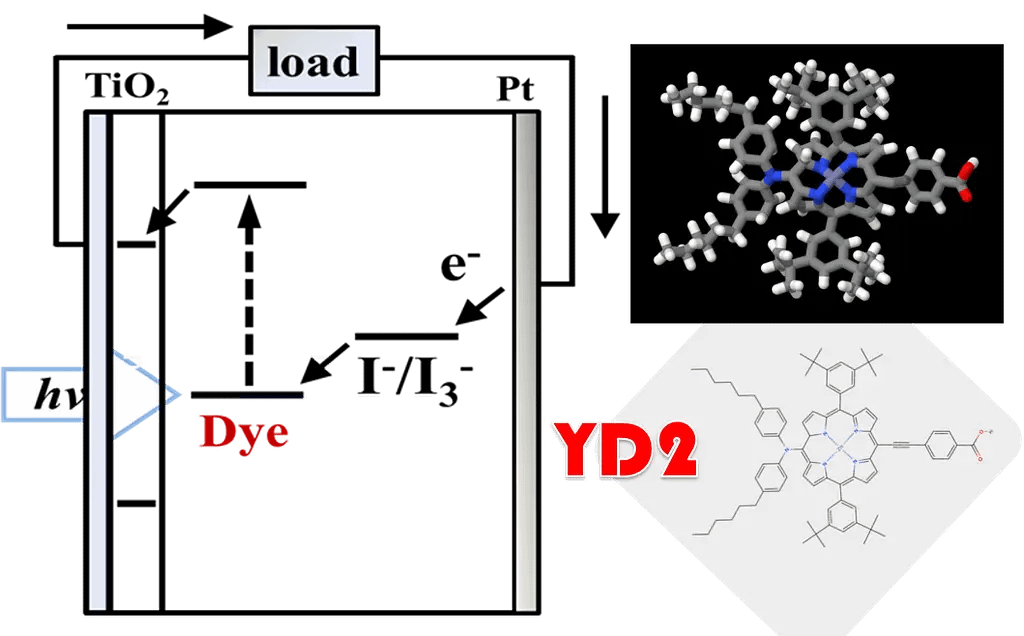
1. 色素増感太陽電池(DSSC)とは?
色素増感太陽電池(DSSC: Dye-Sensitized Solar Cell) は、
- ナノ多孔質の酸化チタン(TiO₂)電極
- 光を吸収する色素分子
- レドックス電解質
- 対向電極
からなる、有機・無機ハイブリッド型の太陽電池です。
色素が太陽光を吸収して励起される → 電子がTiO₂の伝導帯に注入される → 外部回路を通って戻る、
という流れで電流が流れます。
シリコン太陽電池に比べて、
- 材料や製造プロセスが比較的低コスト
- 色や透明度をデザインしやすい
- 曲げられる基板や布への応用も可能
といった特徴があり、IoT機器の電源や建物一体型太陽電池(BIPV)、ウェアラブルデバイスなど、
「用途と見た目を同時に設計できる太陽電池」として注目されています。fileciteturn19file0
2. 論文1:室内光で28.9%の変換効率を示すDSSC
Freitag et al., Nature Photonics, 2017
2-1. 研究のねらい
Freitag らは、
「屋内の蛍光灯やLEDの光だけで、
IoT機器を動かせる“室内光専用DSSC”を作ろう」
という発想から、室内環境での発電に特化したDSSCを開発しました。
2-2. デバイスの工夫
この研究では、
- 2種類の有機色素 D35 と XY1 を組み合わせた「共増感系」
- 銅錯体 Cu(II/I)(tmby)(tmby = 4,4′,6,6′-tetramethyl-2,2′-bipyridine)を
レドックスシャトルとして利用
することで、
- 開放電圧 Voc ≈ 1.1 V
- 400〜650 nm の可視域で、外部量子効率(EQE)が90%以上
を達成しています。
2-3. 室内光条件での驚異的な効率
蛍光灯(Osram 930、warm-white)の室内光条件下で、
- 200 lux では 15.6 µW/cm²
- 1000 lux では 88.5 µW/cm²
という電力密度が得られ、これを効率に換算すると
- PCE = 28.9 %
という非常に高い値になります。
ポイント:
太陽光(約100,000 lux)ではなく、数百〜数千 lux 程度の「室内照明」に合わせて
スペクトルと電圧を最適化しているため、
低照度環境での効率が最大化されていることが特徴です。
2-4. IoT・センサーへの応用
著者らは、このような室内光DSSCが、
- ワイヤレスセンサーネットワーク
- 小型IoT端末
- バッテリー消費を抑えたい携帯電子機器
などの独立電源として有望であることを示しています。
従来は「屋外で太陽電池、室内ではコンセント」と役割が分かれていましたが、
この研究は、“室内でも発電する” 第2の太陽電池の姿を提案していると言えます。
3. 論文2:DSSCを織り込んだ「自己給電テキスタイル」
Wen et al., Science Advances, 2016
3-1. ハイブリッド自己給電システムのコンセプト
Wen らは、繊維状デバイスを組み合わせた
「着るだけで発電・蓄電できる自己給電テキスタイル」
を提案しました。システム全体は3つの要素から構成されています。
- 繊維状DSSC(fiber-shaped dye-sensitized solar cells)
→ 屋外の太陽光を電気エネルギーに変換 - 繊維状トライボ発電機(triboelectric nanogenerators)
→ 歩行や腕振りなど、ランダムな体の動きから電気を取り出す - 繊維状スーパーキャパシタ(supercapacitors)
→ 得られた電気を化学エネルギーとして蓄える
これらすべてが糸のような形状になっており、布として織り込むことができます。fileciteturn19file0
3-2. 布そのものが「発電+蓄電デバイス」
この自己給電テキスタイルの特長は、
- 太陽光 → 繊維DSSCで発電
- 体の動き → 繊維TENGで発電
- どちらのエネルギーも → 繊維スーパーキャパシタに蓄電
という流れを一枚の布の中で完結できる点です。
実験では、こうした繊維デバイスを織り込んだ布から、
モバイル機器やウェアラブル端末を駆動できることが示されています。
つまり、服そのものが“電源”となる未来像を具体的に示した研究であり、
DSSCが「ウェアラブルエレクトロニクスの心臓部」として機能し得ることを示しています。
4. コラム:DSSCから生まれたペロブスカイト太陽電池
Park, Materials Today, 2015
Park によるレビュー論文は、有機無機ハロゲン化ペロブスカイトを用いた
ペロブスカイト太陽電池の発展をまとめたものです。fileciteturn19file0
ポイントは、
- ペロブスカイト太陽電池はもともとDSSC構造をベースにして登場したこと
- 2009年の初報では、TiO₂電極と液体系電解質を用いた構造で
PCE ≈ 3–4% 程度だったこと - 液体電解質の代わりに「固体ホール輸送層」を導入することで、
2012年には ≈ 10%、その後わずか数年で ≈ 18% まで効率が向上したこと - 一方で、安定性や鉛の環境影響など、解決すべき課題も多いこと
などです。
この論文は、
「DSSC のコンセプト(ナノ結晶TiO₂+色素/吸収層)」が
新しいペロブスカイト太陽電池技術へと発展していった
という歴史的な流れを整理しており、DSSC研究の広がりを理解する上で重要な位置づけにあります。
5. 日本語まとめ(HP向け)
- Freitag ら(2017):室内光スペクトルに最適化したDSSCにより、1000 lux の蛍光灯下で PCE 28.9%、
IoT/センサー向けの高効率室内発電デバイスを実証。 - Wen ら(2016):繊維状DSSC・トライボ発電機・スーパーキャパシタを一体化した
自己給電テキスタイルを提案し、「着るだけで発電・蓄電する服」のコンセプトを実験的に示した。 - Park(2015):DSSC構造を起源とするペロブスカイト太陽電池の急速な効率向上と、
材料物性・安定性・将来課題を総括し、次世代太陽電池技術としての可能性を論じた。
これらの研究は、DSSCが
「室内光電源」「ウェアラブル電源」「新しいペロブスカイト太陽電池への橋渡し」
として活躍できることを示しており、
今後のエネルギーハーベスティング社会におけるDSSCの役割を考える上で、
とても示唆に富んだ内容となっています。
English Version
1. DSSCs as flexible, designable solar cells
A dye-sensitized solar cell (DSSC) is a hybrid photovoltaic device composed of:
- a nanocrystalline TiO₂ photoanode,
- a molecular dye as a light harvester,
- a redox electrolyte, and
- a counter electrode.
Because the dye largely defines the absorption spectrum and color, DSSCs can be tailored to:
- specific illumination conditions (outdoor sunlight vs indoor lighting),
- desired optical appearance (colored, semi-transparent, or nearly colorless),
- and even non-flat form factors such as fibers and flexible substrates.
This makes DSSCs attractive power sources for indoor IoT devices, building-integrated photovoltaics (BIPV), and wearable electronics.fileciteturn19file0
2. Paper 1 – DSSCs with 28.9% PCE under ambient lighting
Freitag et al., Nature Photonics, 2017
2-1. Goal
Freitag and co-workers set out to design DSSCs that operate optimally under indoor lighting,
with the specific aim of powering low-consumption electronics such as wireless sensor nodes and IoT devices.
2-2. Device design
Their photosystem combines:
- two carefully engineered organic sensitizers, D35 and XY1, and
- a copper complex Cu(II/I)(tmby) (tmby = 4,4′,6,6′-tetramethyl-2,2′-bipyridine) as the redox shuttle.
With this combination, the device exhibits:
- an open-circuit photovoltage Voc ≈ 1.1 V, and
- an external quantum efficiency for photocurrent generation exceeding 90% between 400 and 650 nm.
2-3. Exceptional efficiency at low illuminance
Under a warm-white fluorescent light source (Osram 930), they obtained:
- 15.6 µW cm⁻² at 200 lux, and
- 88.5 µW cm⁻² at 1000 lux,
corresponding to a power conversion efficiency of 28.9% at 1000 lux.
The key idea is that the device is spectrally and electrically optimized for indoor lighting,
rather than for standard 1-sun outdoor conditions.
2-4. Relevance for IoT
Such indoor-light DSSCs can act as:
- autonomous power sources for wireless sensor networks,
- energy harvesters for low-power IoT electronics, and
- replacements or supplements for conventional batteries in portable devices.
3. Paper 2 – Self-powered textile integrating DSSCs, nanogenerators, and supercapacitors
Wen et al., Science Advances, 2016
3-1. Concept of a hybrid self-charging power textile
Wen and co-workers proposed a hybrid self-charging power textile system that:
- harvests outdoor sunlight using fiber-shaped DSSCs,
- harvests random body motion using fiber-shaped triboelectric nanogenerators (TENGs), and
- stores the harvested energy in fiber-shaped supercapacitors.fileciteturn19file0
All components share a fiber-like geometry, so the entire system can be woven into fabrics.
3-2. Clothing that generates and stores energy
In their demonstrations, the hybrid textile:
- continuously converts mechanical and solar energy into electricity, and
- stores it directly within the textile itself.
This approach shows that smart clothes can, in principle:
- power mobile or wearable electronics,
- operate sustainably without frequent battery replacement,
- and integrate energy harvesting into everyday garments.
Here, DSSCs play the role of solar “threads” that collaborate with mechanical energy harvesters and storage fibers.
4. Paper 3 – Perovskite solar cells emerging from DSSC concepts
Park, Materials Today, 2015
Park’s review article traces the evolution of organometal halide perovskite solar cells,
a rapidly emerging photovoltaic technology that originated from DSSC architectures.fileciteturn19file0
Key points include:
- In 2009, perovskite absorbers deposited on TiO₂ in a liquid-electrolyte DSSC-like configuration
delivered PCEs of about 3–4%. - By replacing the liquid electrolyte with a solid-state hole conductor and optimizing interfaces,
device efficiencies reached ~10% by 2012, and then ~18% within just two years. - The review discusses:
- optoelectronic properties of perovskite materials,
- device structures and charge-transport mechanisms, and
- major challenges such as long-term stability and lead toxicity.
This article illustrates how DSSC-inspired concepts paved the way for perovskite solar cells,
linking classical DSSC research to one of the most active frontiers in photovoltaics.
5. Summary (English)
From these three classic papers, we can draw a coherent picture:
- Freitag et al. demonstrate that DSSCs can reach ~29% PCE under indoor fluorescent lighting,
making them strong candidates for powering IoT and sensor devices directly from ambient light. - Wen et al. show that fiber-shaped DSSCs can be integrated into textiles together with nanogenerators and supercapacitors,
realizing a self-powered fabric capable of driving wearable electronics. - Park reviews the rapid rise of perovskite solar cells, which grew out of DSSC architectures and
have quickly achieved high efficiencies, while still facing important materials and stability challenges.
Taken together, these works highlight the versatility of DSSCs:
from high-efficiency indoor power sources,
to building-integrated and wearable applications,
and even as a conceptual bridge to next-generation perovskite photovoltaics.
参考文献 / References
- Freitag, M.; Teuscher, J.; Saygili, Y.; Zhang, X.; Giordano, F.; Liska, P.; Hua, J.; Zakeeruddin, S. M.; Moser, J.-E.; Grätzel, M.; Hagfeldt, A.
“Dye-sensitized solar cells for efficient power generation under ambient lighting.”
Nature Photonics 2017, 11 (6), 372–378. DOI: 10.1038/nphoton.2017.60. - Wen, Z.; Yeh, M.-H.; Guo, H.; Wang, J.; Zi, Y.; Xu, W.; Deng, J.; Zhu, L.; Wang, X.; Hu, C.; Zhu, L.; Sun, X.; Wang, Z. L.
“Self-powered textile for wearable electronics by hybridizing fiber-shaped nanogenerators, solar cells, and supercapacitors.”
Science Advances 2016, 2 (10), e1600097. DOI: 10.1126/sciadv.1600097. - Park, N.-G.
“Perovskite solar cells: an emerging photovoltaic technology.”
Materials Today 2015, 18 (2), 65–72. DOI: 10.1016/j.mattod.2014.07.007.