次世代DSSCフロンティア
高性能カウンター電極・新機能・長期安定性
1. 色素増感太陽電池(DSSC)とは?
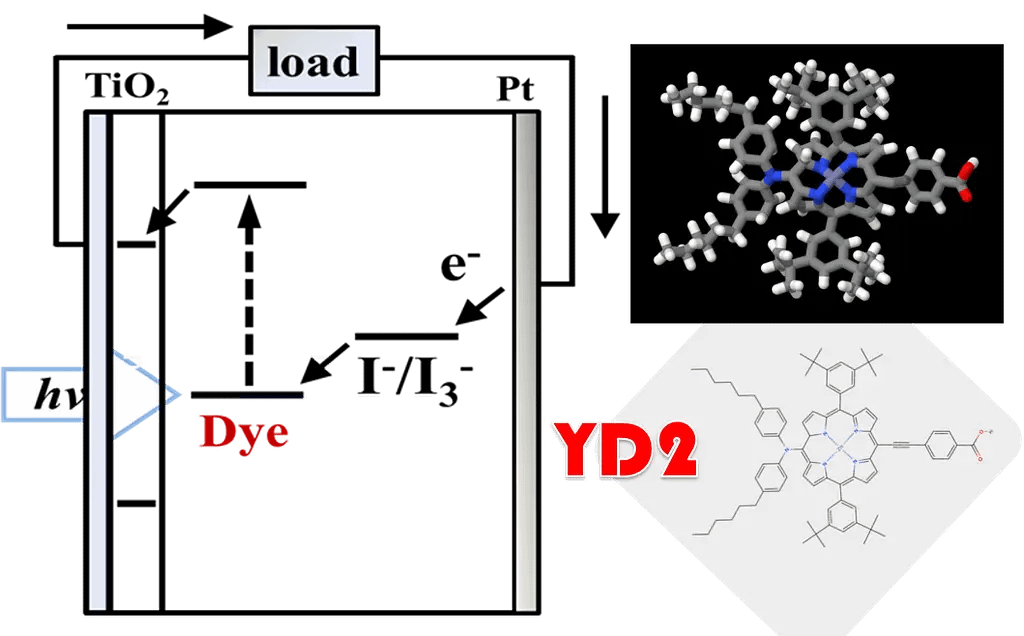
色素増感太陽電池(Dye-Sensitized Solar Cell, DSSC)は、
「色素が光を吸収して電子を流す」タイプの薄膜太陽電池です。
基本構成は次の4つです。
- 多孔質TiO₂電極:白いスポンジ状の酸化物。電子の通り道。
- 色素分子:光を吸収して電子を励起する「色の主役」。
- 電解質(ヨウ素/ヨウ化物や銅錯体など):電子を失った色素に電子を戻す役割。
- カウンター電極:電解質側にあり、酸化還元反応を助ける触媒電極。
光が当たると、
色素が光を吸収 → 電子がTiO₂へ注入 → 外部回路へ流れる →
カウンター電極で電解質が還元/酸化 → 電解質が色素に電子を戻す
というループがまわり、電力として取り出すことができます。
2. 薄膜太陽電池の中でのDSSCの位置づけ
Intal & Ebong, Renewable & Sustainable Energy Reviews, 2026
Intal と Ebong は、薄膜太陽電池全体の動向と今後の方向性を整理しています。
この総説では、
- 既に商業的に成熟した薄膜太陽電池
- アモルファスシリコン(a-Si)
- カドミウムテルル(CdTe)
- CIGS(Cu(In,Ga)Se₂)
- 新しい薄膜技術
- ペロブスカイト太陽電池
- CZTS(Cu₂ZnSnS₄)
- 量子ドット太陽電池
- 有機薄膜太陽電池
- DSSC(色素増感太陽電池)
がまとめて議論されています。
さらに、効率だけでなく、
- 長期安定性や劣化
- 温度係数
- 量産スケールと技術成熟度
- 発電コスト(LCOE)
といった観点から比較が行われています。
たとえば、
- CdTe と CIGS は 23% 程度の研究室効率とマルチGW規模の生産を両立していること、
- ペロブスカイトは 26.7% の単接合変換効率に到達し、シリコンとのタンデム化が進んでいること、
- 代表的な太陽電池の発電コストが 数十ドル/MWh レベルまで低下していること
などが紹介されており、DSSCは
「材料使用量が少なく、軽量・フレキシブルな薄膜太陽電池の一員」
として位置づけられています。
3. DSSC構造を利用した高感度キラルセンサー
Wang et al., Advanced Functional Materials, 2025
Wang らは、DSSCの仕組みを光電気化学センサーに応用し、
アミノ酸(DOPA)の左右の違い(エナンチオマー)を見分ける手法を提案しています。
3-1. しくみのイメージ
- キラルTiO₂電極
- L-DOPA と D-DOPA を選択的に認識できる「手の形」を持つ電極を用意します。
- Ptナノクラスター(PtNC)の固定
- DOPA のカテコール基とTiO₂表面を利用して、Ptナノ粒子を電極上に導入します。
- N719色素をアンテナとして導入
- PtNC を含む電極に Ru系色素 N719 を吸着させ、光を効率よく吸収させます。
- ヨウ素/ヨウ化物レドックス電解質
- I⁻/I₃⁻ 電解質によって、励起色素の再生を高速に行います。
これにより、光を当てたときの光電流量が、
L-DOPA と D-DOPA の量によって変化し、エナンチオマーの区別が可能になります。
3-2. 一般向けのポイント
- DSSCの「光で電子を流す仕組み」をそのままセンサーに転用した例。
- 「どれくらい光電流が流れるか」が、分析対象分子の情報になる。
- 太陽電池技術が、バイオ・医療分析にも広がっていることを示す研究です。
4. 室内光にも強い高性能カウンター電極
Yang et al., Advanced Functional Materials, 2025
Yang らは、DSSC などの太陽電池において重要な役割を担う
カウンター電極(対極)触媒を高度化する研究を行っています。
4-1. Fe₃Cを利用したヘテロ構造触媒
- BCN@Fe₃C
- PCN@Fe₃C
とよばれるヘテロ接合触媒を設計し、
金属状態の Fe₃C と周囲の窒素ドープカーボン(BCN, PCN)の界面に
内蔵電場(built-in electric field)をつくっています。
この内蔵電場と、プロトン結合した電子移動(proton-coupled electron transfer)を利用することで、
- I₃⁻/I⁻ レドックス反応(ヨウ素系電解質)
- Cu(II/I) レドックス反応(銅系電解質)
の電子移動と拡散を大幅に加速しています。
4-2. 太陽光と室内光の両方で高い性能
- 標準AM1.5G太陽光下では、N719–I₃⁻/I⁻系DSSCで
変換効率 9.03% を達成。 - 500 lux の室内照明下でも、開放電圧 0.76 V、
変換効率 18.99% を維持。
つまり、「屋外でも室内でもよく働くカウンター電極」を実現しており、
室内IoT電源としてのDSSC実用化に向けた重要なステップとなっています。
5. 二重内蔵電場をもつBi系ヘテロ構造電極
Xu et al., Advanced Functional Materials, 2025
Xu らは、ビスマス系酸化物とカルコゲナイドを組み合わせた
多次元ヘテロ接合触媒(1D/3D/2D構造)を設計し、DSSCと水素発生反応(HER)の両方で
高い性能を示しています。
5-1. 1D/3D/2D 階層構造
- 1次元ナノワイヤ:Bi₂Se₃
- 3次元「アジサイ型」酸化物:酸素欠損を導入した BiO₂₋ₓ (BO)
- 2次元超薄層:Bi₂MoO₆ (BMO)
これらを穏やかなセレン化プロセスで組み合わせ、
BS/BO/BMO ヘテロ接合触媒を形成しています。
5-2. 二重内蔵電場と高い活性
この構造により、
- 異なる界面で 2つの内蔵電場(dual built-in electric fields) が形成
- 酸素空孔とあわせて、電荷移動とプロトン拡散が大幅に改善
- HER(10 mA/cm²)の過電圧が 約94 mV と低く、
- これをカウンター電極に用いたDSSCでは、
変換効率 8.87% を達成
しています。
カウンター電極を「単なる白金の代わり」ではなく、
「界面で積極的に電荷を引っ張る高機能触媒」として設計した例と言えます。
6. N719 DSSCの劣化メカニズムの解明
Adhikari et al., Advanced Materials Interfaces, 2025
Adhikari らは、ルテニウム色素 N719 を用いた DSSC の
長期動作中の劣化メカニズムを、表面分析の観点から詳しく調べています。
6-1. 何が劣化を起こすのか?
- 暗所ではセルは比較的安定だが、光照射下で性能が低下する。
- XPS, UPS, NICISS などの表面感受性の高い手法により、
電極界面の元素組成と化学状態の変化を解析。 - FTIR と UV-Vis DRS により、色素と電解質の相互作用や
色素構造の変化を評価。
その結果、
- 電解質中の Iₓ⁻(I⁻ や I₃⁻)種が色素層内部に浸み込むこと、
- それによって色素分子の構造が変化し、
光吸収能が低下 → 光電子生成量が減少すること
が、性能劣化の主因であると結論づけています。
6-2. 一般向けのイメージ
「電子のやり取りを助けるヨウ素が、
長く動かすと色素の“服”の中に入り込みすぎて、
色素そのものを傷めてしまう」
というイメージです。
このような詳細な界面解析は、
- 新しい電解質系(例えば銅錯体系)の設計
- 色素や表面保護層の耐久性向上
にとって重要な指針を与えています。
7. 高校生・一般向けまとめ
- DSSCは、「色で発電する薄膜太陽電池」であり、
軽くて曲げやすく、室内光にも強いことから、
IoTデバイスやウェアラブルへの応用が期待されています。 - 最新の研究では、
- DSSCの構造を活かした高感度センサー、
- 内蔵電場を賢く利用した高性能カウンター電極、
- 長期動作中の劣化メカニズムの可視化
など、「電極界面の設計」と「耐久性の理解」が大きなテーマとなっています。 - こうしたフロンティア研究は、将来の
“電池いらず”の小型機器や環境にやさしいエネルギーシステムを支える基盤技術になると期待されています。
English Version
Frontiers of DSSCs: Advanced Counter Electrodes, New Functions, and Stability
1. DSSCs in the landscape of thin-film photovoltaics
Intal & Ebong, Renewable & Sustainable Energy Reviews, 2026
Intal and Ebong review thin-film solar photovoltaics and discuss both established and emerging technologies.
- Mature thin films: a-Si, CdTe, CIGS
- Emerging thin films: perovskites, CZTS, quantum dots, organic photovoltaics, and DSSCs
- III–V thin films (GaAs, etc.) set the efficiency roadmap, especially for space applications.
They compare these technologies in terms of:
- power conversion efficiency and field stability,
- degradation and temperature coefficients,
- scalability and technology readiness,
- and levelized cost of electricity (LCOE).
DSSCs appear in this context as lightweight, flexible, and material-efficient thin-film cells,
suited for niche and integrated applications rather than large solar farms.
2. DSSC-inspired photoelectrochemical sensing
Wang et al., Advanced Functional Materials, 2025
Wang and co-workers transfer the DSSC concept into a photoelectrochemical (PEC) sensing platform
for enantiomer discrimination of 3,4-dihydroxyphenylalanine (DOPA).
Key ideas:
- A chiral TiO₂ photoelectrode selectively recognizes L- and D-DOPA.
- Pt nanoclusters are anchored via catechol coordination and serve as cocatalysts.
- N719 dye acts as a light-harvesting antenna on the electrode.
- An I⁻/I₃⁻ redox couple in a non-aqueous electrolyte rapidly regenerates oxidized N719.
The photocurrent becomes directly correlated with the amount of L- or D-DOPA,
enabling enantioselective and sensitive detection.
3. Advanced counter electrodes for sunlight and indoor lighting
Yang et al., Advanced Functional Materials, 2025
Yang and co-workers design BCN@Fe₃C and PCN@Fe₃C heterojunction catalysts
for use as counter electrodes in DSSCs.
- Metallic Fe₃C combined with N-doped carbon forms a Schottky-type heterojunction.
- This junction generates a localized built-in electric field.
- A proton-coupled electron transport channel is established,
which accelerates triiodide reduction (IRR) and copper redox reactions (CRR).
Performance:
- Under AM 1.5G sunlight, a DSSC with BCN@Fe₃C and N719/I₃⁻/I⁻ reaches 9.03% PCE.
- Under 500 lux indoor lighting, the device maintains Voc ≈ 0.76 V and 18.99% PCE.
This demonstrates that well-designed counter electrodes can make DSSCs viable
for both outdoor and indoor photovoltaic applications, including IoT devices.
4. Dual built-in electric fields in multidimensional Bi-based heterojunctions
Xu et al., Advanced Functional Materials, 2025
Xu and co-workers synthesize a 1D/3D/2D Bi-based heterojunction catalyst (BS/BO/BMO):
- 1D Bi₂Se₃ nanowires (BS)
- 3D hydrangea-like BiO₂₋ₓ with oxygen vacancies (BO)
- 2D ultrathin Bi₂MoO₆ nanosheets (BMO)
Using a mild selenization strategy, they construct a catalyst with dual built-in electric fields (BIEFs).
Highlights:
- The dual BIEFs and oxygen vacancies increase the number of active sites.
- Charge transfer and proton diffusion between electrode and electrolyte are greatly enhanced.
- For the hydrogen evolution reaction (HER), the overpotential at 10 mA cm⁻² is only ≈94 mV.
- A DSSC assembled with this catalyst as a counter electrode shows 8.87% PCE.
This work illustrates how multidimensional heterojunction design can boost both photovoltaic
and electrocatalytic performance.
5. Understanding aging at the N719/TiO₂ interface
Adhikari et al., Advanced Materials Interfaces, 2025
Adhikari and co-workers study degradation processes in N719-based DSSCs.
Using surface-sensitive techniques (XPS, UPS, NICISS) and FTIR/UV–Vis DRS, they reveal that:
- The cells remain stable in the dark but degrade under light exposure.
- Iₓ⁻ species (I⁻ or I₃⁻) penetrate into the dye layer at the TiO₂ interface.
- This penetration induces structural changes in the N719 dye,
reducing its light-harvesting ability and thus the photoelectron generation.
In simple terms:
The very electrolyte that helps dyes regenerate can, over time,
infiltrate and damage the dye layer, slowly reducing device performance.
These insights provide important guidance for:
- designing more stable electrolytes and interfacial protection layers,
- and improving the long-term durability of DSSCs.
6. Key takeaways (English)
- DSSCs remain an important member of the thin-film PV family,
especially where lightweight, flexibility, and design freedom are needed. - Frontier studies focus on:
- DSSC-inspired PEC sensors for chiral analysis,
- engineered counter electrodes with built-in electric fields and proton-coupled transport,
- and detailed interfacial degradation mechanisms at the dye/TiO₂/electrolyte interface.
- Together, these works point toward DSSCs as enabling technologies for
indoor photovoltaics, smart sensors, and durable, integrated energy systems.
References
- Intal, D.; Ebong, A. U. Thin-film solar photovoltaics: Trends and future directions. Renewable & Sustainable Energy Reviews 2026, 226, 116464. DOI: 10.1016/j.rser.2025.116464.
- Wang, S. J.; Zhu, J. H.; Zheng, Y. L.; Gao, Z. D.; Song, Y. Y. Target-Induced Dye-Sensitized Solar Cell Design on Photoelectrochemical Anode for Improved Enantiomer Discrimination. Advanced Functional Materials 2025, Early Access. DOI: 10.1002/adfm.202523978.
- Yang, G. P.; Yun, S. N.; Pang, Q.; Wang, R. M.; Yang, T. X.; Dang, J. E.; Xu, X. R.; Wang, Z. G.; Yang, H. J.; Feng, R.; Guo, W. Q. Building Fast Proton-Coupled Electron Transport Paths for Accelerating Reduction Reactions in Solar Cells Under Sunlight and Indoor Lighting: Modulating Energy Band Structure and Surface Reactions. Advanced Functional Materials 2025, 12. DOI: 10.1002/adfm.202510467.
- Xu, X. R.; Yun, S. N.; Yang, G. P.; Yang, T. X.; Pang, Q.; Wang, Z. G.; Yang, H. J.; Feng, R.; Guo, W. Q.; Luo, C. W.; Chen, H. Y.; Zhang, T. Y. Oxygen Vacancy-Mediated 3D/2D Hydrange-Type Bismuth Oxides with 1D Bi2Se3 Nanowires Confined via a Mild Selenization Strategy to Trigger Dual Built-in Electric Fields for Accelerated Energy Conversion. Advanced Functional Materials 2025, 35 (42). DOI: 10.1002/adfm.202504278.
- Adhikari, S. G.; Gascooke, J. R.; Kloo, L.; Andersson, G. G. Unveiling the Aging Effect at the Interface of N719 Dye-Sensitized Solar Cells. Advanced Materials Interfaces 2025, 12 (14), 2400746. DOI: 10.1002/admi.202400746.