DE20260207:ジアリールエテン(Diarylethene, DTE)関連論文のやさしい解説(HP用 / JP+EN)
作成日: 2026-02-07
対象: 添付ファイル DE20260207.txt に含まれる論文のみ(全 1 件) fileciteturn20file0
注)今回の添付ファイルには 1本のみ収録されていました。そのため、インパクトファクター順の「上位3本」の選定は行わず、収録論文をそのまま掲載しています。
参考:本論文の掲載誌 Dyes and Pigments の 2024 Journal Impact Factor = 4.2(公開されているJCR系指標に基づく)。
日本語版(HP向け)
どんなテーマ?
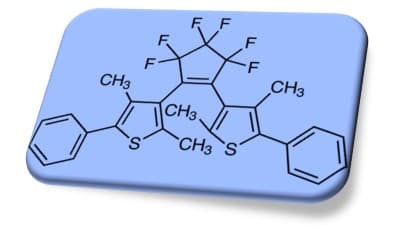
ジアリールエテン(DTE)は、光で“開環⇄閉環”が切り替わる代表的なフォトクロミック分子です。
この性質を蛍光材料に組み込むと、光で発光色や強度を制御できます。本論文は、光刺激と温度刺激を別々に使って色を切り替え、高セキュリティ暗号化(偽造防止)に応用する材料設計を提案しています。
対象論文
Stimuli-responsive multicolor fluorescent bilayer film for high-security encryption based on FRET and phase-change modulated emission
- 掲載誌: DYES AND PIGMENTS(JIF 2024: 4.2)
- 年: 2026
- 著者: Cong, X; Ou, KD; Dong, XL; Liao, YG; Yang, YJ; Wang, H
- DOI: 10.1016/j.dyepig.2026.113573
やさしい解説(Abstractの要点を整理:本文の転載なし)
– 複数の刺激(光と温度)で“別々に”色を切り替えられる蛍光材料は、高度な偽造防止(暗号化)に役立ちますが、設計が難しい点が課題です。
– 本研究は、二層(bilayer)構造のフィルムにして、上層を“光応答”、下層を“熱応答”として役割分担させ、干渉しにくい設計を採用しています。
– 上層は、Eu³⁺錯体とジアリールエテン(DTE:フォトクロミック分子)などを組み合わせ、FRET(蛍光共鳴エネルギー移動)を利用して、UV/可視光で赤色発光を可逆にON/OFFします。
– 下層は、アントラセン誘導体(BPEA)と相変化材料(PCM)を分散し、PCMの固体⇄液体転移に伴う凝集状態の変化で、緑色発光を鋭く切り替えます。
– 二層の重ね合わせにより、光刺激×熱刺激の組合せで4種類の発光色を作り分け、素早い応答と可逆性を示しました。
– さらに、発光色をRGB量子化して“4進コード”に変換する手法を提案し、情報量と安全性を高める暗号化材料としての可能性を示しています。
English version (for website)
What is this topic about?
Diarylethene (DTE) is a classic photochromic molecule that reversibly switches between open/closed forms under light.
By integrating DTE into fluorescent systems, emission can be controlled photochemically. This paper proposes a bilayer design that independently responds to light and heat, enabling high‑security encryption / anti‑counterfeiting.
Paper in the attached file
{row.get(‘TI’,”).strip()}
- Journal: {row.get(‘SO’,”).strip()} (2024 JIF: {jif_2024})
- Year: {row.get(‘PY’,”).strip()}
- Authors: {row.get(‘AU’,”).strip()}
- DOI: {row.get(‘DI’,”).strip()})})
Plain-language bullets (paraphrased from the abstract; no verbatim text)
– Fluorescent materials that can switch colors orthogonally under multiple stimuli (e.g., light and heat) are valuable for anti‑counterfeiting, but are challenging to design.
– This study uses a bilayer film where the top layer is photo‑responsive and the bottom layer is thermo‑responsive, reducing cross‑interference by spatial separation.
– The top layer combines a Eu³⁺ complex with a diarylethene (DTE) photochromic unit and exploits FRET to reversibly switch red emission under UV/visible light.
– The bottom layer disperses an anthracene derivative (BPEA) with a phase‑change material (PCM); the PCM solid–liquid transition controls aggregation and sharply modulates green emission.
– By overlaying the two independently addressable layers, the film delivers four distinct emission colors through combinations of photo and thermal stimuli, with fast and reversible responses.
– It further introduces a Python‑assisted RGB quantization approach to convert dynamic colors into quaternary codes, improving encryption capacity and security.
参考文献 / Reference(ファイル内)
- {ref}