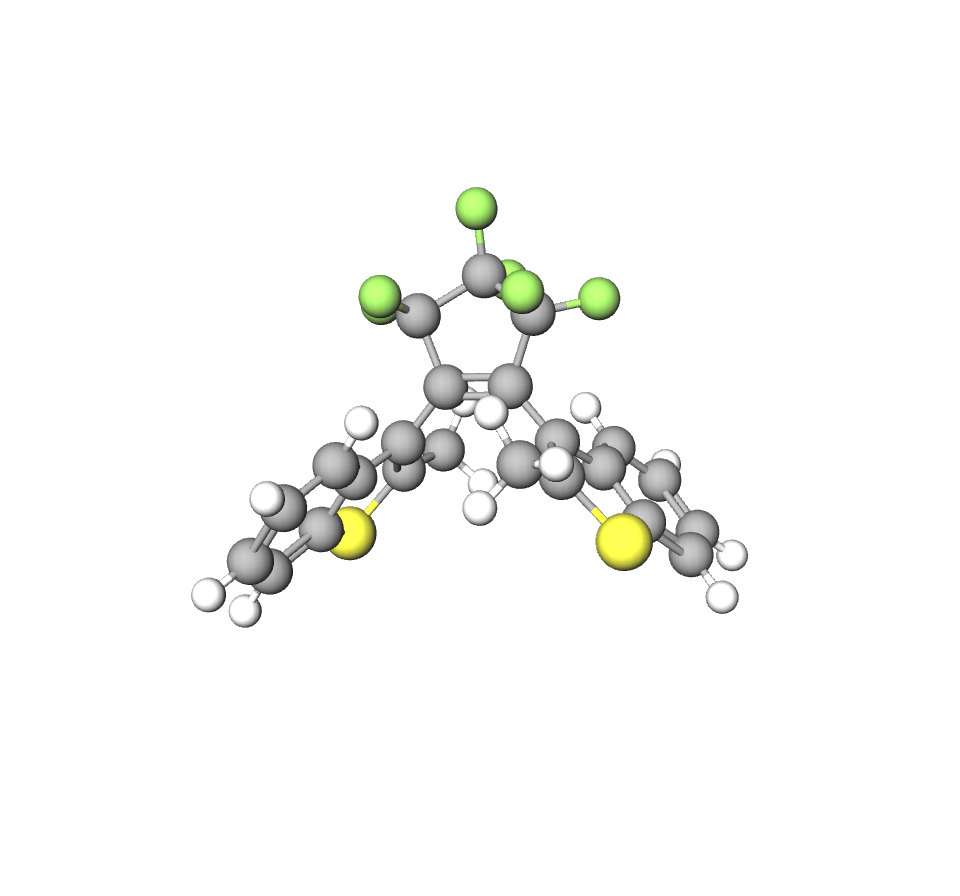
0) DEsとは?(ざっくり) / What is DEs?
日本語
- DEs は、主にジアリールエテン(Diarylethene, DAE)系の光で状態が切り替わる分子(フォトスイッチ)を中心とした研究トピックです。
- 光で色・蛍光・屈折率などが変わるため、光メモリ、センサー、フォトニクス(光回路)、分離膜の制御などに応用が広がります。
English
- DEs here refers to research around diarylethene (DAE)-type photoswitches and related photoresponsive molecules.
- Light-triggered changes (color/fluorescence/refractive index, etc.) enable applications in optical memory, sensing, photonics, and tunable separation interfaces.
1) 選定した上位3本
- NATURE COMMUNICATIONS(JIF 15.7)— Visible-light-triggered exclusive bistable E/Z photoswitching based on sterically frustrated dicyanostilbene derivatives — DOI: 10.1038/s41467-026-69516-8
- ADVANCED OPTICAL MATERIALS(JIF 7.2)— Photochromic Diarylethene-doped SU-8 for Rewritable Optics and Integrated Photonic Switching — DOI: 10.1002/adom.202503814
- ADVANCED MATERIALS INTERFACES(JIF 4.4)— Light-Programmable Interfaces: From Molecular Photoswitching to Adaptive Membrane Separations — DOI: 10.1002/admi.70471
2) 解説(日本語)
1. Visible-light-triggered exclusive bistable E/Z photoswitching based on sterically frustrated dicyanostilbene derivatives
- 掲載誌:NATURE COMMUNICATIONS(JIF 15.7)
- 年:2026
- DOI:10.1038/s41467-026-69516-8
ポイント(わかりやすい箇条書き) - 目的:可視光で確実に切り替わり、しかも“戻りにくい/戻りやすい”を狙って設計できるフォトスイッチ分子(E/Z切替)を実現する。
- 仕組み:立体障害(分子の“混み合い”)を意図的に与えて、望まない副反応(別の環化など)を抑えつつ、E/Zの光異性化だけを起こすようにする。
- 特徴:熱で勝手に戻るまでの時間(熱半減期)が非常に長い=“状態を長期保持できる”設計を示す。
- 応用像:光で情報を切り替える・記録する・暗号化するなど、フォトニクス/スマート材料への基盤になる。
HP向け一文(例) - 「可視光で“確実に切り替わり、長く保つ”分子スイッチ——スマート材料の基盤へ。」
2. Photochromic Diarylethene-doped SU-8 for Rewritable Optics and Integrated Photonic Switching
- 掲載誌:ADVANCED OPTICAL MATERIALS(JIF 7.2)
- 年:2026
- DOI:10.1002/adom.202503814
ポイント(わかりやすい箇条書き) - 目的:光で色や光の通り方が変わる分子(ジアリールエテン)を、微細加工(リソグラフィ)で作るフォトニック素子に組み込む。
- 方法:SU-8(代表的フォトレジスト)にジアリールエテンを混ぜ、薄膜・導波路として加工できる“CMOS互換”の材料系を構築。
- できること:QRコードや回折格子などを“書いて消せる”光学パターンとして作り、導波路の減衰量も光で大きく可変にする。
- 意味:光で再設定できるフォトニクス(光回路)やセキュリティ印刷などに繋がる材料プラットフォーム。
HP向け一文(例) - 「書いて消せる光学パターンと光回路スイッチ——DAE×SU-8で実装可能に。」
3. Light-Programmable Interfaces: From Molecular Photoswitching to Adaptive Membrane Separations
- 掲載誌:ADVANCED MATERIALS INTERFACES(JIF 4.4)
- 年:2026
- DOI:10.1002/admi.70471
ポイント(わかりやすい箇条書き) - 内容:分子レベルのフォトスイッチ(アゾベンゼン、スピロピラン、ジアリールエテン等)を“界面設計”に使い、膜分離の性能を光で調整する研究動向を整理。
- 狙い:濡れ性・表面電荷・透過性を光で可逆に変え、ファウリング(汚れ付着)を抑えつつ選択性を上げる。
- 設計手法:共有結合固定、超分子組立、混合マトリクス化、フォトグラフトなど、材料への入れ方を比較。
- 課題:光の届きにくさ(厚い膜・濁った媒体)、繰返し耐久性(疲労)、スケールアップなどを指摘。
HP向け一文(例) - 「光で界面を設計し、膜分離を“プログラム”する——フォトスイッチ材料の最新俯瞰。」
3) English Version (Website-ready)
1. Visible-light-triggered exclusive bistable E/Z photoswitching based on sterically frustrated dicyanostilbene derivatives
- Journal: NATURE COMMUNICATIONS (JIF 15.7)
- Year: 2026
- DOI: 10.1038/s41467-026-69516-8
Key points (rephrased; no abstract text copied) - Goal: achieve visible-light-driven E/Z photoswitching with high pathway selectivity and long-lived bistable states.
- Mechanism: use steric frustration to suppress competing photoreactions while enabling efficient E/Z isomerization.
- Key feature: extremely long thermal stability (very slow thermal back-isomerization), supporting long-term state retention.
- Why it matters: enables practical switching/recording concepts for smart materials and photonic information handling.
2. Photochromic Diarylethene-doped SU-8 for Rewritable Optics and Integrated Photonic Switching
- Journal: ADVANCED OPTICAL MATERIALS (JIF 7.2)
- Year: 2026
- DOI: 10.1002/adom.202503814
Key points (rephrased; no abstract text copied) - Goal: integrate diarylethene photochromic switching into lithographically defined photonic structures.
- Approach: dope SU-8 photoresist with diarylethene to form thin films and waveguides compatible with common fabrication workflows.
- Demonstrations: rewritable optical patterns (e.g., QR codes, gratings) and light-tunable attenuation in waveguide devices.
- Why it matters: a materials platform for reconfigurable integrated photonics and optical security/encoding.
3. Light-Programmable Interfaces: From Molecular Photoswitching to Adaptive Membrane Separations
- Journal: ADVANCED MATERIALS INTERFACES (JIF 4.4)
- Year: 2026
- DOI: 10.1002/admi.70471
Key points (rephrased; no abstract text copied) - Scope: review how molecular photoswitches are used to engineer light-programmable interfaces for membrane separations.
- Concept: reversibly tune wettability, surface charge, and permeability to improve selectivity and mitigate fouling.
- Design routes: compare covalent grafting, supramolecular assembly, mixed-matrix integration, and photografting strategies.
- Challenges: light penetration, chromophore fatigue, and scalable fabrication are highlighted as key hurdles.
4) 参考文献 / References
- Bi, HQ; Zhao, YY; Deng, SY; Zhang, XW; Wei, PF. Visible-light-triggered exclusive bistable E/Z photoswitching based on sterically frustrated dicyanostilbene derivatives. NATURE COMMUNICATIONS (2026). DOI: 10.1038/s41467-026-69516-8.
- Chang, Y; Chen, HH; Wang, CT. Photochromic Diarylethene-doped SU-8 for Rewritable Optics and Integrated Photonic Switching. ADVANCED OPTICAL MATERIALS (2026). DOI: 10.1002/adom.202503814.
- Zhang, LL; Gu, SL; Zhao, JY; Hao, XJ; Li, LH; Li, JH; Kong, LX. Light-Programmable Interfaces: From Molecular Photoswitching to Adaptive Membrane Separations. ADVANCED MATERIALS INTERFACES (2026). DOI: 10.1002/admi.70471.