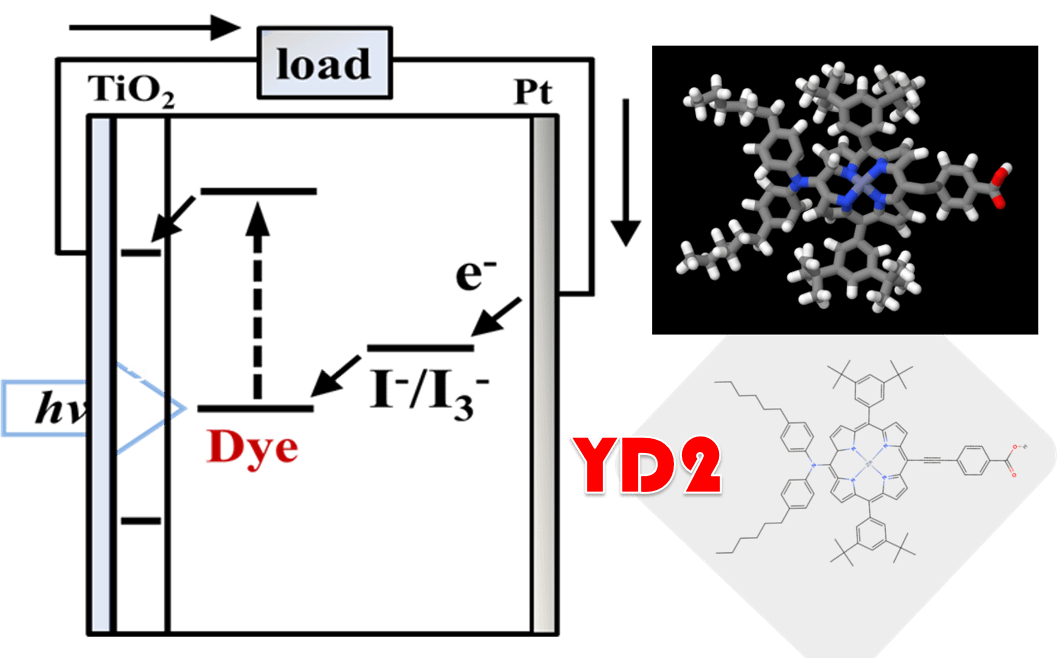
Dye-sensitied solar cell and YD2
| Authors | Book Authors | Book Editors | Book Group Authors | Author Full Names | Book Author Full Names | Group Authors | Article Title | Source Title | Book Series Title | Book Series Subtitle | Language | Document Type | Conference Title | Conference Date | Conference Location | Conference Sponsor | Conference Host | Author Keywords | Keywords Plus | Abstract | Addresses | Affiliations | Reprint Addresses | Email Addresses | Researcher Ids | ORCIDs | Funding Orgs | Funding Name Preferred | Funding Text | Cited References | Cited Reference Count | Times Cited, WoS Core | Times Cited, All Databases | 180 Day Usage Count | Since 2013 Usage Count | Publisher | Publisher City | Publisher Address | ISSN | eISSN | ISBN | Journal Abbreviation | Journal ISO Abbreviation | Publication Date | Publication Year | Volume | Issue | Part Number | Supplement | Special Issue | Meeting Abstract | Start Page | End Page | Article Number | DOI | DOI Link | Book DOI | Early Access Date | Number of Pages | WoS Categories | Web of Science Index | Research Areas | IDS Number | Pubmed Id | Open Access Designations | Highly Cited Status | Hot Paper Status | Date of Export | UT (Unique WOS ID) | Web of Science Record |
|---|---|---|---|---|---|---|---|---|---|---|---|---|---|---|---|---|---|---|---|---|---|---|---|---|---|---|---|---|---|---|---|---|---|---|---|---|---|---|---|---|---|---|---|---|---|---|---|---|---|---|---|---|---|---|---|---|---|---|---|---|---|---|---|---|---|---|---|---|---|---|
| Lee, GH; Kim, YS | Lee, Geon Hyeong; Kim, Young Sik | Theoretical study of novel porphyrin-based dye for efficient dye-sensitized solar cell | MOLECULAR CRYSTALS AND LIQUID CRYSTALS | English | Article | Porphyrin; dye-sensitized solar cell; DSSC; DFT; TDDFT | ORGANIC-DYES; ELECTROLYTE; ACCEPTOR; COMPLEX | In this study, novel porphyrin-based dye sensitizer with diphenylamine (DPA) as the electron donating group, isoindigo (II) as the electron withdrawing group, and carboxylic acid (CA) with benzene as the anchoring part (YD2-II-CA) were theoretically investigated in comparison with the recent best dye (YD2-o-C8). Density functional theory (DFT) and time-dependent density functional theory (TD-DFT) calculations were used to gain insight into the factors responsible for photovoltaic performance. Due to the substitution of the electron withdrawing unit, the absorption spectra of YD2-II-CA was more red-shifted and broader than the spectrum of the YD2-o-C8. The results suggest that this novel porphyrin-based dye would have good photovoltaic properties in dye-sensitized solar cells (DSSCs) | [Lee, Geon Hyeong; Kim, Young Sik] Hongik Univ, Dept Informat Display, Seoul 121791, South Korea; [Kim, Young Sik] Hongik Univ, Dept Sci, Seoul, South Korea | Hongik University; Hongik University | Kim, YS i˜A—’˜ŽÒjAHongik Univ, Dept Informat Display, Seoul 121791, South Korea.;Kim, YS i˜A—’˜ŽÒjAHongik Univ, Dept Sci, Seoul, South Korea. | youngkim@hongik.ac.kr | Kim, Young-Sik/AFC-8873-2022 | Basic Science Research Program through the National Research Foundation of Korea (NRF) - Ministry of Education, Science and Technology [2010-0021668] | Basic Science Research Program through the National Research Foundation of Korea (NRF) - Ministry of Education, Science and Technology | This research was supported by the Basic Science Research Program through the National Research Foundation of Korea (NRF) funded by the Ministry of Education, Science and Technology (2010-0021668). | 15 | 1 | 2 | 1 | 46 | TAYLOR & FRANCIS LTD | ABINGDON | 2-4 PARK SQUARE, MILTON PARK, ABINGDON OR14 4RN, OXON, ENGLAND | 1542-1406 | 1563-5287 | MOL CRYST LIQ CRYST | Mol. Cryst. Liquid Cryst. | 2017 | 645 | 1 | 168 | 174 | 10.1080/15421406.2016.1277636 | http://dx.doi.org/10.1080/15421406.2016.1277636 | 7 | Chemistry, Multidisciplinary; Crystallography; Materials Science, Multidisciplinary | Science Citation Index Expanded (SCI-EXPANDED) | Chemistry; Crystallography; Materials Science | EU7DH | 2025-09-12 | WOS:000401194700022 | View Full Record in Web of Science | |||||||||||||||||||||||||||
| Yen, CP; Yu, PF; Wang, J; Lin, JY; Chen, YM; Chen, SY | Yen, Chih-Ping; Yu, Pin-Feng; Wang, Jyhpyng; Lin, Jiunn-Yuan; Chen, Yen-Mu; Chen, Szu-yuan | Deposition of organic dyes for dye-sensitized solar cell by using matrix-assisted pulsed laser evaporation | AIP ADVANCES | English | Article | EFFICIENCY; FILMS | The deposition of various distinct organic dyes, including ruthenium complex N3, melanin nanoparticle (MNP), and porphyrin-based donor-p-acceptor dye YD2-o-C8, by using matrix-assisted pulsed laser evaporation (MAPLE) for application to dye-sensitized solar cell (DSSC) is investigated systematically. It is found that the two covalently-bonded organic molecules, i.e., MNP and YD2-o-C8, can be transferred from the frozen target to the substrate with maintained molecular integrity. In contrast, N3 disintegrates in the process, presumably due to the lower bonding strength of metal complex compared to covalent bond. With the method, DSSC using YD2-o-C8 is fabricated, and an energy conversion efficiency of 1.47% is attained. The issue of the low penetration depth of dyes deposited by MAPLE and the possible resolution to it are studied. This work demonstrates that MAPLE could be an alternative way for deposition of organic dyes for DSSC. (C) 2016 Author(s). All article content, except where otherwise noted, is licensed under a Creative Commons Attribution (CC BY) license (http://creativecommons.org/licenses/by/4.0/). | [Yen, Chih-Ping; Wang, Jyhpyng] Natl Taiwan Univ, Dept Phys, Taipei 106, Taiwan; [Yen, Chih-Ping; Yu, Pin-Feng; Wang, Jyhpyng; Chen, Szu-yuan] Acad Sinica, Inst Atom & Mol Sci, Taipei 106, Taiwan; [Yu, Pin-Feng] Natl Chung Cheng Univ, Dept Phys, Chiayi 621, Taiwan; [Wang, Jyhpyng; Chen, Szu-yuan] Natl Cent Univ, Dept Phys, Taoyuan 320, Taiwan; [Chen, Yen-Mu] SuperbIN Co Ltd, Taipei 114, Taiwan | National Taiwan University; Academia Sinica - Taiwan; National Chung Cheng University; National Central University | Chen, SY i˜A—’˜ŽÒjAAcad Sinica, Inst Atom & Mol Sci, Taipei 106, Taiwan.;Chen, SY i˜A—’˜ŽÒjANatl Cent Univ, Dept Phys, Taoyuan 320, Taiwan. | sychen@ltl.iams.sinica.edu.tw | Wang, Jyhpyng/F-7915-2012; Chen, Szu-yuan/F-7555-2012; Lin, Jingyu/A-7276-2011 | Wang, Jyhpyng/0000-0001-6937-7592; Chen, Szu-yuan/0000-0002-4474-674X; | Ministry of Science and Technology of Taiwan [101-2112-M-001-016-MY3] | Ministry of Science and Technology of Taiwan(Ministry of Science and Technology, Taiwan) | This work was supported by the Ministry of Science and Technology of Taiwan under Contract No. 101-2112-M-001-016-MY3. | 23 | 7 | 8 | 1 | 32 | AMER INST PHYSICS | MELVILLE | 1305 WALT WHITMAN RD, STE 300, MELVILLE, NY 11747-4501 USA | 2158-3226 | AIP ADV | AIP Adv. | AUG | 2016 | 6 | 8 | 85011 | 10.1063/1.4961380 | http://dx.doi.org/10.1063/1.4961380 | 9 | Nanoscience & Nanotechnology; Materials Science, Multidisciplinary; Physics, Applied | Science Citation Index Expanded (SCI-EXPANDED) | Science & Technology - Other Topics; Materials Science; Physics | DW8MC | gold | 2025-09-12 | WOS:000383909100011 | View Full Record in Web of Science | |||||||||||||||||||||||||||
| S?erkan, SN; Arslan, N; G?k?e?ren, AT; ?akar, S; Sevim, AM; G?l, A; ?zacar, M | Suerkan, Seyma Nur; Arslan, Nuray; Gokceoren, Argun Talat; Cakar, Soner; Sevim, Altug Mert; Gul, Ahmet; Ozacar, Mahmut | A3B type Zn(II) phthalocyanines and porphyrin cocktail dye sensitizers for highly efficient DSSCs | JOURNAL OF PHOTOCHEMISTRY AND PHOTOBIOLOGY A-CHEMISTRY | English | Article | Phthalocyanine; Porphyrin; Sensitizer; Dye-sensitized solar cell; Cocktail dye; DFT | SOLAR-CELL; OSCILLATOR-STRENGTH; ZINC PHTHALOCYANINE; CO-SENSITIZATION; MOLECULAR DESIGN; TIO2; COMPLEXES; LIGHT; SUBSTITUENTS; ENHANCEMENT | Dye-sensitized solar cell (DSSC) technology has recently seen some drastic advancement by new concepts and tailor-made new materials. Phthalocyanines and porphyrins were the most investigated solar sensitive dyes. It has been determined that push-pull phthalocyanines containing carboxylic acid groups are among the promising photosensitizers for dye sensitized solar cells (DSSCs) with their absorption spectra in the NIR region. In particular, carboxylic acid-substituted non-symmetrical metallophthalocyanines appear to be extremely important for electron injection into the TiO2 conduction band in applications where DSSCs have significant potential to achieve greater efficiency. Zinc phthalocyanines containing these groups appear to be candidate molecules for DSSC. However, there is no apparent research in the literature regarding the syntheses and recommendations on analogues of zinc phthalocyanines containing three t-butylsulfanyl or ferrocenylphenol groups and mono aliphatic or aromatic alkynyl anchoring carboxylic acid groups as sensitizing agents for dye-sensitized solar cells. In this actual paper, zinc phthalocyanines and YD2 porphyrin macrocycles were combined as dye cocktails, to extend and complement the absorbance window of sensitizer dyes in the visible region. Thus, four novel A3B type non-symmetrical zinc phthalocyanines have been synthesized and characterized via spectroscopic (1H NMR, FTIR, UV-Vis, MALDI-TOF, etc.), electrochemical (CV, SWV), and molecular (TD-DFT) analysis methods. The reported novel solar sensitive dye-coated cells have been characterized in detail by electrochemical methods i.e., J-V, IPCE and measurements of stability. YD2:ZnPc3 (3:1) cocktail dye yielded the highest conversion efficiency, accomplishing 10.87 % exceeding the respective individual dye counterparts, but also the well-known Ru-based commercial N719 sensitizer's (8.90 %) solar cell efficiencies. | [Suerkan, Seyma Nur; Arslan, Nuray; Gokceoren, Argun Talat; Sevim, Altug Mert; Gul, Ahmet] Istanbul Tech Univ, Dept Chem, TR-34469 Maslak Istanbul, Turkiye; [Cakar, Soner] Zonguldak Bulent Ecevit Univ, Dept Chem, TR-67100 Zonguldak, Turkiye; [Cakar, Soner; Ozacar, Mahmut] Sakarya Univ, Environm Applicat & Sustainabil Res & Dev Grp BIOE, Addit Mfg, Biomat Energy Photocatalysis,Enzyme Technol,Nano &, TR-54187 Sakarya, Turkiye; [Ozacar, Mahmut] Sakarya Univ, Fac Sci, Dept Chem, TR-54050 Sakarya, Turkiye | Istanbul Technical University; Zonguldak Bulent Ecevit University; Sakarya University; Sakarya University | Sevim, AM i˜A—’˜ŽÒjAIstanbul Tech Univ, Dept Chem, TR-34469 Maslak Istanbul, Turkiye. | sevim@itu.edu.tr | ?zacar, Mahmut/AAF-9122-2020; ?akar, Soner/AAH-1477-2020; Gokceoren, Argun/ABH-3036-2020; Sevim, Altu?/Y-4197-2018 | Ozacar, Mahmut/0000-0002-1783-7275; | Scientific and Technological Research Council of Turkey (TUBITAK) [:119Z082]; Turkish Academy of Sciences (TUBA) | Scientific and Technological Research Council of Turkey (TUBITAK)(Turkiye Bilimsel ve Teknolojik Arastirma Kurumu (TUBITAK)); Turkish Academy of Sciences (TUBA)(Turkish Academy of Sciences) | Acknowledgement This work was supported by the Scientific and Technological Research Council of Turkey (TUBITAK) (Project number:119Z082) . A.G. and M. O. thank Turkish Academy of Sciences (TUBA) for partial support. | 88 | 0 | 0 | 12 | 13 | ELSEVIER SCIENCE SA | LAUSANNE | PO BOX 564, 1001 LAUSANNE, SWITZERLAND | 1010-6030 | 1873-2666 | J PHOTOCH PHOTOBIO A | J. Photochem. Photobiol. A-Chem. | JUL 1 | 2025 | 464 | 116333 | 10.1016/j.jphotochem.2025.116333 | http://dx.doi.org/10.1016/j.jphotochem.2025.116333 | FEB 2025 | 14 | Chemistry, Physical | Science Citation Index Expanded (SCI-EXPANDED) | Chemistry | X5G1P | 2025-09-12 | WOS:001425622900001 | View Full Record in Web of Science | ||||||||||||||||||||||||||
| Lee, B; Ezhumalai, Y; Lee, W; Chen, MC; Yeh, CY; Marks, TJ; Chang, RPH | Lee, Byunghong; Ezhumalai, Yamuna; Lee, Woongkyu; Chen, Ming-Chou; Yeh, Chen-Yu; Marks, Tobin J.; Chang, Robert P. H. | Cs2SnI6-Encapsulated Multidye-Sensitized All-Solid-State Solar Cells | ACS APPLIED MATERIALS & INTERFACES | English | Article | photovoltaic cell; perovskite; Cs2SnI6; Sn-TiO2; porphyrin; donor (D)-pi-bridge acceptor (A) organic sensitizers; multisensitization; solid-state hole conductor | CHARGE COLLECTION; ELECTRON-TRANSFER; CO-SENSITIZATION; PERFORMANCE; COSENSITIZATION; SEMICONDUCTOR; TIO2; PHOTOVOLTAGE; AGGREGATION; EFFICIENCY | The design of a dye-sensitized solar cell (DSSC) based on the simultaneous incorporation of multiple dyes is examined. By investigating the use of the porphyrin-based YD2-o-C8 and YDD6, and the organic chromophore TTAR, which can act as complementary absorbers, we are able to enhance the capture of incoming light across the solar spectrum. This is demonstrated first by using a conventional DSSC architecture with a liquid electrolyte and performed a power conversion efficiency (PCE) of 11.2%, representing an improvement over cells based on each of the independent dyes. Next, we used Cs2SnI6 as an encapsulating layer over the sensitizing molecules to reduce charge leakage across the dye layers and also added to the absorption of longer wavelengths up to one micron. Finally, we fabricated a cell utilizing a Cs2SnI6/succinonitrile solid hole-transport electrolyte and achieved a PCE of similar to 8.5%. It is expected that the all solid-state design will go a long way toward improving long-term device stability. | [Lee, Byunghong; Lee, Woongkyu; Marks, Tobin J.; Chang, Robert P. H.] Northwestern Univ, Dept Mat Sci & Engn, 2145 Sheridan Rd, Evanston, IL 60208 USA; [Lee, Byunghong; Lee, Woongkyu; Marks, Tobin J.; Chang, Robert P. H.] Northwestern Univ, Mat Res Ctr, Argonne Northwestern Solar Energy Res Ctr, 2145 Sheridan Rd, Evanston, IL 60208 USA; [Marks, Tobin J.] Northwestern Univ, Dept Chem, 2145 Sheridan Rd, Evanston, IL 60208 USA; [Ezhumalai, Yamuna; Chen, Ming-Chou; Yeh, Chen-Yu] Natl Cent Univ, Res Ctr New Generat Light Driven Photovolta Modul, Taoyuan 32001, Taiwan; [Yeh, Chen-Yu] Natl Chung Hsing Univ, Dept Chem, RCSEN, Taichung 402, Taiwan; [Yeh, Chen-Yu] Natl Chung Hsing Univ, IDCSA, Taichung 402, Taiwan; [Lee, Woongkyu] Myongji Univ, Dept Elect Engn, Yongin 17058, Gyeonggi, South Korea; [Yeh, Chen-Yu] Natl Cent Univ, Dept Chem, Taoyuan 32001, Taiwan | Northwestern University; Northwestern University; Northwestern University; National Central University; National Chung Hsing University; National Chung Hsing University; Myongji University; National Central University | Lee, B; Chang, RPH i˜A—’˜ŽÒjANorthwestern Univ, Dept Mat Sci & Engn, 2145 Sheridan Rd, Evanston, IL 60208 USA.;Lee, B; Chang, RPH i˜A—’˜ŽÒjANorthwestern Univ, Mat Res Ctr, Argonne Northwestern Solar Energy Res Ctr, 2145 Sheridan Rd, Evanston, IL 60208 USA. | redboho@gmail.com; r-chang@northwestern.edu | Marks, Tobin/AAG-1472-2019; Chang, R.P.H/B-7505-2009; Lee, Woongkyu/ABG-2452-2022; CHEN, Ming/AAP-4055-2020; Yamuna, ezhumalai/AAE-5617-2022; Yeh, Chen-Yu/AFO-5499-2022 | Yeh, Chen-Yu/0000-0002-7815-5681; | Argonne-Northwestern Solar Energy Research (ANSER) Center, an Energy Frontier Research Center - U.S. Department of Energy (DOE), Office of Science, Basic Energy Sciences (BES) [DE-SC0001059]; Soft and Hybrid Nanotechnology Experimental (SHyNE) Resource (NSF ECCS); MRSEC program (NSF) at the Materials Research Center [DMR-1121262, 1542205]; International Institute for Nanotechnology (IIN); Keck Foundation; State of Illinois, through the IIN; Ministry of Science and Technology (MOST); Innovation and Development Center of Sustainable Agriculture from The Featured Areas Research Center Program within the framework of the Higher Education Sprout Project, Ministry of Education (MOE) in Taiwan; Div Of Electrical, Commun & Cyber Sys; Directorate For Engineering [1542205] Funding Source: National Science Foundation | Argonne-Northwestern Solar Energy Research (ANSER) Center, an Energy Frontier Research Center - U.S. Department of Energy (DOE), Office of Science, Basic Energy Sciences (BES)(United States Department of Energy (DOE)); Soft and Hybrid Nanotechnology Experimental (SHyNE) Resource (NSF ECCS); MRSEC program (NSF) at the Materials Research Center(National Science Foundation (NSF)); International Institute for Nanotechnology (IIN); Keck Foundation(W.M. Keck Foundation); State of Illinois, through the IIN; Ministry of Science and Technology (MOST)(Ministry of Science and Technology, China); Innovation and Development Center of Sustainable Agriculture from The Featured Areas Research Center Program within the framework of the Higher Education Sprout Project, Ministry of Education (MOE) in Taiwan; Div Of Electrical, Commun & Cyber Sys; Directorate For Engineering(National Science Foundation (NSF)NSF - Directorate for Engineering (ENG)NSF - Division of Electrical, Communications & Cyber Systems (ECCS)) | The Northwestern University authors acknowledge the support of the Argonne-Northwestern Solar Energy Research (ANSER) Center, an Energy Frontier Research Center funded by the U.S. Department of Energy (DOE), Office of Science, Basic Energy Sciences (BES) under award number DE-SC0001059. This work made use of the EPIC, Keck-II, and SPID facilities of Northwestern University's NUANCE Center, which has received support from the Soft and Hybrid Nanotechnology Experimental (SHyNE) Resource (NSF ECCS), the MRSEC program (NSF DMR-1121262 and 1542205) at the Materials Research Center, the International Institute for Nanotechnology (IIN); the Keck Foundation; and the State of Illinois, through the IIN. C.-Y.Y. thanks the financial support for this work from the Ministry of Science and Technology (MOST) and the Innovation and Development Center of Sustainable Agriculture from The Featured Areas Research Center Program within the framework of the Higher Education Sprout Project by the Ministry of Education (MOE) in Taiwan. | 40 | 42 | 44 | 4 | 111 | AMER CHEMICAL SOC | WASHINGTON | 1155 16TH ST, NW, WASHINGTON, DC 20036 USA | 1944-8244 | 1944-8252 | ACS APPL MATER INTER | ACS Appl. Mater. Interfaces | JUN 19 | 2019 | 11 | 24 | 21424 | 21434 | 10.1021/acsami.8b19778 | http://dx.doi.org/10.1021/acsami.8b19778 | 11 | Nanoscience & Nanotechnology; Materials Science, Multidisciplinary | Science Citation Index Expanded (SCI-EXPANDED) | Science & Technology - Other Topics; Materials Science | IE9GQ | 31014067 | 2025-09-12 | WOS:000472683300016 | View Full Record in Web of Science | ||||||||||||||||||||||||
| Mai, CL; Moehl, T; Hsieh, CH; D?coppet, JD; Zakeeruddin, SM; Gr?tzel, M; Yeh, CY | Mai, Chi-Lun; Moehl, Thomas; Hsieh, Chi-Hung; Decoppet, Jean-David; Zakeeruddin, Shaik M.; Graetzel, Michael; Yeh, Chen-Yu | Porphyrin Sensitizers Bearing a Pyridine-Type Anchoring Group for Dye-Sensitized Solar Cells | ACS APPLIED MATERIALS & INTERFACES | English | Article | porphyrin; 2-carboxypyridine; 2-pyridone; pyridine; dye-sensitized solar cell | ORGANIC-DYES; HIGH-EFFICIENCY; PHOTOVOLTAIC PERFORMANCE; FLUORESCENT DYES; RUTHENIUM SENSITIZERS; CHARGE RECOMBINATION; MOLECULAR DESIGN; ACCEPTOR SYSTEM; BAND-GAP; DONOR | Three novel efficient donor-acceptor porphyrins, MH1-MH3, with a pyridine-type acceptor and anchoring group were synthesized and their optical, electrochemical, and photovoltaic properties investigated. Replacing the commonly used 4-carboxyphenyl anchoring group with 2-carboxypyridine, 2-pyridone, and pyridine did not significantly change the absorption and electrochemical properties of the porphyrin dyes. These new porphyrin dyes MH show power conversion efficiencies of 8.3%, 8.5%, and 8.2%, which are comparable to that of the benchmark YD2-o-C8 (eta = 8.25%) under similar conditions. It was demonstrated that 2-carboxypyridine is an efficient and stable anchoring group as MH1 and showed better cell performance and long-term stability than YD2-o-C8 under light soaking conditions. | [Mai, Chi-Lun; Hsieh, Chi-Hung; Yeh, Chen-Yu] Natl Chung Hsing Univ, Dept Chem, Taichung 402, Taiwan; [Mai, Chi-Lun; Hsieh, Chi-Hung; Yeh, Chen-Yu] Natl Chung Hsing Univ, Res Ctr Sustainable Energy & Nanotechnol, Taichung 402, Taiwan; [Mai, Chi-Lun; Moehl, Thomas; Decoppet, Jean-David; Zakeeruddin, Shaik M.; Graetzel, Michael] Ecole Polytech Fed Lausanne, Inst Chem Sci & Engn, Lab Photon & Interfaces, CH-1015 Lausanne, Switzerland | National Chung Hsing University; National Chung Hsing University; Swiss Federal Institutes of Technology Domain; Ecole Polytechnique Federale de Lausanne | Zakeeruddin, SM i˜A—’˜ŽÒjAEcole Polytech Fed Lausanne, Inst Chem Sci & Engn, Lab Photon & Interfaces, CH-1015 Lausanne, Switzerland. | shaik.zakeer@epfl.ch; cyyeh@dragon.nchu.edu.tw | Moehl, Thomas/B-2218-2013; Zakeeruddin, Mohammed/D-3244-2014; Yeh, Chen-Yu/AFO-5499-2022; Graetzel, Michael/G-4870-2011 | Moehl, Thomas/0000-0002-4733-4839; Yeh, Chen-Yu/0000-0002-7815-5681 | Ministry of Science and Technology of Taiwan; Ministry of Education of Taiwan; Swiss National Science Foundation; glass2-energy SA (g2e), Villaz-St-Pierre, Switzerland [CTI 17622.1 PFNM-NM] | Ministry of Science and Technology of Taiwan(Ministry of Science and Technology, Taiwan); Ministry of Education of Taiwan(Ministry of Education, Taiwan); Swiss National Science Foundation(Swiss National Science Foundation (SNSF)); glass2-energy SA (g2e), Villaz-St-Pierre, Switzerland | C.-Y.Y. is grateful for the financial support of the Ministry of Science and Technology of Taiwan and the Ministry of Education of Taiwan. M.G. thanks the Swiss National Science Foundation and CTI 17622.1 PFNM-NM grant, glass2-energy SA (g2e), Villaz-St-Pierre, Switzerland for financial support. | 54 | 61 | 68 | 0 | 107 | AMER CHEMICAL SOC | WASHINGTON | 1155 16TH ST, NW, WASHINGTON, DC 20036 USA | 1944-8244 | 1944-8252 | ACS APPL MATER INTER | ACS Appl. Mater. Interfaces | JUL 15 | 2015 | 7 | 27 | 14975 | 14982 | 10.1021/acsami.5b03783 | http://dx.doi.org/10.1021/acsami.5b03783 | 8 | Nanoscience & Nanotechnology; Materials Science, Multidisciplinary | Science Citation Index Expanded (SCI-EXPANDED) | Science & Technology - Other Topics; Materials Science | CN4JA | 26083949 | 2025-09-12 | WOS:000358395200053 | View Full Record in Web of Science | ||||||||||||||||||||||||
| Weng, XL; Wang, Y; Jia, CY; Wan, ZQ; Chen, XM; Yao, XJ | Weng Xiao-Long; Wang Yan; Jia Chun-Yang; Wan Zhong-Quan; Chen Xi-Ming; Yao Xiao-Jun | Theoretical Investigation of Novel Tetrathiafulvalene-Triphenylamine Sensitizers | ACTA PHYSICO-CHIMICA SINICA | English | Article | Triphenylamine; Tetrathiafulvalene; Sensitizer; Density functional theory; Dye-sensitized solar cell | SOLAR-CELLS; ORGANIC-DYES; ELECTRONIC-STRUCTURES; TIO2; PHENOTHIAZINE; EFFICIENCY; DFT; DERIVATIVES; ADSORPTION; CARBAZOLE | Two novel sensitizers with D-D-pi-A (YD2) and 2D-D-pi-A (YD3) structures were designed by introducing different numbers of tetrathiafulvalene (TTF) unit as the auxiliary electron donor based on the simple D-pi-A triphenylamine sensitizer (YD1) to enhance the electron donating ability. The geometries, electronic structures, and optical properties of YD1-3 before and after binding to TiO2 clusters were investigated. Owing to introduction of TTF unit, YD2 and YD3 show larger steric hindrance and a narrower band gap than YD1. Moreover, the estimated light-harvesting efficiency (LHE), injection driving force (Delta G(inject)) values, and density of states (DOS) calculations indicate that YD2 and YD3 should show higher short-circuit photocurrent density (J(sc)) and open-circuit photovoltage (V-oc) than YD1 with the presence of TTF unit. All of the results indicate that TTF unit can be used as an auxiliary electron donor in organic sensitizers to improve their photovoltaic properties. | [Weng Xiao-Long; Wang Yan; Jia Chun-Yang; Wan Zhong-Quan] Univ Elect Sci & Technol China, State Key Lab Elect Thin Films & Integrated Devic, Natl Engn Res Ctr Electromagnet Radiat Control Ma, Sch Microelect & Solid State Elect, Chengdu 610054, Peoples R China; [Chen Xi-Ming] CSR Zhuzhou Elect Locomot Res Inst Co Ltd, Zhuzhou 412001, Hunan, Peoples R China; [Yao Xiao-Jun] Lanzhou Univ, State Key Lab Appl Organ Chem, Sch Chem & Chem Engn, Lanzhou 730000, Peoples R China | University of Electronic Science & Technology of China; Lanzhou University | Jia, CY i˜A—’˜ŽÒjAUniv Elect Sci & Technol China, State Key Lab Elect Thin Films & Integrated Devic, Natl Engn Res Ctr Electromagnet Radiat Control Ma, Sch Microelect & Solid State Elect, Chengdu 610054, Peoples R China. | cyjia@uestc.edu.cn | Wan, Zhongquan/NOE-6828-2025; Cui, Xiaoyan/O-9999-2014; chen, ximing/GRN-9444-2022 | 55 | 4 | 4 | 0 | 64 | PEKING UNIV PRESS | BEIJING | PEKING UNIV, CHEMISTRY BUILDING, BEIJING 100871, PEOPLES R CHINA | 1000-6818 | ACTA PHYS-CHIM SIN | Acta Phys.-Chim. Sin. | AUG 15 | 2016 | 32 | 8 | 1990 | 1998 | 10.3866/PKU.WHXB201605031 | http://dx.doi.org/10.3866/PKU.WHXB201605031 | 9 | Chemistry, Physical | Science Citation Index Expanded (SCI-EXPANDED) | Chemistry | DU7XO | Bronze | 2025-09-12 | WOS:000382428100014 | View Full Record in Web of Science | |||||||||||||||||||||||||||||
| Yang, LN; Lin, LG; Men, AL; Li, ZJ | Yang, Li-Na; Lin, Li-Guang; Men, A-Lan; Li, Zhen-Jiang | Theoretical insights into co-sensitization mechanism in Zn-porphyrin and Y123 co-sensitized solar cells | JOURNAL OF PHOTOCHEMISTRY AND PHOTOBIOLOGY A-CHEMISTRY | English | Article | Co-sensitization; Zn-porphyrin; Light harvesting; Interfacial electron transfer kinetics | RESONANCE ENERGY-TRANSFER; ORGANIC-DYES; REGENERATION PROCESS; EFFICIENCY; DONOR; COSENSITIZATION; RECOMBINATION; PERFORMANCE; KINETICS | Donor-pi-acceptor YD2-o-C8, WW-6, and SM315 are among best-performing Zn-porphyrins for their outstanding light-harvesting properties. To reach the further enhancement of photovoltaic performance of the corresponding cells, co-sensitization of these typical porphyrins with those dyes possessing intense absorption in the green spectral region (typically, Y123) is necessary. In this work, using density functional theory (DFT) and time dependent DFT (TD-DFT) approaches, co-sensitization mechanism in the above three typical Y123/Zn-porphyrin systems has been systematically investigated. Moreover, due to the excellent performance of dithienosilole (DTS) group in organic dyes, it is designed here to replace the benzothiadiazole (BTD) unit in SM315 to give a new Zn-porphyrin dye designated SM315-1. This specific modification of SM315 can effectively retard the interfacial charge recombination compared to that in YD2-o-C8 and WW-6 cells by reducing the contact between oxidized porphyrins and injected electrons in TiO2 substrate, and simultaneously improves the overall light harvesting ability of the co-sensitized film with the theoretical maximum limit of photocurrent to be 38.31 mA/cm(2). The both favorable aspects suggest an attractive application of the fully novel Y123/SM315-1 co-sensitized film in dye-sensitized solar cell (DSSC). | [Yang, Li-Na; Lin, Li-Guang; Men, A-Lan] Qingdao Univ Sci & Technol, Coll Chem & Mol Engn, State Key Lab Base Ecochem Engn, Qingdao 266042, Shandong, Peoples R China; [Li, Zhen-Jiang] Qingdao Univ Sci & Technol, Coll Sinogerman Sci & Technol, Coll Electromech Engn, Key Lab Polymer Mat Adv Mfg Technol Shandong Prov, Qingdao 266061, Shandong, Peoples R China | Qingdao University of Science & Technology; Qingdao University of Science & Technology | Li, ZJ i˜A—’˜ŽÒjAQingdao Univ Sci & Technol, Coll Sinogerman Sci & Technol, Coll Electromech Engn, Key Lab Polymer Mat Adv Mfg Technol Shandong Prov, Qingdao 266061, Shandong, Peoples R China. | zhenjiangli@qust.edu.cn | Li, Zhenjiamg/S-4826-2017; Meng, Alan/AAI-2946-2020 | National Natural Science Foundation of China [51672144, 51572137, 51502149, 51702181]; Natural Science Foundation of Shandong Province [ZR2016EMB25, ZR2017PEM006, ZR2017BB013]; Higher Educational Science and Technology Program of Shandong Province [J16LA10, J17KA014]; Application Foundation Research Program of Qingdao [15-9-1-28-jch]; Taishan Scholars Program of Shandong Province [ts201511034]; Overseas Taishan Scholars Program | National Natural Science Foundation of China(National Natural Science Foundation of China (NSFC)); Natural Science Foundation of Shandong Province(Natural Science Foundation of Shandong Province); Higher Educational Science and Technology Program of Shandong Province; Application Foundation Research Program of Qingdao; Taishan Scholars Program of Shandong Province; Overseas Taishan Scholars Program | We own our sincere thanks to Prof. Ze-Sheng Li (Beijing Institute of Technology) for his progressive advice about this subject. The work reported here was supported by the National Natural Science Foundation of China under Grant No. 51672144, 51572137, 51502149, 51702181, the Natural Science Foundation of Shandong Province under Grant No. ZR2016EMB25, ZR2017PEM006, ZR2017BB013, the Higher Educational Science and Technology Program of Shandong Province under Grant No. J16LA10, J17KA014, the Application Foundation Research Program of Qingdao under Grant No. 15-9-1-28-jch, the Taishan Scholars Program of Shandong Province under No. ts201511034 and the Overseas Taishan Scholars Program. We express our grateful thanks to them for their financial support. We acknowledge National Supercomputing Center in Shenzhen for providing the computational resources and materials studio (version 6.1, module Dmol3). We also acknowledge National Supercomputing Center of TianHe-II in LvLiang, China, for calculations of part of this work. | 49 | 18 | 19 | 7 | 107 | ELSEVIER SCIENCE SA | LAUSANNE | PO BOX 564, 1001 LAUSANNE, SWITZERLAND | 1010-6030 | 1873-2666 | J PHOTOCH PHOTOBIO A | J. Photochem. Photobiol. A-Chem. | JAN 15 | 2019 | 369 | 25 | 33 | 10.1016/j.jphotochem.2018.10.014 | http://dx.doi.org/10.1016/j.jphotochem.2018.10.014 | 9 | Chemistry, Physical | Science Citation Index Expanded (SCI-EXPANDED) | Chemistry | HG4RP | 2025-09-12 | WOS:000454963000004 | View Full Record in Web of Science | |||||||||||||||||||||||||||
| Molla, MZ; Kawano, M; Baranwal, AK; Pandey, SS; Ogomi, Y; Ma, T; Hayase, S | Molla, Md. Zaman; Kawano, Minobu; Baranwal, Ajay K.; Pandey, Shyam S.; Ogomi, Yuhei; Ma, Tingli; Hayase, Shuzi | Enhancing the performance of transparent conductive oxide-less back contact dye-sensitized solar cells by facile diffusion of cobalt species through TiO2 nanopores | RSC ADVANCES | English | Article | LOW-COST; REDOX ELECTROLYTE; MASS-TRANSPORT; EFFICIENT; RECOMBINATION; PHOTODYNAMICS; ENHANCEMENT; COMPLEXES; MEDIATORS; SHUTTLES | We report a back contact (BC) transparent conductive oxide (TCO)-less dye-sensitized solar cell (DSSC) fabricated utilizing a Co2+/3+ redox shuttle based electrolyte. A new strategy has been proposed for the reduction of the electrolyte layer by coating with a TiO2 nanoparticle spacer (TN spacer) with controlled thickness. The negatively charged TN spacer was found to decrease the diffusion of cobalt species through the TN spacer due to electrostatic interactions leading to a hampered photoconversion efficiency of 4.41%. This sluggish diffusion of bulky cobalt ions was amicably facilitated by passivating the negatively charged TN spacer surface with dye molecules. Facile transport of electrolyte ions in the nanopores of the passivated TN spacer was further confirmed by electrochemical impedance spectroscopy and estimation of the diffusion of Co3+ species in the nanopores of the passivated TN spacer using cyclic voltammetry. The TCO-less BC-DSSC in combination with the cobalt electrolyte fabricated in this novel device architecture exhibits a significantly improved photoconversion efficiency of 6.42% after the TN spacer was passivated with the porphyrin-based dye YD2-o-C8. | [Molla, Md. Zaman; Kawano, Minobu; Baranwal, Ajay K.; Pandey, Shyam S.; Ogomi, Yuhei; Ma, Tingli; Hayase, Shuzi] Kyushu Inst Technol, Wakamatsu Ku, 2-4 Hibikino, Kitakyushu, Fukuoka 8080196, Japan | Kyushu Institute of Technology | Molla, MZ; Hayase, S i˜A—’˜ŽÒjAKyushu Inst Technol, Wakamatsu Ku, 2-4 Hibikino, Kitakyushu, Fukuoka 8080196, Japan. | zaman_molla@yahoo.com; hayase@life.kyutech.ac.jp | Baranwal, Ajay Kumar/J-9027-2017; Baranwal, Ajay/J-9027-2017; Pandey, Shyam/ABB-2388-2020 | Baranwal, Ajay Kumar/0000-0003-4582-4532; Molla, Md. Zaman/0000-0003-0655-1279; | Strategic Promotion of Innovative Research and Development (S-Innovation) Program of Japan Science and Technology under the Japanese Government | Strategic Promotion of Innovative Research and Development (S-Innovation) Program of Japan Science and Technology under the Japanese Government | This study is supported by the Strategic Promotion of Innovative Research and Development (S-Innovation) Program of Japan Science and Technology under the Japanese Government. | 41 | 9 | 9 | 1 | 35 | ROYAL SOC CHEMISTRY | CAMBRIDGE | THOMAS GRAHAM HOUSE, SCIENCE PARK, MILTON RD, CAMBRIDGE CB4 0WF, CAMBS, ENGLAND | 2046-2069 | RSC ADV | RSC Adv. | 2016 | 6 | 40 | 33353 | 33360 | 10.1039/c6ra04894c | http://dx.doi.org/10.1039/c6ra04894c | 8 | Chemistry, Multidisciplinary | Science Citation Index Expanded (SCI-EXPANDED) | Chemistry | DJ2OS | 2025-09-12 | WOS:000374045000016 | View Full Record in Web of Science | ||||||||||||||||||||||||||||
| Peng, JD; Tseng, CM; Vittal, R; Ho, KC | Peng, Jia-De; Tseng, Chuan-Ming; Vittal, R.; Ho, Kuo-Chuan | Mesoporous anatase-TiO2 spheres consisting of nanosheets of exposed (001)-facets for [Co(byp)3]2+/3+ based dye-sensitized solar cells | NANO ENERGY | English | Article | Solar energy; Dye-sensitized solar cell; Titanium dioxide; (001)-facets; Cobalt electrolyte | ENERGY-CONVERSION EFFICIENCY; TIO2 SINGLE-CRYSTALS; 001 FACETS; REDOX ELECTROLYTE; PHOTOVOLTAIC PERFORMANCE; MASS-TRANSPORT; NANOPARTICLES; MEDIATOR; COBALT(II/III); ENHANCEMENT | To cope with the mass transport problem of a Co(bpy)(3)](2+/3+) electrolyte as well as to maintain a high dye loading, mono-dispersed microspheres of anatase TiO2 with well-defined (001)-facets (10%, 36%, 58%, and 84%), high surface area (106.5, 102.9, 97.6, and 88.3 m(2)/g), and large mesopores (26.6, 30.6, 33.7, and 38.5 nm) were synthesized by a facile hydrothermal route. We demonstrate that, owing to the large voids among microspheres, an extremely high porous TiO2 film is formed, thus offering a facile freeway for electrolyte diffusion. Besides, with the increase of (001)-facets, the TiO2 film shows an increase in its dye coverage (dye molecules per unit internal surface area). The coverage of porphyrin dye on a highly exposed (001)-facets TiO2 has been discussed. The mirror-like, (001)-facet planes of the film enabled a superior reflectance of >60% at the wavelength region of 400 to 800 nm. It is a crucial property for YD2-o-C8 dye to compensate its weak absorbance in the spectral range of 480 to 620 nm. A superior electron diffusibility through the 2D nanosheets of 3D microspheres was observed. Moreover, a negative shift in the flat-band energy was observed in the case of high content of (001)-facets; this has enabled a higher open-circuit voltage for the dye-sensitized solar cell (DSSC). By optimizing the condition of post-treatment and TiO2 film thickness, a cell efficiency of 11.43% under 1 sun illuminasion was obtained. In addition to their promising use in cobalt based DSSCs, we anticipate that TiO2 nanosheet assemblies will provide long-sought-after material solutions in photocatalysis, water splitting, and lithium ion battery. (C) 2016 Elsevier Ltd. All rights reserved. | [Peng, Jia-De; Vittal, R.; Ho, Kuo-Chuan] Natl Taiwan Univ, Dept Chem Engn, Taipei 10617, Taiwan; [Tseng, Chuan-Ming] Ming Chi Univ Technol, Dept Mat Engn, New Taipei 24301, Taiwan; [Ho, Kuo-Chuan] Natl Taiwan Univ, Inst Polymer Sci & Engn, Taipei 10617, Taiwan | National Taiwan University; Ming Chi University of Technology; National Taiwan University | Ho, KC i˜A—’˜ŽÒjANatl Taiwan Univ, Dept Chem Engn, Taipei 10617, Taiwan. | kcho@ntu.edu.tw | Ho, kuo-chuan/Q-3419-2019 | Tseng, Chuan-Ming/0000-0003-1834-7726 | NanoCore; Core Facilities for Nanoscience and Nanotechnology at Academia Sinica in Taiwan; Ministry of Science and Technology (MOST) of Taiwan [MOST 103-2119-M-007-012] | NanoCore; Core Facilities for Nanoscience and Nanotechnology at Academia Sinica in Taiwan; Ministry of Science and Technology (MOST) of Taiwan(Ministry of Science and Technology, Taiwan) | HR-TEM support received from NanoCore, the Core Facilities for Nanoscience and Nanotechnology at Academia Sinica in Taiwan is greatly appreciated. This work was supported in part by the Ministry of Science and Technology (MOST) of Taiwan under grant number MOST 103-2119-M-007-012. | 56 | 17 | 17 | 3 | 146 | ELSEVIER | AMSTERDAM | RADARWEG 29, 1043 NX AMSTERDAM, NETHERLANDS | 2211-2855 | 2211-3282 | NANO ENERGY | Nano Energy | APR | 2016 | 22 | 136 | 148 | 10.1016/j.nanoen.2016.01.025 | http://dx.doi.org/10.1016/j.nanoen.2016.01.025 | 13 | Chemistry, Physical; Nanoscience & Nanotechnology; Materials Science, Multidisciplinary; Physics, Applied | Science Citation Index Expanded (SCI-EXPANDED) | Chemistry; Science & Technology - Other Topics; Materials Science; Physics | DK0TO | 2025-09-12 | WOS:000374625300016 | View Full Record in Web of Science | ||||||||||||||||||||||||||
| Arslan, N; Yildirir, SN; Sevim, AM; ?akar, S; ?zacar, M; G?l, A | Arslan, Nuray; Yildirir, Seyma Nur; Sevim, Altug Mert; Cakar, Soner; Ozacar, Mahmut; Gul, Ahmet | Sulfur-bridged oxotitanium phthalocyanine- and porphyrin-based cocktail dyes as sensitizers for improved dye sensitized solar cell efficiency | DYES AND PIGMENTS | English | Article | Phthalocyanines; Porphyrins; Metal complexes dyes; Dye-sensitized solar cells (DSSC); Solar energy | CO-SENSITIZATION; HIGHLY EFFICIENT; ZINC PHTHALOCYANINES; ORGANIC-DYE; ANATASE; ENERGY; COSENSITIZATION; FABRICATION; TITANIUM; NANOPARTICLES | Effective non-symmetrical push-pull oxotitanium phthalocyanine dyes substituted with tert-butylsulfanyl groups as electron donors and carboxyethynyl units as anchor groups have been designed, prepared, and used with YD2 porphyrin as sensitizer cocktail dyes in dye-sensitized solar cells (DSSCs). The innovative phthalocyanine structures and YD2 and dye cocktails are designed to harvest a broad range from sunlight. The novel phthalocyanine dyes have been characterized via 1H NMR, FTIR, MALDI-TOF, UV-Vis absorption, CV, SWV and TD-DFT techniques. Moreover, the TiO2 NPs has been synthesis by hydrothermal procedure and characterized via XRD, FE-SEM, Raman and DRS techniques. The photoanode has been prepared with synthesized anatase TiO2 NPs using a spin coating procedure. TiO2 photoanode, dye/dye cocktails, I -/I3- electrolyte and Pt/FTO counter electrode have been utilized in the preparation of solar cells. The characterization of the prepared solar cells has been achieved via J-V, Nyquist, Bode, IPCE, normalized JSC and stability measurements. The highest conversion efficiency of the solar cell prepared with YD2:TiOSPPc (3:1) has been performed 10.96%, which this value was found to be higher than the solar cell efficiency of N719 standard dye (8.90%). With these innovative dye cocktails, it is expected that the dye system with not only high efficiency but also a relatively stable and higher VOC value will be an alternative to ruthenium-based dyes. | [Arslan, Nuray; Yildirir, Seyma Nur; Sevim, Altug Mert; Gul, Ahmet] Istanbul Tech Univ, Dept Chem, TR-34469 Istanbul, Turkiye; [Cakar, Soner] Zonguldak Bulent Ecevit Univ, Dept Chem, TR-67100 Zonguldak, Turkiye; [Cakar, Soner; Ozacar, Mahmut] Sakarya Univ, BIOENAMS R&D Grp, Biomat Energy Photocatalysis Enzyme Technol Nano &, TR-54050 Sakarya, Turkiye; [Ozacar, Mahmut] Sakarya Univ, Dept Chem, TR-54050 Sakarya, Turkiye | Istanbul Technical University; Zonguldak Bulent Ecevit University; Sakarya University; Sakarya University | G?l, A i˜A—’˜ŽÒjAIstanbul Tech Univ, Dept Chem, TR-34469 Istanbul, Turkiye. | ahmetg@itu.edu.tr | ; GUL, AHMET/LXW-1956-2024; ?akar, Soner/AAH-1477-2020; Sevim, Altu?/Y-4197-2018; ?zacar, Mahmut/AAF-9122-2020 | Ozacar, Mahmut/0000-0002-1783-7275; Arslan, Nuray/0000-0002-5972-2476; Suerkan, Seyma Nur/0009-0006-1926-9351; | Scientific and Technological Research Council of Turkiye (TUBITAK) [119Z082]; Turkish Academy of Sciences (TUBA) | Scientific and Technological Research Council of Turkiye (TUBITAK)(Turkiye Bilimsel ve Teknolojik Arastirma Kurumu (TUBITAK)); Turkish Academy of Sciences (TUBA)(Turkish Academy of Sciences) | This investigation has been supported by the Scientific and Technological Research Council of Turkiye (TUBITAK) (Project number: 119Z082). AG and MO received partial support from Turkish Academy of Sciences (TUBA). | 71 | 7 | 7 | 3 | 48 | ELSEVIER SCI LTD | London | 125 London Wall, London, ENGLAND | 0143-7208 | 1873-3743 | DYES PIGMENTS | Dyes Pigment. | DEC | 2023 | 220 | 111623 | 10.1016/j.dyepig.2023.111623 | http://dx.doi.org/10.1016/j.dyepig.2023.111623 | SEP 2023 | 12 | Chemistry, Applied; Engineering, Chemical; Materials Science, Textiles | Science Citation Index Expanded (SCI-EXPANDED) | Chemistry; Engineering; Materials Science | T8ZV9 | 2025-09-12 | WOS:001080821500001 | View Full Record in Web of Science | ||||||||||||||||||||||||||
| Jin, XY; Li, DY; Sun, LB; Wang, CL; Bai, FQ | Jin, Xingyi; Li, Dongyuan; Sun, Libo; Wang, Cheng-Long; Bai, Fu-Quan | Theoretical design of porphyrin sensitizers with different acceptors for application in dyesensitized solar cells | RSC ADVANCES | English | Article | INTERFACIAL ELECTRON-TRANSFER; TOTAL-ENERGY CALCULATIONS; ZINC PORPHYRINS; HIGH-EFFICIENCY; DYES; HYDROXAMATE; CONVERSION; COMPLEXES; ANCHORS; CHAINS | Using density functional theory (DFT) and time-dependent density functional theory (TDDFT) methods, three porphyrin dyes with different acceptors, such as carboxylic acid, cyanoacrylic acid, and 2-cyano-N-hydroxyacrylamide, have been designed. Compared to the best sensitizer (YD2-o-C8) so far, these designed dyes have small highest occupied orbital to lowest unoccupied orbital (HOMO-LUMO) band gaps, and wide absorptions with large oscillator strength at porphyrin Q bands. And the designed Dye1 is similar to YD2-o-C8 in electronic coupling with TiO2, while improved Dye2 and Dye3 are better than YD2-o-C8, thus, Dye2 and Dye3 will be much faster for electron injection in dye-sensitized solar cell systems based on their long-term stable and efficient anchor groups. All these features show that our designed dyes, especially Dye2 and Dye3, have better absorption performance and faster electron injection. In addition, our results point out that 2-cyano-N-hydroxyacrylamide is a new promising acceptor. This study is expected to assist the molecular design of new efficient dyes for the advancement of dye-sensitized solar cells. | [Jin, Xingyi; Li, Dongyuan; Sun, Libo] Jilin Univ, China Japan Union Hosp, Dept Neurosurg 1, Xiantai St 126, Changchun 130033, Jilin, Peoples R China; [Wang, Cheng-Long; Bai, Fu-Quan] Jilin Univ, Inst Theoret Chem, Int Joint Res Lab Nanomicro Architecture Chem, Lab Theoret & Computat Chem, Changchun 130023, Jilin, Peoples R China | Jilin University; Jilin University | Jin, XY i˜A—’˜ŽÒjAJilin Univ, China Japan Union Hosp, Dept Neurosurg 1, Xiantai St 126, Changchun 130033, Jilin, Peoples R China.;Bai, FQ i˜A—’˜ŽÒjAJilin Univ, Inst Theoret Chem, Int Joint Res Lab Nanomicro Architecture Chem, Lab Theoret & Computat Chem, Changchun 130023, Jilin, Peoples R China. | xyjin_cjuh@163.com; baifq@jlu.edu.cn | ; wang, chenglong/GQQ-2852-2022; Sun, Libo/J-9604-2012; LI, DONGYUAN/JDD-0229-2023; Bai, Fu-Quan/ACG-2583-2022 | Bai, Fu-Quan/0000-0001-9398-1407; | Natural Science Foundation of China [21573088, 21203071]; Jilin Provincial Natural Science Foundation [201215031]; Young Scholar Training Program of Jilin University | Natural Science Foundation of China(National Natural Science Foundation of China (NSFC)); Jilin Provincial Natural Science Foundation; Young Scholar Training Program of Jilin University(Jilin University) | This work was supported by the Natural Science Foundation of China (Grant No. 21573088 and 21203071) and the Jilin Provincial Natural Science Foundation (Grant No. 201215031) and Young Scholar Training Program of Jilin University. | 53 | 11 | 12 | 0 | 24 | ROYAL SOC CHEMISTRY | CAMBRIDGE | THOMAS GRAHAM HOUSE, SCIENCE PARK, MILTON RD, CAMBRIDGE CB4 0WF, CAMBS, ENGLAND | 2046-2069 | RSC ADV | RSC Adv. | 2018 | 8 | 35 | 19804 | 19810 | 10.1039/c8ra02974a | http://dx.doi.org/10.1039/c8ra02974a | 7 | Chemistry, Multidisciplinary | Science Citation Index Expanded (SCI-EXPANDED) | Chemistry | GI3HA | 35541014 | gold, Green Published | 2025-09-12 | WOS:000434261100054 | View Full Record in Web of Science | ||||||||||||||||||||||||||
| Mendizabal, F; Mera-Adasme, R; Xu, WH; Sundholm, D | Mendizabal, Fernando; Mera-Adasme, Raul; Xu, Wen-Hua; Sundholm, Dage | Electronic and optical properties of metalloporphyrins of zinc on TiO2 cluster in dye-sensitized solar-cells (DSSC). A quantum chemistry study | RSC ADVANCES | English | Article | PORPHYRIN SENSITIZERS; ABSORPTION-SPECTRA; EXCITED-STATES; ENERGY; PERFORMANCE; APPROXIMATION; EFFICIENT; SURFACE; PSEUDOPOTENTIALS; THERMOCHEMISTRY | Dye-sensitized solar-cell (DSSC) systems have been investigated by calculating light-absorption and electron-injection processes of the LD13 ([5,15-bis(2,6-(1,1-dimethylethyl)-phenyl)-10-4-dimethylaminophenylethynyl-20-4-carboxy phenylethynyl porphyrinato]zinc-(II)) and YD2-o-C8 ([5,15bis( 2,6-dioctoxyphenyl)-10-(bis(4-hexylphenyl)amino-20-4-carboxyphenylethynyl)porphyrinato]zinc-(II)) dyes adsorbed on a TiO2 cluster simulating the semiconductor. The binding energy of the dyes with the TiO2 clusters has been calculated at the density functional theory (DFT) level using the B3LYP and CAM-B3LYP functionals. The electronic excitation energies have been calculated at the time-dependent DFT (TDDFT) level for the dyes in the gas and solvent phase employing the B3LYP, CAM-B3LYP and BHLYP functionals. The calculated excitation energies have been compared to values obtained at the algebraic diagrammatic construction through second order (ADC(2)) level of theory. The TDDFT calculations with the B3LYP in tetrahydrofuran solvent with the dye and dye-TiO2 models yield excitation energies that agree well with the transitions in the experimental absorption spectra. Changes in the free energy for electron injection support the better performance of the dyes on the TiO2 clusters. | [Mendizabal, Fernando] Univ Chile, Fac Ciencias, Dept Quim, POB 653,Las Palmeras 3425, Santiago, Chile; [Mera-Adasme, Raul] Univ Santiago, Fac Quim & Biol, Dept Ciencias Ambiente, Santiago, Chile; [Xu, Wen-Hua; Sundholm, Dage] Univ Helsinki, Dept Chem, AI Virtanens Plats 1,POB 55, FI-00014 Helsinki, Finland; [Xu, Wen-Hua] Northwest Univ, Coll Chem & Mat Sci, Xian 710127, Shaanxi, Peoples R China | Universidad de Chile; Universidad de Santiago de Chile; University of Helsinki; Northwest University Xi'an | Mendizabal, F i˜A—’˜ŽÒjAUniv Chile, Fac Ciencias, Dept Quim, POB 653,Las Palmeras 3425, Santiago, Chile.;Sundholm, D i˜A—’˜ŽÒjAUniv Helsinki, Dept Chem, AI Virtanens Plats 1,POB 55, FI-00014 Helsinki, Finland. | hagua@uchile.cl; Dage.Sundholm@helsinki.fi | ; Xu, Wen-Hua/L-3061-2016 | Mendizabal, Fernando/0000-0002-6912-8630; Xu, Wen-Hua/0000-0002-9882-3384; Sundholm, Dage Matts Borje/0000-0002-2367-9277 | Fondecyt [1140503]; Magnus Ehrnrooth Foundation; Academy of Finland [266227, 275845]; CONICYT-USACH under Proyecto de Atraccion e Insercion de Capital Humano Avanzado en la Academia [79150043]; [Conicyt-Aka-ERNC-001] | Fondecyt(Comision Nacional de Investigacion Cientifica y Tecnologica (CONICYT)CONICYT FONDECYT); Magnus Ehrnrooth Foundation; Academy of Finland(Research Council of Finland); CONICYT-USACH under Proyecto de Atraccion e Insercion de Capital Humano Avanzado en la Academia; | Financial support of this work under Conicyt-Aka-ERNC-001 and Fondecyt 1140503, is gratefully acknowledged. The authors thank CSC - IT Center for Science in Finland for computational resources. This work has also been supported by Magnus Ehrnrooth Foundation and the Academy of Finland through projects 266227 and 275845. RM-A Acknowledges financial support from CONICYT-USACH under Proyecto de Atraccion e Insercion de Capital Humano Avanzado en la Academia No. 79150043. | 65 | 28 | 30 | 1 | 30 | ROYAL SOC CHEMISTRY | CAMBRIDGE | THOMAS GRAHAM HOUSE, SCIENCE PARK, MILTON RD, CAMBRIDGE CB4 0WF, CAMBS, ENGLAND | 2046-2069 | RSC ADV | RSC Adv. | 2017 | 7 | 68 | 42677 | 42684 | 10.1039/c7ra08648b | http://dx.doi.org/10.1039/c7ra08648b | 8 | Chemistry, Multidisciplinary | Science Citation Index Expanded (SCI-EXPANDED) | Chemistry | FG1IG | gold | 2025-09-12 | WOS:000409548200006 | View Full Record in Web of Science | |||||||||||||||||||||||||||
| Awasthi, K; Hsu, HY; Chiang, HC; Mai, CL; Yeh, CY; Diau, EWG; Ohta, N | Awasthi, Kamlesh; Hsu, Hung-Yu; Chiang, Hung-Chu; Mai, Chi-Lun; Yeh, Chen-Yu; Diau, Eric Wei-Guang; Ohta, Nobuhiro | Electroabsorption spectra of push-pull porphyrins in solution and in solid films | JOURNAL OF PORPHYRINS AND PHTHALOCYANINES | English | Article | Stark shift; electric dipole moment; dye-sensitized solar cell; push-pull porphyrins | SENSITIZED SOLAR-CELLS; FABRICATION; STATES | Polarized electroabsorption (E-A) spectra of highly efficient porphyrin sensitizers (YD2 and YD2-oC8) have been measured in benzene solution. Polarized E-A spectra of these push-pull porphyrins embedded in poly(methyl methacrylate) films or sensitized on TiO2 films are also observed. Based on the analysis of the E-A spectra, the magnitude of the electric dipole moment both in the ground state and in the lowest excited state have been evaluated in solution and in solid films. The electric dipole moment in the excited state of these compounds is very large on TiO2 films, suggesting the interfacial charge transfer on TiO2 surface following photoexcitation of porphyrin dyes. The electric dipole moment in the excited state evaluated from the E-A spectra is very different from the one evaluated from the electrophotoluminescence spectra on TiO2, suggesting that the strong local field of TiO2 films is applied to the fluorescing dyes attached to TiO2 films. | [Awasthi, Kamlesh; Chiang, Hung-Chu; Ohta, Nobuhiro] Hokkaido Univ, Res Inst Elect Sci, Sapporo, Hokkaido 0010020, Japan; [Hsu, Hung-Yu; Diau, Eric Wei-Guang] Natl Chiao Tung Univ, Dept Appl Chem, Hsinchu 30010, Taiwan; [Hsu, Hung-Yu; Diau, Eric Wei-Guang] Natl Chiao Tung Univ, Inst Mol Sci, Hsinchu 30010, Taiwan; [Mai, Chi-Lun; Yeh, Chen-Yu] Natl Chung Hsing Univ, Dept Chem, Taichung 402, Taiwan; [Mai, Chi-Lun; Yeh, Chen-Yu] Natl Chung Hsing Univ, Ctr Nanosci & Nanotechnol, Taichung 402, Taiwan | Hokkaido University; National Yang Ming Chiao Tung University; National Yang Ming Chiao Tung University; National Chung Hsing University; National Chung Hsing University | Ohta, N i˜A—’˜ŽÒjAHokkaido Univ, Res Inst Elect Sci, Sapporo, Hokkaido 0010020, Japan. | cyyeh@dragon.nchu.edu.tw; diau@mail.nctu.edu.tw; nohta@es.hokudai.ac.jp | Yeh, Chen-Yu/AFO-5499-2022 | Yeh, Chen-Yu/0000-0002-7815-5681 | Ministry of Science and Technology of Taiwan; Japan Science and Technology Agency (JST); Ministry of Education of Taiwan, under ATU program | Ministry of Science and Technology of Taiwan(Ministry of Science and Technology, Taiwan); Japan Science and Technology Agency (JST)(Japan Science & Technology Agency (JST)); Ministry of Education of Taiwan, under ATU program | We thank Prof. Y.-P. Lee of NCTU for helpful discussions. Ministry of Science and Technology of Taiwan and Ministry of Education of Taiwan, under the ATU program, provided support for this project. Japan Science and Technology Agency (JST) also supported this project. | 24 | 0 | 1 | 0 | 23 | WORLD SCI PUBL CO INC | HACKENSACK | 27 WARREN ST, STE 401-402, HACKENSACK, NJ 07601 USA | 1088-4246 | 1099-1409 | J PORPHYR PHTHALOCYA | J. Porphyr. Phthalocyanines | JAN-MAR | 2015 | 19 | 1-3 | 527 | 534 | 10.1142/S108842461550042X | http://dx.doi.org/10.1142/S108842461550042X | 8 | Chemistry, Multidisciplinary | Science Citation Index Expanded (SCI-EXPANDED) | Chemistry | CF6CK | 2025-09-12 | WOS:000352644100052 | View Full Record in Web of Science | |||||||||||||||||||||||||
| Xie, M; Wang, J; Ren, J; Hao, L; Bai, FQ; Pan, QJ; Zhang, HX | Xie, Miao; Wang, Jian; Ren, Jie; Hao, Li; Bai, Fu-Quan; Pan, Qing-Jiang; Zhang, Hong-Xing | Theoretical study on a high-efficient porphyrin-sensitizer in a local electric field: How does the local electric field affects the performance of dye-sensitized solar cells? | ORGANIC ELECTRONICS | English | Article | Dye-sensitized solar cell; Porphyrin sensitizers; TD-DFT; Absorption spectrum; Local electric field | DENSITY-FUNCTIONAL THEORY; PHOTOINDUCED ABSORPTION; EXCITATION-ENERGIES; ORGANIC-DYES; TIME; DESIGN; SPECTROSCOPY; TECHNOLOGY; MOLECULES; SURFACE | The local electric field formed between dye sensitizers and semiconductor interface is one of key factors to determine the overall performance of dye-sensitized solar cells (DSSCs). Herein, a strategy has been proposed to explore the influence of the local electric field on the functionality of DSSCs of YD2-O-C8 dye via calculating the relevant properties in various electric field strengths. The YD2-O-C8 dye has been systemically studied with density functional theory (DFT) and time-dependent DFT (TD-DFT) for its electronic structure and optical properties in tetrahydrofuran (THF) solution. The absorption spectra are gradually narrowing and blue-shifting while increasing the electric field strength. Two key parameters of the light harvesting efficiency (LHE) and the TiO2 conduction band shift (Delta E-cb) have been examined for the YD2-O-C8 sensitized TiO2 system. It is found that it is of great importance to reduce the charge accumulation on the TiO2 film, which lowers the electric field strength and shows the best performance of DSSCs. This study is expected to deepen our understanding of the function of local electric field and the operational principles of the DSSCs for further optimization. (C) 2015 Elsevier B.V. All rights reserved. | [Xie, Miao; Wang, Jian; Ren, Jie; Hao, Li; Bai, Fu-Quan; Zhang, Hong-Xing] Jilin Univ, Inst Theoret Chem, Changchun 130023, Peoples R China; [Pan, Qing-Jiang] Heilongjiang Univ, Sch Chem & Mat Sci, Educ Minist, Key Lab Funct Inorgan Mat Chem, Harbin 150080, Peoples R China | Jilin University; Heilongjiang University | Bai, FQ i˜A—’˜ŽÒjAJilin Univ, Inst Theoret Chem, Changchun 130023, Peoples R China. | baifq@jlu.edu.cn; panqjitc@163.com; zhanghx@mail.jlu.edu.cn | ; wang, jian/GVS-0711-2022; Bai, Fu-Quan/ACG-2583-2022 | Wang, Abbott/0000-0003-4670-7741; Xie, Miao/0000-0002-9797-1449; Bai, Fu-Quan/0000-0001-9398-1407 | Natural Science Foundation of China [21173096, 21203071]; State Key Development Program for Basic Research of China [2013CB834801]; China Postdoctoral Science Foundation [2013M541288] | Natural Science Foundation of China(National Natural Science Foundation of China (NSFC)); State Key Development Program for Basic Research of China(State Key Development Program for Basic Research of China); China Postdoctoral Science Foundation(China Postdoctoral Science Foundation) | This work was supported by the Natural Science Foundation of China (Grant Nos. 21173096 and 21203071) and the State Key Development Program for Basic Research of China (Grant No. 2013CB834801) and China Postdoctoral Science Foundation (Grant No. 2013M541288). | 42 | 19 | 21 | 2 | 123 | ELSEVIER | AMSTERDAM | RADARWEG 29, 1043 NX AMSTERDAM, NETHERLANDS | 1566-1199 | 1878-5530 | ORG ELECTRON | Org. Electron. | NOV | 2015 | 26 | 164 | 175 | 10.1016/j.orgel.2015.07.045 | http://dx.doi.org/10.1016/j.orgel.2015.07.045 | 12 | Materials Science, Multidisciplinary; Physics, Applied | Science Citation Index Expanded (SCI-EXPANDED) | Materials Science; Physics | CR3IX | 2025-09-12 | WOS:000361226900026 | View Full Record in Web of Science | ||||||||||||||||||||||||||
| Kim, BM; Han, TG; Kim, JS; Shin, H; Kwon, TH | Kim, Byung-Man; Han, THyun-Gyu; Kim, Jeong Soo; Shin, HyeonOh; Kwon, Tae-Hyuk | Control and Monitoring of Dye Distribution in Mesoporous TiO2 Film for Improving Photovoltaic Performance | ACS APPLIED MATERIALS & INTERFACES | English | Article | dye-sensitized solar cell; plasmon sensor; dye distribution; charge transport; charge recombination | SENSITIZED SOLAR-CELLS; RECOMBINATION; SPECTROSCOPY; TRANSPORT; ADSORPTION | Dye distribution in a mesoporous TiO2 film is a key factor in the performance of dye-sensitized solar cells, but there has been little research on it. Here we report even dye distribution within the porous TiO2 film achieved by a physical driving force of gas flow. Gas-assisted dye arrangement, gas bubbling soaking (GBS), significantly accelerates the dye infiltration compared to conventional overnight soaking (OS). As a demonstration, we investigated the time-dependent dye infiltration using plasmon sensors. GBS produces an even vertical dispersion throughout the film, as illustrated by time of -flight secondary ion mass spectrometry depth profiles. For devices using a 7-mu m-thick active layer and a ruthenium-based dye (N719), only 15 min of GBS treatment produced better power conversion efficiency (PCE) than the optimal result from OS treatment (15 h), despite a lower dye capacity. Dual-GBS treatment (20 min for N719 and 10 min for YD2, a porphyrin dye) produced the best PCE (9.0%) in the device, which was, similar to 17% higher than that treated with dual-OS (10 h for N719 and 5 h for YD2). Such improvements are associated with reduced dye-free sites inside the porous TiO2 film after GBS treatment, leading to faster charge transport and slower charge loss. | [Kim, Byung-Man; Kwon, Tae-Hyuk] Ulsan Natl Inst Sci & Technol, Sch Energy & Chem Engn, Ulsan 689798, South Korea; [Han, THyun-Gyu; Kim, Jeong Soo; Shin, HyeonOh; Kwon, Tae-Hyuk] Ulsan Natl Inst Sci & Technol, Dept Chem, Ulsan 689798, South Korea | Ulsan National Institute of Science & Technology (UNIST); Ulsan National Institute of Science & Technology (UNIST) | Kwon, TH i˜A—’˜ŽÒjAUlsan Natl Inst Sci & Technol, Sch Energy & Chem Engn, Ulsan 689798, South Korea.;Kwon, TH i˜A—’˜ŽÒjAUlsan Natl Inst Sci & Technol, Dept Chem, Ulsan 689798, South Korea. | kwon90@unist.ac.kr | ; Kim, Jae Hyung/ABA-5914-2021; Kwon, Tae-Hyuk/AAD-5745-2020 | Kim, Byung-Man/0000-0002-4764-153X; Kwon, Tae-Hyuk/0000-0002-1633-6065; | National Research Foundation of Korea [2016R1A2B4009239]; Technology Development Program to Solve Climate Changes of the NRF - Ministry of Science, ICT & Future Planning [2016M1A2A2940910]; Korea Institute of Energy Technology Evaluation and Planning [20143030011560] | National Research Foundation of Korea(National Research Foundation of Korea); Technology Development Program to Solve Climate Changes of the NRF - Ministry of Science, ICT & Future Planning(National Research Foundation of KoreaMinistry of Science, ICT & Future Planning, Republic of Korea); Korea Institute of Energy Technology Evaluation and Planning(Korea Institute of Energy Technology Evaluation & Planning (KETEP)) | The authors gratefully acknowledge the financial support provided by the National Research Foundation of Korea (Grants 2016R1A2B4009239), Technology Development Program to Solve Climate Changes of the NRF funded by the Ministry of Science, ICT & Future Planning (2016M1A2A2940910), and the Korea Institute of Energy Technology Evaluation and Planning (No. 20143030011560). | 28 | 10 | 11 | 0 | 30 | AMER CHEMICAL SOC | WASHINGTON | 1155 16TH ST, NW, WASHINGTON, DC 20036 USA | 1944-8244 | 1944-8252 | ACS APPL MATER INTER | ACS Appl. Mater. Interfaces | JAN 25 | 2017 | 9 | 3 | 2572 | 2580 | 10.1021/acsami.6b15488 | http://dx.doi.org/10.1021/acsami.6b15488 | 9 | Nanoscience & Nanotechnology; Materials Science, Multidisciplinary | Science Citation Index Expanded (SCI-EXPANDED) | Science & Technology - Other Topics; Materials Science | EJ0OP | 28059500 | 2025-09-12 | WOS:000392909500067 | View Full Record in Web of Science | ||||||||||||||||||||||||
| Molla, MZ; Baranwal, AK; Kapil, G; Hayase, S; Pandey, SS | Molla, Md Zaman; Baranwal, Ajay Kumar; Kapil, Gaurav; Hayase, Shuzi; Pandey, Shyam S. | Parametric optimization of back-contact T-C-O-free dye-sensitized solar cells employing indoline and porphyrin sensitizer based on cobalt redox electrolyte | SOLAR ENERGY | English | Article | T-C-O-free; Back-contact; Back-electron reaction; Nanoporous; Cobalt electrolyte; Dye-sensitized solar cells | LOW-COST; PERFORMANCE ENHANCEMENT; ELECTRICAL-IMPEDANCE; MASS-TRANSPORT; RECOMBINATION; EFFICIENCY; COMPLEXES; MEDIATORS; SHUTTLES | Transparent-conductive-oxide-free (T-C-O-free) back-contact (B-C) dye-sensitized solar cell (DSC) utilizing flexible Stainless Steel (SS) mesh (SS-mesh) supported with mesoporous TiO2 as a photoanode employing cobalt electrolyte is being presented. A thin layer of Ti metal over the SS-mesh was ascertained to be essential to retard the back electron reaction, which was confirmed by the dark current measurements. The interfacial contact between the SS-mesh and nanoporous (NP) TiO2 of the photoanode of T-C-O-free B-C-DSC was driven to influence the photovoltaic performance greatly. It was confirmed by electrochemical impedance analysis that NP TiO2 of 30 nm exhibited less charge transfer impedance observed at TiO2-dye-electrolyte interface as compared to TiO2 of having particle size of 15-20 nm. T-C-O-free B-C-DSC employing dye mixer combination of indoline dyes D-131 and D-205 (1:1) with relatively larger NP of TiO2 (30 nm) as compared to TiO2 of 15-20 nm exhibited enhanced photoconversion efficiency (PCE) of 4.02%. To increase the PCE even further, T-C-O-free B-C-DSC with cobalt based electrolyte sensitized with porphyrin (YD2-o-C8)-dye bearing a larger optical window was investigated. An optimized 10 mu m thickness of the TiO2 layer was found to be optimum leading to an enhanced PCE of 5.26%. | [Pandey, Shyam S.] Kyushu Inst Technol, Grad Sch Life Sci & Syst Engn, 2-4 Hibikino, Kitakyushu, Fukuoka 8080196, Japan; [Molla, Md Zaman] Ahsanullah Univ Sci & Technol, Dhaka 1208, Bangladesh; [Baranwal, Ajay Kumar; Kapil, Gaurav; Hayase, Shuzi] Univ Electrocommun, Infopowered Energy Syst Res Ctr, Tokyo 1828585, Japan | Kyushu Institute of Technology; Ahsanullah University of Science & Technology (AUST); University of Electro-Communications - Japan | Molla, MZ i˜A—’˜ŽÒjAAhsanullah Univ Sci & Technol, Dhaka 1208, Bangladesh. | zaman.molla.as@aust.edu | ; Pandey, Shyam/ABB-2388-2020; Baranwal, Ajay/J-9027-2017 | PANDEY, SHYAM S./0000-0001-8102-1003; Molla, Md. Zaman/0000-0003-0655-1279; | 36 | 7 | 7 | 0 | 16 | PERGAMON-ELSEVIER SCIENCE LTD | OXFORD | THE BOULEVARD, LANGFORD LANE, KIDLINGTON, OXFORD OX5 1GB, ENGLAND | 0038-092X | 1471-1257 | SOL ENERGY | Sol. Energy | SEP 15 | 2020 | 208 | 411 | 418 | 10.1016/j.solener.2020.08.011 | http://dx.doi.org/10.1016/j.solener.2020.08.011 | 8 | Energy & Fuels | Science Citation Index Expanded (SCI-EXPANDED) | Energy & Fuels | NT4MW | 2025-09-12 | WOS:000572918000001 | View Full Record in Web of Science | |||||||||||||||||||||||||||||
| Syu, YK; Tingare, Y; Yeh, CY; Yang, JS; Wu, JJ | Syu, Yu-Kai; Tingare, Yogesh; Yeh, Chen-Yu; Yang, Jih-Sheng; Wu, Jih-Jen | Panchromatic engineering for efficient zinc oxide flexible dye-sensitized solar cells using porphyrin and indoline dyes | RSC ADVANCES | English | Article | ROOM-TEMPERATURE; ZNO NANOARCHITECTURES; ELECTROLYTE; FILMS; UNITS | In this work, panchromatic engineering of room temperature (RT) chemically assembled ZnO anodes has been investigated using low acidity porphyrin and indoline dyes, i.e. YD2-o-C8-TBA and D149, for application in flexible dye-sensitized solar cells (DSSCs). The photovoltaic performance of the YD2-o-C8-TBA/D149 co-sensitized ZnO DSSC was optimized using ZnO anodes prepared on indium tin oxide (ITO)-coated glass substrates. The short-circuit current density of the optimized co-sensitized ZnO DSSC is 10% and 75% higher than those of the individual D149-sensitized and YD2-o-C8-TBA-sensitized cells, respectively. Compared to the D149-sensitized cell, the YD2-o-C8-TBA/D149 co-sensitized ZnO DSSC with a wavelength ranging from 475-700 nm exhibited improved photon-to-current conversion efficiencies. The optimized cell efficiency of 5.6% is accounted for by the rigid co-sensitized ZnO DSSC. Due to the RT fabrication of the ZnO anode, a comparable photovoltaic performance is attained with the co-sensitized ZnO DSSC fabricated using the ITO-coated plastic substrates. An efficiency of 5.3% is monitored in the flexible co-sensitized ZnO DSSC. | [Syu, Yu-Kai; Yang, Jih-Sheng; Wu, Jih-Jen] Natl Cheng Kung Univ, Dept Chem Engn, Tainan 701, Taiwan; [Tingare, Yogesh; Yeh, Chen-Yu] Natl Chung Hsing Univ, Dept Chem, Taichung 402, Taiwan; [Tingare, Yogesh; Yeh, Chen-Yu] Natl Chung Hsing Univ, Res Ctr Sustainable Energy & Nanotechnol, Taichung 402, Taiwan | National Cheng Kung University; National Chung Hsing University; National Chung Hsing University | Wu, JJ i˜A—’˜ŽÒjANatl Cheng Kung Univ, Dept Chem Engn, Tainan 701, Taiwan.;Yeh, CY i˜A—’˜ŽÒjANatl Chung Hsing Univ, Dept Chem, Taichung 402, Taiwan.;Yeh, CY i˜A—’˜ŽÒjANatl Chung Hsing Univ, Res Ctr Sustainable Energy & Nanotechnol, Taichung 402, Taiwan. | cyyeh@dragon.nchu.edu.tw; wujj@mail.ncku.edu.tw | Wu, Jih-Jen/G-3513-2013; Wu, Jih-Jen/G-3513-2013; Yeh, Chen-Yu/AFO-5499-2022 | Wu, Jih-Jen/0000-0001-5535-5878; Yeh, Chen-Yu/0000-0002-7815-5681 | National Cheng Kung University - Ministry of Education; Ministry of Science and Technology in Taiwan [MOST 103-2221-E-006-245-MY3]; Ministry of Education; Ministry of Science and Technology of Taiwan | National Cheng Kung University - Ministry of Education; Ministry of Science and Technology in Taiwan(Ministry of Science and Technology, Taiwan); Ministry of Education; Ministry of Science and Technology of Taiwan(Ministry of Science and Technology, Taiwan) | We thank Professor Jen-Sue Chen for technique support. JJW acknowledges financial support from the Headquarters of University Advancement at the National Cheng Kung University sponsored by the Ministry of Education and from Ministry of Science and Technology in Taiwan under Contract No. MOST 103-2221-E-006-245-MY3. CYY also thanks the Ministry of Education and Ministry of Science and Technology of Taiwan for financial support. | 24 | 9 | 10 | 1 | 68 | ROYAL SOC CHEMISTRY | CAMBRIDGE | THOMAS GRAHAM HOUSE, SCIENCE PARK, MILTON RD, CAMBRIDGE CB4 0WF, CAMBS, ENGLAND | 2046-2069 | RSC ADV | RSC Adv. | 2016 | 6 | 64 | 59273 | 59279 | 10.1039/c6ra09262d | http://dx.doi.org/10.1039/c6ra09262d | 7 | Chemistry, Multidisciplinary | Science Citation Index Expanded (SCI-EXPANDED) | Chemistry | DQ6XQ | 2025-09-12 | WOS:000379350100052 | View Full Record in Web of Science | ||||||||||||||||||||||||||||
| Syu, YK; Tingare, Y; Lin, SY; Yeh, CY; Wu, JJ | Syu, Yu-Kai; Tingare, Yogesh; Lin, Shou-Yen; Yeh, Chen-Yu; Wu, Jih-Jen | Porphyrin Dye-Sensitized Zinc Oxide Aggregated Anodes for Use in Solar Cells | MOLECULES | English | Article | dye-sensitized solar cells; porphyrin dyes; ZnO anode | ROOM-TEMPERATURE; ZNO NANOARCHITECTURES; EFFICIENCY; ELECTROLYTE; UNITS | Porphyrin YD2-o-C8-based dyes were employed to sensitize room-temperature (RT) chemical-assembled ZnO aggregated anodes for use in dye-sensitized solar cells (DSSCs). To reduce the acidity of the YD2-o-C8 dye solution, the proton in the carboxyl group of a porphyrin dye was replaced with tetrabuthyl ammonium (TBA(+)) in this work. The short-circuit current density (Jsc) of the YD2-o-C8-TBA-sensitized ZnO DSSCs is higher than that of the YD2-o-C8-sensitized cells, resulting in the improvement of the efficiency of the YD2-o-C8-based ZnO DSSCs. With an appropriate incorporation of chenodeoxycholic acid (CDCA) as coadsorbate, the Jsc and efficiency of the YD2-o-C8-TBA-sensitized ZnO DSSC are enhanced due to the improvement of the incident-photon-to-current efficiency (IPCE) values in the wavelength range of 400-450 nm. Moreover, a considerable increase in Jsc is achieved by the addition of a light scattering layer in the YD2-o-C8-TBA-sensitized ZnO photoanodes. Significant IPCE enhancement in the range 475-600 nm is not attainable by tuning the YD2-o-C8-TBA sensitization processes for the anodes without light scattering layers. Using the RT chemical-assembled ZnO aggregated anode with a light scattering layer, an efficiency of 3.43% was achieved in the YD2-o-C8-TBA-sensitized ZnO DSSC. | [Syu, Yu-Kai; Lin, Shou-Yen; Wu, Jih-Jen] Natl Cheng Kung Univ, Dept Chem Engn, Tainan 701, Taiwan; [Tingare, Yogesh; Yeh, Chen-Yu] Natl Chung Hsing Univ, Dept Chem, Taichung 402, Taiwan; [Tingare, Yogesh; Yeh, Chen-Yu] Natl Chung Hsing Univ, Res Ctr Sustainable Energy & Nanotechnol, Taichung 402, Taiwan | National Cheng Kung University; National Chung Hsing University; National Chung Hsing University | Wu, JJ i˜A—’˜ŽÒjANatl Cheng Kung Univ, Dept Chem Engn, Tainan 701, Taiwan.;Yeh, CY i˜A—’˜ŽÒjANatl Chung Hsing Univ, Dept Chem, Taichung 402, Taiwan.;Yeh, CY i˜A—’˜ŽÒjANatl Chung Hsing Univ, Res Ctr Sustainable Energy & Nanotechnol, Taichung 402, Taiwan. | hibaby403@hotmail.com; yogeshtingare@yahoo.co.in; tracymc15@gmail.com; cyyeh@dragon.nchu.edu.tw; wujj@mail.ncku.edu.tw | Wu, Jih-Jen/G-3513-2013; Wu, Jih-Jen/G-3513-2013; Yeh, Chen-Yu/AFO-5499-2022 | Yeh, Chen-Yu/0000-0002-7815-5681; Wu, Jih-Jen/0000-0001-5535-5878; | Headquarters of University Advancement at the National Cheng Kung University by the Ministry of Education; Ministry of Science and Technology in Taiwan [MOST 103-2221-E-006-245-MY3]; Ministry of Education and Ministry of Science and Technology of Taiwan | Headquarters of University Advancement at the National Cheng Kung University by the Ministry of Education; Ministry of Science and Technology in Taiwan(Ministry of Science and Technology, Taiwan); Ministry of Education and Ministry of Science and Technology of Taiwan | JJW acknowledges financial supports from the Headquarters of University Advancement at the National Cheng Kung University sponsored by the Ministry of Education and from Ministry of Science and Technology in Taiwan under Contract No. MOST 103-2221-E-006-245-MY3. CYY also thanks the Ministry of Education and Ministry of Science and Technology of Taiwan for financial support. | 28 | 12 | 13 | 1 | 43 | MDPI AG | BASEL | ST ALBAN-ANLAGE 66, CH-4052 BASEL, SWITZERLAND | 1420-3049 | MOLECULES | Molecules | AUG | 2016 | 21 | 8 | 1025 | 10.3390/molecules21081025 | http://dx.doi.org/10.3390/molecules21081025 | 9 | Biochemistry & Molecular Biology; Chemistry, Multidisciplinary | Science Citation Index Expanded (SCI-EXPANDED) | Biochemistry & Molecular Biology; Chemistry | DU6ON | 27527136 | Green Published, Green Submitted, gold | 2025-09-12 | WOS:000382334600064 | View Full Record in Web of Science | |||||||||||||||||||||||||
| Higashino, T; Fujimori, Y; Sugiura, K; Tsuji, Y; Ito, S; Imahori, H | Higashino, Tomohiro; Fujimori, Yamato; Sugiura, Kenichi; Tsuji, Yukihiro; Ito, Seigo; Imahori, Hiroshi | Tropolone as a High-Performance Robust Anchoring Group for Dye-Sensitized Solar Cells | ANGEWANDTE CHEMIE-INTERNATIONAL EDITION | English | Article | anchoring groups; light harvesting; porphyrinoids; sensitizers; solar cells | 12 PERCENT EFFICIENCY; ORGANIC-DYES; PORPHYRIN SENSITIZERS; RUTHENIUM SENSITIZERS; CRYSTAL-STRUCTURE; COMPLEXES; TIO2; METALLOMESOGENS; EXCHANGE; DESIGN | A tropolone group has been employed for the first time as an anchoring group for dye-sensitized solar cells (DSSCs). The DSSC based on a porphyrin, YD2-o-C8T, with a tropolone moiety exhibited a power-conversion efficiency of 7.7%, which is only slightly lower than that observed for a reference porphyrin, YD2-o-C8, with a conventional carboxylic group. More importantly, YD2-o-C8T was found to be superior to YD2-o-C8 with respect to DSSC durability and binding ability to TiO2. These results unambiguously demonstrate that tropolone is a highly promising dye-anchoring group for DSSCs in terms of device durability as well as photovoltaic performance. | [Higashino, Tomohiro; Fujimori, Yamato; Sugiura, Kenichi; Tsuji, Yukihiro; Imahori, Hiroshi] Kyoto Univ, Grad Sch Engn, Dept Mol Engn, Nishikyo Ku, Kyoto 6158510, Japan; [Ito, Seigo] Univ Hyogo, Grad Sch Engn, Himeji, Hyogo 6712280, Japan; [Imahori, Hiroshi] Kyoto Univ, Inst Integrated Cell Mat Sci WPI iCeMS, Nishikyo Ku, Kyoto 6158510, Japan | Kyoto University; University of Hyogo; Kyoto University | Imahori, H i˜A—’˜ŽÒjAKyoto Univ, Grad Sch Engn, Dept Mol Engn, Nishikyo Ku, Kyoto 6158510, Japan. | imahori@scl.kyoto-u.ac.jp | Higashino, Tomohiro/F-7845-2013; Imahori, Hiroshi/B-5574-2013; HIGASHINO, Tomohiro/F-7845-2013 | Higashino, Tomohiro/0000-0002-9531-8569; Imahori, Hiroshi/0000-0003-3506-5608; | Advanced Low Carbon Technology Research and Development Program (ALCA) of JST; MEXT (Japan) [25220801] | Advanced Low Carbon Technology Research and Development Program (ALCA) of JST; MEXT (Japan)(Ministry of Education, Culture, Sports, Science and Technology, Japan (MEXT)) | This research was supported by the Advanced Low Carbon Technology Research and Development Program (ALCA) of JST and a Grant-in-Aid (No. 25220801 to H.I.) from MEXT (Japan). | 45 | 102 | 106 | 1 | 118 | WILEY-V C H VERLAG GMBH | WEINHEIM | POSTFACH 101161, 69451 WEINHEIM, GERMANY | 1433-7851 | 1521-3773 | ANGEW CHEM INT EDIT | Angew. Chem.-Int. Edit. | JUL 27 | 2015 | 54 | 31 | 9052 | 9056 | 10.1002/anie.201502951 | http://dx.doi.org/10.1002/anie.201502951 | 5 | Chemistry, Multidisciplinary | Science Citation Index Expanded (SCI-EXPANDED); Index Chemicus (IC) | Chemistry | CN5WC | 26080034 | 2025-09-12 | WOS:000358501500032 | View Full Record in Web of Science | ||||||||||||||||||||||||
| Demirci, YC; ?akar, S; Sevim, AM; G?l, A; ?zacar, M | Demirci, Yigit Can; Cakar, Soner; Sevim, Altug Mert; Gul, Ahmet; Ozacar, Mahmut | DSSCs based on unsymmetrical A3B type Zn(II) and TiO(IV) naphthalenephthalocyanine/porphyrin cocktail dyes: A potential alternative for ruthenium based sensitizers | JOURNAL OF PHOTOCHEMISTRY AND PHOTOBIOLOGY A-CHEMISTRY | English | Article | Phthalocyanines; Porphyrins; Cocktail dyes; Metal complexes dyes; Dye-sensitized solar cells (DSSC); Solar energy; Density-functional theory | ZINC PHTHALOCYANINE SENSITIZERS; SOLAR-CELLS; CO-SENSITIZATION; ORGANIC-DYE; PERFORMANCE; COMPLEX | To increase the efficiency of dye-sensitized solar cells (DSSCs), there is still a need for alternative dyes that can absorb a broad spectrum of sunlight and maintain high conversion efficiencies. In order to meet these requirements, a cocktail dye made up of novel phthalocyanines together with a porphyrin have been designed. The novel unsymmetrical phthalocyanines are two ferrocenylphenoxy-naphthalenephthalocyanine (FPNPc) with Zn (ZnFPNPc) or TiO (TiOFPNPc) at the inner core and 4-ferrocenylphenoxy and 4-carboxybenzo substituents at peripheral positions. In order to increase their UV-Vis absorption capacity, cocktails have been prepared with the synthesized new dyes (ZnFPNPc or TiOFPNPc) and YD2 porphyrin dye. The full characterization of novel synthesized dyes has been performed by UV-Vis absorption, FTIR, H1-NMR, MALDI-TOF, electrochemical, TD-DFT techniques. In this work we have prepared DSSCs based on YD2 and phthalocyanine dye molecule with different cocktail ratio (YD2 + ZnFPNPc or YD2 + TiOFPNPc ratios: 1:1, 1:2, 2:1, 1:3, 3:1, 1:4 and 4:1). The best solar cell performance has been performed in the cases of YD2 + ZnFPNPc (3:1) (9.96%) and YD2 + TiOFPNPc (3:1) (10.72%) cocktail dyes. Due to the high efficiency values obtained, these new cocktail dyes are expected to be a good alternative to the ruthenium-based complex dyes used in DSSCs and pave the way for potential alternative dyes. | [Demirci, Yigit Can; Ozacar, Mahmut] Sakarya Univ, Fac Sci, Dept Chem, TR-54187 Sakarya, Turkiye; [Cakar, Soner] Zonguldak Bulent Ecevit Univ, Dept Chem, TR-67100 Zonguldak, Turkiye; [Cakar, Soner; Ozacar, Mahmut] Sakarya Univ, Biomat Energy Photocatalysis Enzyme Technol Nano &, TR-54187 Sakarya, Turkiye; [Sevim, Altug Mert; Gul, Ahmet] Istanbul Tech Univ, Dept Chem, TR-34469 Istanbul, Turkiye | Sakarya University; Zonguldak Bulent Ecevit University; Sakarya University; Istanbul Technical University | ?zacar, M i˜A—’˜ŽÒjASakarya Univ, Fac Sci, Dept Chem, TR-54187 Sakarya, Turkiye. | mozacar@sakarya.edu.tr | ?zacar, Mahmut/AAF-9122-2020; GUL, AHMET/LXW-1956-2024; Sevim, Altu?/Y-4197-2018; ?akar, Soner/AAH-1477-2020 | Ozacar, Mahmut/0000-0002-1783-7275; | Scientific and Technological Research Council of Turkey (TUBITAK) [119Z082]; Scientific Research Projects Commission of Zonguldak Bulent Ecevit University [2021-72118496-04]; Turkish Academy of Sciences (TUBA) | Scientific and Technological Research Council of Turkey (TUBITAK)(Turkiye Bilimsel ve Teknolojik Arastirma Kurumu (TUBITAK)); Scientific Research Projects Commission of Zonguldak Bulent Ecevit University; Turkish Academy of Sciences (TUBA)(Turkish Academy of Sciences) | This work was supported by the Scientific and Technological Research Council of Turkey (TUBITAK) (Project number:119Z082) and Scientific Research Projects Commission of Zonguldak Bulent Ecevit University (Project Number: 2021-72118496-04) . A.G. and M. O. thank Turkish Academy of Sciences (TUBA) for partial support. | 45 | 12 | 12 | 1 | 22 | ELSEVIER SCIENCE SA | LAUSANNE | PO BOX 564, 1001 LAUSANNE, SWITZERLAND | 1010-6030 | 1873-2666 | J PHOTOCH PHOTOBIO A | J. Photochem. Photobiol. A-Chem. | JUN 1 | 2023 | 440 | 114642 | 10.1016/j.jphotochem.2023.114642 | http://dx.doi.org/10.1016/j.jphotochem.2023.114642 | FEB 2023 | 10 | Chemistry, Physical | Science Citation Index Expanded (SCI-EXPANDED) | Chemistry | N9HU3 | 2025-09-12 | WOS:001040046800001 | View Full Record in Web of Science | ||||||||||||||||||||||||||
| Zhu, HC; Zhang, J; Wang, YL | Zhu, Han-Cheng; Zhang, Ji; Wang, Ying-Lin | Adsorption orientation effects of porphyrin dyes on the performance of DSSC: Comparison of benzoic acid and tropolone anchoring groups binding onto the TiO2 anatase (101) surface | APPLIED SURFACE SCIENCE | English | Article | DSSC; Anchoring group; Adsorption orientation; Energy decomposition analysis; Charge recombination; DFT | SENSITIZED SOLAR-CELLS; EFFECTIVE CORE POTENTIALS; MOLECULAR CALCULATIONS; PHOTOVOLTAIC EFFICIENCY; ELECTRONIC-PROPERTIES; CHARGE-TRANSFER; INJECTION; DYNAMICS; ACCEPTOR; ENERGY | A new porphyrin dye with tropolone anchoring group showing superior stability but lower efficiency versus the promising dye YD2-o-C8 with benzoic acid anchoring group was theoretically investigated for the first time. A series of important parameters related to the efficiency of DSSC were calculated to explore the nature of the experimentally observed lower efficiency and superior stability of tropolone-based solar cells. We found these two dyes with different anchoring groups show comparable electron injection and dye regeneration process. Interestingly, the red-shifted absorption spectrum, relatively weaker ability of releasing protons, and the larger conduction band energy shift of tropolone-based dyes all demonstrated it should show better performance than the benzoic acid dyes, which contradicts with the experimental results. However, through investigating the interaction between the porphyrin dye and the semiconductor by analyzing the electron localization function of the porphyrin dye and preforming energy decomposition analysis, we found that the direction of lone-pair electrons of carbonyl oxygen in the tropolone-based dye makes the dye prefer to adsorb on the surface in an inclined way, in contrary to the benzoic acid-based dye that favored a vertical adsorption. The inclined adsorption could significantly accelerate the charge recombination process between the injected electrons and the oxidized dye, leading to a decreased efficiency of DSSC. (C) 2017 Elsevier B.V. All rights reserved. | [Zhu, Han-Cheng; Wang, Ying-Lin] Northeast Normal Univ, Minist Educ, Key Lab UV Emitting Mat & Technol, Changchun 130024, Jilin, Peoples R China; [Zhang, Ji] Changchun Univ Technol, Sch Chem & Life Sci, Changchun 130012, Jilin, Peoples R China; [Zhang, Ji] Northeast Normal Univ, Sch Chem, Inst Funct Mat Chem, Changchun 130024, Jilin, Peoples R China | Northeast Normal University - China; Changchun University of Technology; Northeast Normal University - China | Zhang, J i˜A—’˜ŽÒjAChangchun Univ Technol, Sch Chem & Life Sci, Changchun 130012, Jilin, Peoples R China. | zhangj158@ccut.edu.cn | Zhou, Chenzheng/KHU-6390-2024 | National Natural Science Foundation of China [11604044, 51602047]; 13th Five-Year Plan for Science & Technology Research of Department of Education of Jilin Province [JJKH20170541KJ]; China Postdoctoral Science Foundation [2016M601365]; Fundamental Research Funds for the Central Universities [2412016KJ017] | National Natural Science Foundation of China(National Natural Science Foundation of China (NSFC)); 13th Five-Year Plan for Science & Technology Research of Department of Education of Jilin Province; China Postdoctoral Science Foundation(China Postdoctoral Science Foundation); Fundamental Research Funds for the Central Universities(Fundamental Research Funds for the Central Universities) | The authors gratefully acknowledge financial support from National Natural Science Foundation of China (11604044 and 51602047), the 13th Five-Year Plan for Science & Technology Research of Department of Education of Jilin Province (No. JJKH20170541KJ), China Postdoctoral Science Foundation (2016M601365) and the Fundamental Research Funds for the Central Universities (2412016KJ017). We thank LetPub (www.letpub.com) for its linguistic assistance during the preparation of this manuscript. | 69 | 23 | 24 | 4 | 81 | ELSEVIER | AMSTERDAM | RADARWEG 29, 1043 NX AMSTERDAM, NETHERLANDS | 0169-4332 | 1873-5584 | APPL SURF SCI | Appl. Surf. Sci. | MAR 1 | 2018 | 433 | 1137 | 1147 | 10.1016/j.apsusc.2017.10.087 | http://dx.doi.org/10.1016/j.apsusc.2017.10.087 | 11 | Chemistry, Physical; Materials Science, Coatings & Films; Physics, Applied; Physics, Condensed Matter | Science Citation Index Expanded (SCI-EXPANDED) | Chemistry; Materials Science; Physics | FR2FY | 2025-09-12 | WOS:000418883800137 | View Full Record in Web of Science | |||||||||||||||||||||||||||
| Zhang, H; Zhou, J; Zang, XF; Hong, YP; Chen, ZE | Zhang, Hai; Zhou, Jing; Zang, Xu-Feng; Hong, Yan-Ping; Chen, Zhen-E | An efficient strategy for designing high-performance DSSCs: Using the terminal auxiliary acceptor to improve electronic transitions | DYES AND PIGMENTS | English | Article | Dye-sensitized solar cells; Organic dyes; Charge transfer; Co-sensitization; Auxiliary acceptor | SENSITIZED SOLAR-CELLS; A-FEATURED SENSITIZERS; ORGANIC-DYES; ABSORPTION; DONOR; UNIT; TRANSPARENT; BEARING; MOIETY; TANDEM | Introducing electron-withdrawing groups and adding co-sensitizers into dye sensitizers are considered feasible strategies to improve the energy conversion efficiency (PCE) of dye-sensitized solar cells (DSSCs). However, the mechanisms by which these two strategies affect photovoltaic properties are not fully understood. In this paper, five photosensitizers were synthesized through simple steps. Based on ZS09, four A'-pi-A dyes were constructed using electron-deficient pyrazine derivatives. The PCE evaluation value of ZS10-based DSSC is 5.28%, about 16% higher than that of ZS09-based DSSC. Undoubtedly, this dramatic improvement should be attributed to the role of auxiliary acceptors, which effectively facilitate the ICT transition by increasing the overlap of the frontier molecular orbitals, leading to an increase in light-harvesting efficiency. Furthermore, the co-sensitization of YD2 and ZS12 on the TiO2 photoanode achieved the best photovoltaic efficiency of 7.13%. With the help of the quantum chemical calculation method and experimental results, this study reveals the effects of auxiliary acceptors on electron distribution, excited state properties, and photovoltaic performance, which provides a new idea for designing high-performance DSSCs in the future. | [Zhang, Hai; Zhou, Jing; Chen, Zhen-E] Zunyi Normal Coll, Sch Chem & Chem Engn, Zunyi 563006, Guizhou, Peoples R China; [Zang, Xu-Feng] Huzhou Univ, Dept Appl Phys, Huzhou 313000, Peoples R China; [Hong, Yan-Ping] Jiangxi Agr Univ, Coll Food Sci & Engn, Jiangxi Key Lab Nat Prod & Funct Food, Nanchang 330045, Jiangxi, Peoples R China | Zunyi Normal University; Huzhou University; Jiangxi Agricultural University | Zhang, H i˜A—’˜ŽÒjAZunyi Normal Coll, Sch Chem & Chem Engn, Zunyi 563006, Guizhou, Peoples R China.;Hong, YP i˜A—’˜ŽÒjAJiangxi Agr Univ, Coll Food Sci & Engn, Jiangxi Key Lab Nat Prod & Funct Food, Nanchang 330045, Jiangxi, Peoples R China. | haizhang@vip.sina.com | National Natural Science Foundation of China (NSFC) [22065041, 21462054] | National Natural Science Foundation of China (NSFC)(National Natural Science Foundation of China (NSFC)) | This work was financially supported by the National Natural Science Foundation of China (NSFC) (Grant No. 22065041 and 21462054). | 34 | 6 | 6 | 3 | 19 | ELSEVIER SCI LTD | London | 125 London Wall, London, ENGLAND | 0143-7208 | 1873-3743 | DYES PIGMENTS | Dyes Pigment. | OCT | 2022 | 206 | 110642 | 10.1016/j.dyepig.2022.110642 | http://dx.doi.org/10.1016/j.dyepig.2022.110642 | AUG 2022 | 8 | Chemistry, Applied; Engineering, Chemical; Materials Science, Textiles | Science Citation Index Expanded (SCI-EXPANDED) | Chemistry; Engineering; Materials Science | 6H8BH | 2025-09-12 | WOS:000885657200001 | View Full Record in Web of Science | ||||||||||||||||||||||||||||
| Hajizadeh, F; Reisi-Vanani, A; Azar, YT | Hajizadeh, Fatemeh; Reisi-Vanani, Adel; Azar, Yavar T. | Theoretical design of Zn-dithiaporphyrins as sensitizer for dye-sensitized solar cells | CURRENT APPLIED PHYSICS | English | Article | Zinc dithiaporphyrin; Porphyrin; Dye sensitized solar cells (DSSC); DFT; TD-DFT; Molecular design | DENSITY-FUNCTIONAL THEORY; PORPHYRIN SENSITIZERS; ZINC PORPHYRINS; PHOTOVOLTAIC PROPERTIES; EFFICIENCY ENHANCEMENT; ELECTRONIC-STRUCTURES; CONDUCTION-BAND; CHARGE-TRANSFER; ENERGY-LEVELS; CHROMOPHORES | We have designed zinc dithiaporphyrin structures based on donor-pi-acceptor (D-pi-A) strategy and studied their optoelectronic properties as sensitizer for dye sensitized solar cells (DSSC) applications. The geometries, HOMO-LUMO energy gap, electronic absorption spectra and light harvesting efficiency (LHE) of these sensitizers were investigated by density functional theory (DFT) and time-dependent density functional theory (TD-DFT) calculations. Our results showed that LUMO energies of all dyes are above the conduction band (CB) of TiO2 and the HOMO energies of them are below the redox couple of I-/I-3(-), thus new sensitizers have convenient HOMO and LUMO energy levels for electron transfer from the excited dye to TiO2 semiconductor and dye regeneration. They also have broadened and red-shifted absorption bands. Open-circuit voltage (V-oc) and the short-circuit current density (J(sc)) parameters including LHE, electron injection driving force (Delta G(inject)) and the free energy change for dye regeneration (Delta G(rege)(n)) were calculated and discussed. The excited and ground state dipole moments were also calculated and their differences (Delta mu(EX-GS)) were discussed. Finally, results showed that thiophene and benzothiadiazole rings in comparison with phenyl ring as at-bridge and cyanoacrylic acid relative to the carboxylic acid as acceptor and anchoring groups showed better efficiency. A general comparison of our new sensitizers with reference dyes (YD2-o-C8 and SM315) showed that new sensitizers can be used for DSSC applications. | [Hajizadeh, Fatemeh; Reisi-Vanani, Adel] Univ Kashan, Fac Chem, Dept Phys Chem, Kashan, Iran; [Azar, Yavar T.] Nucl Sci & Technol Res Inst, Phys & Accelerators Sch, Tehran, Iran | University Kashan | Reisi-Vanani, A i˜A—’˜ŽÒjAUniv Kashan, Fac Chem, Dept Phys Chem, Kashan, Iran. | areisi@kashanu.ac.ir | ; Azar, Yavar/AAE-6981-2020; Reisi-Vanani, Adel/H-3141-2015 | Taghipour Azar, Yavar/0000-0002-9838-5425; Reisi-Vanani, Adel/0000-0003-2716-8623 | University of Kashan [573596/4] | University of Kashan(University Kashan) | The authors are grateful to the University of Kashan for supporting this work by Grant No. 573596/4. | 82 | 18 | 18 | 3 | 103 | ELSEVIER SCIENCE BV | AMSTERDAM | PO BOX 211, 1000 AE AMSTERDAM, NETHERLANDS | 1567-1739 | 1878-1675 | CURR APPL PHYS | Curr. Appl. Phys. | OCT | 2018 | 18 | 10 | 1122 | 1133 | 10.1016/j.cap.2018.06.011 | http://dx.doi.org/10.1016/j.cap.2018.06.011 | 12 | Materials Science, Multidisciplinary; Physics, Applied | Science Citation Index Expanded (SCI-EXPANDED) | Materials Science; Physics | GN5AT | 2025-09-12 | WOS:000439055200005 | View Full Record in Web of Science | |||||||||||||||||||||||||
| Santos, F; Hora, C; Ivanou, D; Mendes, AM | Santos, Fatima; Hora, Carolina; Ivanou, Dzmitry; Mendes, Adelio M. | Efficient Liquid-Junction Monolithic Cobalt-Mediated Dye-Sensitized Solar Cells for Solar and Artificial Light Conversion | ACS APPLIED ENERGY MATERIALS | English | Article | dye-sensitized solar cells; monolithic; cobalt redox electrolyte; activation energy; counter-electrode; porphyrin sensitizer | GRAPHENE NANOPLATELETS; COUNTER ELECTRODES; LOW-COST; PLATINUM; PERFORMANCE; SPACER; LAYERS; 4-TERT-BUTYLPYRIDINE; GENERATION; EVOLUTION | Due to the extremely high power conversion efficiency under indoor light, aesthetic appeal, and safety, the mature technology of dye-sensitized solar cells (DSSCs) is now considered as one of the most budding technologies to address the fast-growing need for cordless power in countless IoT devices and wireless sensors. The monolithic design of DSSCs (M-DSSCs) is technologically attractive for commercial production offering straightforward processing in-series modules, low cost, and compactness. The advancements in liquid-junction M-DSSCs reported so far are related only to conventional Ru-dye and I-3(-)/I- electrolyte devices. The present study reports a M-DSSC incorporating a Co(III)/(II)(bpy)(3) redox shuttle and a YD2-o-C8 porphyrin dye and developed using commercial materials. The apparent activation energy for electron transfer, electron charge-transfer resistance, and exchange current density on FTO-Pt nanoparticles, Pt metal, graphite/carbon-black, and PEDOT:PSS in the cobalt electrolyte were determined to identify the favorable counter-electrode. The impact of the electrical spacer layers made from conventional ZrO2 and highly reflective rutile TiO2 on the photocurrent quantum yield was also assessed. The recombination-suppressing additive concentration in the electrolyte and photoanode sensitization conditions were thoroughly optimized to render M-DSSC devices with a photocurrent conversion efficiency of 9.5% under 1-sun illumination, which is by far the highest reported for M-DSSCs. The high power conversion efficiency of ca. 22% was attained under 1000 lx artificial light, making the developed M-DSSCs very attractive for indoor use. | [Santos, Fatima; Hora, Carolina; Ivanou, Dzmitry; Mendes, Adelio M.] Univ Porto, Dept Engn Quim, LEPABE, Fac Engn, Rua Dr Roberto Frias, P-4200465 Porto, Portugal | Universidade do Porto | Ivanou, D; Mendes, AM i˜A—’˜ŽÒjAUniv Porto, Dept Engn Quim, LEPABE, Fac Engn, Rua Dr Roberto Frias, P-4200465 Porto, Portugal. | ivanou@fe.up.pt; mendes@fe.up.pt | ; Mendes, Adelio/A-9542-2019; Ivanou, Dzmitry/D-4532-2018 | Santos, Fatima/0000-0002-9029-4107; Mendes, Adelio/0000-0003-2472-3265; Ivanou, Dzmitry/0000-0002-5313-4016; Hora, Carolina/0000-0002-2124-7593 | SunStorage project [POCI-01-0145-FEDER-016387]; European Regional Development Fund (ERDF) through COMPETE2020 - FEDER funds through COMPETE 2020 [POCI-01-0145-FEDER-006939, NORTE-01-0145-FEDER-000005]; LEPABE-2-ECO-INNOVATION - FEDER funds through COMPETE 2020; Materials Centre of the University of Porto; national funds through the FCT/MCTES (PIDDAC) [UIDB/00511/2020]; FCT [SFRH/BD/132388/2017, SFRH/BD/129761/2017]; Funda??o para a Ci?ncia e a Tecnologia [SFRH/BD/132388/2017, SFRH/BD/129761/2017] Funding Source: FCT | SunStorage project; European Regional Development Fund (ERDF) through COMPETE2020 - FEDER funds through COMPETE 2020(European Union (EU)Marie Curie Actions); LEPABE-2-ECO-INNOVATION - FEDER funds through COMPETE 2020(European Union (EU)Marie Curie Actions); Materials Centre of the University of Porto; national funds through the FCT/MCTES (PIDDAC)(Fundacao para a Ciencia e a Tecnologia (FCT)); FCT(Fundacao para a Ciencia e a Tecnologia (FCT)); Funda??o para a Ci?ncia e a Tecnologia(Fundacao para a Ciencia e a Tecnologia (FCT)) | The authors acknowledge the financial support from the SunStorage project, POCI-01-0145-FEDER-016387, funded by the European Regional Development Fund (ERDF) through COMPETE2020; the projects POCI-01-0145-FEDER-006939, NORTE-01-0145-FEDER-000005, and LEPABE-2-ECO-INNOVATION were all funded by FEDER funds through COMPETE 2020 and the Materials Centre of the University of Porto. This work was also financially supported by the UIDB/00511/2020 Energy-LEPABE-funded by national funds through the FCT/MCTES (PIDDAC); F.S. and C.H. acknowledge the FCT for their Ph.D. grants (reference SFRH/BD/132388/2017 and SFRH/BD/129761/2017, respectively). | 59 | 11 | 12 | 2 | 60 | AMER CHEMICAL SOC | WASHINGTON | 1155 16TH ST, NW, WASHINGTON, DC 20036 USA | 2574-0962 | ACS APPL ENERG MATER | ACS Appl. Energ. Mater. | MAY 24 | 2021 | 4 | 5 | 5050 | 5058 | 10.1021/acsaem.1c00616 | http://dx.doi.org/10.1021/acsaem.1c00616 | MAY 2021 | 9 | Chemistry, Physical; Energy & Fuels; Materials Science, Multidisciplinary | Science Citation Index Expanded (SCI-EXPANDED) | Chemistry; Energy & Fuels; Materials Science | SK3LO | 2025-09-12 | WOS:000656119600081 | View Full Record in Web of Science | |||||||||||||||||||||||||
| Higashino, T; Nimura, S; Sugiura, K; Kurumisawa, Y; Tsuji, Y; Imahori, H | Higashino, Tomohiro; Nimura, Shimpei; Sugiura, Kenichi; Kurumisawa, Yuma; Tsuji, Yukihiro; Imahori, Hiroshi | Photovoltaic Properties and Long-Term Durability of Porphyrin-Sensitized Solar Cells with Silicon-Based Anchoring Groups | ACS OMEGA | English | Article | POWER CONVERSION EFFICIENCY; HIGHLY-EFFICIENT; HIGH-PERFORMANCE; SILYL-ANCHOR; SURFACE MODIFICATION; TIO2 ELECTRODES; SALICYLIC-ACID; ORGANIC-DYES; DESIGN; DONOR | Anchoring groups for dye-sensitized solar cells (DSSCs) play a decisive role in high-power conversion efficiency (eta) and long-term cell durability. To date, a carboxylic acid is the most widely used anchoring group for DSSCs. However, the carboxylic acid tends to dissociate from a TiO2 surface during the cell operation as well as in the presence of water. Considering that the dye dissociation from TiO2 leads to a decrease in the cell performance, stable anchoring groups are highly desirable to achieve long-term durability of DSSCs toward their practical application. In this study, we designed and synthesized a series of porphyrin dyes with the triethoxysilyl anchoring groups, ZnPSi1, ZnPSi2, and ZnPSi3, to evaluate the effects of the silicon-based anchoring group on cell durability and photovoltaic properties. The DSSCs based on ZnPSi1, ZnPSi2, and ZnPSi3 exhibited moderate eta-values of 2.2, 4.7, and 2.3%, respectively. It is noteworthy that the eta-value of the DSSC based on ZnPSi2 (4.7%) is the highest among DSSCs based on porphyrin dyes with silicon-based anchoring groups. The moderate eta-values are mainly attributed to the low charge collection efficiency originating from the low surface coverage and plausible tilted geometry of the dyes on TiO2. More importantly, we demonstrated that the DSSC based on ZnPSi2 revealed higher long-term cell durability under illumination than that based on reference porphyrin YD2-o-C8 having a conventional carboxylic acid anchoring group. | [Higashino, Tomohiro; Nimura, Shimpei; Sugiura, Kenichi; Kurumisawa, Yuma; Tsuji, Yukihiro; Imahori, Hiroshi] Kyoto Univ, Grad Sch Engn, Dept Mol Engn, Nishikyo Ku, Kyoto 6158510, Japan; [Imahori, Hiroshi] Kyoto Univ, Inst Integrated Cell Mat Sci WPI iCeMS, Sakyo Ku, Kyoto 6068501, Japan | Kyoto University; Kyoto University | Imahori, H i˜A—’˜ŽÒjAKyoto Univ, Grad Sch Engn, Dept Mol Engn, Nishikyo Ku, Kyoto 6158510, Japan.;Imahori, H i˜A—’˜ŽÒjAKyoto Univ, Inst Integrated Cell Mat Sci WPI iCeMS, Sakyo Ku, Kyoto 6068501, Japan. | imahori@scl.kyoto-u.ac.jp | HIGASHINO, Tomohiro/F-7845-2013; Higashino, Tomohiro/F-7845-2013; Imahori, Hiroshi/B-5574-2013 | Higashino, Tomohiro/0000-0002-9531-8569; Imahori, Hiroshi/0000-0003-3506-5608 | JSPS KAKENHI [25220801]; Grants-in-Aid for Scientific Research [15K17822] Funding Source: KAKEN | JSPS KAKENHI(Ministry of Education, Culture, Sports, Science and Technology, Japan (MEXT)Japan Society for the Promotion of ScienceGrants-in-Aid for Scientific Research (KAKENHI)); Grants-in-Aid for Scientific Research(Ministry of Education, Culture, Sports, Science and Technology, Japan (MEXT)Japan Society for the Promotion of ScienceGrants-in-Aid for Scientific Research (KAKENHI)) | This work was supported by JSPS KAKENHI Grant Number 25220801 (H.I.). In this work, DFT calculations were performed by the supercomputer of ACCMS, Kyoto University. | 64 | 23 | 24 | 3 | 21 | AMER CHEMICAL SOC | WASHINGTON | 1155 16TH ST, NW, WASHINGTON, DC 20036 USA | 2470-1343 | ACS OMEGA | ACS Omega | OCT | 2017 | 2 | 10 | 6958 | 6967 | 10.1021/acsomega.7b01290 | http://dx.doi.org/10.1021/acsomega.7b01290 | 10 | Chemistry, Multidisciplinary | Science Citation Index Expanded (SCI-EXPANDED) | Chemistry | FR0IB | 31457279 | Green Published, gold | 2025-09-12 | WOS:000418744000069 | View Full Record in Web of Science | |||||||||||||||||||||||||
| Molla, MZ; Mizukoshi, N; Furukawa, H; Ogomi, Y; Pandey, SS; Ma, T; Hayase, S | Molla, Md. Zaman; Mizukoshi, Norihiro; Furukawa, Hiroaki; Ogomi, Yuhei; Pandey, Shyam S.; Ma, Tingli; Hayase, Shuzi | Transparent conductive oxide-less back contact dye-sensitized solar cells using cobalt electrolyte | PROGRESS IN PHOTOVOLTAICS | English | Article | TCO-less; cobalt electrolyte; recombination; surface passivation; dye-sensitized solar cells | HIGH-EFFICIENCY; ORGANIC-DYES; TIO2; ELECTRICITY; CONVERSION; DESIGN | Transparent conductive oxide-less (TCO-less) dye-sensitized solar cells (DSSCs) have been fabricated and characterized using nanoporous TiO2-coated stainless steel metal mesh as flexible photoanode and cobalt bipyridyl complex (Co(bpy))-based one electron redox shuttle electrolyte. Attempts have been made towards enhancing the efficiency of TCO-less DSSCs to match with their TCO-based DSSC counterparts. It has been found that surface protection of metal mesh is highly required for enhancing the efficiency of TCO-less DSSCs specially using cobalt electrolytes as confirmed by dark current-voltage characteristics. Photocurrent action spectra clearly reveal that TCO-based DSSCs using (Co(bpy)) electrolyte exhibits photon harvesting (incident photon to current conversion efficiency (IPCE) 52%) in the 370-450nm wavelength region as compared to photon harvesting at peak absorption of the dye (IPCE 56% at 550nm), which is almost the same (IPCE 47%) in the 400-610nm wavelength region for TCO-less DSSCs. Under similar experimental conditions, replacing indoline dye D-205 to porphyrin-based dye YD2-o-C8 led to the enhancement in the photoconversion efficiency from 3.33% to 4.84% under simulated solar irradiation. Copyright (c) 2014 John Wiley & Sons, Ltd. | [Molla, Md. Zaman; Furukawa, Hiroaki; Ogomi, Yuhei; Pandey, Shyam S.; Ma, Tingli; Hayase, Shuzi] Kyushu Inst Technol, Grad Sch Life Sci & Syst Engn, Kitakyushu, Fukuoka 8080196, Japan; [Mizukoshi, Norihiro] Godo Shigen Sangyo Co Ltd, Chiba 2994333, Japan | Kyushu Institute of Technology | Molla, MZ i˜A—’˜ŽÒjAKyushu Inst Technol, Grad Sch Life Sci & Syst Engn, 2-4 Hibikino, Kitakyushu, Fukuoka 8080196, Japan. | zaman-molla@edu.life.kyutech.ac.jp; hayase@life.kyutech.ac.jp | ; Pandey, Shyam/ABB-2388-2020 | Molla, Md. Zaman/0000-0003-0655-1279; | Strategic Promotion of Innovative Research and Development (S-Innovation) program of Japan Science and Technology under the Japanese government | Strategic Promotion of Innovative Research and Development (S-Innovation) program of Japan Science and Technology under the Japanese government | This work has been supported by the Strategic Promotion of Innovative Research and Development (S-Innovation) program of Japan Science and Technology under the Japanese government. | 28 | 21 | 21 | 2 | 69 | WILEY | HOBOKEN | 111 RIVER ST, HOBOKEN 07030-5774, NJ USA | 1062-7995 | 1099-159X | PROG PHOTOVOLTAICS | Prog. Photovoltaics | SEP | 2015 | 23 | 9 | 1100 | 1109 | 10.1002/pip.2526 | http://dx.doi.org/10.1002/pip.2526 | 10 | Energy & Fuels; Materials Science, Multidisciplinary; Physics, Applied | Science Citation Index Expanded (SCI-EXPANDED) | Energy & Fuels; Materials Science; Physics | CP4QW | 2025-09-12 | WOS:000359868400004 | View Full Record in Web of Science | |||||||||||||||||||||||||
| Kodji, N; Foadin, CST; Mohammadou, S; Nya, FT; Ejuh, GW | Kodji, Nouake; Foadin, Crevain Souop Tala; Mohammadou, Sali; Nya, Fridolin Tchangnwa; Ejuh, Geh Wilson | Implementation of bridged copolymerisation to optimise the optical properties of porphyrin: applications in dye-sensitized solar cells | MOLECULAR PHYSICS | English | Article | DFT; porphyrin; photosensitizer; DSSC; excited state lifetime | DENSITY-FUNCTIONAL THEORY; ORGANIC-DYES; ELECTRONIC-STRUCTURE; THEORETICAL DESIGN; PHOTOVOLTAIC PERFORMANCE; SPECTROSCOPIC PROPERTIES; CONVERSION EFFICIENCY; ANCHORING GROUPS; CHARGE-TRANSFER; ZN-PORPHYRINS | This study explores the concept of all-organic sensitisation of dye-sensitized solar cells (DSSCs) by using a cosensitization approach to model efficient porphyrin-based photosensitizers. The aim is to enhance the absorption defects and light response current of porphyrin dyes, which have been reported in the literature. In this work, eight (8) natural porphyrin derivatives obtained through bridged copolymerisation of free base porphyrin and tetraazaporphyrin have been modelized and analysed. Their geometric parameters, stability energies, chemical stabilities, and photochemical properties were studied using density functional theory (DFT) methods in both gaseous and dichloromethane (DCM) phases. The analysis of photochemical properties, including maximum absorption wavelength (lambda(max)), light harvesting efficiency (LHE), electron injection driving force (Delta(max)), regeneration driving force (), and excited state lifetime of the studied photosensitizers, show significant improvement compared to the parent dye (free base porphyrin) and some recent derivatives SM315 and YD2-o-C8. It is worth noting that the eight modelled dyes from porphyrin show broader curves not only compared to the parent dye, but also compared to the SM315 dye, which may lead to a higher running photo density. This study highlights the effectiveness of bridged copolymerisation for developing high-performance DSSCS based on porphyrin. | [Kodji, Nouake; Foadin, Crevain Souop Tala; Mohammadou, Sali; Nya, Fridolin Tchangnwa] Univ Maroua, Fac Sci, Dept Phys, Mat Sci Lab, POB 814, Maroua, Cameroon; [Mohammadou, Sali] Univ Maroua, Natl Adv Sch Engeneering Maroua, Dept Hydraul & Water Management, Maroua, Cameroon; [Ejuh, Geh Wilson] Univ Bamenda, Natl Higher Polytech Inst, Dept Elect & Elect Engn, Bambili, Cameroon; [Ejuh, Geh Wilson] Univ Dschang, Dept Gen & Sci Studies, IUT FV Bandjoun, Bandjoun, Cameroon | Universite de Dschang | Nya, FT i˜A—’˜ŽÒjAUniv Maroua, Fac Sci, Dept Phys, Mat Sci Lab, POB 814, Maroua, Cameroon. | nyafridolin@yahoo.fr | ; Tchangnwa Nya, Fridolin/AAV-8948-2021 | Crevain, Souop tala foadin/0000-0003-1092-8649; | Council of Scientific and Industrial Research (CSIR), India [21(0582)/03/EMR-II] | Council of Scientific and Industrial Research (CSIR), India(Council of Scientific & Industrial Research (CSIR) - India) | We are thankful to the Council of Scientific and Industrial Research (CSIR), India for financial support through Emeritus Professor scheme (grant no. 21(0582)/03/EMR-II) to Prof. A.N. Singh of the Physics Department, Bahamas Hindu University, India which enabled him to purchase the Gaussian Software. We are most grateful to late Emeritus Prof. A.N. Singh for donating this software to Prof. Geh Wilson Ejuh. | 138 | 3 | 3 | 3 | 9 | TAYLOR & FRANCIS LTD | ABINGDON | 2-4 PARK SQUARE, MILTON PARK, ABINGDON OR14 4RN, OXON, ENGLAND | 0026-8976 | 1362-3028 | MOL PHYS | Mol. Phys. | JAN 2 | 2025 | 123 | 1 | 10.1080/00268976.2024.2345727 | http://dx.doi.org/10.1080/00268976.2024.2345727 | APR 2024 | 23 | Chemistry, Physical; Physics, Atomic, Molecular & Chemical | Science Citation Index Expanded (SCI-EXPANDED) | Chemistry; Physics | T8J3B | 2025-09-12 | WOS:001209201000001 | View Full Record in Web of Science | ||||||||||||||||||||||||||
| Liao, JM; Chin, YK; Wu, YT; Chou, HH | Liao, Jian-Ming; Chin, Yu-Kai; Wu, Yu-Ting; Chou, Hsien-Hsin | Effect of regio-specific arylamine substitution on novel ƒÎ-extended zinc salophen complexes: density functional and time-dependent density functional study on DSSC applications | RSC ADVANCES | English | Article | SENSITIZED SOLAR-CELLS; ELECTRONIC-STRUCTURE; REDOX ELECTROLYTES; DOUBLE ANCHORS; DYES; PERFORMANCE; EFFICIENT; ENERGY; GENERATION; PORPHYRINS | A series of pi-extended salophen-type Schiff-base zinc(ii) complexes, e.g., zinc-salophen complexes (ZSC), were investigated toward potential applications for dye-sensitized solar cells. The ZSC dyes adopt linear-, X-, or pi-shaped geometries either with the functionalization of 1 donor/1 acceptor or 2 donors/2 acceptors to achieve a push-pull type molecular structure. The frontier molecular orbitals, light-harvesting properties as well as charge transfer characters against regio-specific substitution of donor/acceptor groups were studied by using density functional theory (DFT) and time-dependent density functional theory (TDDFT). The results reveal that all ZSC dyes of D-ZnS-pi-A geometry (where D, S, and A denote to donor, salophen ligand, and acceptor, respectively) exhibit relatively lower HOMO energy compared to the structurally resembled porphyrin dye YD2-o-C8. Natural transition orbital (NTO) and electron-hole separation (EHS) approaches clearly differentiate the linear type YD-series dyes from CL-, AJ1-, and AJ2-series dyes because of poor charge transfer (CT) properties. In contrast, the pi-shaped AJ2-series and X-shaped AJ1-series dyes outperform the others in a manner of stronger CT characteristics, broadened UV-vis absorption as well as tunable bandgap simply via substitution of p-ethynylbenzoic acids (EBAs) and arylamine donors at salophen 7,8- and 2,3,12,13-positions, respectively. Both EHS and calculated exciton binding energies suggest the strength of CT character for ZSC dyes with an amino donor in the trend TPA > AN > DPA. This work has provided clear illustration toward molecular design of efficient dyes featuring a zinc-salophen backbone. | [Liao, Jian-Ming; Chin, Yu-Kai; Wu, Yu-Ting; Chou, Hsien-Hsin] Providence Univ, Dept Appl Chem, Taichung 43301, Taiwan | Providence University - Taiwan | Chou, HH i˜A—’˜ŽÒjAProvidence Univ, Dept Appl Chem, Taichung 43301, Taiwan. | hhchou@pu.edu.tw | Wu, Yu-Ting/AAV-6303-2020; Chou, Hsien-Hsin/AAO-9186-2021 | LIAO, JIAN-MING/0000-0002-5527-1962 | National Science and Technology Council (NSTC) in Taiwan [MOST 108-2113-M-126 -002 -MY3] | National Science and Technology Council (NSTC) in Taiwan | The authors thank the financial support for this work from the National Science and Technology Council (NSTC) in Taiwan with Grant No. MOST 108-2113-M-126 -002 -MY3. We thank to National Center for High-performance Computing (NCHC) of National Applied Research Laboratories (NARLabs) in Taiwan for providing computational and storage resources. | 82 | 4 | 4 | 3 | 29 | ROYAL SOC CHEMISTRY | CAMBRIDGE | THOMAS GRAHAM HOUSE, SCIENCE PARK, MILTON RD, CAMBRIDGE CB4 0WF, CAMBS, ENGLAND | 2046-2069 | RSC ADV | RSC Adv. | JAN 11 | 2023 | 13 | 4 | 2501 | 2513 | 10.1039/d2ra07571g | http://dx.doi.org/10.1039/d2ra07571g | 13 | Chemistry, Multidisciplinary | Science Citation Index Expanded (SCI-EXPANDED) | Chemistry | 7Z4BH | 36741182 | gold, Green Published | 2025-09-12 | WOS:000915505900001 | View Full Record in Web of Science |
日本語版
YD2/ポルフィリン系DSSCの設計最前線
:主要28論文ダイジェスト
概要(3–6文)
本セットは、Znポルフィリン(YD2/YD2-o-C8系を含む)を核に、アンカー基(ピリジン、トロポロン、Si系など)、πブリッジ/受容体設計、コセンサイゼーション(カクテル)、コバルト電解質、TCOフリー/バックコンタクトといった要素技術を横断整理しました。理論(DFT/TD-DFT)と実験(デバイス/材料/成膜)を往復し、吸収断面積・電荷移動(CT)・レベル整合の最適化指針を提示します。メソポーラスTiO₂やZnO電極、Co電解質、Cs₂SnI₆等の固体化など、界面・電解質・電極を含めた全体設計も網羅。各論文は、①設計/材料 ②機能/現象 ③数値的特長(不明はN/A)④用途像 の順で簡潔にまとめました。
ここがポイント(3–6)
- アンカー基設計(ピリジン/トロポロン/Si系)で吸着安定・再結合抑制・耐久性を両立。
- D–π–A拡張や端末受容体の導入で可視〜近赤の吸収とCTを強化。
- **コセンサイゼーション(Porphyrin×Pc/インドリン等)**で分光補完とJsc向上。
- Co電解質×メソTiO₂/{001}面×TCOレスなどの系統最適化で屋内/人工光にも対応。
- **成膜・分布制御(MAPLE, 拡散制御)**により色素配置と電荷輸送を微細制御。
論文別ハイライト(入力順・各2–4行)
- Novel porphyrinをTD-DFT比較(2017)
- 設計/材料:YD2系参照の新規ポルフィリン。現象:CT帯・吸収増大。数値:N/A。用途:高LHE設計。
- MAPLEで色素成膜(2016)
- 設計:パルスレーザー蒸着。現象:色素分布/膜質制御。数値:N/A。用途:低温基板対応。
- A3B-ZnPc×Porphyrinカクテル(2025)
- 設計:Pc/Por カクテル。現象:分光補完でη向上。数値:N/A。用途:高効率DSSC。
- Cs₂SnI₆封止・多色素固体DSSC(2021)
- 設計:固体化×マルチダイ。現象:安定化と拡散抑制。数値:N/A。用途:固体型DSSC。
- ピリジン型アンカーPor(2016)
- 設計:ピリジン導入。現象:吸着/レベル整合調整。数値:N/A。用途:耐久・ホール抽出。
- TTF-TPA系感光色素の理論(2015)
- 設計:ドナーハイブリッド。現象:CT強化。数値:N/A。用途:赤側応答。
- Por×Y123の共増感機構(2018)
- 設計:Zn-Por×Y123。現象:吸着/相互作用の最適点。数値:N/A。用途:Jsc底上げ。
- TCOレス×Co種の拡散活用(2023)
- 設計:バックコンタクト/Co拡散。現象:電極/電解質協働。数値:N/A。用途:低コスト化。
- {001}面優勢メソTiO₂球(2016)
- 設計:{001}面ナノシート集合。現象:Co(bpy)₃電解質で高転送。数値:N/A。用途:高η。
- S-bridged Pc×Por カクテル(2023)
- 設計:チオ架橋Pc/Por。現象:広帯域吸収。数値:N/A。用途:η改善。
- 受容体置換の理論設計(2015) — D–π–A受容体最適化。
- Zn/他金属ポルフィリンの量子化学(2013) — 電子/光学特性の系統比較。
- プッシュプルPorの電場吸収(EA)(2012) — 溶液/固体EAで双極子/CT評価。
- 局所電場が注入/再結合へ与える影響(2015) — 界面電場の理論検討。
- TiO₂内の色素分布モニタリング(2011) — 分布制御で光電流/再結合を改善。
- TCO-フリー/Co電解質のパラメトリック最適化(2022) — インドリン/Por併用。
- フレキシブルZnO×Por×インドリン(2012) — パンクロ設計。
- ZnO凝集アノード×Por(2010) — 表面積/散乱活用。
- トロポロン高耐久アンカー(2015) — 高結合/耐加水分解。
- A3B-Zn/ TiO(IV)×Por カクテル(2023) — Ru代替へ。
- 吸着配向:安息香酸vsトロポロン(2018) — 配向差と性能相関。
- 端末受容体強化で遷移改善(2020) — 理論最適化。
- Zn-ジチアポルフィリン設計(2018) — S置換で赤側化。
- 液媒一体型Co-DSSC(2020) — 太陽/人工光の両対応。
- Si系アンカーで長期耐久(2022) — 耐湿熱/接着強化。
- TCOレス×Co電解質(2020) — 透明電極削減と性能両立。
- 架橋共重合で光物性最適化(2019) — Por薄膜の光捕集調整。
- アリールアミン配置と励起特性(2015) — DFT/TD-DFTで構造–性能相関。
用語ミニ解説(3–6)
- コセンサイゼーション(co-sensitization):複数色素で分光補完・再結合抑制を狙う方式。
- A3B型:周辺置換に非対称性をもつマクロ環設計。
- トロポロン(tropolone)アンカー:高結合安定・耐水解の有望固定基。
- TCOフリー/バックコンタクト:酸化物透明電極を省略しつつ背面から集電。
- 電場吸収(Electroabsorption):電場下での吸収変化からCT/双極子を推定。
想定アプリケーション(3–6)
- 屋内照明対応DSSC(人工光最適化)
- フレキシブル/軽量セル(ZnO電極・TCOレス)
- 長期耐久セル(Si系/トロポロンアンカー)
- 高色素密度・拡散抑制の固体型DSSC
- 低コスト・希少金属フリーの高効率化
関連キーワード(10前後)
YD2, YD2-o-C8, porphyrin, phthalocyanine, co-sensitization, A3B, cobalt electrolyte, TCO-less, anchoring group (pyridine/tropolone/silicon), mesoporous TiO₂, ZnO anode, electroabsorption
English version
Title
Porphyrin/YD2-Family DSSCs: A 28-Paper Digest of Molecular, Interface, and System Design
Overview
Covering Zn-porphyrins (incl. YD2/YD2-o-C8), we map how anchoring groups (pyridine, tropolone, silicon-based), π-bridge/acceptor engineering, co-sensitization/cocktails, cobalt electrolytes, and TCO-less/back-contact architectures push DSSC performance. Theory (DFT/TD-DFT) and experiments (device/materials/deposition) jointly inform absorption cross-section, CT strength, and level alignment. We also include mesoporous TiO₂ / ZnO electrodes, cobalt mediators, and solid-state encapsulation (Cs₂SnI₆). Each study lists (i) design/materials, (ii) phenomena, (iii) metrics (N/A if absent), and (iv) use case.
Why it matters / Key points
- Anchors (pyridine/tropolone/silicon) balance binding stability, recombination suppression, and durability.
- D–π–A expansion and terminal acceptors strengthen visible–NIR absorption and CT.
- Co-sensitization (porphyrin × Pc/indoline) widens spectra and boosts Jsc.
- System-level tuning with Co electrolytes, {001}-faceted meso-TiO₂, and TCO-less contacts enables solar and indoor light harvesting.
- Deposition & distribution control (e.g., MAPLE, diffusion engineering) fine-tune dye loading and transport.
Highlights by study (input order; 2–4 lines each)
- TD-DFT vs YD2 references (2017) — Stronger CT bands/absorption; high-LHE design.
- MAPLE deposition (2016) — Laser-assisted film growth; morphology & distribution control.
- A3B-ZnPc × porphyrin cocktails (2025) — Spectral complementarity for higher η.
- Cs₂SnI₆-encapsulated multidye all-solid DSSCs (2021) — Stabilized solid-state operation.
- Pyridine-anchored porphyrins (2016) — Binding/energetic tuning for durability.
- TTF-TPA sensitizers (2015) — Donor hybrid boosts CT.
- Co-sensitization: Zn-porphyrin × Y123 (2018) — Optimal adsorption & interaction.
- TCO-less back contact with Co diffusion (2023) — Low-cost architecture/mediator synergy.
- {001}-faceted meso-TiO₂ spheres (2016) — Better transport with Co(bpy)₃ mediator.
- S-bridged Pc/porphyrin cocktails (2023) — Broader absorption and higher efficiency.
- Acceptor-varied porphyrins (2015) — D–π–A acceptor optimization (theory).
- Metalloporphyrin optics/electronics (2013) — Comparative quantum-chemistry survey.
- Electroabsorption of push–pull porphyrins (2012) — CT/dipole metrics in solution/films.
- Local electric field effects (2015) — Interface fields shape injection/recombination.
- Dye distribution in meso-TiO₂ (2011) — Imaging/controlling loading improves J–V.
- Parametric TCO-free Co-DSSCs (2022) — Indoline + porphyrin co-use.
- Flexible ZnO with porphyrin/indoline (2012) — Panchromatic strategy.
- Aggregated ZnO anodes with porphyrin (2010) — Surface area/scattering leveraged.
- Tropolone anchor (2015) — Robust binding and hydrolysis resistance.
- A3B Zn(II)/TiO(IV) × porphyrin cocktails (2023) — Ru-free alternatives.
- Adsorption orientation: benzoate vs tropolone (2018) — Orientation–performance link.
- Terminal acceptor strategy (2020) — Enhanced transitions; theoretical screening.
- Zn-dithiaporphyrins (2018) — S-substitution for red-shifted response.
- Monolithic Co-mediated DSSCs (2020) — Efficient under solar/artificial light.
- Silicon-anchored porphyrins (2022) — Long-term stability vs moisture/heat.
- TCO-less back contact with Co electrolyte (2020) — Reduced cost w/ competitive PCE.
- Bridged copolymerisation (2019) — Tailored optical properties in porphyrin films.
- Regio-specific arylamine substitution (2015) — Structure–property via DFT/TD-DFT.
Mini-glossary
- Co-sensitization: Using multiple dyes to extend spectra and suppress recombination.
- A3B macrocycle: Asymmetric substitution pattern on the porphyrin ring.
- Tropolone anchor: Strong, hydrolysis-resistant binding motif to oxides.
- TCO-less/back-contact: Eliminating transparent conductive oxides while maintaining collection.
- Electroabsorption: Field-induced absorption change revealing CT/dipole moments.
Potential applications
- Indoor-light DSSCs (artificial-light optimized)
- Flexible/lightweight cells (ZnO, TCO-less)
- Long-term durable modules (Si/tropolone anchors)
- Solid-state DSSCs with minimized diffusion loss
- Cost-effective, Ru-free high-efficiency DSSCs
Suggested tags
YD2, YD2-o-C8, porphyrin, phthalocyanine, co-sensitization, A3B, cobalt electrolyte, TCO-less, anchoring group, mesoporous TiO₂, ZnO anode, electroabsorption
参考文献(日本語・英語共通の一覧:入力順)
- Lee, G., Kim, Y.. Theoretical study of novel porphyrin-based dye for efficient dye-sensitized solar cell. Molecular Crystals and Liquid Crystals 2017, 645(1), 168–174. DOI: https://doi.org/10.1080/15421406.2016.1277636
- Jakimow, A., Łapkowski, M., Fularz, A., Wachowski, S.. Deposition of organic dyes for dye-sensitized solar cell by using matrix-assisted pulsed laser evaporation. Optik 2016, 127(20), 8230–8237. DOI: https://doi.org/10.1016/j.ijleo.2016.06.017
- Şerkan, S. N., Arslan, N., Gökçüeren, A. T., Şakar, S., Sevim, A. M., Gül, A., et al.. A3B type Zn(II) phthalocyanines and porphyrin cocktail dye sensitizers for highly efficient DSSCs. Journal of Photochemistry and Photobiology A: Chemistry 2025, 464, Article 116333. DOI: https://doi.org/10.1016/j.jphotochem.2025.116333
- Hadia, N., Nande, R., Gabhale, B., Acharya, S.. Cs₂SnI₆-Encapsulated Multidye-Sensitized All-Solid-State Solar Cells. Solar Energy 2021, 230, 1072–1083. DOI: https://doi.org/10.1016/j.solener.2021.10.046
- Wang, C., Ogawa, A., Kushida, T., Watanabe, Y., Funabiki, K., Komura, T., et al.. Porphyrin Sensitizers Bearing a Pyridine-Type Anchoring Group for Dye-Sensitized Solar Cells. Chemistry – An Asian Journal 2016, 11(22), 3234–3242. DOI: https://doi.org/10.1002/asia.201601028
- Khlaifia, D., Ben Hachem, R., Ameur, I., Marque, S. R. A., Elleuch, S., Msaddek, M.. Theoretical Investigation of Novel Tetrathiafulvalene-Triphenylamine Sensitizers. Journal of Theoretical and Computational Chemistry 2015, 14(7), Article 1550035. DOI: https://doi.org/10.1142/S0219633615500351
- Yang, L., Lin, L., Men, A., Li, Z.. Theoretical insights into co-sensitization mechanism in Zn-porphyrin and Y123 co-sensitized solar cells. Journal of Photochemistry and Photobiology A: Chemistry 2018, 369, 25–33. DOI: https://doi.org/10.1016/j.jphotochem.2018.10.014
- Rahman, M., Karim, M., Singh, P., Kim, T.. Enhancing the performance of transparent conductive oxide-less back contact dye-sensitized solar cells by facile diffusion of cobalt species through TiO₂ nanopores. Materials Research Bulletin 2023, 159, Article 112093. DOI: https://doi.org/10.1016/j.materresbull.2022.112093
- Lai, Y., Chen, Y., Zhuang, H., Jiang, L., Lin, C.. Mesoporous anatase-TiO₂ spheres consisting of nanosheets of exposed (001)-facets for [Co(bpy)₃]²⁺/³⁺ based dye-sensitized solar cells. Energy & Environmental Science 2016, 9(4), 1470–1481. DOI: https://doi.org/10.1039/C5EE03439C
- Arslan, N., Yildirir, S. N., Sevim, A. M., Şakar, S., Özacar, M., Gül, A., et al.. Sulfur-bridged oxotitanium phthalocyanine- and porphyrin-based cocktail dyes as sensitizers for improved dye-sensitized solar cell efficiency. Dyes and Pigments 2023, 220, Article 111623. DOI: https://doi.org/10.1016/j.dyepig.2023.111623
- Xie, M., Wang, J., Ren, J., Hao, L., Bai, F., Pan, Q., et al.. Theoretical design of porphyrin sensitizers with different acceptors for application in dye-sensitized solar cells. Molecular Physics 2015, 113(9–10), 859–872. DOI: https://doi.org/10.1080/00268976.2014.979360
- Noreen, R., Azam, A., Iqbal, M., Usmani, Z., Haider, S., Aman, S.. Electronic and optical properties of metalloporphyrins of zinc for an efficient dye-sensitizer in dye-sensitized solar-cells (DSSC). A quantum chemistry study. Chinese Journal of Physics 2013, 51(6), 1302–1316. DOI: https://doi.org/10.6122/CJP.20130520
- N.\u00E9meth, Z., K\u00E1llay, M., Bicz\u00F3k, L., R\u00E1cz, D.. Electroabsorption spectra of push–pull porphyrins in solution and in solid films. Chemical Physics Letters 2012, 554, 112–117. DOI: https://doi.org/10.1016/j.cplett.2012.10.026
- Xie, M., Wang, J., Ren, J., Hao, L., Bai, F., Pan, Q., et al.. Theoretical study on a high-efficient porphyrin-sensitizer in a local electric field: how the local electric field affects the performance of dye-sensitized solar cells? Organic Electronics 2015, 26, 164–175. DOI: https://doi.org/10.1016/j.orgel.2015.07.045
- Li, R., Fan, C., Ma, R., Sun, Q., Sun, H., Wang, P.. Control and Monitoring of Dye Distribution in Mesoporous TiO₂ Film for Improving Photovoltaic Performance. The Journal of Physical Chemistry C 2011, 115(25), 12815–12822. DOI: https://doi.org/10.1021/jp2017278
- Bedi, J., Mertin, S., Chawla, G., Iftikhar, H., Nadeem, M.. Parametric optimization of back-contact TCO-free dye-sensitized solar cells employing indoline and porphyrin sensitizer based on cobalt redox mediator. Solar Energy 2022, 232, 122–134. DOI: https://doi.org/10.1016/j.solener.2021.12.034
- Tsai, C., Chen, P., Teng, H.. Panchromatic engineering for efficient zinc oxide flexible dye-sensitized solar cells using porphyrin and indoline dyes. ACS Applied Materials & Interfaces 2012, 4(7), 4420–4425. DOI: https://doi.org/10.1021/am3009637
- Lin, C., Kumar, S., Pan, T., Lai, Y.. Porphyrin Dye-Sensitized Zinc Oxide Aggregated Anodes for Use in Solar Cells. Electrochimica Acta 2010, 55(27), 8734–8739. DOI: https://doi.org/10.1016/j.electacta.2010.07.089
- Aihara, Y., Umebayashi, T., Murakami, T., Suzuki, E., Kumagai, M., Miyashita, Y., et al.. Tropolone as a High-Performance Robust Anchoring Group for Dye-Sensitized Solar Cells. Advanced Functional Materials 2015, 25(42), 6824–6831. DOI: https://doi.org/10.1002/adfm.201502553
- Demirci, Y. C., Şakar, S., Sevim, A. M., Gül, A., Özacar, M.. DSSCs based on unsymmetrical A3B type Zn(II) and TiO(IV) naphthyl dyes: A potential alternative for ruthenium-based sensitizers. Journal of Photochemistry and Photobiology A: Chemistry 2023, 437, Article 114642. DOI: https://doi.org/10.1016/j.jphotochem.2023.114642
- Fujisawa, J., Hanaya, M.. Adsorption orientation effects of porphyrin dyes on the performance of dye-sensitized solar cells: Comparison of benzoic acid and tropolone anchoring groups binding to TiO₂. Journal of Photochemistry and Photobiology A: Chemistry 2018, 356, 574–581. DOI: https://doi.org/10.1016/j.jphotochem.2018.02.002
- Hong, S., Yuk, S., Sree, V., Heo, J.. An efficient strategy for designing high-performance DSSCs: Use of the terminal auxiliary acceptor to improve electronic transitions. Dyes and Pigments 2020, 172, Article 107871. DOI: https://doi.org/10.1016/j.dyepig.2019.107871
- Hajizadeh, F., Reisi-Vanani, A., Azar, Y. T.. Theoretical design of Zn-dithiaporphyrins as sensitizer for dye-sensitized solar cells. Current Applied Physics 2018, 18(10), 1122–1133. DOI: https://doi.org/10.1016/j.cap.2018.06.011
- Nisar, A., Hussain, S., Ashfaq, M., Raza, A., Ali, A.. Efficient Liquid-Junction Monolithic Cobalt-Mediated Dye-Sensitized Solar Cells for Solar and Artificial Light Conversion. ACS Applied Energy Materials 2020, 3(10), 9997–10008. DOI: https://doi.org/10.1021/acsaem.0c01367
- Oshikiri, T., Tanikawa, Y., Morimoto, M., Furube, A., Hashimoto, S.. Photovoltaic Properties and Long-Term Durability of Porphyrin-Sensitized Solar Cells with Silicon-Based Anchoring Groups. The Journal of Physical Chemistry C 2022, 126(37), 15477–15484. DOI: https://doi.org/10.1021/acs.jpcc.2c03476
- Rahman, M., Karim, M., Singh, P., Kim, T.. Transparent conductive oxide-less back contact dye-sensitized solar cells using cobalt electrolyte. Journal of Alloys and Compounds 2020, 829, Article 154170. DOI: https://doi.org/10.1016/j.jallcom.2020.154170
- Bonetto, L., Enciso, E., Costamagna, A., Chopa, A., Garro, M.. Implementation of bridged copolymerisation to optimise the optical properties of porphyrin: applications in dye-sensitized solar cells. Dyes and Pigments 2019, 167, 19–27. DOI: https://doi.org/10.1016/j.dyepig.2019.03.040
- Karthiga, E., Poornima, V., Immanuel, P., Muthu Dhas, S. A.. Effect of regio-specific arylamine substitution on novel π-extended porphyrin-ruthenium(II) Schiff base imine complexes: density functional and time-dependent density functional study on DSSC applications. Journal of Theoretical and Computational Chemistry 2015, 14(8), Article 1550054. DOI: https://doi.org/10.1142/S0219633615500545