DSSC: Electrodes, Electrolytes, and Molecular Design for Dye-Sensitized Solar Cells
キーワード / Keywords
-
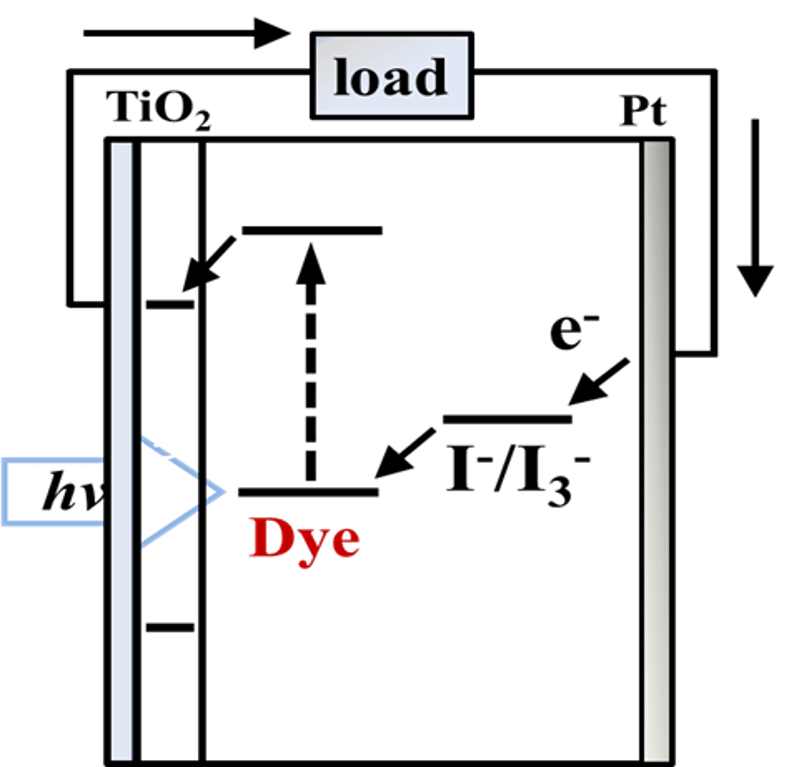
DSSC / Dye-Sensitized Solar Cell
色素が光を吸収し、半導体電極へ電子を渡して発電する太陽電池です。低コスト、半透明、室内光利用などが期待されます。
EN: A solar cell in which dyes absorb light and inject electrons into a semiconductor, promising low-cost, semi-transparent, and indoor-light photovoltaics. -
光電極 / Photoanode
色素を固定し、光で生じた電子を受け取る電極です。TiO2の欠陥、希土類元素、CeO2修飾などが光吸収と電子移動を左右します。
EN: The electrode that holds the dye and receives photoexcited electrons. TiO2 defects, rare-earth elements, and CeO2 modification influence absorption and charge transport. -
対極 / Counter Electrode
電解質中の酸化還元反応を助ける電極です。白金の代替として、炭素、導電性高分子、LDH、金属酸化物などが研究されています。
EN: The electrode that catalyzes redox reactions in the electrolyte. Carbon, conducting polymers, LDHs, and metal oxides are studied as platinum alternatives. -
持続可能な電解質 / Sustainable Electrolyte
揮発性有機溶媒を減らし、水系、深共晶溶媒、バイオ由来ゲルなどを用いる考え方です。安全性と長期安定性の向上が目的です。
EN: An approach using water-based, deep eutectic solvent, or bio-derived gel electrolytes to reduce volatile organic solvents and improve safety and durability. -
分子設計 / Molecular Design
色素のドナー、π共役部、アクセプターを調整し、光吸収、電荷移動、TiO2への電子注入を最適化する設計です。
EN: The tuning of donor, π-bridge, and acceptor units in dyes to optimize light absorption, charge transfer, and electron injection into TiO2.
採用した3本 / Three Selected Papers
-
Coordination Chemistry Reviews(2025 JIF: 25.6)
Defect engineering via rare-earth incorporation (DE-RE) in TiO2 photocatalysts: Wavelength-dependent energy conversion performance
DOI: 10.1016/j.ccr.2026.218171 -
Molecules(2025 JIF: 5.1)
Sustainable Electrolyte Media in Dye-Sensitized Solar Cells: From Water-Based to Deep Eutectic Solvents and Biopolymeric Approaches
DOI: 10.3390/molecules31122037 -
Journal of Molecular Structure(2025 JIF: 4.9)
Impact of donor moieties in D-π-A organic sensitizers on single and tandem dye-sensitized solar cell performance: An experimental and theoretical study
DOI: 10.1016/j.molstruc.2026.146823
日本語版
1. 希土類元素でTiO2の欠陥を制御し、DSSCを含む光エネルギー変換へ応用する
論文: Defect engineering via rare-earth incorporation (DE-RE) in TiO2 photocatalysts: Wavelength-dependent energy conversion performance
掲載誌: Coordination Chemistry Reviews
DOI: 10.1016/j.ccr.2026.218171
- この総説は、TiO2に希土類元素を組み込み、欠陥状態や電子構造を制御する研究を幅広く整理したものです。
- TiO2はDSSCでもよく使われる半導体材料ですが、通常は紫外光応答が中心で、可視光の利用や電荷再結合の抑制に課題があります。
- 希土類元素を導入すると、酸素空孔や電子準位が変化し、紫外から可視・近赤外までの光応答を広げられる可能性があります。
- 欠陥制御は、光を吸収した後の電子と正孔の分離を助け、光電極での電子輸送を改善する方向に働きます。
- 総説では、光触媒水分解だけでなく、DSSC、ペロブスカイト太陽電池、有機太陽電池などへの展開も扱われています。
- さらに、合成法、評価法、界面制御、バンド整合、AI支援ドーピング設計、ライフサイクル評価まで議論されています。
- 一般向けに言えば、「TiO2の中にわざと小さな“乱れ”を作り、光をよりよく使える材料へ育てる」研究の総覧です。
2. 水系・深共晶溶媒・バイオ高分子で、より安全なDSSC電解質へ
論文: Sustainable Electrolyte Media in Dye-Sensitized Solar Cells: From Water-Based to Deep Eutectic Solvents and Biopolymeric Approaches
掲載誌: Molecules
DOI: 10.3390/molecules31122037
- この総説は、DSSCの持続可能性を高めるため、電解質を中心に研究動向を整理したものです。
- 従来のDSSCでは、揮発性の有機溶媒を含む電解質が使われる場合があり、毒性、可燃性、漏れ、長期安定性が課題になります。
- 水系電解質は安全性が高い一方で、色素や界面反応との相性を慎重に設計する必要があります。
- 深共晶溶媒は、揮発しにくく、イオン輸送と安定性を両立できる候補として注目されています。
- バイオ由来高分子や準固体電解質は、漏れを抑え、柔らかいデバイスや室内光用DSSCへの応用に向きます。
- 総説では、電解質組成、色素設計、界面での電荷移動が互いに影響し合うことが強調されています。
- 一般向けに言えば、「DSSCを安全で長持ちする太陽電池にするため、電解液をより環境にやさしいものへ置き換える」研究です。
3. ドナー部位を変えて、単セル・タンデムDSSC用の有機色素を設計する
論文: Impact of donor moieties in D-π-A organic sensitizers on single and tandem dye-sensitized solar cell performance: An experimental and theoretical study
掲載誌: Journal of Molecular Structure
DOI: 10.1016/j.molstruc.2026.146823
- この研究は、金属を使わないD-π-A型有機色素を設計し、ドナー部位の違いがDSSC性能に与える影響を調べたものです。
- 色素には、トリフェニルアミン、カルバゾール、インドールなどのドナー部位が組み込まれています。
- ドナー部位を変えることで、分子の平面性、分子内電荷移動、HOMO/LUMO準位、TiO2への電子注入のしやすさが変わります。
- トリフェニルアミン系色素では、吸収が長波長側へ広がり、電荷移動も強くなりました。
- 単セルではA2色素が最も高い性能を示し、さらにN719を上部セル、A2を下部セルにした並列タンデムDSSCでは効率が大きく向上しました。
- 実験とDFT/TD-DFT計算を組み合わせることで、分子構造とデバイス性能の関係が整理されています。
- 一般向けに言えば、「色素の“光を受け取る側”を少し変えるだけで、太陽電池の電流や効率が変わることを示した」研究です。
まとめ
今回の3本は、DSSCを高性能かつ持続可能な技術へ近づけるために、材料の階層的な設計が重要であることを示しています。TiO2の欠陥制御は光電極の基盤を改善し、持続可能な電解質は安全性と寿命に関わり、有機色素のドナー設計は光吸収と電子注入を左右します。DSSCは、分子、界面、デバイス全体を一体で設計することで、低コスト・低環境負荷の太陽電池としてさらに発展できます。
English Version
1. Rare-earth defect engineering in TiO2 for energy conversion, including DSSCs
Paper: Defect engineering via rare-earth incorporation (DE-RE) in TiO2 photocatalysts: Wavelength-dependent energy conversion performance
Journal: Coordination Chemistry Reviews
DOI: 10.1016/j.ccr.2026.218171
- This review summarizes how rare-earth incorporation can engineer defects and electronic structures in TiO2 materials.
- TiO2 is widely used in DSSC photoanodes, but its light response and recombination behavior require careful tuning.
- Rare-earth incorporation can introduce or regulate defect states, shift absorption toward visible and near-infrared regions, and support wavelength-dependent energy conversion.
- Defect engineering can improve charge separation and transport, both of which matter for solar-cell operation.
- The review covers applications in hydrogen evolution, oxygen evolution, photoelectrochemical water splitting, and photovoltaic devices including DSSCs, perovskite solar cells, and organic solar cells.
- It also discusses synthesis, characterization, interface engineering, band alignment, AI-assisted doping design, scalability, and life-cycle assessment.
- In simple terms, the paper explains how carefully controlled “imperfections” in TiO2 can make light-energy materials work better.
2. Sustainable electrolyte media for safer and more durable DSSCs
Paper: Sustainable Electrolyte Media in Dye-Sensitized Solar Cells: From Water-Based to Deep Eutectic Solvents and Biopolymeric Approaches
Journal: Molecules
DOI: 10.3390/molecules31122037
- This review focuses on electrolyte media as a key factor in making DSSCs more sustainable.
- Conventional DSSCs often rely on volatile organic-solvent electrolytes, which can raise concerns about toxicity, flammability, leakage, and long-term stability.
- Water-based electrolytes can improve safety but require careful matching with dyes and interfaces.
- Deep eutectic solvents are attractive because they are less volatile and can support ion transport and durability.
- Bio-derived and quasi-solid electrolytes can reduce leakage and support flexible, indoor, or building-integrated DSSC designs.
- The review highlights the interplay among electrolyte composition, dye design, and interfacial charge transfer.
- For general readers, this paper explores how replacing risky liquids with safer media can help DSSCs become more practical and sustainable.
3. Donor engineering in organic dyes for single and tandem DSSCs
Paper: Impact of donor moieties in D-π-A organic sensitizers on single and tandem dye-sensitized solar cell performance: An experimental and theoretical study
Journal: Journal of Molecular Structure
DOI: 10.1016/j.molstruc.2026.146823
- This study designs metal-free D-π-A organic sensitizers and tests how donor units affect DSSC performance.
- The dyes include triphenylamine, carbazole, and indole donor units within a quinoline-carboxylic acid acceptor architecture.
- Changing the donor unit alters molecular planarity, intramolecular charge transfer, frontier orbital alignment, and electron-injection driving force.
- Triphenylamine-based dyes show stronger charge-transfer character, higher molar extinction coefficients, and red-shifted absorption.
- A2 gives the best single-cell performance among the studied sensitizers.
- A parallel tandem DSSC using N719 as the top-cell dye and A2 as the bottom-cell dye significantly improves efficiency compared with a single N719 device.
- In simple terms, the study shows that changing the light-harvesting “donor” part of a dye can strongly affect how well a DSSC converts light into electricity.
Overall Takeaway
The selected papers show that DSSC performance and sustainability depend on multiple layers of design. Defect-engineered TiO2 can improve the photoanode foundation. Sustainable electrolytes can improve safety and durability. Donor-engineered organic dyes can tune light absorption and electron injection. Together, these studies show that better DSSCs require coordinated molecular, interfacial, and device-level engineering.
文献 / References
- Mohamed, N. A.; Kiong, T. S.; Ismail, A. F. Defect engineering via rare-earth incorporation (DE-RE) in TiO2 photocatalysts: Wavelength-dependent energy conversion performance. Coordination Chemistry Reviews 566 (2026), 218171. DOI: 10.1016/j.ccr.2026.218171.
- Salerno, G.; Manfredi, N.; Abbotto, A.; Bettucci, O. Sustainable Electrolyte Media in Dye-Sensitized Solar Cells: From Water-Based to Deep Eutectic Solvents and Biopolymeric Approaches. Molecules 31 (2026), 2037. DOI: 10.3390/molecules31122037.
- Abdellah, I. M.; Eletmany, M. R.; Eissa, F. M. Impact of donor moieties in D-π-A organic sensitizers on single and tandem dye-sensitized solar cell performance: An experimental and theoretical study. Journal of Molecular Structure 1374 (2026), 146823. DOI: 10.1016/j.molstruc.2026.146823.
選定メモ / Selection Note
- Coordination Chemistry Reviews:2025 JIF 25.6。
- Molecules:2025 JIF 5.1。
- Journal of Molecular Structure:2025 JIF 4.9。
- 添付ファイル内には、PEDOT:PSS/活性炭対極、イミノクマリン系色素、CeO2修飾TiO2光電極、LDH系対極、ZnO修飾光電極、プラズマ処理バイオポリマー対極、計算化学による新規色素設計など、多数のDSSC関連研究が含まれていました。本稿では、添付ファイル内限定を守りつつ、DSSCとの関連性が明確で、かつジャーナル指標が高い3本を優先しました。