date: 2026-01-24
keywords: [Stern-Volmer analysis, photoluminescence quenching, quantum dot-dye assembly, quantum dots, rster resonance energy transfer, time-resolved optical spectroscopy]
FRET(フォースター共鳴エネルギー移動)とは?
FRETは、光を吸収した分子(ドナー)の励起エネルギーが、近くにある別の分子(アクセプター)へ “光を出さずに” 移る現象です。
距離(数nm)とスペクトルの重なりに強く依存するため、分子間距離の“ものさし”や、エネルギー移動を利用した機能材料として広く使われます。
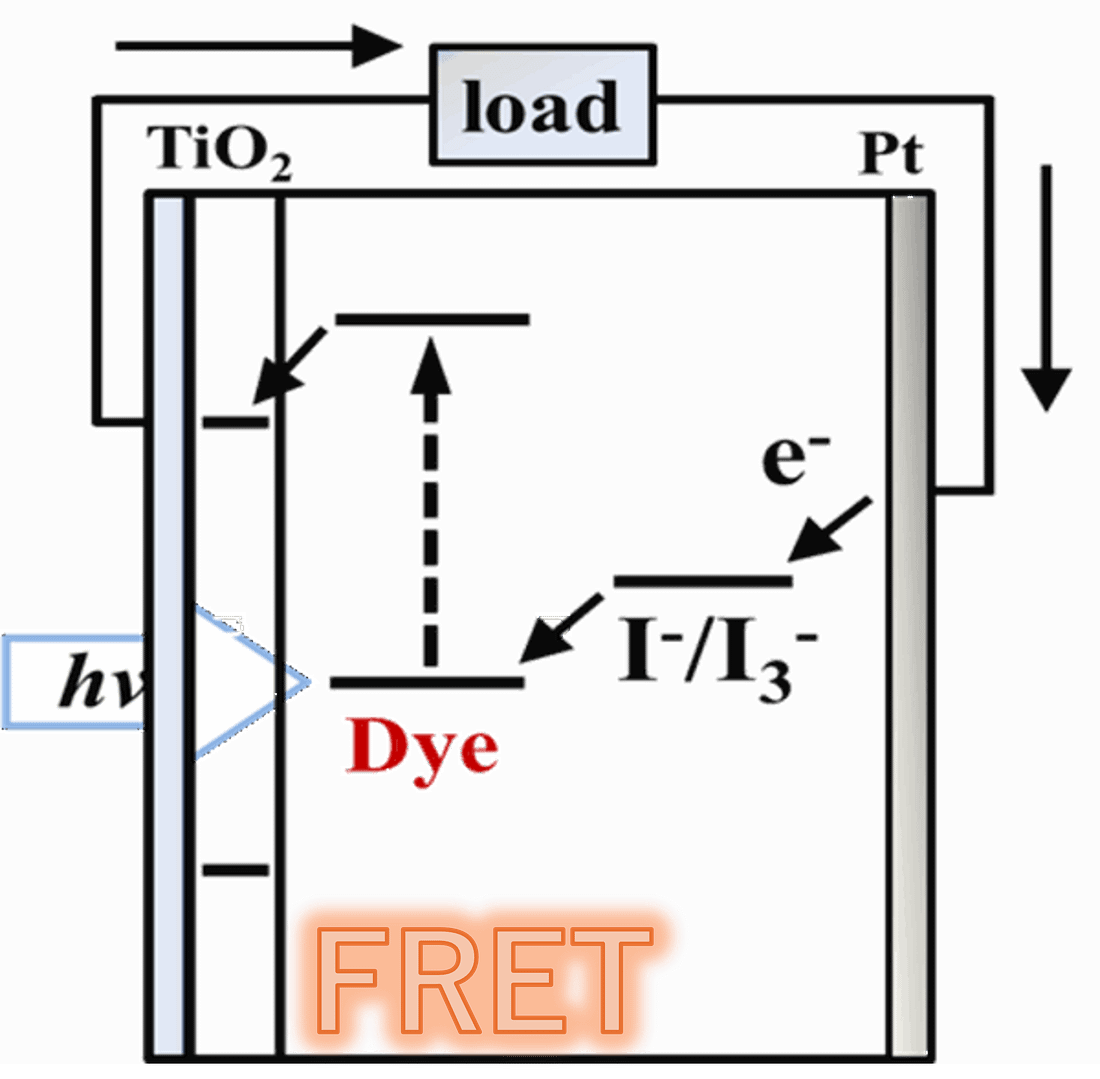
DSSC(色素増感太陽電池)でも、- 光をよく吸う色素 → 別の吸収体へエネルギー移動- あるいは、エネルギー移動と電荷分離の競争を制御
といった観点で、FRETを含む相互作用の理解が重要です。
論文のやさしい解説
論文1:Photoluminescence Quenching Versus Enhancement of InP Core/Shell and Core/Shell/Shell Quantum Dots Induced by Adsorption of Rhodamine Dyes
- 著者:Al-Maskari, S; Issac, A; Hildner, R; Al-Hammadi, M; Sofin, RGS; Myint, MTZ; Abou-Zied, OK
- 掲載誌:CHEMISTRYSELECT(2026)
- DOI:10.1002/slct.202504297
日本語:何の研究?(ひとことで)
量子ドット(QD)と色素(ローダミン)を近づけたとき、「発光が弱まる(消光)」のか「強まる(増強)」のかを、FRETと電荷分離の競争として整理した研究
ポイント(やさしく)
– QDと色素が近いと、光エネルギーが非接触で移る FRET(フォレスター共鳴エネルギー移動) が起こり得る。
– 一方で、QD表面に色素由来の状態ができると、電子が移って 電荷分離→非発光失活(消光) が起こることもある。
– 本研究は、InP/ZnS(CS)とInP/ZnSe/ZnS(CSS)で“電子波動関数の広がり”が違う点に注目し、消光の起こりやすさやFRET効率が大きく変わることを、定常・時間分解分光で示した。
– 励起波長を変えると、QD側を強く励起するか/色素側も励起するかが変わり、消光とFRETのバランスが変化。
– 500 nm励起では、CS系で色素→QDのFRETが高効率(約77%)になり、QD発光が増強し得る。
– CSS系では中間のZnSe層が距離や結合を変え、FRET効率が下がる(約18%)。一方で消光速度がFRETを上回り、電荷分離が有利になる条件も示された。
応用イメージ
– バイオイメージング:発光“増強”を活かすQD–色素アセンブリ
– 色素増感太陽電池(DSSC)や光電変換:電荷分離が進む条件を設計に利用
– 励起波長・材料構造で“FRET↔消光”を切り替える分子設計指針
English: What is this about?
Quantum dot–dye assemblies: when does photoluminescence quench vs enhance? A competition between charge separation and FRET
Key points
– At short distances, dyes can transfer excitation energy to quantum dots via Förster resonance energy transfer (FRET).
– Dye-induced surface states can also promote charge separation / nonradiative recombination, leading to PL quenching.
– By comparing InP/ZnS (core/shell) vs InP/ZnSe/ZnS (core/shell/shell), the study links quenching strength to the spatial extent of the electron wavefunction and surface interactions.
– Excitation wavelength tunes whether QDs or dyes are primarily excited, shifting the balance between quenching and FRET.
– Under 500 nm excitation, efficient dye→QD FRET (~77%) can enhance PL for core/shell QDs.
– For core/shell/shell QDs, an intermediate shell reduces FRET (~18%), and quenching can dominate—relevant for designing charge-separating assemblies.
Possible applications
– Bioimaging (leveraging PL enhancement)
– Dye-sensitized solar cells and photoconversion (designing for efficient charge separation)
– Design rules to control FRET vs quenching via structure and excitation conditions
用語ミニ解説 / Mini‑Glossary
- FRET:Förster resonance energy transfer(距離依存の非放射エネルギー移動)
- PL(Photoluminescence):光励起による発光(フォトルミネッセンス)
- Quenching(消光):発光が弱くなる現象(非放射過程や電荷分離が原因になりうる)
- Stern–Volmer解析:消光の強さ(KSV)や速度を見積もる基本解析
- Core/Shell QDs:中心核(core)と殻(shell)で構成される量子ドット
- Wavefunction extent(波動関数の広がり):電子がどこまで広がって存在するか(表面相互作用に効く)
References(添付データ内)
- Al-Maskari, S; Issac, A; Hildner, R; Al-Hammadi, M; Sofin, RGS; Myint, MTZ; Abou-Zied, OK Photoluminescence Quenching Versus Enhancement of InP Core/Shell and Core/Shell/Shell Quantum Dots Induced by Adsorption of Rhodamine Dyes. CHEMISTRYSELECT (2026). DOI: 10.1002/slct.202504297
Tags
DSSC, FRET, quantum dots, dye assembly, photoluminescence, quenching, charge separation