HP用解説(日本語 / English)
キーワード / Keywords
- OLED(有機EL) / organic light-emitting diode
- TADF(熱活性化遅延蛍光) / thermally activated delayed fluorescence
- 青色発光 / blue emission
- 狭帯域発光 / narrowband emission
- 多重共鳴(MR) / multiple resonance
- 励起状態設計 / excited-state design
- 遅延蛍光寿命 / delayed fluorescence lifetime
- 溶液プロセス / solution processing
- データ駆動材料探索 / data-driven materials discovery
- 外部量子効率(EQE) / external quantum efficiency
日本語版
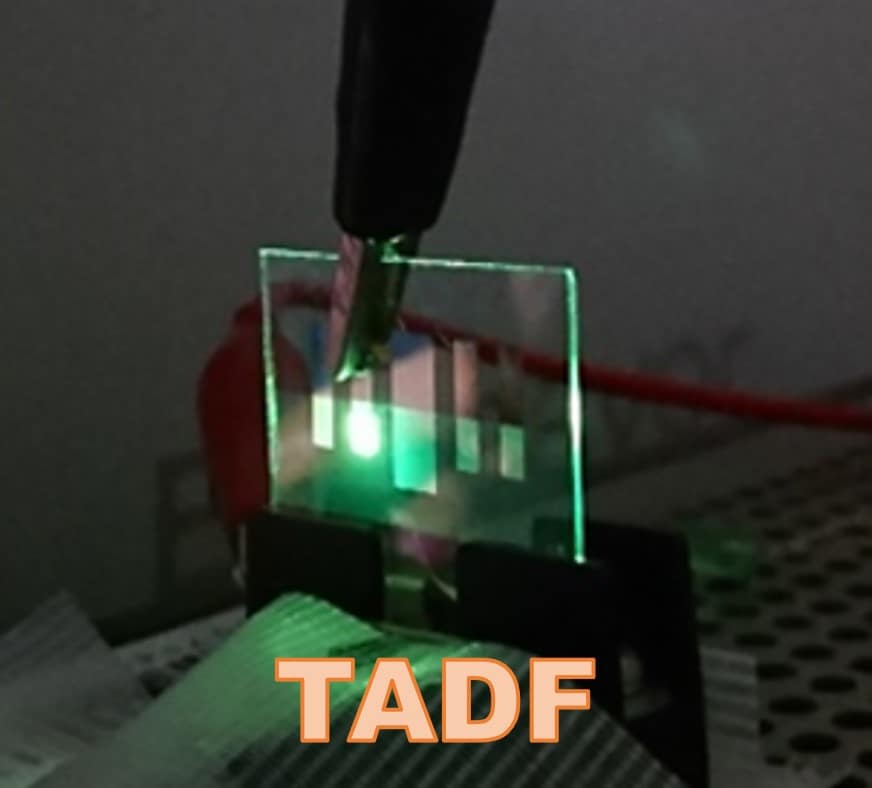
TADFとは?
TADF(熱活性化遅延蛍光)は、有機EL材料が本来は使いにくい三重項励起子のエネルギーを、再び一重項へ戻して光に変える仕組みです。
これにより、貴金属を使わなくても高効率発光が期待できるため、次世代OLED材料として大きな注目を集めています。
今回のファイルでは、AIによる材料探索、分子配列を利用した溶液プロセス化、高色純度ブルー発光分子の設計という3つの方向から、TADF研究の代表例が見られました。
1. AIで高効率TADF発光体を見つける研究
論文
Chen ZJ, Zong SL, Zhao WY, Gong XF, Chen PZ, Sun W, Li ML, Chen XQ, Du JJ, Fan JL, Peng XJ.
An Interpretable Multimodal Architecture for the Discovery of High-Efficiency Thermally Activated Delayed Fluorescence Emitters
ACS Nano (2026), 20(21), 15473–15487.
DOI: 10.1021/acsnano.6c03751
この論文を選んだ理由
– TADF材料探索を「経験」だけでなく 機械学習で加速するという、一般の方にも伝わりやすい新しい流れを示しています。
わかりやすいポイント
– 高効率TADF材料を探すには、本来多くの分子を合成して調べる必要があります。
– この研究では、HoloMat-TADF という解釈可能な機械学習モデルを使って、分子構造や物性の情報をまとめて学習させています。
– そのモデルから有望候補として提案された 2つの分子(Mol-5, Mol-9)を実際に合成し、予測が正しいかを確認しています。
– その結果、PLQYが98%以上、ΔESTが約0.1 eV、遅延蛍光寿命が6 µs未満 といった優れた特性が得られ、OLEDでは 最大EQE 31.3% が報告されました。
– つまりこの研究は、「どんな材料が良いか」を人の勘だけでなく、AIに“考えさせる”ことで新材料探索を速くする研究です。
一般向けに言うと…
「有機ELに向いた“よく光る分子”を、AIで効率よく見つける研究」 です。
2. 液晶のように自分で並ぶTADF分子で、塗って作るOLEDを高性能化する研究
論文
De J, Yasuda Y, Takenaka M, Drysdale-Dykes A, Kaji H, Zysman-Colman E.
A columnar liquid crystalline self-assembly of a donor-acceptor TADF emitter design for solution-processed OLEDs
Chemical Science (2026)
DOI: 10.1039/d6sc02453j
この論文を選んだ理由
– TADF材料そのものだけでなく、どう並ぶか・どう塗れるか まで含めて設計している点が特徴的です。
– 将来の低コスト製造や柔軟デバイスにもつながる視点があります。
わかりやすいポイント
– 通常の高性能OLEDは真空蒸着で作ることが多いですが、より安価に作るには 溶液プロセス(塗布法) が魅力です。
– ただし、塗って作ると分子の並び方が乱れやすく、性能が落ちやすいという課題があります。
– この研究では、TADF分子が 円柱状の液晶構造 を自発的につくるように設計されています。
– その結果、分子が比較的そろって並び、光を外へ取り出しやすくなるため、緑色の溶液プロセスOLEDで 最大EQE 15.5% を達成しました。
– つまり、「分子が自分で並ぶ性質」を利用して、塗って作るOLEDの性能を底上げした研究です。
一般向けに言うと…
「塗って作る有機ELでも高性能にするために、分子が自分で整列するよう設計した研究」 です。
3. 狭帯域で純青色に光る、新しいMR-TADF分子の研究
論文
Keshri SK, Nomura H, Yasuda T.
Boron-Doped Azacalix[3]arene Macrocycles Enabling Narrowband Blue TADF
Advanced Optical Materials (2026)
DOI: 10.1002/adom.71298
この論文を選んだ理由
– ディスプレイ分野で特に重要な 高色純度ブルー発光 に正面から取り組んでいる研究です。
– 「青く、きれいに、しかも効率よく光る」はOLED材料開発の中心課題の一つです。
わかりやすいポイント
– 青色OLEDでは、発光効率と色純度を両立するのが難しいという課題があります。
– この研究では、azacalix[3]arene 骨格にホウ素を導入した MR-TADF分子(B1-ACCz3, B2-ACCz3)を設計しています。
– 分子が「ちょうちょう」のようにねじれた構造をとることで、不要な振動が抑えられ、半値幅22–28 nm の狭帯域青色発光が得られています。
– B1-ACCz3は 460 nm の超高純度ブルー発光、B2-ACCz3デバイスは 最大EQE 23.8% を示しました。
– これは、超高精細ディスプレイに求められる「にごりの少ない青色」を実現するうえで重要な成果です。
一般向けに言うと…
「にじみにくい“きれいな青”を、効率よく出せる有機EL分子をつくった研究」 です。
まとめ
- 今回のTADF関連ファイルでは、
- AIで発光分子を見つける
- 分子の自己組織化で塗布型OLEDを高性能化する
- 狭帯域ブルーMR-TADF分子を設計する
という3つの方向が見られました。 - 共通しているのは、単に「光る分子を作る」だけでなく、
- どう探索するか
- どう並べるか
- どう色純度を高めるか
まで含めて材料設計している点です。 - これらの研究は、将来の 高効率OLED, 高精細ディスプレイ, 低コスト製造プロセス につながる重要な流れといえます。
English Version
What is TADF?
TADF (thermally activated delayed fluorescence) is a mechanism that allows organic emitters to convert normally hard-to-use triplet excitons back into singlet excitons and then into light.
Because this can enable very high efficiency without relying on precious-metal emitters, TADF has become one of the most important directions in next-generation OLED research.
In the uploaded files, three representative directions stood out: AI-driven materials discovery, self-assembled solution-processable emitters, and high-color-purity blue-emitting molecular design.
1. Using AI to discover high-efficiency TADF emitters
Paper
Chen ZJ, Zong SL, Zhao WY, Gong XF, Chen PZ, Sun W, Li ML, Chen XQ, Du JJ, Fan JL, Peng XJ.
An Interpretable Multimodal Architecture for the Discovery of High-Efficiency Thermally Activated Delayed Fluorescence Emitters
ACS Nano (2026), 20(21), 15473–15487.
DOI: 10.1021/acsnano.6c03751
Why this paper was selected
– It was published in the highest-impact journal among the uploaded candidates.
– It clearly shows a new trend that is easy to explain to a general audience: using AI to accelerate OLED materials discovery.
Easy-to-understand points
– Finding efficient TADF emitters usually requires synthesizing and testing many candidate molecules.
– In this work, the researchers developed an interpretable machine-learning framework called HoloMat-TADF, which combines molecular structure information with broader physicochemical features.
– The model proposed two promising molecules, Mol-5 and Mol-9, which were then actually synthesized and tested.
– The experiments confirmed excellent properties, including PLQY above 98%, ΔEST around 0.1 eV, and delayed-fluorescence lifetimes below 6 µs, leading to OLEDs with a maximum EQE of 31.3%.
– This means the study is not just about AI prediction, but about using AI to efficiently guide real materials discovery.
In simple words…
This is a study on using AI to find “well-glowing” OLED molecules much more efficiently.
2. Designing self-assembling TADF molecules for high-performance solution-processed OLEDs
Paper
De J, Yasuda Y, Takenaka M, Drysdale-Dykes A, Kaji H, Zysman-Colman E.
A columnar liquid crystalline self-assembly of a donor-acceptor TADF emitter design for solution-processed OLEDs
Chemical Science (2026)
DOI: 10.1039/d6sc02453j
Why this paper was selected
– It was published in a high-impact journal and highlights not only TADF emission itself, but also how molecules arrange themselves and how devices can be made more cheaply by coating methods.
Easy-to-understand points
– High-performance OLEDs are often made by vacuum deposition, but solution processing is attractive for lower-cost fabrication.
– The difficulty is that coated molecules often arrange poorly, which reduces device performance.
– In this study, the TADF molecule was designed to self-assemble into columnar liquid-crystalline structures.
– This self-organization improves molecular alignment and light out-coupling, leading to green solution-processed OLEDs with a maximum EQE of 15.5%.
– In other words, the material was designed so that the molecules “line themselves up” in a useful way.
In simple words…
This is a study on designing OLED molecules that organize themselves so coated devices can still perform well.
3. A new MR-TADF molecule for narrowband pure-blue emission
Paper
Keshri SK, Nomura H, Yasuda T.
Boron-Doped Azacalix[3]arene Macrocycles Enabling Narrowband Blue TADF
Advanced Optical Materials (2026)
DOI: 10.1002/adom.71298
Why this paper was selected
– It was published in a high-impact journal and directly addresses one of the biggest OLED challenges: high-color-purity blue emission.
– Producing blue light that is both efficient and spectrally pure is a central issue in display technology.
Easy-to-understand points
– In blue OLEDs, it is difficult to achieve both high efficiency and high color purity at the same time.
– This study designed boron-doped azacalix[3]arene MR-TADF emitters (B1-ACCz3 and B2-ACCz3).
– Their rigid and twisted macrocyclic structure suppresses unwanted molecular vibrations, leading to very narrow emission bands with FWHM of 22–28 nm.
– B1-ACCz3 produced ultrapure blue electroluminescence at 460 nm, while a B2-ACCz3-based OLED reached a maximum EQE of 23.8%.
– These properties are highly valuable for future ultra-high-definition displays.
In simple words…
This is a study on creating an OLED molecule that gives a cleaner, more vivid blue without losing efficiency.
Take-home message
- In the uploaded TADF-related files, the selected studies focused on:
- discovering emitters with AI,
- improving coated OLEDs through self-assembly, and
- designing narrowband blue MR-TADF emitters.
- The shared theme is that modern OLED research is not only about making molecules that emit light, but also about
- how to discover them,
- how to organize them, and
- how to achieve both efficiency and color purity.
- These studies point toward future high-efficiency OLEDs, ultra-high-definition displays, and lower-cost fabrication routes.
参考文献 / References
- Chen ZJ, Zong SL, Zhao WY, Gong XF, Chen PZ, Sun W, Li ML, Chen XQ, Du JJ, Fan JL, Peng XJ. An Interpretable Multimodal Architecture for the Discovery of High-Efficiency Thermally Activated Delayed Fluorescence Emitters. ACS Nano. 2026;20(21):15473–15487. DOI: 10.1021/acsnano.6c03751
- De J, Yasuda Y, Takenaka M, Drysdale-Dykes A, Kaji H, Zysman-Colman E. A columnar liquid crystalline self-assembly of a donor-acceptor TADF emitter design for solution-processed OLEDs. Chemical Science. 2026. DOI: 10.1039/d6sc02453j
- Keshri SK, Nomura H, Yasuda T. Boron-Doped Azacalix[3]arene Macrocycles Enabling Narrowband Blue TADF. Advanced Optical Materials. 2026. DOI: 10.1002/adom.71298