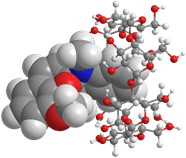
SP_CD: Making Light- and pH-Responsive Molecules Usable in Water with Molecular Containers
キーワード / Keywords
-
スピロピラン / Spiropyran
光、pH、熱などで構造や色が変わる刺激応答性分子です。薬物放出やセンサーに有望ですが、水中で扱いにくいことが課題です。
EN: Spiropyran changes structure and color in response to light, pH, or heat. It is promising for delivery systems and sensors but is difficult to use in water. -
メロシアニン / Merocyanine
スピロピランが開環してできる形です。電荷分布が変わるため、ホスト分子との結合や放出のしやすさが大きく変わります。
EN: Merocyanine is the open-ring form of spiropyran. Its charge distribution changes how strongly it binds to host molecules. -
ククルビット[8]ウリル / Cucurbit[8]uril
分子を内部に取り込める“容器”型のホスト分子です。水中で疎水性分子を包み、安定化や放出制御に利用できます。
EN: Cucurbit[8]uril is a barrel-shaped host molecule that can encapsulate guests, helping stabilize hydrophobic molecules in water. -
γ-シクロデキストリン / γ-Cyclodextrin
環状の糖分子で、内側に分子を入れる空洞を持ちます。本研究では、SP2に対してより受け入れやすい空洞環境を示す候補として比較されています。
EN: γ-Cyclodextrin is a cyclic sugar with an inner cavity. In this study, it is compared as a more accommodating host for SP2. -
ホスト–ゲスト相互作用 / Host-Guest Interaction
容器役の分子と中に入る分子の相互作用です。結合の強さだけでなく、入りやすさ・抜けにくさも機能設計に重要です。
EN: Host-guest interaction describes how a host molecule binds a guest. Both binding strength and kinetic retention matter for functional design.
採用した論文 / Selected Paper
- Physical Chemistry Chemical Physics(2025 JIF: 3.0)
Thermodynamic selectivity and kinetic control in the encapsulation of spiropyran derivatives by cucurbit[8]uril
DOI: 10.1039/d6cp00611f
日本語版
光で性質が変わる分子を、水の中で安定に使うには?
論文: Thermodynamic selectivity and kinetic control in the encapsulation of spiropyran derivatives by cucurbit[8]uril
掲載誌: Physical Chemistry Chemical Physics
DOI: 10.1039/d6cp00611f
- この研究は、スピロピラン誘導体を水中で扱いやすくするために、ホスト分子で包み込む方法を調べたものです。
- スピロピランは、光、pH、熱などの刺激で構造が変わるため、薬物送達や放出制御材料に使える可能性があります。
- 一方で、スピロピランは水に溶けにくく、水中で安定に働かせることが難しいという課題があります。
- 研究では、ククルビット[8]ウリル(CB[8])という“分子の容器”を使い、3種類のスピロピラン誘導体SP1〜SP3と、その開環体であるMC1〜MC3を比較しています。
- 計算化学により、どの分子がCB[8]に入りやすいかを、熱力学的な結合の安定性から評価しています。
- さらに、分子が容器に入る・出る過程をシミュレーションし、単に結合が強いだけでなく、「入りやすいか」「抜けにくいか」も調べています。
- MC1とMC2は、容器に入りやすく、入った後も比較的保持されやすい性質を示しました。
- 一方、より大きなSP3/MC3は、立体的に入りにくく、浅くふたをするような結合になりやすいと考えられました。
- 実験では、¹H NMRと時間分解UV-vis測定により、ホスト–ゲスト相互作用や異性化速度の変化が確認されています。
- 比較計算では、γ-シクロデキストリンがSP2に対して、より受け入れやすい空洞環境を持つ可能性も示されています。
- 一般向けに言えば、「光で形が変わる分子を、分子サイズのカプセルに入れて、水の中でも安定に使えるようにする」研究です。
何が新しいのか
- 従来は、ホスト分子とゲスト分子がどれくらい強く結合するかに注目しがちでした。
- この研究では、結合の強さに加えて、分子が容器に入る速さ、出にくさ、刺激で構造が変わるときの挙動まで合わせて評価しています。
- つまり、「よく入る」「中で安定」「必要なときに出せる」という3つの条件を同時に考えています。
- 計算で候補を絞り、実験で確かめる流れを示している点も重要です。
- この考え方は、光応答性材料、薬物送達、スマートゲル、分子センサーなどの設計に応用できます。
まとめ
SP_CDというファイル名に対応する今回の内容は、スピロピラン(SP)とシクロデキストリン(CD)を含むホスト–ゲスト化学の話題です。添付ファイル内の論文では、主にCB[8]を使ったスピロピラン誘導体の包接が扱われ、比較対象としてγ-シクロデキストリンも登場します。ポイントは、分子を包む力だけでなく、入る・出る速度まで考えて、低漏出で刺激応答性のある分子放出システムを設計することです。
English Version
How can light-responsive molecules work stably in water?
Paper: Thermodynamic selectivity and kinetic control in the encapsulation of spiropyran derivatives by cucurbit[8]uril
Journal: Physical Chemistry Chemical Physics
DOI: 10.1039/d6cp00611f
- This study investigates how spiropyran derivatives can be made more compatible with water by encapsulating them in host molecules.
- Spiropyrans are attractive because they respond to light, pH, and heat, making them useful candidates for controlled delivery and release systems.
- However, spiropyrans are hydrophobic and often unstable in aqueous environments, which limits practical use under physiological conditions.
- The researchers use cucurbit[8]uril, or CB[8], as a molecular container and compare three spiropyran derivatives, SP1-SP3, and their merocyanine forms, MC1-MC3.
- Computational analysis is used to evaluate which guest molecules bind more favorably inside CB[8].
- The study also examines the kinetics of entry and release, meaning how easily the guest enters the host and how strongly it is retained once inside.
- MC1 and MC2 show behavior consistent with efficient loading and good kinetic retention.
- The bulkier SP3/MC3 pair is sterically restricted and tends to form a shallower capping-type interaction rather than stable encapsulation.
- ¹H NMR and time-resolved UV-vis measurements confirm strong host-guest interactions and host-modulated isomerization behavior.
- Comparative simulations suggest that γ-cyclodextrin may provide a more accommodating cavity environment for SP2.
- In simple terms, this work studies how molecular capsules can help light-responsive molecules function more reliably in water.
What is new?
- Many host-guest studies focus mainly on binding strength.
- This work considers both thermodynamics and kinetics: how strongly a guest binds, how it enters, how long it stays, and how it responds to stimuli.
- The key design idea is to identify host-guest pairs that allow efficient loading, stable retention, and controlled release.
- The study combines computational screening with experimental validation.
- This workflow may help design future light-responsive delivery systems, smart gels, molecular sensors, and controlled-release platforms.
Overall Takeaway
The file theme SP_CD points to host-guest chemistry involving spiropyran (SP) and cyclodextrin (CD). The paper in the uploaded file mainly studies CB[8]-based encapsulation of spiropyran derivatives, while also comparing γ-cyclodextrin as a possible host for SP2. The central message is that useful supramolecular delivery systems require not only strong binding, but also controlled entry, retention, and release.
文献 / References
- Niu, Y.; Chen, F.; Guo, X.; Chen, Y.; Wen, J.; Zhu, M. Thermodynamic selectivity and kinetic control in the encapsulation of spiropyran derivatives by cucurbit[8]uril. Physical Chemistry Chemical Physics 28 (2026), 15898-15909. DOI: 10.1039/d6cp00611f.