作成日: 2026-02-01
どんなテーマ?
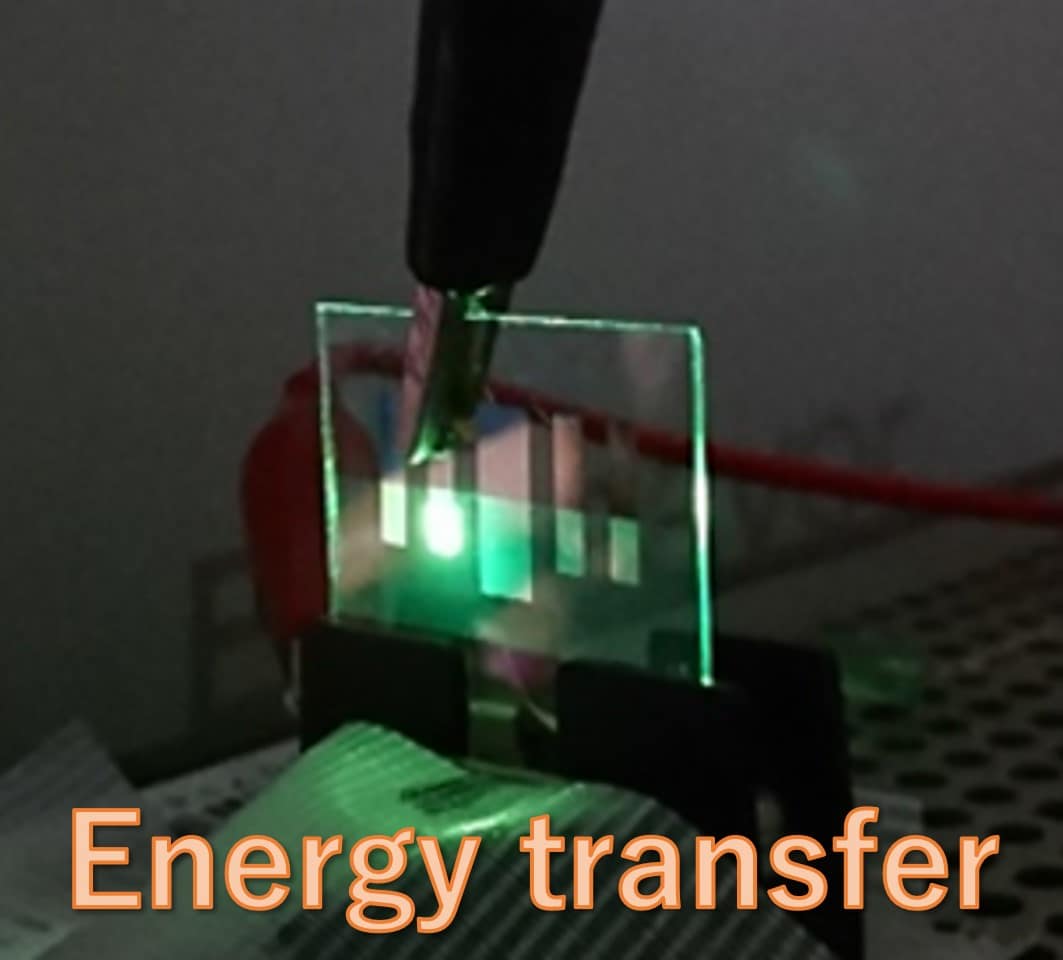
OLED(有機EL)では、電気で作った“励起子(エキシトン)”が光として放出されます。
その途中で起こる エネルギー移動(Förster / Dexter) や エキシプレックス形成、三重項(triplet)の蓄積 などが、
「明るさ」「色」「寿命(劣化)」を大きく左右します。
ピックアップ論文
1. Multispectral Oxide Phototransistor Array via Electrohydrodynamic Subpixel QD Patterning and Engineered IGZO Channels for Persistent Photoconductivity Suppression
- 掲載誌: ADVANCED FUNCTIONAL MATERIALS
- 年: 2026
- 著者: Na, JW; Lee, DK; Lee, IS; Choi, S; Hwang, YS; Kim, HJ
- DOI: 10.1002/adfm.202519144
やさしい解説(Abstractの要点を整理:本文の転載なし)
– IGZO(酸化物半導体)に量子ドット(CdSe QD)を組み合わせ、赤・緑・青を見分けられる多波長フォトトランジスタアレイを作製。
– EHDジェット印刷でQDをサブピクセル状に精密配置し、リソグラフィを使わない工程で作れる点が特徴。
– 酸素プラズマ処理で酸素欠陥由来のトラップを抑え、光を当てた後に戻りにくいPPC(持続光導電)を低減して高速回復を実現。
– アニール条件でQD/IGZO界面を最適化し、波長選択性と電荷移動を強化。
– RGB光に対して高い応答度・検出感度と、長時間の繰り返し照射でも安定な動作を示した(カラーセンシング/統合型光電子デバイス向け)。
2. Key Excitonic Processes Governing the Stability of Deep-Blue Phosphor-Sensitized Fluorescent Organic Light-Emitting Diodes
- 掲載誌: ADVANCED OPTICAL MATERIALS
- 年: 2026
- 著者: Yang, K; Oh, J; Kim, J; Lee, E; Nam, S; Lee, J
- DOI: 10.1002/adom.202503267
やさしい解説(Abstractの要点を整理:本文の転載なし)
– 深青色OLEDで有望な「PSF(リン光感作蛍光)」構造を対象に、劣化の原因となる励起子(エキシトン)過程を定量的に切り分けた研究。
– 低温フォトルミネッセンス測定と、複数経路を含む励起子動力学モデルを組み合わせ、どこでエネルギーが溜まり・失われるかを解析。
– 劣化の主因は、MR-TADFエミッタ側に高エネルギー三重項が蓄積し、分子が分解しやすくなることだと示した。
– 設計指針として、RISC(逆項間交差)の活性化エネルギーを高めること、さらにFörster(長距離)ETがDexter(短距離)ETに勝つ条件が有利と整理。
– 最適化により、CIEy≤0.15の深青色で寿命(T90)を大きく伸ばした(1000 cd m⁻²で141 h)。
3. Dual-Exciplex Architecture: A Universal Route to Color-Tunable OLEDs
- 掲載誌: ADVANCED OPTICAL MATERIALS
- 年: 2026
- 著者: Shen, ZT; Lü, ZY; Mu, HC; Xiao, J
- DOI: 10.1002/adom.202503202
やさしい解説(Abstractの要点を整理:本文の転載なし)
– 2種類のドナーと1種類のアクセプターを混ぜ、同時に2つのエキシプレックス(高エネルギー/低エネルギー)を作るデュアル・エキシプレックス設計を提案。
– 電圧(バイアス)によって、ホスト側からゲスト側へのエネルギー移動の効き方が変わり、発光色が連続的に変わる仕組み。
– 低電圧ではゲスト発光が優勢、高電圧ではゲストが飽和してホスト発光が強まり、CIE座標がシフト。
– 同じ考え方を、共混合・簡略二層・積層ヘテロ構造など複数の素子アーキテクチャへ展開できることを示した。
– ドナーをTAPCやTPDに置き換えることで、色可変範囲をさらに広げられることを実証(照明や偽造防止などへ応用)。
English version (for website)
What is this topic about?
In OLEDs, electrically generated excitons must be converted into light efficiently.
Processes such as energy transfer (Förster/Dexter), exciplex formation, and triplet accumulation strongly affect brightness, color, and operational lifetime.
Selected papers
1. Multispectral Oxide Phototransistor Array via Electrohydrodynamic Subpixel QD Patterning and Engineered IGZO Channels for Persistent Photoconductivity Suppression
- Journal: ADVANCED FUNCTIONAL MATERIALS (2024 JIF: 19.0)
- Year: 2026
- Authors: Na, JW; Lee, DK; Lee, IS; Choi, S; Hwang, YS; Kim, HJ
- DOI: 10.1002/adfm.202519144
Plain-language bullets (paraphrased from the abstract; no verbatim text)
– Creates a multispectral IGZO phototransistor array by integrating CdSe quantum dots (QDs) to discriminate red/green while keeping native blue sensitivity.
– Uses electrohydrodynamic (EHD) jet printing to pattern QDs at subpixel level without conventional lithography.
– Oxygen‑plasma treatment suppresses oxygen‑vacancy traps, reducing persistent photoconductivity (PPC) and enabling fast recovery.
– Thermal annealing optimizes the QD/IGZO interface for improved charge transfer and spectral selectivity.
– Demonstrates strong RGB responsivity and robust cycling stability, supporting scalable color‑sensing and integrated optoelectronics.
2. Key Excitonic Processes Governing the Stability of Deep-Blue Phosphor-Sensitized Fluorescent Organic Light-Emitting Diodes
- Journal: ADVANCED OPTICAL MATERIALS (2024 JIF: 7.2)
- Year: 2026
- Authors: Yang, K; Oh, J; Kim, J; Lee, E; Nam, S; Lee, J
- DOI: 10.1002/adom.202503267
Plain-language bullets (paraphrased from the abstract; no verbatim text)
– Quantitatively disentangles key exciton processes that govern degradation in deep‑blue phosphor‑sensitized fluorescent (PSF) OLEDs.
– Combines cryogenic photoluminescence with multi‑channel exciton‑kinetic modeling to identify where energy accumulates and how it decays.
– Finds degradation is mainly driven by MR‑emitter dissociation triggered by high‑energy triplet accumulation.
– Derives design rules: increasing the activation energy for RISC and ensuring Förster energy transfer outcompetes Dexter transfer improves stability.
– Demonstrates a deep‑blue device (CIEy ≤ 0.15) with improved lifetime (T90 = 141 h at 1000 cd m⁻²).
3. Dual-Exciplex Architecture: A Universal Route to Color-Tunable OLEDs
- Journal: ADVANCED OPTICAL MATERIALS (2024 JIF: 7.2)
- Year: 2026
- Authors: Shen, ZT; Lü, ZY; Mu, HC; Xiao, J
- DOI: 10.1002/adom.202503202
Plain-language bullets (paraphrased from the abstract; no verbatim text)
– Proposes a dual‑exciplex strategy that forms two exciplex states (high‑ and low‑energy) by blending two donors with one acceptor.
– Voltage controls host‑to‑guest energy transfer, enabling continuous color tuning.
– At low bias, efficient transfer yields dominant guest emission; at higher bias, guest saturation suppresses transfer and enhances host emission.
– Demonstrates architectural versatility across co‑doping, simplified bilayers, and layered heterostructures.
– Shows wider tuning ranges by swapping the guest donor (e.g., TAPC or TPD), supporting applications like smart lighting and anti‑counterfeiting.
参考文献 / References
- Na, JW; Lee, DK; Lee, IS; Choi, S; Hwang, YS; Kim, HJ (2026). Multispectral Oxide Phototransistor Array via Electrohydrodynamic Subpixel QD Patterning and Engineered IGZO Channels for Persistent Photoconductivity Suppression. ADVANCED FUNCTIONAL MATERIALS. doi:10.1002/adfm.202519144
- Yang, K; Oh, J; Kim, J; Lee, E; Nam, S; Lee, J (2026). Key Excitonic Processes Governing the Stability of Deep-Blue Phosphor-Sensitized Fluorescent Organic Light-Emitting Diodes. ADVANCED OPTICAL MATERIALS. doi:10.1002/adom.202503267
- Shen, ZT; Lü, ZY; Mu, HC; Xiao, J (2026). Dual-Exciplex Architecture: A Universal Route to Color-Tunable OLEDs. ADVANCED OPTICAL MATERIALS. doi:10.1002/adom.202503202