作成日: 2026-02-01
日本語版(HP向け)
どんなテーマ?
OLED(有機EL)では、発光分子(エミッター)にエネルギーをうまく渡し、明るさ(効率)と長寿命(劣化しにくさ)を両立する設計が重要です。
特に、分子間のエネルギー移動(Förster/Dexter)や、ドナーとアクセプターの界面で生じるエキシプレックスは、色・効率・寿命に直結します。
対象論文
1. Substituent modification to prevent Dexter energy transfer for stable hyperfluorescent organic light-emitting diodes
- 掲載誌: CHEMISTRY LETTERS
- 年: 2026
- 著者: Lee, C; Tsuchiya, Y; Lee, SY; Adachi, C
- DOI: 10.1093/chemle/upaf240
やさしい解説(Abstractの要点を整理:本文の転載なし)
– “ハイパーフルオレッセンスOLED”では、補助ドーパントから終端発光体(TE)へのエネルギー移動が鍵ですが、近距離で起こるDexter型エネルギー移動が劣化に関わることがあります。
– 本研究は、TEにかさ高い置換基を導入して分子同士の距離を広げ、Dexter型エネルギー移動が起こりにくい配置を狙いました。
– その結果、発光効率(EQE)を保ちながら、素子寿命(安定性)を伸ばせることを示しました。
– “分子を少し大きくして距離を稼ぐ”という、直感的で設計に使いやすい指針が得られます。
2. Dual-Exciplex Architecture: A Universal Route to Color-Tunable OLEDs
- 掲載誌: ADVANCED OPTICAL MATERIALS
- 年: 2026
- 著者: Shen, ZT; Lü, ZY; Mu, HC; Xiao, J
- DOI: 10.1002/adom.202503202
やさしい解説(Abstractの要点を整理:本文の転載なし)
– 2種類のドナー(例:mCPとTCTA)と1種類のアクセプター(PO‑T2T)を組み合わせ、同時に2つのエキシプレックス状態(高エネルギー/低エネルギー)を作る設計を提案。
– 電圧(バイアス)を変えると、ホスト側→ゲスト側へのエネルギー移動の効き方が変わり、発光色が連続的に変化します。
– 低電圧ではゲスト発光が優勢、高電圧ではゲスト側が飽和してホスト発光が増える、という切り替わりがポイント。
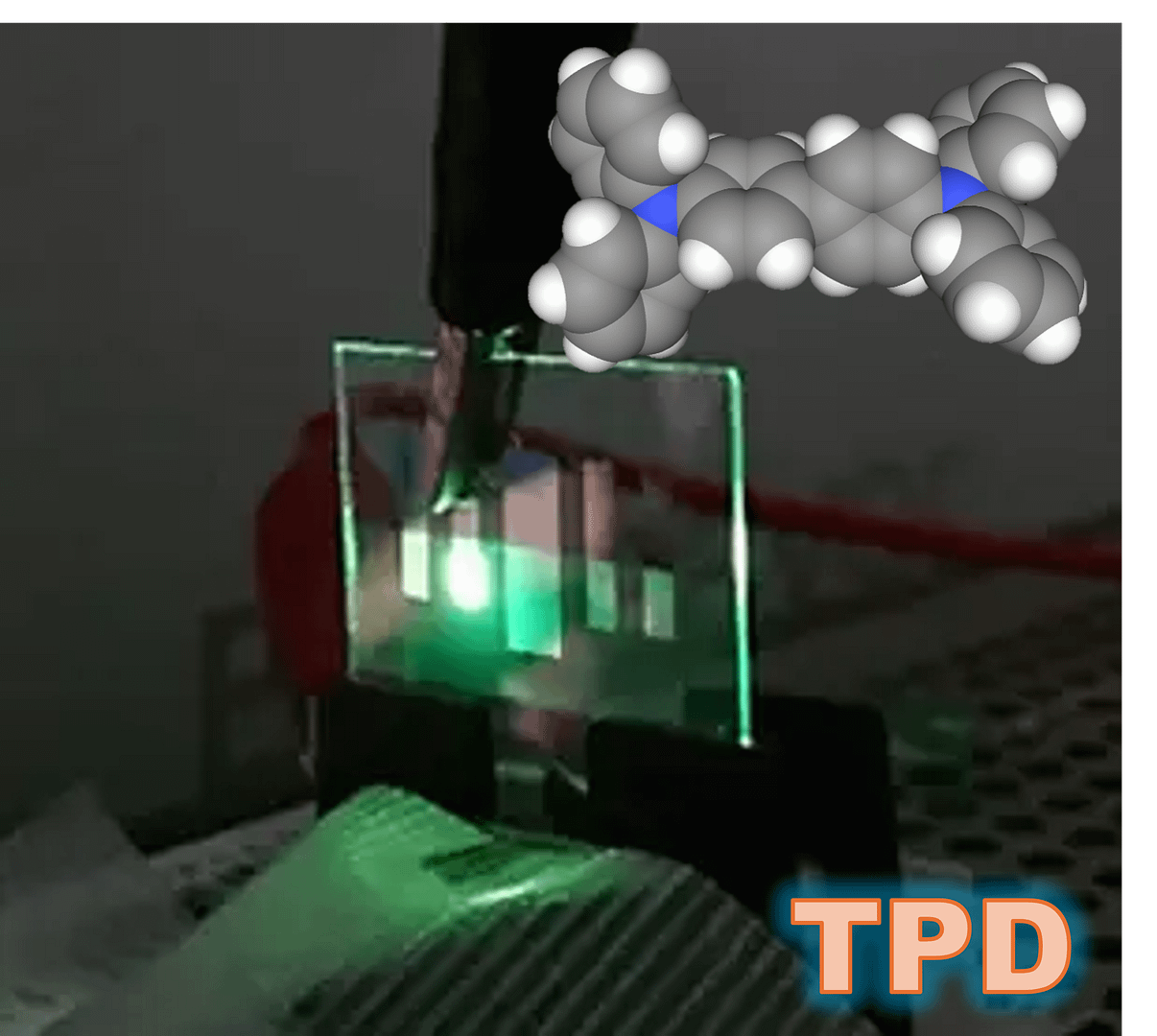
– 同じ考え方を複数の素子構造(共混合、簡略二層、積層ヘテロ構造など)に展開でき、ドナーをTAPCやTPDに替えると色変化範囲をさらに広げられることを示しました。
English version (for website)
What is this topic about?
In OLEDs, achieving both high efficiency and long operational lifetime requires careful control of energy flow between molecules.
Intermolecular energy transfer (Förster/Dexter) and exciplex formation at donor/acceptor interfaces strongly influence color, efficiency, and device stability.
Papers in the attached file
1. Substituent modification to prevent Dexter energy transfer for stable hyperfluorescent organic light-emitting diodes
- Journal: CHEMISTRY LETTERS (2024 JIF: 1.1)
- Year: 2026
- Authors: Lee, C; Tsuchiya, Y; Lee, SY; Adachi, C
- DOI: 10.1093/chemle/upaf240
Plain-language bullets (paraphrased from the abstract; no verbatim text)
– In hyperfluorescent OLEDs, energy transfer to the terminal emitter (TE) is essential, but short‑range Dexter energy transfer can accelerate degradation.
– This study introduces bulkier substituents on the TE to increase the spacing between dopants, suppressing Dexter transfer.
– As a result, device lifetime is extended while maintaining external quantum efficiency (EQE).
– The work offers a practical design rule: increase intermolecular distance to improve stability without sacrificing efficiency.
2. Dual-Exciplex Architecture: A Universal Route to Color-Tunable OLEDs
- Journal: ADVANCED OPTICAL MATERIALS (2024 JIF: 7.2)
- Year: 2026
- Authors: Shen, ZT; Lü, ZY; Mu, HC; Xiao, J
- DOI: 10.1002/adom.202503202
Plain-language bullets (paraphrased from the abstract; no verbatim text)
– Proposes a tricomponent dual‑exciplex concept by combining two donors (e.g., mCP and TCTA) with one acceptor (PO‑T2T), forming two exciplex states (high‑/low‑energy).
– Changing the applied voltage modulates host‑to‑guest energy transfer, enabling continuous color tuning.
– At low bias, guest emission dominates; at higher bias, guest saturation weakens transfer and host emission becomes stronger.
– The concept works across multiple device architectures, and swapping donors (e.g., to TAPC or TPD) can widen the achievable color‑tuning range.
参考文献 / References
- Lee, C; Tsuchiya, Y; Lee, SY; Adachi, C (2026). Substituent modification to prevent Dexter energy transfer for stable hyperfluorescent organic light-emitting diodes. CHEMISTRY LETTERS 55(1) upaf240. doi:10.1093/chemle/upaf240
- Shen, ZT; Lü, ZY; Mu, HC; Xiao, J (2026). Dual-Exciplex Architecture: A Universal Route to Color-Tunable OLEDs. ADVANCED OPTICAL MATERIALS. doi:10.1002/adom.202503202