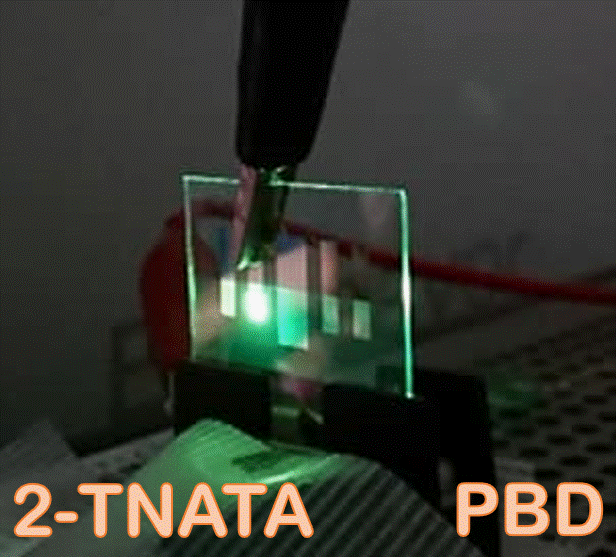
OLED 2-TNATA PBD: Plasmon‑Enhanced OLEDs with Reduced Efficiency Roll‑Off at High Luminance — Plain‑language overview
キーワード(Keywords)
- 効率ロールオフ(Efficiency roll‑off):明るさを上げると発光効率が下がる現象。高輝度用途(VR等)で大きな壁。
EN: Efficiency drop at high luminance; a key barrier for practical high‑brightness OLEDs. - プラズモン(Surface plasmon polariton, SPP):金属表面に生じる光と電子の結合波。発光速度や光の流れを変えられる。
EN: Coupled light‑electron waves at metal surfaces that can reshape emission dynamics. - パーセル効果(Purcell factor):周囲構造で発光の“速さ”が変わる効果。速い発光は励起子密度を下げやすい。
EN: The environment can speed up emission; faster decay can lower exciton density. - 三重項—三重項消滅(TTA):三重項励起子どうしがぶつかって損失になる現象。高輝度ほど起こりやすい。
EN: Triplet‑triplet annihilation causes losses, especially at high excitation densities. - 三重項—ポーラロン消光(TPQ):励起子と電荷(ポーラロン)の相互作用による損失。効率低下の原因の一つ。
EN: Triplet‑polaron quenching: exciton–charge interactions that reduce efficiency.
Plasmon‑Enhanced Phosphorescent OLEDs With Suppressed Efficiency Roll‑Off for High‑Luminance Applications
– Journal: Journal of the Society for Information Display(J. Soc. Inf. Disp.)
– DOI: https://doi.org/10.1002/jsid.70041
– 主題(ざっくり):銀薄膜(Ag)を電極近傍に入れて、発光の損失(ロールオフ)を減らす。
解説
- 高輝度(透明ディスプレイやVR)では、発光効率が大きく落ちる「ロールオフ」が問題だと述べています。
- 主な原因として TTA(triplet‑triplet annihilation) と TPQ(triplet‑polaron quenching) を挙げています。
- 発光層の近くに薄い銀(Ag)アノードを配置し、Purcell factor 3.7(従来ITO系の約3倍)を得たとしています。
- これにより励起子の減衰が速くなり、励起子密度が下がって、TTA/TPQが抑えられる、と説明しています。
- 結果としてロールオフが 57%→11% に改善し、20,000 cd/m² で電流効率が 17%向上したと報告しています(追加の光取り出し技術なし)。
- さらに動作寿命(LT90)が 5倍に延びたと述べています。
Explanation
- At high brightness (e.g., transparent displays and VR), severe efficiency roll‑off limits phosphorescent OLEDs.
- The paper attributes this mainly to TTA and TPQ loss processes.
- By placing a thin silver anode close to the emitter, they report a Purcell factor of 3.7 (≈3× vs ITO‑based devices).
- Faster exciton decay lowers exciton density, suppressing TTA/TPQ, as described.
- Roll‑off is reduced from 57% to 11%, and current efficiency improves by 17% at 20,000 cd/m² without extra out‑coupling methods.
- The operational lifetime (LT90) is reported to be extended by 5×.
文献(References)
- An, Di; Kang, Jiachen; Huang, Wenzhe; Xia, Zixiang; He, Gufeng. Plasmon‑Enhanced Phosphorescent OLEDs With Suppressed Efficiency Roll‑Off for High‑Luminance Applications. J. Soc. Inf. Disp. (2026). https://doi.org/10.1002/jsid.70041