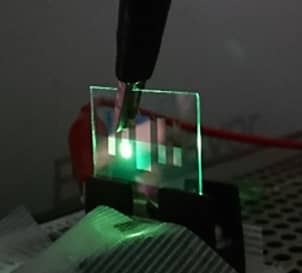
有機ELとTADF:電気をほぼ100%光に変える有機材料
このページでは、有機EL(OLED) と、その中でも近年とくに注目されている
熱活性化遅延蛍光(Thermally Activated Delayed Fluorescence:TADF) について、
代表的な論文をもとに、一般の方向けにやさしく紹介します。
ここで取り上げる3つの論文は、Web of Science から出力した文献ファイル
(OLED_Classic.txt)に含まれているものの中から選びました。:contentReference[oaicite:0]{index=0}
1. 有機EL(OLED)とは?
有機EL(OLED) は、薄い「有機分子の膜」そのものが光るディスプレイ・照明技術です。
- ガラスやプラスチックの上に、
- 透明電極(アノード)
- 有機薄膜(発光層など)
- 金属電極(カソード)
を重ねた「サンドイッチ構造」になっています。 - 電圧をかけると、有機分子の中で「励起状態」(エネルギーの高い状態)が生まれ、
もとの状態に戻るときに光(フォトン) を出します。
従来の液晶ディスプレイ(LCD)は、後ろに白い光源(バックライト)があり、
その前で光を「遮る/通す」ことで表示していました。
これに対して OLED は、画素そのものが光る「自発光」 なので、
- 真っ黒な部分は本当に「消灯」できる → コントラストが高い
- とても薄く、曲げられる → 折りたたみスマホやフレキシブルディスプレイが可能
- 応答が速い → 動画やゲームに向いている
といった特徴があります。
2. なぜ TADF(熱活性化遅延蛍光)が重要なのか?
OLED の中では、電気エネルギーがいったん励起状態となり、
そこから光として放出されます。このとき、励起状態には大きく
- 「一重項励起状態(シングレット)」:すぐ光る「明るい状態」
- 「三重項励起状態(トリプレット)」:普通は光りにくい「暗い状態」
の2種類があります。
従来の有機ELでは、この「暗い三重項」のエネルギーを十分に使えず、
理論上100%のうち、4分の1(25%)しか光にできない という限界がありました。
そこで登場したのが TADF(熱活性化遅延蛍光) です。
- 室温の熱エネルギーを利用して、
「暗い三重項」→「明るい一重項」へと再び引き上げる - これにより、ほぼ100%の励起状態を光として取り出す ことが可能になります。
- しかも、貴金属(Ir, Pt など)を使わず、
有機分子だけで高効率 を目指せる点が大きな魅力です。
3. 代表的な3つの研究(やさしい解説)
3-1. 有機分子だけで「ほぼ100%の光」を取り出す材料
Kaji et al., Nature Communications, 2015
この論文では、日本(京大・九大)の研究チームが
「電気から光への変換効率100%」に近い有機EL材料 を報告しています。
- 分子の中に
- 電子を押し出す部分(ドナー:ジフェニルアミノカルバゾール)
- 電子を引きつける部分(アクセプター:トリフェニルトリアジン)
を組み合わせた設計を採用。 - その結果、
- 一重項と三重項のエネルギー差が極めて小さい
- 室温の「熱」で三重項→一重項へスムーズに戻せる
- 発光量子収率(光になる割合)はほぼ100%、
外部量子効率(EQE)は約30%、光取り出しシートを使うと41.5% という非常に高い値を達成しました。
ポイント(一般向け)
「今まで捨てていた暗いエネルギー(三重項)も、
ほとんど全部、明るい光(一重項)として使えるようにした」
というイメージの研究です。
しかも、有機分子だけ でこれを達成したことが大きなインパクトでした。
3-2. TADF がなぜ起こるのか?「しくみ」を解き明かした研究
Etherington et al., Nature Communications, 2016
Kaji らのような TADF 材料は「高効率」であることは分かっていましたが、
なぜ三重項から一重項に戻れるのか、その物理的なしくみ は
当時まだ十分に理解されていませんでした。
この論文では、イギリスの研究チームが
- 分子内の「電荷移動状態(CT)」と「局在三重項状態(局在T)」の
エネルギー関係を細かく変えながら、発光特性を測定 - TADF が最も強くなるのは、
CT 状態と局在三重項状態のエネルギーが「ちょうど共鳴」したとき である - 分子の「振動」(ビブロニック結合)が、
スピンの変換(トリプレット→シングレット)を助けている
ことを示しました。
ポイント(一般向け)
「分子がプルプル振動することで、
暗い状態(三重項)から明るい状態(一重項)へとスイッチする」
という「TADF の裏側のしくみ」を明らかにした研究で、
材料設計の基本原理 を与えた重要な論文です。
3-3. TADF 材料を総まとめした大規模レビュー
Wong & Zysman-Colman, Advanced Materials, 2017
3本目は個別の物質ではなく、
「純有機TADF材料」全体を見渡した総説(レビュー論文) です。
この論文では、
- 小分子、デンドリマー、高分子、エキシプレックス(分子間励起状態)など、
さまざまなタイプの TADF 材料を整理 - 青・緑〜黄・オレンジ・赤・白色 OLED まで、
色ごとに代表的な材料と素子性能を比較 - 分子構造(ドナー・アクセプターの組み合わせ、ねじれ具合など)と
発光波長・効率・寿命との関係を詳しくまとめています。
ポイント(一般向け)
「どんな分子構造にすると、どの色でどのくらい効率よく光るか」
という マップと設計指針 を示した論文
であり、TADF OLED の研究を進めるうえでの「教科書」として
世界中の研究で引用されています。
4. これからの展望
TADF を利用した有機ELは、
- 貴金属を使わずに高効率を実現できる
- 将来的には、より安価で環境負荷の少ないディスプレイ・照明が期待できる
- 高効率の青色・深青色、長寿命化など、まだ課題も多く、
研究の余地が大きい分野
です。
ここで紹介した3つの論文は、
- 「有機だけで本当に高効率にできる」ことを示した研究
- 「その効率がなぜ出るのか」という物理的なしくみを明らかにした研究
- 「多くの材料を整理し、設計指針を与えた総説」
として、現在の OLED・TADF 研究の土台になっています。
OLED and TADF: New Organic Materials for (Almost) 100% Light Emission
In this section, we explain organic light-emitting diodes (OLEDs) and
thermally activated delayed fluorescence (TADF) for a general audience,
based on three key papers included in our classic OLED literature file
(OLED_Classic.txt).:contentReference[oaicite:1]{index=1}
1. What is an OLED?
An OLED is a display and lighting technology where thin organic films themselves emit light.
- On a glass or plastic substrate, you stack:
- a transparent anode,
- organic thin films (including an emitting layer),
- and a metal cathode.
- When you apply a voltage, an excited state is created in the organic molecules.
When this excited state relaxes back to the ground state, it emits light (photons).
Compared with liquid crystal displays (LCDs), which need a white backlight behind them,
each pixel of an OLED emits its own light. This brings several advantages:
- Very high contrast (true blacks: off = no light)
- Ultra-thin and flexible panels (foldable phones, rollable displays)
- Fast response, suitable for videos and games
2. Why is TADF so important?
In an OLED, electrical energy first becomes an excited state.
There are two main types of excited states:
- Singlet excited states: “bright” states that easily emit light
- Triplet excited states: usually “dark” states that hardly emit light
In conventional purely organic OLEDs, triplet states were mostly wasted,
so only about 25% of the excitations could be converted into light.
TADF (Thermally Activated Delayed Fluorescence) changes this situation:
- At room temperature, thermal energy helps convert
dark triplet states back into bright singlet states. - As a result, almost 100% of the excitations can be harvested as light.
- This can be done with purely organic molecules, without using rare metals
such as iridium or platinum.
In short, TADF opens the door to very efficient, metal-free OLED emitters.
3. Three key papers (simple overview)
3-1. A purely organic emitter with almost 100% light conversion
Kaji et al., Nature Communications, 2015
This paper by a Japanese team (Kyoto University & Kyushu University) reports a
purely organic material that converts electricity to light with nearly 100% efficiency.
- The molecule combines
- an electron-donating unit (diphenylaminocarbazole)
- and an electron-accepting unit (triphenyltriazine).
- This design makes the energy gap between singlet and triplet states extremely small,
so even room-temperature heat can efficiently promote triplets to singlets. - The material shows:
- almost 100% photoluminescence quantum yield
- external quantum efficiency (EQE) of about 30%,
and 41.5% EQE when using a light out-coupling sheet.
Intuitive takeaway
Energy that used to be “lost in the dark” (triplets) can now be almost fully
turned into bright light (singlets), using only organic molecules.
This work strongly demonstrated that purely organic TADF emitters can rival or even
surpass phosphorescent metal complexes in efficiency.
3-2. Revealing how TADF actually works
Etherington et al., Nature Communications, 2016
High-efficiency TADF devices existed, but
the detailed physical mechanism behind TADF was not fully clear.
In this paper, a UK team systematically investigates how TADF works:
- They tune the energies of
- the charge-transfer (CT) excited states
- and a local triplet state
and measure how the emission changes. - They show that TADF is strongest when the CT state and the local triplet state
are in energetic resonance. - They propose that spin–vibronic coupling — tiny molecular vibrations coupled with spin —
mediates the reverse intersystem crossing (triplet → singlet).
Intuitive takeaway
The molecule’s tiny vibrations help it “switch” from a dark triplet state
to a bright singlet state, enabling TADF.
This work provides a fundamental physical picture of TADF,
which is very important for rational molecular design.
3-3. A comprehensive review of purely organic TADF materials
Wong & Zysman-Colman, Advanced Materials, 2017
The third paper is not about one specific molecule, but a
large review article that summarizes purely organic TADF materials.
It:
- Covers many types of materials: small molecules, dendrimers, polymers, exciplexes
- Compares emitters across different colors:
blue, green–yellow, orange–red, and white OLEDs - Discusses how molecular structure (donor–acceptor arrangement, twisting, etc.)
affects emission color, efficiency, and lifetime.
Intuitive takeaway
This review provides a “map and design guide” showing
what kind of structures give which color and how efficient they can be.
Because of this, the paper is widely used as a reference and guideline
for researchers developing new TADF OLED materials.
4. Outlook
TADF-based OLEDs offer:
- High efficiency without rare metals
- The potential for more sustainable, lower-cost displays and lighting
- Many research challenges, especially in deep-blue emission and device lifetime
The three papers introduced here together form a foundation of modern TADF OLED research:
- Demonstrating that purely organic emitters can reach near-ideal efficiency
- Explaining the microscopic mechanism of TADF
- Providing a broad overview and design rules for many TADF materials
References
- Wong, M. Y.; Zysman-Colman, E.
Purely Organic Thermally Activated Delayed Fluorescence Materials for Organic Light-Emitting Diodes.
Advanced Materials 2017, 29 (22), 1605444.
DOI: 10.1002/adma.201605444. - Etherington, M. K.; Gibson, J.; Higginbotham, H. F.; Penfold, T. J.; Monkman, A. P.
Revealing the Spin-Vibronic Coupling Mechanism of Thermally Activated Delayed Fluorescence.
Nature Communications 2016, 7, 13680.
DOI: 10.1038/ncomms13680. - Kaji, H.; Suzuki, H.; Fukushima, T.; Shizu, K.; Suzuki, K.; Kubo, S.; Komino, T.; Oiwa, H.; Suzuki, F.; Wakamiya, A.; Murata, Y.; Adachi, C.
Purely Organic Electroluminescent Material Realizing 100% Conversion from Electricity to Light.
Nature Communications 2015, 6, 8476.
DOI: 10.1038/ncomms9476.