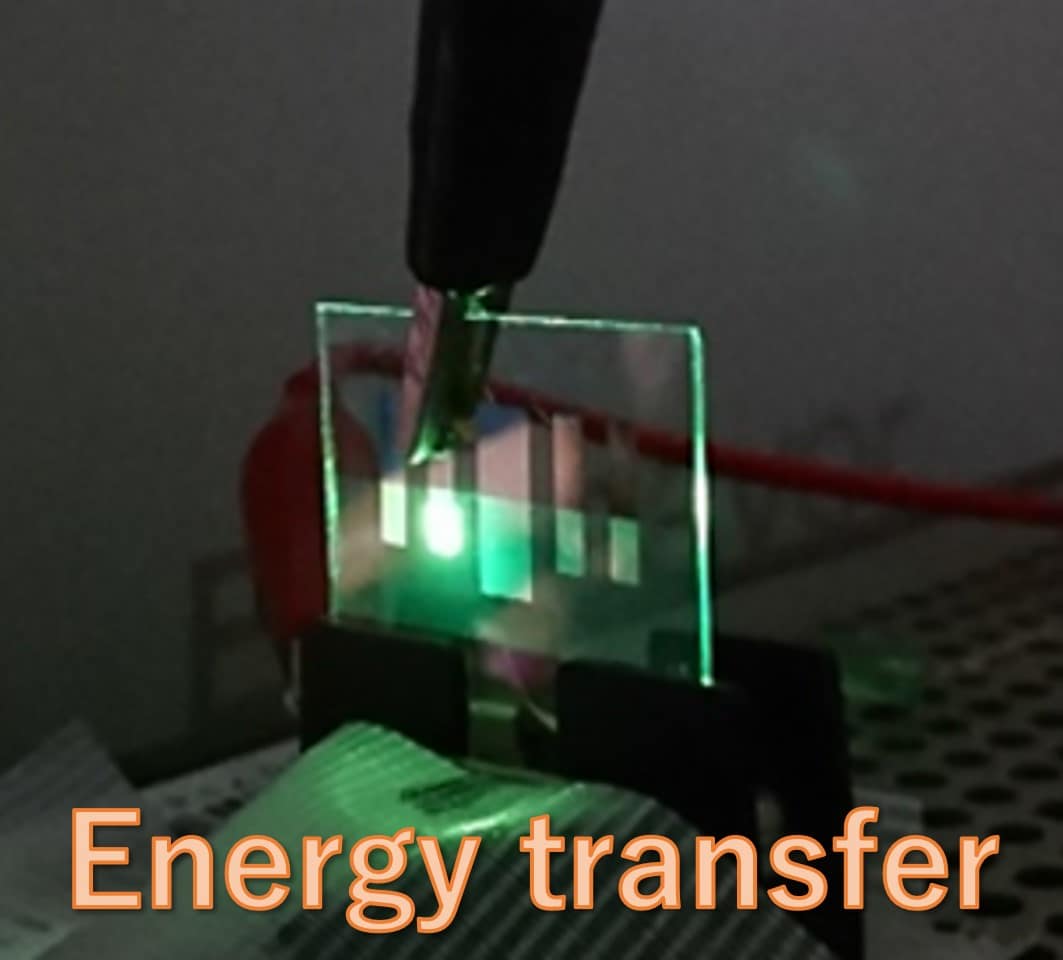
有機ELとエネルギー移動
— TADF材料と次世代ディスプレイ研究の紹介(一般向け)
1. 有機EL(OLED)とは?
有機EL(Organic Light-Emitting Diode, OLED)は、「有機分子そのものが光る」タイプの薄型ディスプレイです。
スマートフォンや有機ELテレビ、車載ディスプレイなどに広く使われており、
- 自発光なので、バックライトが不要
- 黒が深く、コントラストが高い
- 薄型・軽量で、曲げたり丸めたりできる
といった特徴があります。
有機ELの中では、「エネルギー(励起子)」がどれだけ無駄なく光に変わるかが、とても重要なポイントです。そのカギを握るのが「エネルギー移動」と「TADF(熱活性化遅延蛍光)材料」です。
2. このページで紹介する研究(ファイル内の論文より)
このページでは、以下の3報の論文(本ページに添付された文献リスト内のもの)をもとに、
有機ELとエネルギー移動・TADFの研究を、一般の方向けにかみ砕いて紹介します。
- Mini-LED, Micro-LED and OLED displays: present status and future perspectives
Y. Huang, E.-L. Hsiang, M.-Y. Deng, S.-T. Wu
Light: Science & Applications 9 (2020), Article 128, DOI: 10.1038/s41377-020-0341-9 - Purely Organic Thermally Activated Delayed Fluorescence Materials for Organic Light-Emitting Diodes
M. Y. Wong, E. Zysman-Colman
Advanced Materials 29 (2017), 1605444, DOI: 10.1002/adma.201605444 - Recent advances in organic thermally activated delayed fluorescence materials
Z. Yang et al.
Chemical Society Reviews 46 (2017), 915–1016, DOI: 10.1039/C6CS00368K
以下では、専門用語をできるだけ避けながら、それぞれの論文のポイントを紹介します。
3. ミニLED・マイクロLED・OLEDディスプレイの今と未来(Huang ら, 2020)
3-1. 3つのディスプレイ方式
Huang らの論文では、Mini-LED, Micro-LED, OLED という3種類の表示方式がまとめて比較されています。
- Mini-LED:とても小さなLEDを多数並べてバックライトに使う方式
- Micro-LED:さらに小さなLEDを、画素そのものとして配置する方式
- OLED:有機分子からなる発光層が、電流によって直接光る方式
3-2. OLEDの強み
このレビューによると、OLEDは
- 広い色域(鮮やかな色)
- 高いコントラスト(真っ黒を出しやすい)
- 柔軟性(フレキシブルディスプレイ)
といった点で非常に有利であり、今後もプレミアムディスプレイとして重要な役割を担うとされています。
一方で、焼き付きや寿命、さらに高輝度化など、解決すべき課題も整理されています。
その課題を解決するためのアプローチの1つが、次に紹介する TADF材料 です。
4. TADF材料とは?(Wong & Zysman-Colman, 2017)
4-1. 有機ELの「もったいない」を減らす工夫
有機ELでは、電流を流すと分子の中に「励起子」と呼ばれるエネルギーのかたまりができます。
この励起子には、大きく分けて2種類あります。
- 一重項励起子(Singlet):すぐに光りやすい
- 三重項励起子(Triplet):そのままでは光りにくい(エネルギーが熱になってしまう)
従来の「蛍光型」の有機ELでは、一重項だけが光るので、三重項のエネルギーが捨てられている状態でした。
4-2. TADF:熱で三重項を再利用するしくみ
Wong & Zysman-Colman のレビュー論文では、
TADF(Thermally Activated Delayed Fluorescence:熱活性化遅延蛍光) という仕組みを使って、三重項のエネルギーまで光に変える新しい材料が紹介されています。
TADF材料では、
- いったん三重項励起子になってしまったエネルギーが、
- 「熱」の助けを借りて一重項励起子に戻り(逆項間交差)、
- もう一度、光として放出される
という「エネルギーの再利用」が行われます。
その結果、理論上は、ほぼすべての励起子を光に変えることができると考えられています。
4-3. 純有機材料でできるメリット
この論文のポイントは、金属を含まない純有機分子だけでTADFを実現している点です。
これにより、
- レアメタルを使わないため、資源面・コスト面で有利
- 分子設計の自由度が高い(色や寿命を細かく調整できる)
といった利点があり、エネルギー移動・励起子制御の観点からも重要な研究分野になっています。
5. TADF研究の「地図」を描くレビュー(Yang ら, 2017)
Yang らのレビューは、TADF材料に関する広範な研究を整理した「地図」のような論文です。
- どのような分子構造がTADFに向いているのか
- 発光色(青・緑・赤)を変えるにはどうしたらよいか
- 効率や寿命を伸ばすための工夫は何か
といった点が、たくさんの具体例とともにまとめられています。
特に、有機ELデバイスの中で、
ホスト材料 → ゲスト発光材料へのエネルギー移動 をどう設計するか、
また、三重項励起子をロスなく利用するか といった観点は、
本研究室で進めているエネルギー移動型有機EL・光応答有機ELとも深く関係しています。
6. まとめ(日本語)
- 有機ELは、薄くてきれいなディスプレイを実現する重要な技術です。
- その高効率化には、「励起子」という目に見えないエネルギーの行き先をコントロールすることが不可欠です。
- TADF材料は、三重項励起子を熱の力で再利用し、光の取りこぼしを減らす革新的な仕組みです。
- ここで紹介した3つの論文は、
- ディスプレイ全体の将来像(Huang ら)
- 純有機TADF材料の開発(Wong & Zysman-Colman)
- TADF研究全体の整理(Yang ら)
という3つの視点から、有機ELとエネルギー移動の最前線を示しています。
Organic Light-Emitting Diodes and Energy Transfer
— TADF Materials and Next-Generation Displays (For general readers)
1. What is an OLED?
An organic light-emitting diode (OLED) is a thin, flexible light source in which organic molecules themselves emit light when an electric current flows.
Compared with conventional LCDs, OLEDs offer:
- Self-emission without a backlight
- Deep blacks and high contrast
- Thin, lightweight and flexible form factors
Behind this beautiful display, there is invisible traffic of excitons (energy packets).
How efficiently we can convert these excitons into light is a key issue, and energy transfer and TADF materials play central roles.
2. Papers introduced on this page
Based on the literature list supplied with this page, we highlight three key review papers:
- Mini-LED, Micro-LED and OLED displays: present status and future perspectives
Y. Huang, E.-L. Hsiang, M.-Y. Deng, S.-T. Wu
Light: Science & Applications 9 (2020), 128, DOI: 10.1038/s41377-020-0341-9 - Purely Organic Thermally Activated Delayed Fluorescence Materials for Organic Light-Emitting Diodes
M. Y. Wong, E. Zysman-Colman
Advanced Materials 29 (2017), 1605444, DOI: 10.1002/adma.201605444 - Recent advances in organic thermally activated delayed fluorescence materials
Z. Yang et al.
Chemical Society Reviews 46 (2017), 915–1016, DOI: 10.1039/C6CS00368K
3. Displays based on mini-LED, micro-LED and OLED (Huang et al., 2020)
Huang and co-workers compare three major display technologies:
- Mini-LED: many tiny LEDs used as a backlight
- Micro-LED: even smaller LEDs used as individual pixels
- OLED: organic molecules form a light-emitting layer driven by electric current
Their review shows that OLEDs are particularly strong in:
- Wide colour gamut
- High contrast ratio
- Flexibility and form factor
At the same time, they discuss challenges such as lifetime and image retention, which motivate the development of more efficient emitter systems such as TADF materials.
4. How TADF materials work (Wong & Zysman-Colman, 2017)
In conventional fluorescent OLEDs, only singlet excitons can emit light efficiently, while triplet excitons are mostly lost as heat.
Thermally activated delayed fluorescence (TADF) provides a way to recycle these triplet excitons:
- Excitons are first created as a mixture of singlets and triplets.
- Triplet excitons are thermally promoted back to the singlet state (reverse intersystem crossing).
- The regenerated singlet excitons emit light with a delay.
In their review, Wong and Zysman-Colman focus on purely organic TADF emitters without heavy metals.
Such molecules are attractive because:
- They avoid scarce metals and can be more sustainable and cost-effective.
- Molecular design (colour, lifetime, stability) is highly tunable.
In terms of energy transfer, TADF materials provide an efficient route to harvest both singlet and triplet energy within OLED devices.
5. Mapping the TADF landscape (Yang et al., 2017)
Yang and co-workers provide a broad overview of the TADF field, including:
- Molecular design strategies suitable for TADF
- Approaches to achieve blue, green and red emission
- Factors governing device efficiency and operational lifetime
They also discuss how to design host–guest systems in which energy is transferred from a host matrix to a TADF emitter, and how to manage triplet excitons to minimize non-radiative losses.
These concepts are closely related to research in our group on energy-transfer-type OLEDs and light-responsive OLED devices.
6. Summary (English)
- OLEDs are key technologies for modern high-quality displays.
- Efficient light emission requires careful control of invisible energy carriers called excitons.
- TADF materials allow us to recycle triplet excitons using thermal energy and greatly reduce energy loss.
- The three papers introduced here provide:
- A comprehensive picture of next-generation displays (Huang et al.)
- A tutorial on purely organic TADF emitters (Wong & Zysman-Colman)
- A broad map of TADF research directions (Yang et al.)
They together illustrate how energy transfer and exciton management underpin the progress of OLED science and technology.
参考文献 / References
- Y. Huang, E.-L. Hsiang, M.-Y. Deng, S.-T. Wu,
“Mini-LED, Micro-LED and OLED displays: present status and future perspectives,”
Light: Science & Applications 9 (2020), 128. DOI: 10.1038/s41377-020-0341-9 - M. Y. Wong, E. Zysman-Colman,
“Purely Organic Thermally Activated Delayed Fluorescence Materials for Organic Light-Emitting Diodes,”
Advanced Materials 29 (2017), 1605444. DOI: 10.1002/adma.201605444 - Z. Yang, Z. Mao, Z. Xie, Y. Zhang, S. Liu, J. Zhao, J. Xu, Z. Chi, M. Aldred,
“Recent advances in organic thermally activated delayed fluorescence materials,”
Chemical Society Reviews 46 (2017), 915–1016. DOI: 10.1039/C6CS00368K