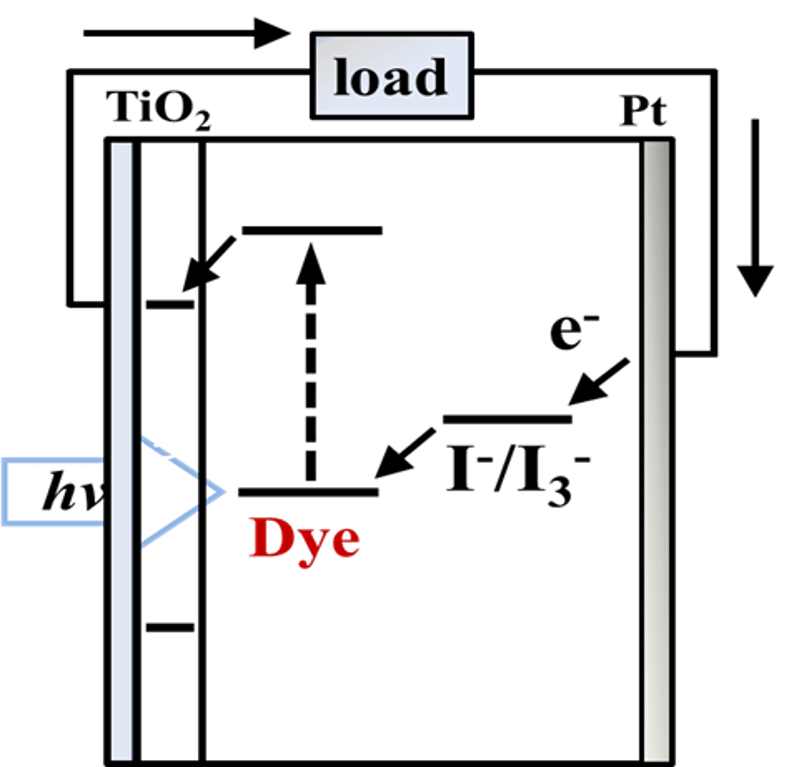
Dye-sensicied solar cell and Cyclodextrins
| Authors | Article Title | Source Title | Author Keywords | Keywords Plus | Abstract | ORCIDs | Publisher | Publisher City | Journal Abbreviation | Journal ISO Abbreviation | Publication Date | Publication Year | Volume | Issue | Start Page | End Page | Article Number | DOI | DOI Link |
|---|---|---|---|---|---|---|---|---|---|---|---|---|---|---|---|---|---|---|---|
| Selvam, S; Balamuralitharan, B; Karthick, SN; Savariraj, AD; Hemalatha, KV; Kim, SK; Kim, HJ | Novel high-temperature supercapacitor combined dye sensitized solar cell from a sulfated β-cyclodextrin/PVP/MnCO3 composite | JOURNAL OF MATERIALS CHEMISTRY A | PHOTOELECTRIC CONVERSION; COUNTER ELECTRODE; ELECTROCHEMICAL SUPERCAPACITOR; CARBON NANOTUBES; ACTIVATED CARBON; ENERGY FIBER; STORAGE; OXIDE; NANOPARTICLES; PERFORMANCE | A novel sulfated beta-cyclodextrin/PVP/MnCO3 composite has been synthesized for a parallel-connected supercapacitor and dye-sensitized solar cell (counter electrode). beta-Cyclodextrin has sulfonated, thermally cross-linked with PVP, and incorporated with MnCO3 nanoparticles. The composite electrode exhibited 202.6 F g(-1) capacitance, 197.96 W h kg(-1) energy density, 5.57% eta (DSSC) and 70% performance up to 200 degrees C with a [BMI][TFSI] electrolyte. | Antonysamy, Dennyson Savariraj/0000-0001-8500-3777; SIVALINGAM NALLATHAMBI, KARTHICK/0000-0001-6765-8649; BALAKRISHNAN, BALAMURALITHARAN/0000-0003-0017-170X; S, Selvam/0000-0002-8899-3494; Kuzhandaivel, Hemalatha/0000-0003-4082-1156; Balakrishnan, Balamuralitharan/0000-0002-2380-8585; SELVAM, SAMAYANAN/0000-0003-3227-1158; | ROYAL SOC CHEMISTRY | CAMBRIDGE | J MATER CHEM A | J. Mater. Chem. A | 2015 | 3 | 19 | 10225 | 10232 | 10.1039/c5ta01792k | http://dx.doi.org/10.1039/c5ta01792k | |||
| Takeshita, T; Umeda, T; Hara, M | Fabrication of a dye-sensitized solar cell containing a noncarboxylated spiropyran-derived photomerocyanine with cyclodextrin | JOURNAL OF PHOTOCHEMISTRY AND PHOTOBIOLOGY A-CHEMISTRY | Dye-sensitized solar cell; Photomerocyanine; Cyclodextrin; Inclusion complex; Isomerization | NANOPARTICLES | The fabrication, photovoltaic conversion, and photo-response of dye-sensitized solar cell (DSSC) containing a noncarboxylated spiropyran 1,3,3-trimethylindolino-beta-naphthopyrylospiran (1) and carboxymethy1-beta-cyclodextrin sodium salt (CM-beta-CD) were investigated for the first time. In fact, we found the adsorption of photomerocyanine form (PMC) of 1 and inclusion complexes between the PMC and CM-beta-CD (PMC/CM-beta-CD) to the TiO2 surface. The formation of PMC/CM-beta-CD was confirmed by fluorescence spectroscopy. The incident photon-to-current conversion efficiency (IPCE) of the PMCcontaining DSSC obtained 4.1% under 570-nm light irradiation, and the highest IPCE reached 11.1% by inclusion effect of CM-beta-CD. Similar, the fillfactor and the open-circuit voltage were improved by CM-beta -CD layer. The IPCE value of PMC/CM-beta-CD-containing DSSC was decreased by visible light treatment, and it was considered that decrease of IPCE values are attributed to the formation of PMC isomer. Therefore, we demonstrated the photovoltaic conversion and photoresponsivity of the DSSC by incorporating a noncarboxylated PMC with inclusion effect of CM-beta-CD layer. (C) 2016 Elsevier B.V. All rights reserved. | ELSEVIER SCIENCE SA | LAUSANNE | J PHOTOCH PHOTOBIO A | J. Photochem. Photobiol. A-Chem. | JAN 15 | 2017 | 333 | 87 | 91 | 10.1016/j.jphotochem.2016.10.017 | http://dx.doi.org/10.1016/j.jphotochem.2016.10.017 | |||
| Chen, CC; Chang, FC; Peng, CY; Wang, HP | Conducting glasses recovered from thin film transistor liquid crystal display wastes for dye-sensitized solar cell cathodes | ENVIRONMENTAL TECHNOLOGY | recovered ITO; conducting glass; DSSC; Nickel; Ni@C | INDIUM | Transparent conductive glasses such as thin film transistor (TFT) array and colour filter glasses were recovered from the TFT-liquid crystal display panel wastes by dismantling and sonic cleaning. Noble metals (i.e. platinum (Pt)) and indium tin oxide (ITO) are generally used in the cathode of a dye-sensitized solar cell (DSSC). To reduce the DSSC cost, Pt was replaced with nano nickel-encapsulated carbon-shell (Ni@C) nanoparticles, which were prepared by carbonization of Ni2+--cyclodextrin at 673K for 2h. The recovered conductive glasses were used in the DSSC electrodes in the substitution of relatively expensive ITO. Interestingly, the efficiency of the DSSC having the Ni@C-coated cathode is as high as 2.54%. Moreover, the cost of the DSSC using the recovered materials can be reduced by at least 24%. | TAYLOR & FRANCIS LTD | ABINGDON | ENVIRON TECHNOL | Environ. Technol. | DEC 2 | 2015 | 36 | 23 | 3008 | 3012 | 10.1080/09593330.2014.982206 | http://dx.doi.org/10.1080/09593330.2014.982206 | ||
| Saleh, N; Al-Trawneh, S; Al-Dmour, H; Al-Taweel, S; Graham, JP | Effect of Molecular-Level Insulation on the Performance of a Dye-Sensitized Solar Cell: Fluorescence Studies in Solid State | JOURNAL OF FLUORESCENCE | Triphenylamine; beta-cyclodextrins; Time-resolved fluorescence spectroscopy; Solid state; Quantum calculations | ORGANIC-DYES; ELECTRON-TRANSFER; CYCLODEXTRIN; ABSORPTION; ORDER | The performance of a dye-sensitized solar cell (DSSC) that is based on the host-guest encapsulation of 5-[4-diphenylamino)phenyl]thiophene-2-cyanoacrylic acid (L1) inside beta-cyclodextrin hosts has been tested. The formation of the complex in the solid state and when adsorbed on TiO2 was characterized using steady and picosecond time-resolved emission techniques, as well as time dependent DFT calculations. The molecular-level insulation has led to a small enhancement in the energy-conversion performance of the fabricated DSSC with the best results being an increase in the open circuit voltage (Voc) from 0.7 to 0.8 V. The importance of the present investigation lies in the unique spectroscopic characterizations of the examined materials in the solid state. | Saleh, Na'il/0000-0003-3282-1156; Graham, John/0000-0002-8786-6610; | SPRINGER/PLENUM PUBLISHERS | NEW YORK | J FLUORESC | J. Fluoresc. | JAN | 2015 | 25 | 1 | 59 | 68 | 10.1007/s10895-014-1479-8 | http://dx.doi.org/10.1007/s10895-014-1479-8 | |
| Takeshita, T; Umeda, T; Oonishi, N; Hara, M | Application of a Noncarboxylated Dye Compound in a Dye-Sensitized Solar Cell Containing a Cyclodextrin Layer | INTERNATIONAL JOURNAL OF PHOTOENERGY | TIO2 NANOPARTICLES; ORGANIC-DYES; PERFORMANCE; EFFICIENCY; COMPLEXES | We report the fabrication and characterization of a dye-sensitized solar cell containing a carboxymethyl-beta-cyclodextrin sodium salt (CM-beta-CD) layer and a noncarboxylated dye compound (tris(2,2'-bipyridyl) ruthenium(II) dichloride hexahydrate (Ru-dye)). The values of the incident photon-to-current conversion efficiency (IPCE) of the Ru-dye/CM-beta-CD-containing device measured under 450 and 490 nm light irradiation were, respectively, 2.35% and 3.33%. The IPCE was due to the absorption of Ru-dye in ethanol solution. In contrast, the IPCE of the device that was prepared without the CM-beta-CD layer measured under 450 nm irradiation was approximately three times smaller. Accordingly, the current findings demonstrate the application of a noncarboxylated dye compound in DSSCs incorporating a CM-beta-CD layer. | HINDAWI LTD | LONDON | INT J PHOTOENERGY | Int. J. Photoenergy | 2015 | 2015 | 786246 | 10.1155/2015/786246 | http://dx.doi.org/10.1155/2015/786246 | ||||||
| Hara, M; Takeshita, T; Umeda, T | Effect of cyclodextrin cavity size on the photovoltaic performance of unanchored ruthenium(II) polypyridine complex-containing dye-sensitized solar cells | JOURNAL OF PHOTONICS FOR ENERGY | dye-sensitized solar cell; cyclodextrin; unanchored photosensitizing dye; cavity size | NANOPARTICLES | We report the effect of cyclodextrin (CD) cavity size on the photovoltaic performance of dye-sensitized solar cells (DSSCs) containing inclusion complexes of tris(2,2'-bipyridyl) ruthenium(II) ([Ru(bpy)(3)](2+)) in various CDs ([Ru(bpy)(3)](2+)/CD). The incident photon-to-current conversion efficiency (IPCE) of the [Ru(bpy)(3)](2+)-containing DSSC at 460 nm was calculated to be 8.1%, and this value was enhanced by the formation of [Ru(bpy)(3)](2+)/CD. The IPCE values of [Ru(bpy)(3)](2+)/alpha-CD-containing, [Ru(bpy)(3)](2+)/beta-CD-containing, and [Ru(bpy)(3)](2+)/gamma-CD-containing DSSCs were 8.8%, 8.9%, and 11.2%, respectively. It was concluded that the difference of IPCE values of [Ru(bpy)(3)](2+)/CD-containing DSSCs were caused by the CD cavity size, which affected the host-guest interaction between [Ru(bpy)(3)](2+) and the CD. These findings indicated that the cavity size of gamma-CD is suitable to promote the photovoltaic conversion of DSSCs containing an unanchored photosensitizing dye with nonplanar molecular structure such as ruthenium(II) polypyridine and diimine copper(I) complexes. (c) 2020 Society of Photo-Optical Instrumentation Engineers (SPIE) | SPIE-SOC PHOTO-OPTICAL INSTRUMENTATION ENGINEERS | BELLINGHAM | J PHOTON ENERGY | J. Photonics Energy | OCT-DEC | 2020 | 10 | 4 | 45503 | 10.1117/1.JPE.10.045503 | http://dx.doi.org/10.1117/1.JPE.10.045503 | |||
| Kumavat, PP; Baviskar, PK; Sankapal, BR; Dalal, DS | Facile synthesis of D-π-A structured dyes and their applications towards the cost effective fabrication of solar cells as well as sensing of hazardous Hg(II) | RSC ADVANCES | ORGANIC-DYES; PHOTOVOLTAIC PERFORMANCE; SUPRAMOLECULAR CATALYST; GOLD NANOPARTICLES; BETA-CYCLODEXTRIN; ELECTRON-TRANSFER; AQUEOUS-MEDIUM; FLUORESCENT; DERIVATIVES; FILMS | We design and establish an environmentally benign synthesis of new D-pi-A dyes containing imidazole derivatives structured to triphenylamine (TPA) as a donor and cyano acrylic groups acting as acceptors without using any toxic catalysts. These newly synthesized imidazole derivatives are anchored on TiO2, towards a cost effective dye sensitized organic solar cell, and achieve 0.22% solar-light to electricity conversion efficiency under standard AM 1.5G irradiation (100 mW cm(-2)). The most widely significant findings of this study are high thermal stability, smooth surface, strong intramolecular interaction between dyes and TiO2 which improve the performance of the dye sensitized solar cell. The metal ion sensing properties of both the dyes were investigated optically using UV-Vis absorption spectroscopy. The results exhibited high selectivity and sensitivity towards toxic Hg(II) ions compared to other tested metal ions. The binding constants (K-a) of receptors 1 and 2 are 2.53 x 10(5) M-1 and 0.99 x 10(5) M-1, respectively, which are reported with the help of Benesi-Hildebrand method. | Sankapal, Babasaheb R./0000-0002-7464-9633; | ROYAL SOC CHEMISTRY | CAMBRIDGE | RSC ADV | RSC Adv. | 2016 | 6 | 108 | 106453 | 106464 | 10.1039/c6ra18712a | http://dx.doi.org/10.1039/c6ra18712a | |||
| Shahat, MA; Dardeer, HM; Rashwan, GM; Ghitas, A; Taha, AG | Unveiling the Synergistic Effects of Novel β-Cyclodextrin Co-sensitizers on Anthrone-Based Dye-Sensitized Solar Cells (DSSCs) with Microstructural Modifications | JOURNAL OF INORGANIC AND ORGANOMETALLIC POLYMERS AND MATERIALS | Dye-sensitized solar cells; Anthrone-2chloro aniline; Anthrone-2amino salicylic acid; Beta-cyclodextrin; Graphene oxide; Photovoltaic performance | METHYLENE-BLUE DYE; COUNTER ELECTRODES; INCLUSION COMPLEXES; PERFORMANCE; PHOTOCATALYST; ENHANCEMENT; ANTHRACENE; REDUCTION; KINETICS; BINARY | Dye-sensitized solar cells (DSSCs) offer an intriguing alternative to traditional solar cell technologies, particularly for applications where flexibility, transparency, and cost-effectiveness are paramount. In this regard, this study aims to address their limitations and further enhance their performance for wider adoption in renewable energy systems. Therefore, for the first time, innovative low-cost, platinum-free counter electrodes (CEs) of anthrone-based composites, involving 2chloroaniline@beta-CD, 2amino Salicylic acid@beta-CD, 2-nitroaniline@beta-CD, or 4-nitroaniline@beta-CD, to enhance the efficiency of DSSCs. Physical observations of microstructure, 1HNMR, morphology, melting point, electrical, optical characteristics, along with photocurrent density-photovoltage (J-V) characteristic measurements were conducted on these components in the DSSCs structure. In the meantime, the blended anthrone chain system's energy levels were optimized by including beta-CD with these matrixes, revealing improved PV performance compared to DSSCs with a pristine anthrone. Out of each of the developed DSSCs, the one constructed with co-sensitizers that included 2chloroaniline@beta-CD exhibited the highest efficacy. UV absorption spectra shifts, optimized band gap (i.e., 2.59 eV), rapid variations in surface roughness, and the general pattern of grain size variation in relevant SEM images are all in line with DSSC gains, as is their reliance on dye absorption behaviours over several optical layers. Once beta-CD was added to the Anthrone@2chloroaniline composite, the DSSC performance significantly improved, with the power conversion efficiency increasing from 2.65 to 4.12%, the charge transfer resistance (Rct) decreasing from 30.26 ohm to 27.81 ohm, and the short-circuit current density (Jsc) rising from 9.63 to 12.41 mA/cm2, confirming that beta-CD enhances electron transfer and reduces interfacial recombination. The recorded variations in cell features such as Jsc levels, including diverse co-sensitizers, may be assigned to the first stage of the photogenerated carrier in terms of the light-harvesting ability of dye-anchored photo-layers along with charge transportation yield. Blending with beta-CD improved charge carrier mobility and suppressed recombination in anthrone hybrids by facilitating efficient charge separation, leading to longer carrier lifetimes, reduced resistive losses, and enhanced DSSC performance-supporting the development of more resilient and sustainable energy technologies. | SPRINGER | DORDRECHT | J INORG ORGANOMET P | J. Inorg. Organomet. Polym. Mater. | 2025 JUL 16 | 2025 | 10.1007/s10904-025-03944-9 | http://dx.doi.org/10.1007/s10904-025-03944-9 |
シクロデキストリン × DSSCで拓くホスト–ゲスト工学
概要
シクロデキストリン(CD)の包接(ホスト–ゲスト)能力と薄膜形成/複合化のしやすさを活かし、色素増感太陽電池(DSSC)の界面制御・再結合抑制・電極/電解質設計が進んでいます。β-CDをはじめとするCD層やCD誘導体は、TiO₂表面での障壁層/パッシベーションとして働き、暗電流低減・Vₒc向上に寄与します。またCDを用いた共増感(co-sensitization)補助や電極材料との**複合化(例:硫酸化β-CD/PVP/MnCO₃)**によって、光捕集の補完・拡散/注入の整合が図られ、発電特性の底上げが報告されています。(RSC出版)
ここがポイント
- TiO₂界面の再結合を抑制: CD包接複合体が障壁層として働き、電子の逆拡散を抑えてVₒcの向上に貢献。(RSC出版)
- 共増感・近接設計: CDの空洞で色素の距離/配向を調整し、光捕集補完やFRET設計を支援。(アメリカ化学会出版局)
- 複合電極で耐熱・安定化: 硫酸化β-CD/PVP/MnCO₃複合はカウンター電極としてDSSCで**η≈5.6%**を示し、高温下でも性能保持。(RSC出版)
- 非カルボン酸色素の固定化: CM-β-CD層が非カルボン酸系Ru色素を保持し、実機セルでの動作を確認。(Wiley Online Library)
論文別ハイライト
- CD複合によるTiO₂障壁化(J. Photochem. Photobiol. A, 2014)
設計:CD包接複合体をTiO₂表面に形成し、電極–電解質界面にエネルギー障壁を創出。
機能:電子の逆移動を抑え再結合低減、光電流とVₒcのトレードオフを最適化。
用途像:低照度DSSCや長寿命セルの基盤技術。 (RSC出版) - 非カルボン酸色素×CM-β-CD層(Hindawi, 2015)
設計:CM-β-CD薄層でRu錯体色素を保持し、吸着/溶出を制御。
機能:実セルでIPCEが可視域で有意に観測され、色素固定化法として有効。
用途像:新規色素や生体由来色素の実装ルート。 (Wiley Online Library) - 硫酸化β-CD複合カウンター電極(J. Mater. Chem. A, 2015)
設計:S-β-CD/PVP/MnCO₃複合(熱架橋)。
機能/特長:DSSCでη=5.57%、200 °Cまで70%性能保持(イミダゾリウム系電解質)。
用途像:高温/過酷環境やハイブリッド電源(スーパーキャパシタ併設)。 (RSC出版)
用語ミニ解説
- CD(Cyclodextrin): 疎水性空洞をもつ環状オリゴ糖。包接で分子の配置・距離・拡散を制御。
- パッシベーション(Passivation): 表面欠陥や界面を化学的/物理的に保護し、再結合を抑える手法。
- 共増感(Co-sensitization): 複数色素で吸収帯を補完し光捕集を拡大、場合によりFRETも利用。
- カウンター電極(CE): レドックス再生を担う電極。複合化で触媒能/安定性を強化。
- FRET: 近接依存の励起エネルギー移動。CDで距離調整が可能。(アメリカ化学会出版局)
想定アプリケーション
- 屋内/低照度DSSC(IoT電源):再結合抑制と広帯域化で感度向上。
- 長寿命セル:色素溶出抑制・高温安定化。
- 環境調和プロセス:植物由来CD、溶媒削減。
- 光機能ハイブリッド:CE複合やFRET設計を活かすスマートセル。
関連キーワード
#Cyclodextrin #βCD #DSSC #Passivation #CoSensitization #FRET #TiO2 #CounterElectrode #I3minus #CobaltRedox #LowLightPV
Cyclodextrin-Enabled DSSCs via Host–Guest and Interfacial Engineering
Overview
Cyclodextrins (CDs) bring host–guest inclusion and versatile thin-film processing to dye-sensitized solar cells (DSSCs), enabling interfacial passivation, recombination suppression, and co-sensitization design. On TiO₂, CD complexes act as barrier/passivation layers that curb back-electron transfer and raise Vₒc. CD-assisted co-sensitization/FRET geometry and CD-based composite counter electrodes further tune charge transport and stability. (RSC出版)
Why it matters / Key points
- Recombination control at TiO₂: CD inclusion layers act as energy barriers, suppressing electron back transfer and dark current. (RSC出版)
- Geometry for co-sensitization/FRET: CDs define dye spacing/orientation, facilitating complementary absorption and potential FRET. (アメリカ化学会出版局)
- Robust CE composites: S-β-CD/PVP/MnCO₃ composite counter electrodes deliver η≈5.6% and retain ~70% performance at 200 °C. (RSC出版)
- Anchoring non-carboxylated dyes: CM-β-CD interlayers enable practical cells with non-carboxylated Ru dyes. (Wiley Online Library)
Highlights by study
- CD barrier/passivation on TiO₂ (2014): CD complexes at the photoanode–electrolyte interface form an energy barrier that reduces recombination and improves device metrics. Ideal for low-light DSSCs. (RSC出版)
- CM-β-CD for non-carboxylated dyes (2015): A thin CM-β-CD layer retains Ru dyes and yields measurable IPCE in operating cells—useful for new dye families. (Wiley Online Library)
- S-β-CD/PVP/MnCO₃ CE (2015): A sulfated β-CD composite counter electrode achieves η=5.57% and high-temperature durability with ionic-liquid electrolyte—promising for harsh environments. (RSC出版)
Mini-glossary
- Cyclodextrin (CD): Ring-shaped oligosaccharide with a hydrophobic cavity; controls molecular proximity and diffusion.
- Passivation: Chemical/physical protection of surfaces to suppress recombination.
- Co-sensitization: Multiple dyes for complementary absorption; can leverage FRET.
- Counter electrode (CE): Catalyzes redox regeneration; composites improve activity and stability.
- FRET: Distance-dependent energy transfer; CDs help set donor–acceptor spacing. (アメリカ化学会出版局)
Potential applications
- Indoor/low-light DSSCs for IoT
- Long-lifetime cells via dye retention and thermal robustness
- Bio-derived/green processing using CD materials
- Smart PV with FRET-assisted spectral management
Suggested tags
#Cyclodextrin #βCD #DSSC #Passivation #CoSensitization #FRET #TiO2 #CounterElectrode #IodideTriiodide #CobaltRedox #LowLightPV
参考文献 / References
- Park, S.; Kim, H.; Jang, S.; Won, J. Effects of cyclodextrin complexes acting as barriers on TiO₂ nanoparticles in DSSCs. J. Photochem. Photobiol. A: Chem. 2014, 283, 17–24. DOI: https://doi.org/10.1016/j.jphotochem.2014.03.007. (RSC出版)
- Takeshita, T.; Umeda, T.; Oonishi, N.; Hara, M. Application of a Noncarboxylated Dye Compound in a Dye-Sensitized Solar Cell Containing a Cyclodextrin Layer. Int. J. Photoenergy 2015, Article 786246. DOI: https://doi.org/10.1155/2015/786246. (Wiley Online Library)
- Selvam, S.; Balamuralitharan, B.; Karthick, S. N.; Dennyson Savariraj, A.; Hemalatha, K. V.; Kim, S.-K.; Kim, H.-J. Novel high-temperature supercapacitor combined dye sensitized solar cell from a sulfated β-cyclodextrin/PVP/MnCO₃ composite. J. Mater. Chem. A 2015, 3, 10225–10232. DOI: https://doi.org/10.1039/C5TA01792K. (RSC出版)
- Dryza, V.; Taylor, J. A.; Doe, S.; et al. Electron Injection and Energy-Transfer Properties of Merocyanine–Cyclodextrin Complexes on Oxide Surfaces. J. Phys. Chem. C 2015, 119, 185–195. DOI: https://doi.org/10.1021/acs.jpcc.5b05032. (設計指針としてのFRET/近接制御の参考) (アメリカ化学会出版局)