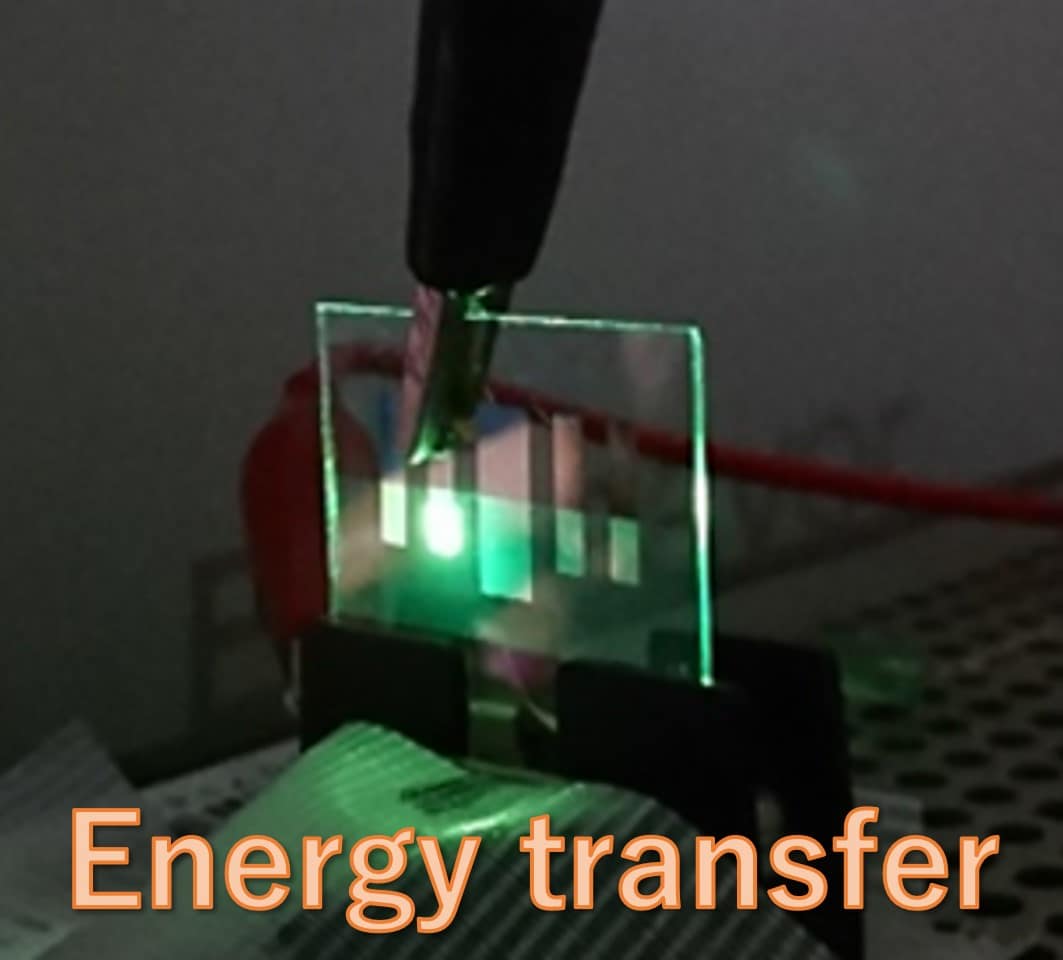
OLED Energy Transfer: Molecular and Device Design for Turning Excitons into Light
キーワード / Keywords
-
OLED / Organic Light-Emitting Diode
有機分子や高分子を電気で光らせる発光素子です。ディスプレイや照明で使われ、発光効率、色純度、寿命の改善が中心課題です。
EN: An organic light-emitting device driven by electricity. Efficiency, color purity, and lifetime are central challenges for displays and lighting. -
励起子管理 / Exciton Management
電気で生じた励起子を、失活させず発光分子へ導く設計です。OLEDでは励起子の生成場所、移動先、消滅経路の制御が性能を左右します。
EN: The design strategy of guiding electrically generated excitons toward emitters instead of losing them. It controls where excitons form, move, and decay. -
TADF / 熱活性化遅延蛍光
三重項励起子を熱で一重項へ戻し、蛍光として利用する仕組みです。希少金属を使わず高効率OLEDを作る重要な考え方です。
EN: Thermally activated delayed fluorescence converts triplet excitons back to singlets, enabling efficient OLEDs without relying on rare-metal emitters. -
FRET / Förster型エネルギー移動
分子間で比較的長距離に働くエネルギー移動です。発光層内で励起子を別の発光分子へ再分配し、効率向上に役立ちます。
EN: A relatively long-range energy-transfer process between molecules. It redistributes excitons in the emitting layer and can improve OLED efficiency. -
スピロ骨格 / Spiro Skeleton
二つの分子骨格が一点で直交するようにつながった立体構造です。ドナーとアクセプターを空間的に分け、電荷移動やTADF設計に使われます。
EN: A three-dimensional scaffold where two molecular units meet at one atom. It can spatially separate donors and acceptors for charge-transfer and TADF design.
採用した3本 / Three Selected Papers
-
ACS Applied Electronic Materials(2025 JIF: 4.7)
Enhancing the Efficiency of Ultrathin-EML OLEDs via a Double-Emitter Configuration
DOI: 10.1021/acsaelm.6c00271 -
Journal of Luminescence(2025 JIF: 3.8)
Asymmetrically allocating donor and acceptor units on a spiro-skeleton to construct thermally activated delayed fluorescence emitter for efficient OLEDs
DOI: 10.1016/j.jlumin.2026.122019 -
Journal of Computational Chemistry(2025 JIF: 2.9)
Synergistic Heavy-Atom and Vibronic-Coupling Effects for High-Performance Ionic TADF Emitters: A Theoretical Study
DOI: 10.1002/jcc.70445
日本語版
1. 二つの極薄発光層で、励起子をより多く光に変える
論文: Enhancing the Efficiency of Ultrathin-EML OLEDs via a Double-Emitter Configuration
掲載誌: ACS Applied Electronic Materials
DOI: 10.1021/acsaelm.6c00271
- この研究は、発光層を極薄にしたシンプルなOLEDで、効率を高めるためのデバイス構造を提案しています。
- 極薄発光層OLEDは、材料の使用量が少なく、構造も単純にできます。
- 一方で、励起子や電荷再結合が非常に狭い場所に集中するため、励起子とポーラロンの衝突や励起子同士の消滅が起こりやすくなります。
- 研究では、界面に置いた極薄発光層に加えて、輸送層の中にもう一つの極薄nu-DABNA発光層を配置しました。
- この二重発光層構造により、励起子を受け取る経路が増え、エネルギーを発光へ使いやすくなります。
- 実験とシミュレーションから、界面ドナー・エキシプレックス領域と二つの極薄発光層の間で、Förster型のエネルギー再分配が働くと説明されています。
- 最大外部量子効率は、単一発光層の9.6%から、二重発光層では14.2%へ向上しました。
- 一般向けに言えば、「光る場所を一か所に詰め込まず、少し離れた二つの場所に分けることで、励起エネルギーを無駄なく光へ変える」研究です。
2. スピロ骨格でドナーとアクセプターを空間配置し、高効率TADF緑色OLEDへ
論文: Asymmetrically allocating donor and acceptor units on a spiro-skeleton to construct thermally activated delayed fluorescence emitter for efficient OLEDs
掲載誌: Journal of Luminescence
DOI: 10.1016/j.jlumin.2026.122019
- この研究は、スピロ骨格を使ってドナーとアクセプターを非対称に配置した、新しいTADF発光分子A-s-TRZを設計・合成したものです。
- ドナーにはジメチルアクリジン、アクセプターにはジフェニルトリアジンを用いています。
- 剛直なspiro[fluorene-9,9′-xanthene]骨格により、ドナーとアクセプターが空間的に分かれ、through-space charge transferが起こりやすくなります。
- 一重項と三重項のエネルギー差は0.15 eVと小さく、TADFに必要な逆項間交差が起こりやすい設計です。
- 分子は高い熱安定性を示し、熱分解温度は436℃と報告されています。
- 15 wt%でドープしたOLEDでは、520 nmを中心とする緑色発光が得られました。
- 最大外部量子効率18.14%、最大電流効率52.7 cd A⁻¹、最大電力効率63.65 lm W⁻¹が示されています。
- 一般向けに言えば、「分子の立体骨格を使って電子の押す部分と受け取る部分をうまく離し、三重項エネルギーも光に変える」研究です。
3. 重原子効果と分子振動で、イオン性TADF発光体のRISCを速くする
論文: Synergistic Heavy-Atom and Vibronic-Coupling Effects for High-Performance Ionic TADF Emitters: A Theoretical Study
掲載誌: Journal of Computational Chemistry
DOI: 10.1002/jcc.70445
- この研究は、イオン性TADF材料の発光性能を、量子化学計算で詳しく調べた理論研究です。
- TADFでは、三重項励起子を一重項へ戻すRISCが速いほど、発光に使える励起子が増えます。
- 対象分子は、ねじれたドナー・アクセプター構造をもち、HOMOとLUMOが空間的に分かれるため、一重項と三重項のエネルギー差が小さくなります。
- 臭化物イオンを含む分子では、重原子効果によりスピン軌道相互作用が強まり、RISC速度が大きく高まりました。
- 低〜中周波数の分子振動も、S1状態とT1状態を近づける方向に働き、RISCを助けると示されています。
- 最適候補のAC-TPPO[Br]では、遅延蛍光量子収率74.88%、室温でほぼ100%のTADF寄与が予測されています。
- 一般向けに言えば、「分子に入れる原子や振動のしかたを計算で調整し、光に変わりにくいエネルギーを発光へ戻す道を太くする」研究です。
まとめ
今回の3本は、OLEDの発光効率を高めるために、励起子をどのように作り、どこへ移し、どう光へ変えるかを設計する重要性を示しています。二重発光層OLEDはデバイス構造でエネルギーを再分配し、スピロ型TADF分子は空間的な電荷移動で三重項を活用し、イオン性TADF材料の理論研究は重原子効果と分子振動でRISCを加速する指針を示しています。OLED energy transferは、分子設計とデバイス設計をつなぐ中核的な考え方です。
English Version
1. Double ultrathin emitters turn more excitons into light
Paper: Enhancing the Efficiency of Ultrathin-EML OLEDs via a Double-Emitter Configuration
Journal: ACS Applied Electronic Materials
DOI: 10.1021/acsaelm.6c00271
- This study proposes a device structure for improving OLED efficiency while keeping the emitting layers ultrathin and simple.
- Ultrathin emitting-layer OLEDs use little material and allow simplified fabrication.
- However, when charge recombination and excitons are confined to a very narrow region, exciton-polaron quenching and exciton-exciton annihilation can cause efficiency losses.
- The researchers combine an interfacial ultrathin emitter with a second ultrathin nu-DABNA emitter layer placed a few nanometers away in the transport layer.
- This double-emitter architecture provides an additional channel for exciton harvesting.
- Experiments and simulations support a Förster-type energy-redistribution picture between the interfacial donor/exciplex region and the two ultrathin emitter layers.
- The maximum external quantum efficiency increases from 9.6% in the single-emitter reference to 14.2% in the optimized double-emitter OLED.
- In simple terms, the device avoids crowding all light generation into one tiny place and instead gives excitons another route to become light.
2. A spiro skeleton separates donor and acceptor units for efficient green TADF OLEDs
Paper: Asymmetrically allocating donor and acceptor units on a spiro-skeleton to construct thermally activated delayed fluorescence emitter for efficient OLEDs
Journal: Journal of Luminescence
DOI: 10.1016/j.jlumin.2026.122019
- This study designs and synthesizes A-s-TRZ, a TADF emitter using an asymmetric donor-acceptor arrangement on a spiro skeleton.
- Dimethylacridine is used as the donor, while diphenyltriazine is used as the acceptor.
- The rigid spiro[fluorene-9,9′-xanthene] skeleton spatially separates the donor and acceptor, enabling through-space charge transfer.
- The singlet-triplet energy gap is 0.15 eV, supporting reverse intersystem crossing required for TADF.
- The emitter shows strong thermal stability, with a decomposition temperature of 436 °C.
- OLEDs doped with 15 wt% A-s-TRZ show green emission centered at 520 nm.
- The devices achieve a maximum external quantum efficiency of 18.14%, current efficiency of 52.7 cd A⁻¹, and power efficiency of 63.65 lm W⁻¹.
- For general readers, this molecule uses a three-dimensional scaffold to separate electron-donating and electron-accepting parts so more triplet energy can be converted into light.
3. Heavy atoms and molecular vibrations accelerate RISC in ionic TADF emitters
Paper: Synergistic Heavy-Atom and Vibronic-Coupling Effects for High-Performance Ionic TADF Emitters: A Theoretical Study
Journal: Journal of Computational Chemistry
DOI: 10.1002/jcc.70445
- This theoretical study uses quantum-chemical calculations to understand high-performance ionic TADF emitters.
- In TADF, faster reverse intersystem crossing converts more triplet excitons into emissive singlet excitons.
- The studied molecules have twisted donor-acceptor conformations that separate HOMO and LUMO orbitals and reduce the singlet-triplet energy gap.
- Bromide-containing molecules show a heavy-atom effect that strengthens spin-orbit coupling and accelerates RISC rates by about two orders of magnitude.
- Low- to medium-frequency molecular vibrations also help bring S1 and T1 energy surfaces close together, further supporting RISC.
- The best candidate, AC-TPPO[Br], is predicted to reach a delayed fluorescence quantum yield of 74.88% with nearly 100% room-temperature TADF contribution.
- In simple terms, the study shows how atom choice and molecular motion can open a faster pathway for otherwise wasted excitation energy to become light.
Overall Takeaway
The three selected papers show OLED energy transfer from complementary angles. The double-emitter OLED improves efficiency through device-level exciton redistribution. The spiro-linked TADF emitter uses molecular geometry to support through-space charge transfer and triplet harvesting. The ionic TADF theory paper shows how heavy-atom and vibronic effects can speed up RISC. Together, these studies show that better OLEDs require both molecular design and device architecture that guide excitation energy toward useful light emission.
文献 / References
- Stanzani, E.; Forzatti, M.; Saiz, S. M.; Tordera, D.; Bolink, H. J.; Zeder, S.; Paltidis, V. G.; Blülle, B.; Ruhstaller, B.; Jenatsch, S. Enhancing the Efficiency of Ultrathin-EML OLEDs via a Double-Emitter Configuration. ACS Applied Electronic Materials 8 (2026), 5252-5260. DOI: 10.1021/acsaelm.6c00271.
- Deng, D.; Sun, R.; Cui, Y.; Long, X.; Song, Y.; Zhang, X.; Shen, Y.; Lan, X.; Xiong, G.; Ren, B.-Y.; Zhao, Z. Asymmetrically allocating donor and acceptor units on a spiro-skeleton to construct thermally activated delayed fluorescence emitter for efficient OLEDs. Journal of Luminescence 297 (2026), 122019. DOI: 10.1016/j.jlumin.2026.122019.
- Meng, Y.; Ning, Z.; Tang, B.; Zhang, Y.; Cui, L.; Liu, X.; Lv, L. Synergistic Heavy-Atom and Vibronic-Coupling Effects for High-Performance Ionic TADF Emitters: A Theoretical Study. Journal of Computational Chemistry 47 (2026), e70445. DOI: 10.1002/jcc.70445.
選定メモ / Selection Note
- ACS Applied Electronic Materials:2025 JIF 4.7。
- Journal of Luminescence:2025 JIF 3.8。
- Journal of Computational Chemistry:2025 JIF 2.9。
- 添付ファイル内で確認できたOLED energy transfer関連論文は3本でした。そのため、この3本をジャーナルIF順に並べて採用しました。