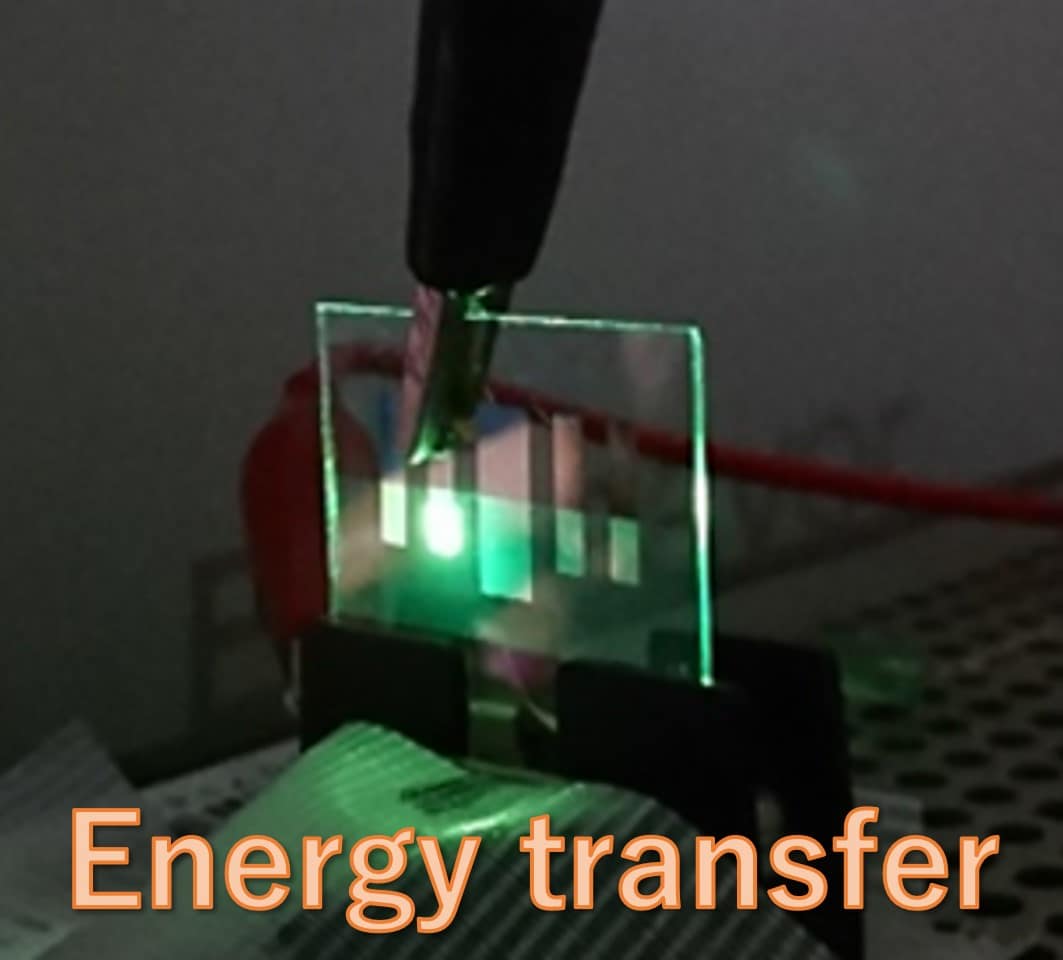
キーワード / Keywords
1. エネルギー移動(Energy Transfer)
日本語: OLED内部で励起エネルギーを効率よく受け渡す現象です。発光効率や色純度を左右する重要な要素であり、高性能デバイス設計の基盤となります。
English: Energy transfer controls how excitations move within OLED layers and strongly influences efficiency and color quality.
2. HLCT材料
日本語: 局在励起状態と電荷移動状態の特徴を組み合わせた発光材料です。高効率発光とエネルギー利用の向上が期待されています。
English: HLCT materials combine local excitation and charge-transfer characteristics to improve light-emission efficiency.
3. TADF
日本語: 熱活性化遅延蛍光は、本来利用しにくい励起状態も発光に活用する技術です。OLEDの高効率化に大きく貢献しています。
English: Thermally activated delayed fluorescence enables efficient utilization of excitons for OLED emission.
4. 界面設計
日本語: OLED層と層の境界を最適化する技術です。電荷注入やエネルギー移動を改善し、性能向上につながります。
English: Interface engineering improves charge injection and energy transfer between OLED layers.
5. ソリューションプロセス
日本語: 塗布によってデバイスを作製する製造方法です。将来的な低コスト大量生産技術として注目されています。
English: Solution processing is a scalable manufacturing approach with potential for low-cost OLED production.
日本語版
研究背景
OLED(有機発光ダイオード)の性能向上には、材料内部でのエネルギー移動をいかに効率よく制御するかが重要です。特に発光効率の向上や色純度の改善には、励起エネルギーの損失を抑えながら目的の発光中心へ届ける分子設計が求められています。今回紹介する研究は、発光材料そのものの設計とデバイス界面の最適化という二つの視点からエネルギー移動の制御に挑戦しています。
研究内容
1. HLCT分子による高効率エネルギー利用
Benzotri(Triazole)-Based HLCT Host Molecular Engineering for Highly Efficient Solution-Processable OLED
- ベンゾトリトリアゾール骨格を利用した新しいHLCT分子を開発。
- 一重項励起子と三重項励起子の両方を利用しやすい分子設計を実現。
- 発光効率の高い青色発光を示した。
- ホスト材料として利用したデバイスでは高い外部量子効率を達成。
- 低コスト化が期待される塗布型OLEDへの応用可能性を示した。
2. 界面設計による発光色と効率の制御
Tuning electroluminescence in hybrid TADF-fluorescent OLEDs via hole injection layer design
- TADF材料と蛍光材料を組み合わせたハイブリッドOLEDを検討。
- 正孔注入層や励起子閉じ込め層を最適化。
- エネルギー移動効率の向上によって輝度が大幅に改善。
- 発光色を青色から青緑色まで制御できることを示した。
- OLEDの色制御や表示性能向上に役立つ設計指針を提供した。
期待される応用
これらの研究は、分子設計と界面設計の両面からエネルギー移動を制御することで、OLEDの高効率化と高機能化を実現できることを示しています。将来的には高精細ディスプレイ、AR/VR機器、省エネルギー照明などへの応用が期待されます。
English Version
Energy Transfer Strategies for High-Performance OLEDs
Research Background
Efficient energy transfer is a key requirement for advanced OLED technologies. By minimizing energy loss and directing excitations toward desired emitters, researchers can improve efficiency, color purity, and device stability.
Research Highlights
1. HLCT Molecular Engineering for Efficient OLEDs
- Developed benzotri(triazole)-based HLCT molecules.
- Enabled efficient utilization of both singlet and triplet excitons.
- Demonstrated strong blue emission with high quantum efficiency.
- Achieved efficient solution-processable OLED performance.
- Highlighted a promising strategy for scalable OLED manufacturing.
2. Interface Engineering for Electroluminescence Control
- Optimized hybrid TADF-fluorescent OLED architectures.
- Improved hole injection and exciton confinement.
- Significantly enhanced luminance through better energy transfer.
- Enabled controllable emission color tuning.
- Provided useful design concepts for future display technologies.
Overall Significance
Together, these studies demonstrate that both molecular design and interface engineering are powerful approaches for managing energy transfer in OLEDs. Such advances can support the development of brighter, more efficient, and more versatile display and lighting technologies.
References / 文献
- Benzotri(Triazole)-Based HLCT Host Molecular Engineering for Highly Efficient Solution-Processable OLED. Advanced Functional Materials (2026). DOI: 10.1002/adfm.77588
- Tuning electroluminescence in hybrid TADF-fluorescent OLEDs via hole injection layer design. Materials Research Bulletin (2027). DOI: 10.1016/j.materresbull.2026.114359