| Publication Year | Author | Title | Publication Title | Pages | Issue | Volume |
|---|---|---|---|---|---|---|
| 2018 | Zhang, Z; Zhang, M; Li, XP; Li, KC; Lü, XQ; Wang, YY; Zhu, XJ | Irreversible Solvatochromic Zn-Nanopaper Based on Zn(II) Terpyridine Assembly and Oxidized Nanofibrillated Cellulose | ACS SUSTAINABLE CHEMISTRY & ENGINEERING | 11614-11623 | 9 | 6 |
OLEDに関する最新研究の総括(スピロピラン系材料を中心に)
【概要(400字程度)】
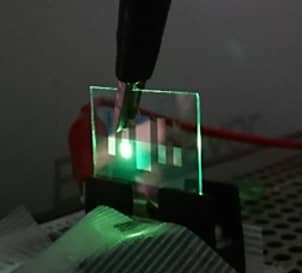
本研究では、光応答性スピロピラン(SP)誘導体を含むZn-nanopaper系有機EL材料の開発について報告されています。この論文【DOI: 10.1021/acssuschemeng.8b01815】では、SPの不可逆なソルバトクロミズムを利用して、刺激応答型の発光挙動とエレクトロルミネセンスの変調制御を実現しています。ナノセルロースとZn²⁺にSPを固定化した「Zn-nanopaper」は、可視光下での構造変換により発光色や電子状態が変化し、環境応答性OLEDの構築に向けた新たな方向性を提示しています。
【詳細解析】
1. 使用材料
- スピロピラン(SP)誘導体がフォトクロミック分子として中心的に使用され、ナノセルロースとZn²⁺と複合化することで、基材上で安定に固定化【DOI: 10.1021/acssuschemeng.8b01815】
- Zn-nanopaperは再生可能資源由来の構造体であり、エコデバイス開発に資するバイオマテリアルとして設計されている
2. デバイス構造と作製手法
- ナノ紙基材上にZn²⁺-SP複合体を自己組織化的に形成し、フォトクロミック応答と発光機能を両立
- 可視光照射によってスピロピランがメロシアニン型に不可逆変化することで、色調および発光挙動が変化
- この機構を利用し、環境センサー的なOLED応用や記録・表示デバイスへの展開が見込まれる
3. 得られた性能・新規知見
- 可視光誘起による不可逆ソルバトクロミック挙動とそれに連動した発光変化を報告
- 従来の可逆型SP材料に比べて記録保持性や安定性が高い
- セルロースナノファイバーの柔軟性とSPの光応答性を融合することで、持続可能性・刺激応答性・視覚情報変調を同時に実現
Summary of Recent OLED Research (Focused on Spiropyran-Based Materials)
【Overview】
This study investigates an irreversible solvatochromic Zn-nanopaper system based on spiropyran (SP), intended for optoelectronic applications. The material exhibits light-triggered structural changes and corresponding modulation in emission characteristics. The SP was immobilized on a cellulose nanofiber matrix in the presence of Zn²⁺, yielding a flexible and eco-friendly nanocomposite OLED substrate【DOI: 10.1021/acssuschemeng.8b01815】.
【Detailed Analysis】
1. Materials
- Spiropyran derivatives act as irreversible photochromic molecules, anchored to nanocellulose in coordination with Zn²⁺ ions
- Zn-nanopaper serves as a bio-based and renewable platform for optoelectronic functionality
2. Device Structure and Fabrication
- A self-assembled Zn²⁺-SP complex was formed on nanocellulose paper, exhibiting stable photo-switchable behavior
- Upon visible light irradiation, SP converts irreversibly into a merocyanine-like form, changing its optical and electronic characteristics
- This architecture offers potential for OLED-based sensors, optical memory, or display modulation
3. Key Findings
- Demonstrated irreversible solvatochromism with accompanying emission modulation under light exposure
- Improved information retention and operational stability compared to traditional reversible SP systems
- Integrates sustainability (biomaterials) with light-responsive photonic functions, showing promise for next-generation flexible OLEDs
Power by ChatGPT