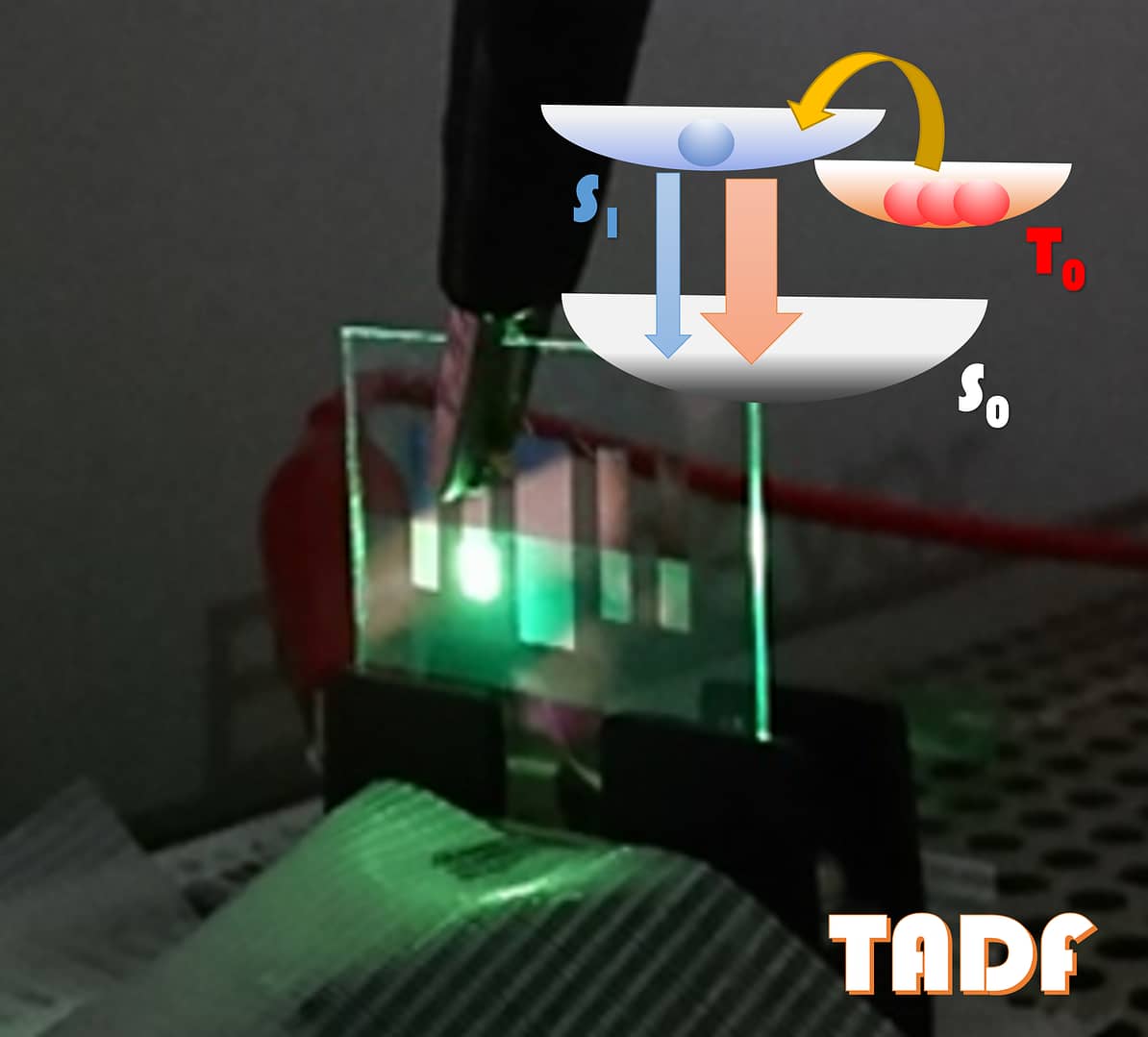
OLED TADF: Designing High-Efficiency Emitters for Next-Generation Displays
キーワード / Keywords
-
TADF / 熱活性化遅延蛍光
三重項励起子を熱で一重項へ戻し、蛍光として使う仕組みです。希少金属に頼らずOLEDを高効率化できる発光原理です。
EN: A mechanism that converts triplet excitons back to emissive singlets, enabling efficient OLEDs without relying only on rare-metal emitters. -
MR-TADF / 多重共鳴TADF
分子内の電子分布を精密に分け、狭い波長幅で発光するTADF材料です。高色純度の青色OLEDや高精細表示に重要です。
EN: A TADF design that separates electron distribution within a molecule, giving narrow emission useful for high-color-purity OLED displays. -
外部量子効率 / External Quantum Efficiency
OLEDから外へ出る光子数が、流した電子数に対してどれだけ多いかを示す指標です。発光材料と光取り出しの両方が効きます。
EN: A metric showing how efficiently injected electrons are converted into photons emitted outside the device. -
水平配向 / Horizontal Dipole Orientation
発光分子の光を出す向きが基板に平行にそろう状態です。光を外へ取り出しやすくし、OLEDの見かけの効率を高めます。
EN: Alignment of emitting dipoles parallel to the substrate, which helps more light escape from an OLED. -
CP-OLED / 円偏光OLED
右回り・左回りの偏光をもつ光を出せるOLEDです。3D表示や新しいディスプレイ技術への応用が期待されています。
EN: An OLED that emits circularly polarized light, promising for 3D displays and advanced optical technologies.
採用した3本 / Three Selected Papers
-
Light: Science & Applications(2025 JIF: 24.0)
High-efficiency and stable deep-blue iridium phosphorescent OLEDs with enhanced charge transfer dynamics
DOI: 10.1038/s41377-026-02264-y -
Advanced Functional Materials(2025 JIF: 19.9)
3,3′-Substituted Binaphthol-Based Axially Chiral MR-TADF Enantiomers for Solution-Processed Circularly Polarized Organic Light-Emitting Diodes (CP-OLEDs) With External Quantum Efficiency Over 28%
DOI: 10.1002/adfm.77389 -
Angewandte Chemie International Edition(2025 JIF: 17.6)
Phosphor-Sensitized Deep Blue Narrowband OLED Devices With EQE Over 40% by Using a Horizontal-Oriented Host
DOI: 10.1002/anie.9859395
日本語版
1. 深青色OLEDを、リン光増感とTADF発光体で安定化する
論文: High-efficiency and stable deep-blue iridium phosphorescent OLEDs with enhanced charge transfer dynamics
掲載誌: Light: Science & Applications
DOI: 10.1038/s41377-026-02264-y
- この研究は、深青色OLEDの高効率化と長寿命化をめざしたものです。
- 深青色OLEDは、画像の色再現性や高精細ディスプレイに重要ですが、高効率と安定性の両立が難しい分野です。
- 研究では、電子を引きつけるCF3基やF基をもつ非対称Ir(III)錯体を設計し、深青色リン光材料として評価しています。
- CF3置換錯体は、電荷移動性が強く、放射失活速度が高いため、443 nm付近の深青色発光を効率よく出せます。
- デバイスでは最大外部量子効率29.0%が得られ、色座標も高品質ディスプレイ用の青色基準に近い値を示しました。
- さらに、これらのIr錯体をリン光増感材料として使い、TADF発光体v-DABNAやDOB2-DABNA-Aと組み合わせたハイパーOLEDも検討しています。
- v-DABNAを用いたハイパーOLEDでは、100 cd m⁻²でLT50 = 2127 hという長寿命が示されました。
- 一般向けに言えば、「青く光るためのエネルギーを速く、無駄なく発光分子へ渡し、明るさと寿命を両立させる」研究です。
2. 軸不斉MR-TADF分子で、円偏光OLEDを高効率化する
論文: 3,3′-Substituted Binaphthol-Based Axially Chiral MR-TADF Enantiomers for Solution-Processed Circularly Polarized Organic Light-Emitting Diodes (CP-OLEDs) With External Quantum Efficiency Over 28%
掲載誌: Advanced Functional Materials
DOI: 10.1002/adfm.77389
- この研究は、円偏光を出せるOLED、すなわちCP-OLEDに向けたキラルMR-TADF発光材料の開発です。
- CP-OLEDは、3D表示や光学情報処理など、新しい表示技術への応用が期待されています。
- 研究では、安価で入手しやすいビナフトール骨格の3,3’位にMR-TADFユニットを結合しました。
- これにより、複雑なキラル分離をせずに、R体とS体の発光材料を高収率で得ています。
- 作製したR/S-DBNPは、狭帯域発光、高効率、キラリティを同時に備えたMR-TADF材料として評価されています。
- R-DBNPを用いた溶液プロセスCP-OLEDでは、最大外部量子効率28.1%が得られました。
- 円偏光発光の指標である|gEL|も示され、効率と偏光機能を同時に扱う設計として有用です。
- 一般向けに言えば、「分子に“ねじれ”を持たせて、効率よく光りながら、特殊な偏光を出せるOLEDを作る」研究です。
3. 横向きホスト分子で、40%超の深青色MR-TADF OLEDへ
論文: Phosphor-Sensitized Deep Blue Narrowband OLED Devices With EQE Over 40% by Using a Horizontal-Oriented Host
掲載誌: Angewandte Chemie International Edition
DOI: 10.1002/anie.9859395
- この研究は、深青色MR-TADF OLEDで、高効率と高色純度を同時に実現するためのホスト材料設計です。
- MR-TADF材料は狭い波長幅で発光できるため、高精細・高色純度ディスプレイに適しています。
- ただし、出た光をデバイス外へ取り出す効率が低いと、材料がよく光っても外部量子効率は伸びません。
- 研究では、4CzTPSというホスト分子を設計し、発光分子D1-DBNを基板に対して横向きにそろえやすくしました。
- 静電的な相互作用により、発光双極子の水平配向比は94.5%まで高まりました。
- リン光増感型の深青色デバイスで外部量子効率40.5%が得られました。
- さらに、4CzTPSを用いたエキシプレックス型共ホストにより、電荷注入と輸送のバランスを整え、外部量子効率42.0%、半値幅16.2 nmの狭帯域深青色発光を実現しています。
- 一般向けに言えば、「光る分子の向きをそろえて、OLEDの中で生まれた光をより多く外へ出す」研究です。
まとめ
今回の3本は、OLED TADF研究が、分子そのものの発光能力だけでなく、電荷移動、発光分子の向き、キラリティ、デバイス構造まで含む総合設計へ進んでいることを示しています。深青色OLEDでは、リン光増感とTADF発光体の組み合わせが高効率と長寿命に関わります。CP-OLEDでは、キラルMR-TADF分子が新しい表示機能を開きます。水平配向ホストでは、材料が発した光を外へ取り出す工夫により、40%を超える外部量子効率が実現されています。
English Version
1. Stabilizing deep-blue OLEDs with phosphorescent sensitization and TADF emitters
Paper: High-efficiency and stable deep-blue iridium phosphorescent OLEDs with enhanced charge transfer dynamics
Journal: Light: Science & Applications
DOI: 10.1038/s41377-026-02264-y
- This study focuses on improving both efficiency and stability in deep-blue OLEDs.
- Deep-blue OLEDs are essential for high-quality displays, but combining high efficiency with long operational lifetime remains difficult.
- The researchers design asymmetric Ir(III) complexes containing electron-withdrawing CF3 and F groups.
- The CF3-substituted complex shows strong charge-transfer character and a high radiative decay rate, enabling efficient deep-blue emission around 443 nm.
- Devices using these complexes achieve a maximum external quantum efficiency of up to 29.0% and color coordinates suitable for high-quality blue display standards.
- The complexes are also used as phosphorescent sensitizers in hyper-OLEDs with TADF emitters such as v-DABNA and DOB2-DABNA-A.
- The v-DABNA-based hyper-OLED achieves LT50 = 2127 h at 100 cd m⁻².
- In simple terms, this work helps blue OLEDs emit more efficiently and last longer by improving how excitation energy is transferred and used.
2. Axially chiral MR-TADF molecules for efficient circularly polarized OLEDs
Paper: 3,3′-Substituted Binaphthol-Based Axially Chiral MR-TADF Enantiomers for Solution-Processed Circularly Polarized Organic Light-Emitting Diodes (CP-OLEDs) With External Quantum Efficiency Over 28%
Journal: Advanced Functional Materials
DOI: 10.1002/adfm.77389
- This study develops chiral MR-TADF emitters for circularly polarized OLEDs.
- CP-OLEDs are promising for 3D displays and advanced optical technologies.
- The researchers use a binaphthol chiral unit and connect MR-TADF units at the 3,3′ positions.
- This design gives R/S-DBNP enantiomers in high yield without complicated chiral separation.
- The molecules combine narrowband emission, high efficiency, and chirality.
- A solution-processed CP-OLED using R-DBNP reaches a maximum external quantum efficiency of 28.1%.
- The device also shows circularly polarized electroluminescence, evaluated using the |gEL| value.
- In simple terms, this work gives OLED molecules a controlled twist so that they emit efficiently and produce circularly polarized light.
3. A horizontally oriented host enables over-40% EQE in deep-blue MR-TADF OLEDs
Paper: Phosphor-Sensitized Deep Blue Narrowband OLED Devices With EQE Over 40% by Using a Horizontal-Oriented Host
Journal: Angewandte Chemie International Edition
DOI: 10.1002/anie.9859395
- This study designs a host material to achieve both high efficiency and high color purity in deep-blue MR-TADF OLEDs.
- MR-TADF emitters are attractive for high-resolution displays because they can provide narrow emission bands.
- However, even strong emitters cannot deliver high external efficiency if too much light remains trapped inside the device.
- The host molecule 4CzTPS is designed to promote horizontal orientation of the D1-DBN emitter relative to the substrate.
- Electrostatic interaction between the host and emitter creates a horizontal dipole ratio of 94.5%.
- A phosphor-sensitized blue device achieves an external quantum efficiency of 40.5%.
- An exciplex-type co-host based on 4CzTPS further balances charge transport and raises EQE to 42.0%, with narrow deep-blue emission of 16.2 nm FWHM.
- For general readers, this study aligns light-emitting molecules so more generated light escapes from the OLED.
Overall Takeaway
The selected papers show that OLED TADF research is no longer limited to making brighter emitters. It now combines molecular photophysics, charge-transfer control, dipole orientation, chirality, sensitization, and device architecture. Deep-blue OLEDs benefit from phosphorescent sensitization and TADF terminal emitters. CP-OLEDs gain new display functionality through chiral MR-TADF molecules. Horizontally oriented hosts improve light extraction and push deep-blue MR-TADF OLEDs beyond 40% EQE.
文献 / References
- Li, S.; Tong, K.-N.; Zhang, M.; He, W.; Wu, C.; Ochi, J.; Wu, D.; Shi, K.; Wang, X.; Jung, S.; Kang, F.; Adachi, C.; Hatakeyama, T.; Wei, G. High-efficiency and stable deep-blue iridium phosphorescent OLEDs with enhanced charge transfer dynamics. Light: Science & Applications 15 (2026), 259. DOI: 10.1038/s41377-026-02264-y.
- Xu, S.; Du, X.; Sun, Y.; Chen, L.; Tao, J.; Yin, H.; Zhou, G.; Xi, J.; Jiao, B.; Chen, Z.; Yang, X. 3,3′-Substituted Binaphthol-Based Axially Chiral MR-TADF Enantiomers for Solution-Processed Circularly Polarized Organic Light-Emitting Diodes (CP-OLEDs) With External Quantum Efficiency Over 28%. Advanced Functional Materials (2026). DOI: 10.1002/adfm.77389.
- Wang, M.; Wang, X.; Zhang, K.; Tian, X.; Zhao, L.; Wang, S.; Wang, L. Phosphor-Sensitized Deep Blue Narrowband OLED Devices With EQE Over 40% by Using a Horizontal-Oriented Host. Angewandte Chemie International Edition (2026). DOI: 10.1002/anie.9859395.
選定メモ / Selection Note
- Light: Science & Applications:2025 JIF 24.0。
- Advanced Functional Materials:2025 JIF 19.9。
- Angewandte Chemie International Edition:2025 JIF 17.6。
- 添付ファイル内には、Chemical Engineering Journal、Chemical Science、Science China Chemistry、Advanced Optical Materials、ACS Applied Materials & InterfacesなどのOLED TADF関連論文も含まれていました。本稿では、添付ファイル内限定を守りつつ、OLED TADFとの関連性が明確で、ジャーナルIFが高い3本を優先しました。