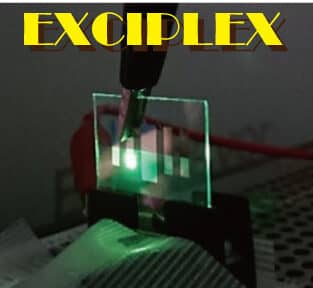
OLED Exciplex: Molecular Design for Efficiency, Color Purity, and Operational Lifetime
キーワード / Keywords
-
エキシプレックス / Exciplex
電子を与える分子と受け取る分子が、励起状態で一時的につくる発光性の組み合わせです。OLEDでは三重項励起子の活用に重要です。
EN: An excited-state complex formed by electron-donating and electron-accepting components. In OLEDs, it is important for using triplet excitons. -
OLED / Organic Light-Emitting Diode
有機分子に電気を流して光らせる発光素子です。スマートフォンやテレビの表示に使われ、効率、色純度、寿命の改善が重要です。
EN: An organic light-emitting device driven by electricity. It is used in displays, where efficiency, color purity, and lifetime are key targets. -
TADF / 熱活性化遅延蛍光
三重項励起子を熱で一重項へ戻し、蛍光として利用する仕組みです。エキシプレックスOLEDの高効率化に有効です。
EN: Thermally activated delayed fluorescence converts triplet excitons back to emissive singlets, helping exciplex OLEDs achieve high efficiency. -
重水素化 / Deuteration
分子中の水素を重水素に置き換える方法です。分子振動を変え、発光材料の劣化を抑えてOLED寿命を延ばす可能性があります。
EN: Replacing hydrogen atoms with deuterium. This can alter molecular vibrations and may improve OLED operational stability. -
エネルギー移動 / Energy Transfer
励起エネルギーがホスト、エキシプレックス、発光分子の間を移る現象です。OLEDの色、明るさ、効率を左右します。
EN: The movement of excitation energy among hosts, exciplexes, and emitters. It strongly affects OLED color, brightness, and efficiency.
採用した3本 / Three Selected Papers
-
Nature Photonics(2025 JIF: 38.1)
Deuterated compounds for organic light-emitting diodes
DOI: 10.1038/s41566-026-01917-z -
ACS Applied Electronic Materials(2025 JIF: 4.7)
Enhancing the Efficiency of Ultrathin-EML OLEDs via a Double-Emitter Configuration
DOI: 10.1021/acsaelm.6c00271 -
Journal of Physical Chemistry Letters(2025 JIF: 4.5)
Highly Efficient, Stable Exciplex-Based OLEDs with Narrowband Emission via Multiple Resonance Effect
DOI: 10.1021/acs.jpclett.6c01379
日本語版
1. 重水素化でOLEDの効率・寿命・ロールオフ問題に挑む
論文: Deuterated compounds for organic light-emitting diodes
掲載誌: Nature Photonics
DOI: 10.1038/s41566-026-01917-z
- この総説は、OLED用のホスト材料や発光材料を重水素化する研究の進展を整理したものです。
- OLEDはすでに高級ディスプレイで実用化されていますが、明るく使ったときの効率低下、寿命、安定性にはまだ課題があります。
- 重水素化は、水素を重水素へ置き換えることで分子振動を変え、発光材料の分解や非発光失活を抑える可能性があります。
- 蛍光材料、リン光材料、ホスト材料など、複数のOLED材料で性能改善が期待されています。
- 一方で、大量合成、コスト、材料設計の一般性など、実用化へ向けた課題も残っています。
- エキシプレックスOLEDでも、ホストや発光層の寿命が重要であり、重水素化は長寿命化に向けた基盤技術として関係します。
- 一般向けに言えば、「分子の水素を少し重い原子に替え、OLEDの劣化を遅らせる」ための研究動向です。
2. 二重発光層で、極薄OLEDの励起子をより効率よく光に変える
論文: Enhancing the Efficiency of Ultrathin-EML OLEDs via a Double-Emitter Configuration
掲載誌: ACS Applied Electronic Materials
DOI: 10.1021/acsaelm.6c00271
- この研究は、発光層を極薄にしたOLEDで、効率を高めるための二重発光層構造を提案しています。
- 極薄発光層OLEDは、材料使用量が少なく、デバイス構造も単純にできます。
- しかし、励起子が狭い場所に集中すると、励起子同士の消滅や励起子と電荷の衝突が起こりやすく、効率が下がります。
- 研究では、界面の極薄発光層に加えて、輸送層の中にもう1つのnu-DABNA極薄発光層を配置しました。
- この構造により、励起子を受け取って光へ変える経路が増えます。
- 実験とシミュレーションから、界面ドナー・エキシプレックス領域と2つの発光層の間で、Förster型の励起子再分配が起こると説明されています。
- 最大外部量子効率は、単一発光層の9.6%から、二重発光層では14.2%へ向上しました。
- 一般向けに言えば、「光る場所を2か所に分け、励起エネルギーを逃がさず光へ変える」OLED設計です。
3. 多重共鳴効果で、狭帯域・高効率・長寿命のエキシプレックスOLEDへ
論文: Highly Efficient, Stable Exciplex-Based OLEDs with Narrowband Emission via Multiple Resonance Effect
掲載誌: Journal of Physical Chemistry Letters
DOI: 10.1021/acs.jpclett.6c01379
- この研究は、エキシプレックスOLEDの弱点である色純度、効率、寿命の同時改善をめざしたものです。
- 研究では、多重共鳴TADFドナーであるSYBNと、トリアジン系アクセプターを組み合わせています。
- 多重共鳴分子は、発光スペクトルを狭くしやすく、色純度の高い発光に向いています。
- ドナーとアクセプターの間で強い分子間電荷移動が起こり、TADFに必要な速い逆項間交差にもつながります。
- 形成されたエキシプレックスは、最大89%のフォトルミネッセンス量子収率と、60 nmまで狭い発光幅を示しました。
- 最適OLEDでは、最大外部量子効率27.28%、半値幅60 nm、初期輝度1000 cd m⁻²で推定LT50が6000時間を超える性能が報告されています。
- 一般向けに言えば、「分子の発光を細くきれいにしながら、明るさと寿命も伸ばすエキシプレックスOLED」の研究です。
まとめ
今回の3本は、OLED exciplexを中心に、発光効率、色純度、寿命をどう同時に高めるかを示しています。重水素化はOLED材料の長寿命化に向けた基盤的な考え方です。二重発光層構造は、励起子を狭い領域に閉じ込めすぎず、エネルギーを再分配する方法です。多重共鳴エキシプレックスは、狭帯域発光と高効率、長寿命を同時に狙う設計です。共通する鍵は、励起エネルギーをどこで作り、どこへ移し、どのように失わず光へ変えるかです。
English Version
1. Deuteration as a route to better OLED efficiency and lifetime
Paper: Deuterated compounds for organic light-emitting diodes
Journal: Nature Photonics
DOI: 10.1038/s41566-026-01917-z
- This review summarizes recent progress in deuterated host and emitter compounds for OLEDs.
- OLEDs are already used in premium displays, but efficiency loss at high brightness, operational lifetime, and stability remain major issues.
- Deuteration replaces hydrogen with deuterium, changing molecular vibrations and potentially reducing degradation or nonradiative loss.
- Performance benefits have been explored in fluorescent, phosphorescent, host, and emitter systems.
- Practical challenges include scalable synthesis, cost, and how generally the strategy can be applied across OLED materials.
- For exciplex OLEDs, host and emitting-layer stability are also essential, making deuteration relevant as a broader lifetime-improvement strategy.
- In simple terms, this review discusses how replacing hydrogen with a heavier isotope can help OLED molecules last longer.
2. Double-emitter ultrathin OLEDs improve exciton use
Paper: Enhancing the Efficiency of Ultrathin-EML OLEDs via a Double-Emitter Configuration
Journal: ACS Applied Electronic Materials
DOI: 10.1021/acsaelm.6c00271
- This study proposes a double-emitter structure for improving the efficiency of ultrathin emitting-layer OLEDs.
- Ultrathin emitting-layer OLEDs use less material and allow simpler device structures.
- However, when excitons are confined to a very narrow region, exciton-polaron quenching and exciton-exciton annihilation can reduce efficiency.
- The authors combine an interfacial ultrathin emitter with a second ultrathin nu-DABNA layer placed a few nanometers away in the transport layer.
- This provides an additional exciton-harvesting channel.
- Experiments and simulations support a Förster-type exciton redistribution process between the interfacial donor/exciplex region and the two ultrathin emitters.
- The optimized double-emitter OLED reaches a maximum external quantum efficiency of 14.2%, compared with 9.6% for the single-emitter reference.
- In simple terms, the device gives excitons a second place to become light instead of crowding all emission into one tiny region.
3. Multiple-resonance exciplex OLEDs for narrowband, efficient, and stable emission
Paper: Highly Efficient, Stable Exciplex-Based OLEDs with Narrowband Emission via Multiple Resonance Effect
Journal: Journal of Physical Chemistry Letters
DOI: 10.1021/acs.jpclett.6c01379
- This study targets three key bottlenecks in exciplex OLEDs: color purity, efficiency, and operational lifetime.
- The design combines the multi-resonance TADF donor SYBN with triazine-based acceptors.
- Multi-resonance molecules tend to produce narrower emission, supporting higher color purity.
- Strong intermolecular charge-transfer character helps form efficient TADF exciplexes with fast reverse intersystem crossing.
- The resulting exciplexes show photoluminescence quantum yield up to 89% and emission full width at half maximum down to 60 nm.
- The best OLED achieves a maximum external quantum efficiency of 27.28%, a 60 nm FWHM, and an extrapolated LT50 lifetime beyond 6000 h at 1000 cd m⁻².
- For general readers, this study designs exciplex OLEDs that emit cleaner color while maintaining high brightness efficiency and long lifetime.
Overall Takeaway
The selected papers show how OLED exciplex research is moving toward simultaneous control of efficiency, color purity, and stability. Deuteration addresses long-term molecular durability. Double-emitter ultrathin OLEDs redistribute excitons to reduce losses. Multiple-resonance exciplexes narrow the emission band while improving efficiency and lifetime. The shared principle is to manage where excitation energy is generated, where it moves, and how it becomes light rather than being wasted.
文献 / References
- Jansen-van Vuuren, R. D.; Yao, J.; Wang, S.-F.; Kwon, O.; Vardeny, Z. V.; Chou, P.-T.; Dong, S.-C. Deuterated compounds for organic light-emitting diodes. Nature Photonics (2026). DOI: 10.1038/s41566-026-01917-z.
- Stanzani, E.; Forzatti, M.; Saiz, S. M.; Tordera, D.; Bolink, H. J.; Zeder, S.; Paltidis, V. G.; Blülle, B.; Ruhstaller, B.; Jenatsch, S. Enhancing the Efficiency of Ultrathin-EML OLEDs via a Double-Emitter Configuration. ACS Applied Electronic Materials 8 (2026), 5252-5260. DOI: 10.1021/acsaelm.6c00271.
- Shen, S.; Xie, X.; Lv, X.; Pang, Z.; Liu, Y.; Liu, J.; Wang, Y. Highly Efficient, Stable Exciplex-Based OLEDs with Narrowband Emission via Multiple Resonance Effect. Journal of Physical Chemistry Letters 17 (2026), 6990-6999. DOI: 10.1021/acs.jpclett.6c01379.
選定メモ / Selection Note
- Nature Photonics:2025 JIF 38.1。
- ACS Applied Electronic Materials:2025 JIF 4.7。
- Journal of Physical Chemistry Letters:2025 JIF 4.5。
- 添付ファイル内には、Journal of Luminescence掲載のスペーサー層設計による白色エキシプレックスOLEDも含まれていました。本稿では、添付ファイル内限定を守りつつ、OLED/exciplex/励起子制御との関連性があり、ジャーナルIFが高い3本を優先しました。