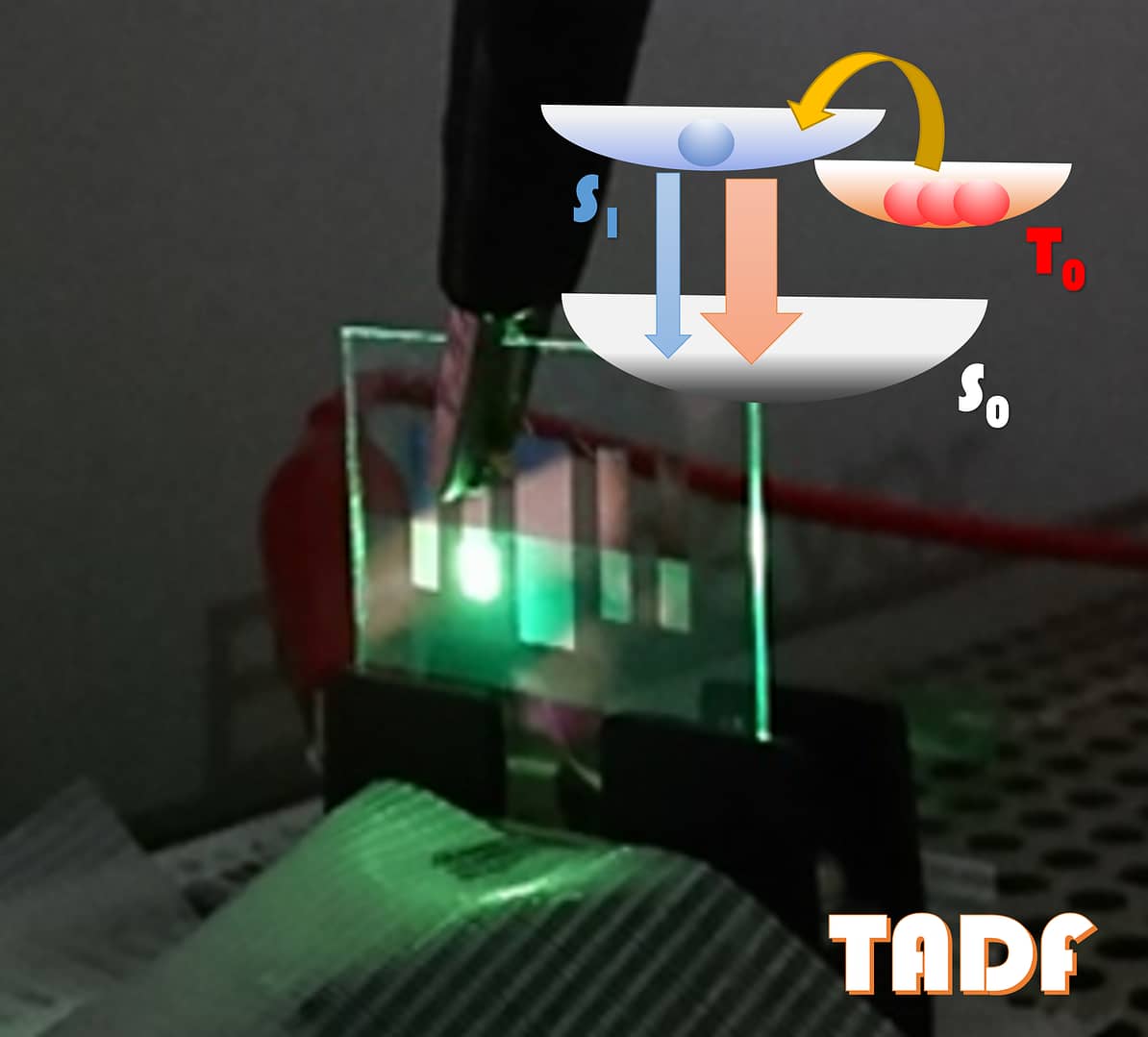
OLED TADF: Emitter Design for High Efficiency, Long Lifetime, and New Optical Functions
キーワード / Keywords
-
TADF / 熱活性化遅延蛍光
三重項励起子を熱で一重項へ戻し、蛍光として利用する発光機構です。希少金属を使わず高効率OLEDを実現する重要原理です。
EN: A mechanism that converts triplet excitons back to emissive singlets, enabling efficient OLEDs without relying only on rare metals. -
MR-TADF / 多重共鳴TADF
分子内の電子分布を精密に制御し、狭い発光幅と高色純度を実現するTADF材料です。高精細ディスプレイの青色発光で重要です。
EN: A TADF design that controls electron distribution within a molecule, giving narrow emission and high color purity for advanced displays. -
CMA / カルベン金属アミド錯体
カルベン、金属、アミド配位子からなる発光錯体です。TADF型OLED材料として、高速発光と低コスト化の可能性があります。
EN: A carbene-metal-amide complex. It is a promising TADF OLED emitter platform for fast emission and potentially lower material cost. -
円偏光発光 / Circularly Polarized Luminescence
左回り・右回りの偏りをもつ光です。3D表示、情報表示、磁場で制御する発光デバイスなど、新しい光機能につながります。
EN: Light with left- or right-handed circular polarization. It is useful for 3D displays, optical information, and magnetically controlled emitters. -
効率ロールオフ / Efficiency Roll-Off
OLEDを明るく光らせたときに効率が下がる現象です。励起子寿命、RISC速度、分子安定性の制御で抑制をめざします。
EN: A drop in efficiency at high brightness. It can be reduced by controlling exciton lifetime, RISC speed, and molecular stability.
採用した3本 / Three Selected Papers
-
Advanced Science(2025 JIF: 14.1)
Metal (n+1)p-nd Orbital Hybridization and Excited-State Metal-Ligand π-Interactions Enable d10 Carbene-Metal-Amide TADF OLEDs with High Efficiency and Long Operational Lifetime
DOI: 10.1002/advs.202600075 -
Journal of Photochemistry and Photobiology C: Photochemistry Reviews(2025 JIF: 12.8)
Magnetic circularly polarized (electro)luminescence: Principles, materials, and applications
DOI: 10.1016/j.jphotochemrev.2026.100767 -
Advanced Optical Materials(2025 JIF: 7.2)
Sulfur-Atom Incorporated Multi-Resonance Emitters via an Isomerization Strategy Enabling High-Performance Narrowband OLEDs With Suppressed Efficiency Roll-Off
DOI: 10.1002/adom.71406
日本語版
1. 金属と配位子の相互作用で、TADF OLEDの効率と寿命を両立する
論文: Metal (n+1)p-nd Orbital Hybridization and Excited-State Metal-Ligand π-Interactions Enable d10 Carbene-Metal-Amide TADF OLEDs with High Efficiency and Long Operational Lifetime
掲載誌: Advanced Science
DOI: 10.1002/advs.202600075
- この研究は、カルベン金属アミド(CMA)錯体を用いたTADF OLEDで、発光効率と動作寿命をどう両立するかを調べたものです。
- CMA錯体は、TADF型OLED発光体として有望ですが、配位子をどのように変えれば効率と安定性が高まるかは十分に整理されていませんでした。
- 研究では、金属の(n+1)p軌道とnd軌道の混成、さらに励起状態での金属–配位子π相互作用に注目しています。
- 計算化学により、励起状態で金属原子とカルバゾール窒素の間にπ相互作用ができることが示されました。
- この相互作用が弱まると、分子の励起状態での回転が起こりやすくなり、TADF発光速度が上がる可能性があります。
- 一方で、金属–窒素結合が弱くなりすぎると、励起状態で結合が切れやすくなり、材料の安定性やOLED寿命を損なうおそれがあります。
- つまり、発光を速くする設計と、壊れにくくする設計の間にはバランスが必要です。
- 一般向けに言えば、「よく光る分子にするには少し動きやすくしたいが、動きすぎると壊れやすい」という微妙な分子設計を明らかにした研究です。
2. 磁場で円偏光を制御する発光材料とOLEDの可能性
論文: Magnetic circularly polarized (electro)luminescence: Principles, materials, and applications
掲載誌: Journal of Photochemistry and Photobiology C: Photochemistry Reviews
DOI: 10.1016/j.jphotochemrev.2026.100767
- この総説は、磁気円偏光発光(MCPL)と磁気円偏光電界発光(MCPEL)の原理、材料、応用を整理したものです。
- 通常の円偏光発光では、分子そのものにキラリティが必要になることが多いですが、MCPLでは外部磁場によって円偏光を誘起できます。
- MCPLは、ゼーマン分裂やスピン軌道相互作用に基づいており、発光の左右性を磁場で切り替えられる点が特徴です。
- 総説では、有機π共役分子、TADF発光体、有機金属錯体、ランタニド錯体、量子ドット、ペロブスカイトなど、幅広い材料が扱われています。
- OLEDやペロブスカイトLEDを含む発光デバイスについても整理され、TADF発光体を含むMCPELデバイスが議論されています。
- 磁場で発光の偏光方向を制御できれば、3D表示、偏光情報、センサー、磁気応答型光源などの応用が広がります。
- 一般向けに言えば、「磁石の向きを変えることで、光の回り方を切り替えられる発光技術」の研究動向です。
3. 硫黄原子を入れたMR-TADF分子で、狭帯域OLEDの効率低下を抑える
論文: Sulfur-Atom Incorporated Multi-Resonance Emitters via an Isomerization Strategy Enabling High-Performance Narrowband OLEDs With Suppressed Efficiency Roll-Off
掲載誌: Advanced Optical Materials
DOI: 10.1002/adom.71406
- この研究は、MR-TADF発光体に硫黄原子を取り入れ、狭帯域発光と高効率、低ロールオフを同時にめざしたものです。
- MR-TADF OLEDは、高効率かつ高色純度の発光が期待されますが、三重項励起子の寿命が長いと、高輝度で効率が落ちやすくなります。
- 研究では、BN系MR骨格の周辺に2つの硫黄原子を橋かけする位置を変え、3種類の異性体発光体を設計しています。
- 硫黄の重原子効果により、スピン軌道相互作用が強まり、RISCが速くなることを狙っています。
- すべての発光体は、溶液中で半値幅24〜30 nmの狭帯域発光を示しました。
- 3,4-TECzBNと2,3-TECzBNでは、高いRISC速度が得られ、OLEDで最大外部量子効率27.2%および30.4%が示されました。
- 1000 cd m⁻²でも、それぞれ18.6%および20.8%の外部量子効率を維持し、効率ロールオフが抑えられています。
- 一般向けに言えば、「硫黄を分子の適切な場所に入れて、三重項エネルギーを早く光へ戻し、明るくしても効率が落ちにくいOLEDを作る」研究です。
まとめ
今回の3本は、OLED TADFの設計が、単に発光色や効率だけでなく、寿命、分子安定性、偏光制御まで広がっていることを示しています。CMA錯体の研究は、速い発光と長寿命の両立には金属–配位子相互作用の精密設計が必要であることを示しました。磁気円偏光発光の総説は、TADF材料を含むOLEDが新しい偏光機能へ展開できる可能性を示しています。硫黄導入MR-TADFの研究は、RISCを速めることで高輝度時の効率低下を抑えられることを示しました。
English Version
1. Metal-ligand interactions balance efficiency and lifetime in TADF OLEDs
Paper: Metal (n+1)p-nd Orbital Hybridization and Excited-State Metal-Ligand π-Interactions Enable d10 Carbene-Metal-Amide TADF OLEDs with High Efficiency and Long Operational Lifetime
Journal: Advanced Science
DOI: 10.1002/advs.202600075
- This study investigates how carbene-metal-amide complexes can achieve both high TADF OLED efficiency and long operational lifetime.
- CMA complexes are promising TADF emitters, but the ligand-design rules for balancing efficiency and stability have remained unclear.
- The authors focus on metal (n+1)p-nd orbital hybridization and excited-state metal-ligand π-interactions.
- Computational analyses show that metal atoms and carbazole nitrogen atoms can form π-interactions in the excited state.
- Weakening this interaction can allow more flexible excited-state rotation and increase the TADF radiative rate.
- However, if the metal-nitrogen bond becomes too weak, excited-state bond dissociation can occur more easily, reducing material stability and device lifetime.
- In simple terms, this work shows that a molecule can emit faster when it is somewhat flexible, but too much flexibility can make it less durable.
2. Magnetically controlled circularly polarized emission for OLED-related devices
Paper: Magnetic circularly polarized (electro)luminescence: Principles, materials, and applications
Journal: Journal of Photochemistry and Photobiology C: Photochemistry Reviews
DOI: 10.1016/j.jphotochemrev.2026.100767
- This review summarizes magnetic circularly polarized luminescence and magnetic circularly polarized electroluminescence.
- Conventional circularly polarized luminescence often requires molecular chirality, while MCPL can induce circularly polarized emission with an external magnetic field.
- MCPL is based on Zeeman splitting and spin-orbit coupling, allowing the handedness of emitted light to be controlled by magnetic-field polarity.
- The review covers organic π-conjugated molecules, TADF emitters, organometallic complexes, lanthanide complexes, quantum dots, and perovskites.
- It also discusses light-emitting devices, including OLEDs and perovskite LEDs, that contain fluorescent, phosphorescent, TADF, or quantum-dot emitters.
- In simple terms, this field explores light sources whose polarization can be switched by a magnetic field.
3. Sulfur-incorporated MR-TADF emitters suppress OLED efficiency roll-off
Paper: Sulfur-Atom Incorporated Multi-Resonance Emitters via an Isomerization Strategy Enabling High-Performance Narrowband OLEDs With Suppressed Efficiency Roll-Off
Journal: Advanced Optical Materials
DOI: 10.1002/adom.71406
- This study designs sulfur-containing MR-TADF emitters for narrowband OLEDs with high efficiency and reduced roll-off.
- MR-TADF OLEDs are attractive because they can combine high efficiency with color-pure emission, but long triplet lifetimes can cause efficiency loss at high brightness.
- The researchers bridge two sulfur atoms at different peripheral positions of a BN-based MR core to create three isomeric emitters.
- The sulfur atoms are intended to enhance spin-orbit coupling through a heavy-atom effect and accelerate reverse intersystem crossing.
- All emitters show narrow emission with full widths at half maximum of 24-30 nm in solution.
- OLEDs using 3,4-TECzBN and 2,3-TECzBN achieve maximum external quantum efficiencies of 27.2% and 30.4%.
- At 1000 cd m⁻², the devices still retain EQEs of 18.6% and 20.8%, showing suppressed efficiency roll-off.
- In simple terms, this work places sulfur atoms in the molecular framework to help triplet energy return to light faster, keeping OLEDs efficient even when bright.
Overall Takeaway
The selected papers show that OLED TADF research now spans efficiency, lifetime, stability, and new optical functions. CMA emitters highlight the balance between fast emission and molecular durability. Magnetic circularly polarized electroluminescence expands OLED-related TADF materials toward controllable polarization. Sulfur-incorporated MR-TADF emitters show how faster RISC can reduce efficiency loss at high brightness. Together, these studies show that future OLEDs will depend on both molecular photophysics and device-level functionality.
文献 / References
- Xu, S.; Tang, R.; Wan, Q.; Cheng, G.; Yang, J.; Che, C.-M. Metal (n+1)p-nd Orbital Hybridization and Excited-State Metal-Ligand π-Interactions Enable d10 Carbene-Metal-Amide TADF OLEDs with High Efficiency and Long Operational Lifetime. Advanced Science (2026). DOI: 10.1002/advs.202600075.
- Imai, Y.; Yagi, S. Magnetic circularly polarized (electro)luminescence: Principles, materials, and applications. Journal of Photochemistry and Photobiology C: Photochemistry Reviews 68 (2026), 100767. DOI: 10.1016/j.jphotochemrev.2026.100767.
- Liu, W.; Li, M.; Liu, D.; Kido, J.; Su, S.-J. Sulfur-Atom Incorporated Multi-Resonance Emitters via an Isomerization Strategy Enabling High-Performance Narrowband OLEDs With Suppressed Efficiency Roll-Off. Advanced Optical Materials 14 (2026). DOI: 10.1002/adom.71406.
選定メモ / Selection Note
- Advanced Science:2025 JIF 14.1。
- Journal of Photochemistry and Photobiology C: Photochemistry Reviews:2025 JIF 12.8。
- Advanced Optical Materials:2025 JIF 7.2。
- 添付ファイル内には、ACS Applied Electronic Materials、Dyes and Pigments、Spectrochimica Acta Part AなどのOLED TADF関連論文も含まれていました。本稿では、添付ファイル内限定を守りつつ、OLED TADFとの関連性が明確で、ジャーナルIFが高い3本を優先しました。