date: 2026-01-24
keywords: [TADF dendrimers, asymmetrical architecture, isolated triplet states, solution-processed OLEDs, symmetry breaking]
OLED(有機EL)は、電気エネルギーを光に変える薄膜デバイスです。
その効率を左右するのが、励起子(電子と正孔が結びついた“光の種”)の スピン状態です。
- 一重項(Singlet):光りやすい(蛍光として発光)
- 三重項(Triplet):そのままでは光りにくい(損失になりやすい)
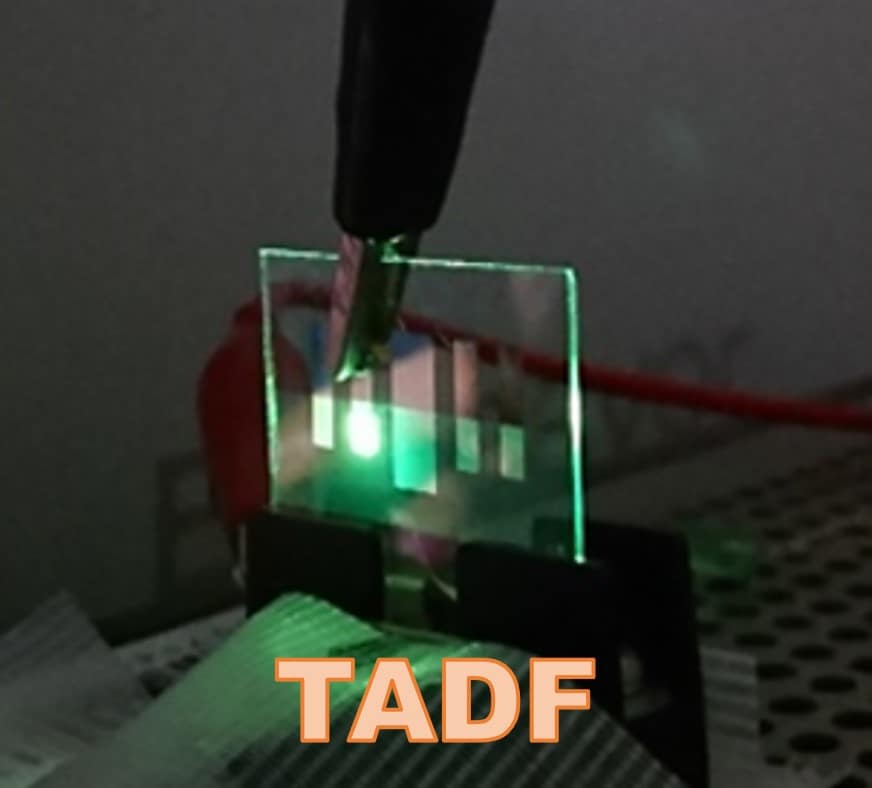
TADF(Thermally Activated Delayed Fluorescence)は、三重項を熱エネルギーで一重項へ戻す RISC を利用し、光として回収する考え方です。
今回のデータでは、(1) ホット励起子系でのRISC加速の理論 と、(2) 溶液プロセスOLEDでの高効率TADF材料設計 の2件が含まれています。
論文のやさしい解説
論文1:Effect of Perturbative Vibronic Correction for Spin-Orbit Coupling in Hot Exciton OLED Systems
- 著者:Choi, H; Park, SW; Rhee, YM
- 掲載誌:JOURNAL OF PHYSICAL CHEMISTRY A(2026)
- DOI:10.1021/acs.jpca.5c05378
日本語:何の研究?(ひとことで)
「ホット励起子OLED」で、振動(分子のゆれ)がスピン反転(RISC)を助けることを理論計算で示した研究
ポイント(やさしく)
– 蛍光OLEDの高効率化では、三重項(triplet)励起子を一重項(singlet)へ戻す RISC が鍵。
– ホット励起子系では高励起準位での hRISC を狙うが、状態の性質が似るとスピン軌道相互作用(SOC)が小さくなりがち。
– 本研究は“振動で少し形が崩れた瞬間”にCT/LE性質が動的に混ざってSOCが増え、hRISC速度が大きく上がり得ることを示した。
応用イメージ
– 材料設計指針(骨格の柔軟性・多環構造)
– 計算評価でのSOC補正の重要性
– 高効率蛍光OLEDの理論解析
English: What is this about?
Theory: vibronic (vibrational) effects can strongly enhance spin–orbit coupling and hRISC in hot‑exciton OLED emitters
Key points
– Efficient OLEDs need to harvest triplet excitons via reverse intersystem crossing (RISC).
– In hot‑exciton systems, target triplet and singlet states may have similar CT character, giving tiny zeroth‑order SOC and slow hRISC.
– A perturbative vibronic correction shows that geometry distortions can mix CT and LE character differently between states, boosting SOC and hRISC by orders of magnitude.
Possible applications
– Design rules for flexible multi‑ring backbones
– More accurate computational screening
– Understanding photophysics in hot‑exciton OLEDs
論文2:High-Efficiency TADF Dendritic Emitters Enabled by Synchronously Inhibiting Degenerated Triplet Excited States and Structural Relaxation Toward Solution-Processed OLEDs with EQE Over 33%
- 著者:Yu, XX; Ping, W; Song, CS; Zhao, JY; Hua, L; Wang, JJ; Ying, S; Liu, YC; Ren, ZJ; Yan, SK
- 掲載誌:ADVANCED SCIENCE(2026)
- DOI:10.1002/advs.202524183
日本語:何の研究?(ひとことで)
TADFデンドリマーを“非対称化”して三重項準位の縮退をほどき、溶液プロセスOLEDでEQE 33%超を実現した研究
ポイント(やさしく)
– TADFでは三重項→一重項の RISC を速くし、発光(PL)損失を減らすことが高効率の鍵。
– 本研究は分子を左右非対称に設計して、三重項励起状態の“縮退(同じエネルギーが重なる)”を解消し、スピン反転を促進。
– 構造緩和や非放射失活も抑え、溶液塗布型OLEDで EQE 33.7% と高い性能を報告している。
応用イメージ
– インク塗布・印刷型OLED(低コスト製造)
– 高効率TADF材料設計(対称性の制御)
– 狭帯域発光(MR‑TADF)への増感剤としての応用
English: What is this about?
Asymmetric TADF dendrimers for solution‑processed OLEDs: suppressing triplet degeneracy and structural relaxation enables >33% EQE
Key points
– High‑performance solution‑processed OLEDs need efficient TADF dendritic emitters with fast RISC and minimal nonradiative decay.
– Symmetry breaking converts degenerate triplet states into isolated ones, facilitating spin‑flip processes.
– Structural locking suppresses relaxation/nonradiative loss, leading to near‑unity PL efficiency and record‑high EQE in devices.
Possible applications
– Printable/solution‑processed OLED manufacturing
– Molecular design via symmetry control
– Sensitizers for narrowband MR‑TADF OLEDs
用語ミニ解説 / Mini‑Glossary
- TADF:熱エネルギーで三重項→一重項へ戻し、遅延蛍光として発光させる仕組み
- RISC / hRISC:Reverse Intersystem Crossing(逆項間交差)/高励起準位でのRISC(hot‑exciton RISC)
- SOC(Spin–Orbit Coupling):スピン反転を起こす“混ざり具合”を決める相互作用
- Vibronic coupling(振電相互作用):電子状態と分子振動の結びつき(RISCの加速要因になり得る)
- Solution‑processed OLED:溶液塗布・印刷などで作れるOLED(低コスト製造につながる)
References
- Choi, H; Park, SW; Rhee, YM Effect of Perturbative Vibronic Correction for Spin-Orbit Coupling in Hot Exciton OLED Systems. JOURNAL OF PHYSICAL CHEMISTRY A (2026). DOI: 10.1021/acs.jpca.5c05378
- Yu, XX; Ping, W; Song, CS; Zhao, JY; Hua, L; Wang, JJ; Ying, S; Liu, YC; Ren, ZJ; Yan, SK High-Efficiency TADF Dendritic Emitters Enabled by Synchronously Inhibiting Degenerated Triplet Excited States and Structural Relaxation Toward Solution-Processed OLEDs with EQE Over 33%. ADVANCED SCIENCE (2026). DOI: 10.1002/advs.202524183
Tags
OLED, TADF, hot exciton, RISC, spin–orbit coupling, vibronic coupling, solution-processed OLED, dendrimer