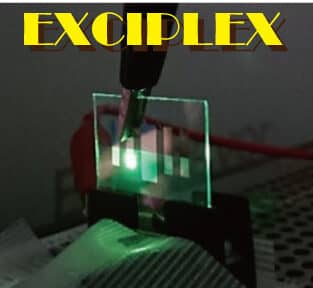
Organic LED and 2-(4-biphenyl)-5-(4-tert-butylphenyl)-1,3,4-oxadiazolee
| Publication Type | Authors | Book Authors | Book Editors | Book Group Authors | Author Full Names | Book Author Full Names | Group Authors | Article Title | Source Title | Book Series Title | Book Series Subtitle | Language | Document Type | Conference Title | Conference Date | Conference Location | Conference Sponsor | Conference Host | Author Keywords | Keywords Plus | Abstract | Addresses | Affiliations | Reprint Addresses | Email Addresses | Researcher Ids | ORCIDs | Funding Orgs | Funding Name Preferred | Funding Text | Cited References | Cited Reference Count | Times Cited, WoS Core | Times Cited, All Databases | 180 Day Usage Count | Since 2013 Usage Count | Publisher | Publisher City | Publisher Address | ISSN | eISSN | ISBN | Journal Abbreviation | Journal ISO Abbreviation | Publication Date | Publication Year | Volume | Issue | Part Number | Supplement | Special Issue | Meeting Abstract | Start Page | End Page | Article Number | DOI | DOI Link | Book DOI | Early Access Date | Number of Pages | WoS Categories | Web of Science Index | Research Areas | IDS Number | Pubmed Id | Open Access Designations | Highly Cited Status | Hot Paper Status | Date of Export | UT (Unique WOS ID) | Web of Science Record |
|---|---|---|---|---|---|---|---|---|---|---|---|---|---|---|---|---|---|---|---|---|---|---|---|---|---|---|---|---|---|---|---|---|---|---|---|---|---|---|---|---|---|---|---|---|---|---|---|---|---|---|---|---|---|---|---|---|---|---|---|---|---|---|---|---|---|---|---|---|---|---|---|
| J | Weatherill, LA; Milverton, R; Pander, P; Dias, FB | Weatherill, Lucy A.; Milverton, Ross; Pander, Piotr; Dias, Fernando B. | Mitigating slow reverse ISC rates in TAPC:PBD exciplex via rapid Forster energy transfer to TTPA | ORGANIC ELECTRONICS | There have been many advances in the development of thermally activated delayed fluorescence (TADF) materials for organic light emitting diode (OLED) applications in recent years. In particular, intramolecular exciplex systems have been highly studied and found to produce OLED devices of high external quantum efficiency (EQE) due to triplet harvesting via TADF. The proposed next generation of OLEDs uses hyperfluorescence to overcome the problem of broad emission associated with exciplexes. This process involves Forster resonance energy transfer (FRET) from the TADF host to a fluorescent dopant. In this work we revisited the photophysics of the TAPC:PBD exciplex (formed between the electron donor di-[4-(N,N-di-p-tolyl-amino)-phenyl]cyclohexane (TAPC) and the electron acceptor, 2-(4-biphenyl)-5-(4-tert-butylphenyl)-1,3,4-oxadiazole (PBD)) as a host capable of simultaneously performing triplet harvesting and work as a donor transferring energy to a bright fluorescent emitter. The aim is to investigate the interplay between energy transfer and intersystem crossing in this hyperfluorescence system. Contrarily to previous findings, films of the TAPC:PBD blend show relatively slow reverse intersystem crossing rate (RISC) and weak luminescence efficiency (PLQY). Despite this, when doped with the strong fluorescent emitter TTPA, the luminescence quantum yield is greatly improved due to the highly efficient energy transfer rate from TAPC:PBD to TTPA. The rapid FRET from the exciplex to the fluorescent emitter overcomes the non-radiative losses affecting the luminescence efficiency of the blend. This study shows that the hyperfluorescence mechanism not only allows colour purity in OLEDs to be optimised, but also facilitates suppressing major loss mechanisms affecting luminescence efficiency, thus creating conditions to maximizing EQE. | Pander, Piotr/AAR-1092-2020; Dias, Fernando B./F-3551-2011; Dias, Fernando/F-3551-2011 | Dias, Fernando B./0000-0001-9841-863X; | 1566-1199 | 1878-5530 | FEB | 2025 | 137 | 107180 | 10.1016/j.orgel.2024.107180 | http://dx.doi.org/10.1016/j.orgel.2024.107180 | DEC 2024 | WOS:001375153100001 | View Full Record in Web of Science | |||||||||||||||||||||||||||||||||||||||||||||||||||||
| J | Altinolcek, N; Battal, A; Tavasli, M; Cameron, J; Peveler, WJ; Yu, HA; Skabara, PJ; Fairbairn, NJ; Hedley, GJ | Altinolcek, Nuray; Battal, Ahmet; Tavasli, Mustafa; Cameron, Joseph; Peveler, William J.; Yu, Holly A.; Skabara, Peter J.; Fairbairn, Nicola J.; Hedley, Gordon J. | A red-orange carbazole-based iridium(III) complex: Synthesis, thermal, optical and electrochemical properties and OLED application | JOURNAL OF ORGANOMETALLIC CHEMISTRY | A novel heteroleptic iridium(III) acetylacetonate (acac) complex, (L-5-CHO)(2)Ir(acac) (3b), was synthesised from 2-(9'-hexylcarbazole-3'-yl)-5-formylpyridine (L-5-CHO) (1b). The complex 3b was determined to be thermally and electrochemically stable. The photoluminescence properties of the compound were studied, with a dichloromethane solution of 3b giving structureless emission at 662 nm, showing that the formyl group red-shifted the emission by 151 nm compared to the parent complex. Complex 3b was also shown to possess a moderate photoluminescence quantum yield (67%) and a short emission lifetime (tau = 280 ns). Organic light-emitting diodes (OLEDs) were fabricated with a solution-processed emissive layer (EML) consisting of poly(N-vinylcarbazole) (PVK), 2-(4-tert-butylphenyl)-5-(4-biphenylyl)-1,3,4-oxadiazole (PBD) and iridium complex (3b). The OLEDs containing complex 3b showed red-orange electroluminescence (EL) at 624 nm. The influence of the host materials was studied and the best performance was achieved with both PVK and PBD in the emissive layer, with the resulting OLEDs exhibiting a current efficiency of 0.84 cd/A, a power efficiency of 0.20 lm/W, and an external quantum efficiency (EQE) of 0.66% at a brightness of 2548 cd/m(2). (C) 2021 Elsevier B.V. All rights reserved. | BATTAL, Ahmet/AAP-1502-2020; Tavasli, Mustafa/AAB-1630-2020; Alt?n?l?ek G?ltekin, Nuray/JCN-8292-2023; Hedley, Gordon/AAC-4926-2019; Cameron, Joseph/AGF-6568-2022; Peveler, William/L-5124-2013; Skabara, Peter/HNJ-5153-2023 | BATTAL, AHMET/0000-0003-0208-1564; Hedley, Gordon/0000-0002-1825-6296; Yu, Holly/0000-0002-9559-3376; Peveler, William/0000-0002-9829-2683; Cameron, Joseph/0000-0001-8622-8353; Fairbairn, Nicola/0000-0003-3984-7340; TAVASLI, Mustafa/0000-0002-9466-1111 | 0022-328X | 1872-8561 | OCT 15 | 2021 | 951 | 122004 | 10.1016/j.jorganchem.2021.122004 | http://dx.doi.org/10.1016/j.jorganchem.2021.122004 | JUL 2021 | WOS:000688430600003 | View Full Record in Web of Science | |||||||||||||||||||||||||||||||||||||||||||||||||||||
| J | Pushparekha; Sarojini, BK; Hegde, S | Pushparekha; Sarojini, Balladka Kunhanna; Hegde, Shreedatta | The structural studies of 2-[(4-tert-butylphenyl)-5-(4-biphenyl)]-1, 3, 4-oxadiazole (PBD) incorporated ƒÁ ray irradiated chitosan films for optoelectronic applications | JOURNAL OF MOLECULAR STRUCTURE | Herein, versatile biopolymer chitosan films doped with 2-[(4--tert-butylphenyl)-5-(4-biphenyl)]-1, 3, 4-oxadiazole (PBD) a known OLED material were prepared by intercalation method. These films witnessed crosslinking which in turn exhibited exciting properties due to gamma irradiation with varied dosages. The radical mediated crosslinking of NH2 group with t-butyl group was envisaged by the increased crystallinity of the films. The XPS analysis showed the formation of the bond between dopant and polymer backbone. The changes in binding energies of unirradiated and irradiated CHPBD films for N1 s from 399.08 eV (1 degrees amine) to 400.7 eV (2 degrees amine), supported reaction of NH2 group with t-butyl group of PBD in crosslinking of dopant and polymer matrix with the formation of C-N linkage. In PXRD, peaks centered around 21.24 degrees for pristine chitosan film, but for the unirradiated CHPBD, it was shifted to the lower angle16.09 degrees to form amorphous film. However, for the irradiated CHPBD shifting to the higher angle 22.9 degrees, 23.08 degrees, 27.23 degrees suggesting that dopant had chemically interacted with the polymer matrix. The Young's modulus, tensile strength indicated supportive properties. An interesting change in UV absorption behavior was observed for the unirradiated CHPBD exhibiting lambda(max) at 290 nm with a hypsochromic shift with respected to dopant (lambda(max),309 nm). This indicated weak head-to-head alignment of dyes in an unirradiated matrix; whereas irradiation brought about changes through chemical crosslinking in the architecture of films with a redshift to 309 nm. Hyperchromism was also the effect of irradiation on films. The unirradiated films exhibited emission maxima around 369 nm whereas irradiated films showed 412 nm. Hence, a simple method was developed for the preparation of blue emissive biopolymeric materials. (C) 2021 Elsevier B.V. All rights reserved. | 0022-2860 | 1872-8014 | OCT 15 | 2021 | 1242 | 130699 | 10.1016/j.molstruc.2021.130699 | http://dx.doi.org/10.1016/j.molstruc.2021.130699 | JUN 2021 | WOS:000675890400001 | View Full Record in Web of Science | |||||||||||||||||||||||||||||||||||||||||||||||||||||||
| J | Chulkin, P; Lapkowski, M; Bryce, MR; Santos, J; Data, P | Chulkin, Pavel; Lapkowski, Mieczyslaw; Bryce, Martin R.; Santos, Jose; Data, Przemyslaw | Determination of standard redox rate constants of OLED active compounds by electrochemical impedance spectroscopy | ELECTROCHIMICA ACTA | A number of commercial organic compounds (m-MTDATA, PBD, CBP, TAPC, NPB, TPBi, etc) as well as several donor-acceptor-donor (D-A-D) compounds were investigated by cyclic voltammetry and electrochemical impedance spectroscopy. The compounds were chosen as they are promising components of small-molecule-based high efficiency Thermally Activated Delayed Fluorescence (TADF) emitters in Organic Light Emitting Diodes (OLEDs). Electrochemical impedance spectra of a Pt electrode in CH2Cl2 solutions containing the investigated compound and Bu4NBF4 as the electrolyte were obtained and analyzed by electrochemical electrical circuit methods. Charge transfer resistance, double layer capacitance, Warburg constant and other parameters were determined and represented as a function of the potential. Analysis of charge transfer resistance as a function of potential allowed an estimation of standard redox rate constants for the compounds' oxidation and reduction processes. Two main features concerning the redox reaction rates of OLED-active compounds were revealed: (i) the oxidation and reduction rates of ambipolar compounds, i. e. containing both donor and acceptor parts, were found to be much higher than those of unipolar donor-only and acceptor-only molecules; (ii) the relationship between the oxidation and reduction rate constants was shown to be related to the compounds' conductivity type in the solid state. (c) 2017 The Authors. Published by Elsevier Ltd. | Data, Przemyslaw/F-3546-2012; Santos, Jose/K-1119-2014; Mieczyslaw, Lapkowski/D-5242-2014; Lapkowski, Mieczyslaw/D-5242-2014; Bryce, Martin/I-2356-2012 | Data, Przemyslaw/0000-0002-1831-971X; Chulkin, Pavel/0000-0001-5038-4864; Santos, Jose/0000-0002-9702-2315; Mieczyslaw, Lapkowski/0000-0001-7099-3982; Bryce, Martin/0000-0003-2097-7823 | 0013-4686 | 1873-3859 | DEC 20 | 2017 | 258 | 1160 | 1172 | 10.1016/j.electacta.2017.11.171 | http://dx.doi.org/10.1016/j.electacta.2017.11.171 | WOS:000418324800129 | View Full Record in Web of Science | |||||||||||||||||||||||||||||||||||||||||||||||||||||
| J | Sarjidan, MAM; Basri, SH; Za'aba, NK; Zaini, MS; Abd Majid, WH | Sarjidan, M. A. Mohd; Basri, S. H.; Za'aba, N. K.; Zaini, M. S.; Abd Majid, W. H. | Electroluminescence and negative differential resistance studies of TPD:PBD:Alq3 blend organic-light-emitting diodes | BULLETIN OF MATERIALS SCIENCE | Ternary system of single-layer organic-light-emitting diodes (OLEDs) were fabricated containing tris(8-hydroxyquinoline) aluminium (Alq (3) ) blended with N,N (')-diphenyl-N,N (')-bis(3-methylphenyl)-1,1 (')-biphenyl-4,4 (')-diamine and 2-(4-biphenylyl)-5-phenyl-1,3,4-oxadiazole small molecules. Electroluminescence properties were investigated with respect to blend systems. Significant improvement in turn-on voltage and luminance intensity was observed by employing the blends technique. Negative differential resistance (NDR) characteristics observed at a low voltage region in blended OLED is related to the generation of guest hopping site and phonon scattering phenomenon. However, luminescence of the devices is not altered by the NDR effect. | Ahmad, Nor/AAA-8361-2020; wan haliza, Abd Majid/B-2797-2010; Abd. Majid, Wan Haliza/B-2797-2010; Mohd Sarjidan, Mohd Arif/AAB-4648-2020 | wan haliza, Abd Majid/0000-0001-8273-5892; Mohd Sarjidan, Mohd Arif/0000-0001-6413-8568 | 0250-4707 | 0973-7669 | FEB | 2015 | 38 | 1 | 235 | 239 | 10.1007/s12034-014-0807-6 | http://dx.doi.org/10.1007/s12034-014-0807-6 | WOS:000350801000035 | View Full Record in Web of Science | ||||||||||||||||||||||||||||||||||||||||||||||||||||
| J | Yoo, DH; Moon, CH | Yoo, Dong-Heon; Moon, Cheol-Hee | Solution-Processed Organic Light-Emitting Diodes Using a Lamination Method | APPLIED SCIENCES-BASEL | This study aimed to improve the luminous characteristics of laminated OLEDs using the electron injection layer as an adhesive layer by introducing several materials to overcome the limitations of previous studies. We improved the adhesiveness and electron injection ability at the same time by mixing polyethylene glycol (PEG) and D-sorbitol with polyethyleneimine (PEI). In addition, we introduced TPBi and PBD, which are electron-transport and hole-blocking (ET/HB) materials, to improve the electron-transport capability of laminated OLEDs. We fabricated a single-carrier device to analyze the balance of movement of holes and electrons, and a single-substrate OLED device to evaluate the luminance performance by comparing ET/HB materials. Finally, the OLED devices laminating the two substrates were manufactured by applying the optimal conditions found in the above experiments. The results showed that there was a serious imbalance between the electron current and the hole current, which was improved by introducing TPBi and PBD as ET/HB materials. In the case of the laminated OLED device, the device applying D-sorbitol to the adhesive layer showed more stable performance than the device using PEG. As a result, the laminated OLED device applying D-sorbitol showed performance similar to that of the single-substrate OLED, and operated stably even at a high voltage. | 2076-3417 | DEC | 2024 | 14 | 24 | 11671 | 10.3390/app142411671 | http://dx.doi.org/10.3390/app142411671 | WOS:001498899100001 | View Full Record in Web of Science | ||||||||||||||||||||||||||||||||||||||||||||||||||||||||
| J | Li, YQ; Gao, SM; Zhang, N; Huang, X; Tian, JC; Xu, F; Sun, ZZ; Yin, SG; Wu, XM; Chu, WY | Li, Yuqin; Gao, Siming; Zhang, Nan; Huang, Xin; Tian, Jinchang; Xu, Feng; Sun, Zhizhong; Yin, Shougen; Wu, Xiaoming; Chu, Wenyi | Solution-processable, high luminance deep-blue organic light emitting devices based on novel naphthalene bridged bis-triphenylamine derivatives | JOURNAL OF MATERIALS CHEMISTRY C | A series of naphthalene bridged bis-triphenylamine derivatives with a twisted structure was designed, synthesized and characterized. The dependence of their thermal, photophysical and electrochemical properties and performance as emitters in OLEDs on their chemical structure was systematically studied by the introduction of aryl groups with electron-donating or electron-withdrawing substituents to the naphthalene bridged bis-triphenylamine core. These compounds exhibited steady blue light emissions and high T-d values ranging from 468 to 500 degrees C. Most importantly, the deep-blue OLEDs were successfully fabricated using a solution processed method by blending PVK and PBD to improve OLED performance. The optimal device E exhibited a very high luminance of 10407 cd m(-2) and a maximum current efficiency of 7.80 cd A(-1) with CIE coordinates of (0.166, 0.097). These results indicated that these compounds with the twisted naphthalene bridged bis-triphenylamine core could show stable deep-blue electroluminescence properties and introducing the electron-donating group (-OCH3) could enable high luminance and current efficiency for OLEDs. | Zhang, Nan/GXH-0361-2022; Wu, XM/G-4102-2010 | 2050-7526 | 2050-7534 | MAR 7 | 2019 | 7 | 9 | 2686 | 2698 | 10.1039/c8tc05911j | http://dx.doi.org/10.1039/c8tc05911j | WOS:000460700100021 | View Full Record in Web of Science | |||||||||||||||||||||||||||||||||||||||||||||||||||||
| J | Jankus, V; Abdullah, K; Griffiths, GC; Al-Attar, H; Zheng, YH; Bryce, MR; Monkman, AP | Jankus, Vygintas; Abdullah, Khalid; Griffiths, Gareth C.; Al-Attar, Hameed; Zheng, Yonghao; Bryce, Martin R.; Monkman, Andrew P. | The role of exciplex states in phosphorescent OLEDs with poly(vinylcarbazole) ( PVK) host | ORGANIC ELECTRONICS | Polymer light emitting diodes (PLEDs) may revolutionize lighting and display industries. PLEDs would enable printing of display or lighting panels on large area substrates that could substantially reduce fabrication costs by avoiding expensive vacuum processes presently used in OLED technologies. PVK is one of the most popular hosts for blue PLEDs. However, PVK has very poor electron transport properties and oxadiazole based electron dopants, e.g. PBD or OXD-7, are used to improve charge transport. This is generally ascribed to capture and transport of electrons on the PBD or OXD-7. Here we show that this is not necessarily the only reason for improved efficiency upon PVK doping. We demonstrate that devices with PVK doped with PBD or OXD-7 have emission lasting up to 1 ms which in some cases may be greater than prompt emission from excitons formed initially on the dopant. This long-lived emission is arising mainly due to formation of an exciplex between the PVK and PBD/OXD-7. This exciplex state then repopulates dopant iridium complexes over a long period of time giving very long-lived emission. We also note that this exciplex-fed long-lived emission from heavy metal complexes is observed in several PLEDs with PBD and PVK (and also OXD-7) doped with blue or green iridium phosphors indicating this to be a general phenomenon. (C) 2015 Elsevier B.V. All rights reserved. | Griffiths, Gareth/N-9019-2013; Al Attar, Hameed/H-7807-2012; Zheng, Yonghao/C-2921-2014; Monkman, Andrew/B-1521-2013; Bryce, Martin/I-2356-2012; ATTAR, HAMEED/H-7807-2012; Monkman, Andrew/AAG-3274-2020 | Al Attar, Hameed/0000-0001-9269-537X; Monkman, Andrew/0000-0002-0784-8640; Bryce, Martin/0000-0003-2097-7823; | 1566-1199 | 1878-5530 | MAY | 2015 | 20 | 97 | 102 | 10.1016/j.orgel.2015.02.002 | http://dx.doi.org/10.1016/j.orgel.2015.02.002 | WOS:000351638600014 | View Full Record in Web of Science | |||||||||||||||||||||||||||||||||||||||||||||||||||||
| J | Janghouri, M; Adineh, M | Janghouri, Mohammad; Adineh, Maryam | Color optimization of red organic light emitting diodes (OLEDs) through dihydroxyphenyl-substituted zinc porphyrins emitters | JOURNAL OF PHOTOCHEMISTRY AND PHOTOBIOLOGY A-CHEMISTRY | Four tetrakis (dihydroxyphenyl) Zinc(II) porphyrin (Zn-TDHPP) were successfully synthesized and used as fluorescent materials in organic light-emitting diodes (OLEDs). Devices were fabricated with an indium tin oxide(ITO)/poly (3,4-ethylenedi-oxythiophene):poly (styrenesulfonate) (PEDOT:PSS) (55 nm)/polyvinylcarbazole (PVK):(2-(4-biphenyl)-5-(4-t-butylphenyl)1,3,4-oxadiazole) (PBD):Zn-TDHPP derivatives (80 nm)/A1 (150 nm). The resultant devices had peak emissions ranging from 602 nm to 645 nm. It has been shown that with modification of Zn-TDHPP molecule having specific backbone with different functional groups R (R=OH, COOH), we could change and control its optical properties such as band gap energy, photoluminescence (PL) and electroluminescence (EL) spectra along with its electrical properties such as current diagram of OLED devices. In addition, it is possible to modify Commission Internationale de l'E'clairage (CIE) coordinates of EL spectrum of fabricated OLED devices for application in the display industry. We used dichloromethane bath and Ultra-Violet laser (405 nm) for improvement of the morphology of layers. Atomic force microscopy (AFM) measurement showed that the morphology of the layers depends on the type of laser irradiations and solvent bath. (C) 2017 Elsevier B.V. All rights reserved. | Janghouri, Mohammad/AAT-2905-2021 | 1010-6030 | MAY 15 | 2017 | 341 | 31 | 38 | 10.1016/j.jphotochem.2017.03.029 | http://dx.doi.org/10.1016/j.jphotochem.2017.03.029 | WOS:000401211600004 | View Full Record in Web of Science | |||||||||||||||||||||||||||||||||||||||||||||||||||||||
| J | Shahedi, Z; Jafari, MR | Shahedi, Zahra; Jafari, Mohammad Reza | Synthesis Al complex and investigating effect of doped ZnO nanoparticles in the electrical and optical efficiency of OLEDS | APPLIED PHYSICS A-MATERIALS SCIENCE & PROCESSING | In this study, an organometallic complex based on aluminum ions is synthesized. And it is utilized as fluorescent material in the organic light-emitting diodes (OLEDs). The synthesized complex was characterized using XRD, UV-Vis, FT-IR as well as PL spectroscopy analyses. The energy levels of Al complex were determined by cyclic voltammetry measurements. Then, the effects of ZnO nanoparticles (NPs) of poly(3,4-ethylene-dioxythiophene): poly(styrene sulfonate), PEDOT:PSS, on the electrical and optical performance of the organic lightemitting diodes have been investigated. For this purpose, two samples containing ITO/PEDOT: PSS/PVK/Alq3/PBD/Al with two different concentration and two samples containing ITO/PEDOT:PSS:ZnO/PVK/Alq3/PBD/Al with two different concentration were prepared. Then, hole transport, electron transport and emissive layers were deposited by the spin coating method and the cathode layer (Al) was deposited by the thermal evaporation method. The OLED simulation was also done by constructing the model and choosing appropriate parameters. Then, the experimental data were collected and the results interpreted both qualitatively and quantitatively. The results of the simulations were compared with experimental data of the J-V spectra. Comparing experimental data and simulation results showed that the electrical and optical efficiency of the samples with ZnO NPs is appreciably higher than the samples without ZnO NPs. | ; Jafari, Mohammad/AAT-7798-2021 | shahedi, zahra/0000-0001-8461-1412; | 0947-8396 | 1432-0630 | JAN | 2017 | 123 | 1 | 98 | 10.1007/s00339-016-0715-2 | http://dx.doi.org/10.1007/s00339-016-0715-2 | WOS:000391433400098 | View Full Record in Web of Science | |||||||||||||||||||||||||||||||||||||||||||||||||||||
| J | Musavi, H; Fadavieslam, MR | Musavi, H.; Fadavieslam, M. R. | Improving organic light-emitting diode performance with ZnO nanoparticles | JOURNAL OF MATERIALS SCIENCE-MATERIALS IN ELECTRONICS | The effect of ZnO nanoparticles as an electron transport layer (ETL) on the electronic properties of organic light-emitting diodes (OLEDs) was experimentally investigated in this study. OLED was fabricated with the structure of ITO/PEDOT:PSS/PVK/Eu/ZnO nanoparticle/PBD/Al, and then loaded with different amounts on ZnO nanoparticles. The scanning electron microscope field effect, optical absorption, luminescence, and current density-voltage of the OLEDs were characterized. Results showed that using ZnO nanoparticles as an ETL enhanced the performance and efficiency of the OLEDs. Moreover, increasing the loading amount of the ZnO nanoparticles increased luminescence and transparency and decreased work voltage. The characterization results showed that adding layers of ZnO nanoparticles changed the work voltage from 12.2 to 10 V, maximum luminescence from 0.19 to 0.23, and transparency from 60 to 86%. | Fadavieslam, Mohammad/I-8147-2019 | Fadavieslam, Mohammad Reza/0000-0003-3981-8697 | 0957-4522 | 1573-482X | JUN | 2017 | 28 | 11 | 7797 | 7801 | 10.1007/s10854-017-6475-8 | http://dx.doi.org/10.1007/s10854-017-6475-8 | WOS:000401266700033 | View Full Record in Web of Science | ||||||||||||||||||||||||||||||||||||||||||||||||||||
| J | Janghouri, M | Janghouri, Mohammad | Electroluminescence and Photoluminescence from a Fluorescent Cobalt Porphyrin Grafted on Graphene Oxide | JOURNAL OF ELECTRONIC MATERIALS | A new graphene oxide-cobalt porphyrin (GO-CoTPP) hybrid material has been used as an emissive layer in organic light-emitting diodes (OLEDs). Devices with fundamental structure of indium-doped tin oxide (ITO)/poly(3,4-ethylenedioxythiophene):poly(styrenesulfonate) (PEDOT:PSS, 45 nm)/polyvinylcarbazole (PVK):2-(4-biphenyl)-5-(4-t-butylphenyl)-1,3,4-oxadiazole (PBD):GO-CoTPP (70 nm)/1,3,5-tris(N-phenylbenzimidazol-2-yl)-benzene (TPBI, 20 nm)/Al (150 nm) were fabricated. A red electroluminescence (EL) was obtained from thin-film PVK:PBD:CoTPP at 70 nm thickness. When CoTPP was covalently grafted on graphene oxide (GO) sheets, near-white EL was obtained. The white emission, which was composed of bluish green and red, is attributed to electroplex formation at the GO-CoTPP/PBD interface. Such electroplex emission between electrons and holes is a reason for the low turn-on voltage of the GO-CoTPP-based OLED. Maximum luminance efficiency of 1.43 cd/A with Commission International de l'Eclairage coordinates of 0.33 and 0.40 was achieved at current of 0.02 mA and voltage of 14 V. | Janghouri, Mohammad/AAT-2905-2021 | 0361-5235 | 1543-186X | OCT | 2017 | 46 | 10 | 5635 | 5641 | 10.1007/s11664-017-5627-1 | http://dx.doi.org/10.1007/s11664-017-5627-1 | WOS:000408947000020 | View Full Record in Web of Science | |||||||||||||||||||||||||||||||||||||||||||||||||||||
| J | Glowacki, I; Szamel, Z | Glowacki, Ireneusz; Szamel, Zbigniew | The impact of 1 wt% of Ir(ppy)3 on trapping sites and radiative recombination centres in PVK and PVK/PBD blend seen by thermoluminescence | ORGANIC ELECTRONICS | Thermoluminescence (TL) of poly(N-vinylcarbazole) (PVK) and PVK + 40 wt% of 2-tert-butylphenyl-5-bi phenyl-1,3,4-oxadiazole (PBD) blend, both doped with 1 wt% of fac-tris(2-phenylpiridine) iridium (Ir(ppy)(3)), were studied. TL spectra, registered in temperature range 15-320 K, reveal that trapping sites localised on the matrices and on Ir(ppy)(3) molecules exist in both investigated systems. The traps localised on Ir(ppy)(3) have depth about 0.4 eV and they dominate in the doped PVK. At the same concentration of the dopant molecules in the PVK/PBD matrix, the traps located on the matrix dominated. Contribution of deep traps on Ir(ppy)(3) is much smaller. After doping, a shift of TL peak, associated with the release of carriers from the matrix traps, to higher temperature was observed. It indicates on the presence of slightly deeper traps as compared with those in the neat matrices. The effect is caused by the interaction of trapped carriers and randomly oriented high permanent dipoles of Ir(ppy)(3). In addition, the experiments of spectrally resolved TL (SRTL) provide evidence that the presence of the dopant creates a new channel of energy transfer. Even at concentration of 1 wt% of Ir(ppy)(3), these molecules act as emission centres which effectively compete with other centres of radiative recombination present in PVK and PVK/PBD systems. (C) 2015 Elsevier B. V. All rights reserved. | Glowacki, Ireneusz/M-2039-2018 | Glowacki, Ireneusz/0000-0002-3828-5422; Szamel, Zbigniew/0009-0002-0867-4918 | 1566-1199 | 1878-5530 | SEP | 2015 | 24 | 288 | 296 | 10.1016/j.orgel.2015.05.048 | http://dx.doi.org/10.1016/j.orgel.2015.05.048 | WOS:000358244600043 | View Full Record in Web of Science | |||||||||||||||||||||||||||||||||||||||||||||||||||||
| J | Yoo, DH; Moon, CH | Yoo, Dong-Heon; Moon, Cheol-Hee | Enhancement of the luminous characteristics of the laminated OLEDs | OPTOELECTRONICS AND ADVANCED MATERIALS-RAPID COMMUNICATIONS | The anode and cathode substrates were manufactured separately using solution processes and combined by a lamination. We created an adhesive layer by mixing polyethyleneimine (PEI), polyethylene glycol (PEG), and D-Sorbitol for both physical and electrical contact. To improve the luminous characteristics of the adhesive solution-processed OLEDs, we added TPBi, BCP, and PBD into the device layers. Our results revealed that OLEDs containing the PBD mixture achieved superior performance, reducing operating voltage by 3V, and significantly increasing current density to 1631 mA/cm2 and luminance to 9665 cd/m 2, which are 5 and 3.5 times higher than devices without PBD. | Moon, Cheol-Hee/AAH-5680-2021 | 1842-6573 | 2065-3824 | SEP-OCT | 2024 | 18 | 9-10 | 405 | 410 | WOS:001356227900001 | View Full Record in Web of Science | |||||||||||||||||||||||||||||||||||||||||||||||||||||||
| J | Witkowska, E; Glowacki, I; Ke, TH; Malinowski, P; Heremans, P | Witkowska, Ewelina; Glowacki, Ireneusz; Ke, Tung-Huei; Malinowski, Pawel; Heremans, Paul | Efficient OLEDs Based on Slot-Die-Coated Multicomponent Emissive Layer | POLYMERS | The optimization of multicomponent emissive layer (EML) deposition by slot-die coating for organic light-emitting diodes (OLEDs) is presented. In the investigated EMLs, the yellow-green iridium complex (Ir) was doped in two types of host: a commonly used mixture of poly(N-vinylcarbazole) (PVK) with oxadiazole derivative (PBD) or PVK with thermally activated delayed fluorescence-assisted dopant (10-(4-(4,6-diphenyl-1,3,5-triazin-2-yl)phenyl)-10H-spiro[acridine-9,9'-fluorene], SpiroAC-TRZ). In this article, OLEDs with EML prepared in air by slot-die coating, facilitating industrial manufacturing, are confronted with those with spin-coated EML in nitrogen. OLEDs based on PVK:PBD + 2 wt.% Ir-dopant exhibit comparable performance: similar to 13 cd A(-1), regardless of the used method. The highest current efficiency (21 cd A(-1)) is shown by OLEDs based on spin-coated PVK with 25 wt.% SpiroAC-TRZ and 2 wt.% Ir-dopant. It is three times higher than the efficiency of OLEDs with slot-die-coated EML in air. The performance reduction, connected with the adverse oxygen effect on the energy transfer from TADF to emitter molecules, is minimized by the rapid EML annealing in a nitrogen atmosphere. This post-treatment causes more than a doubling of the OLED efficiency, from 7 cd A(-1) to over 15 cd A(-1). Such an approach may be easily implemented in other printing techniques and result in a yield enhancement. | ; Malinowski, Pawel/AAZ-3412-2020; Witkowska, Ewelina/Q-2681-2019; Glowacki, Ireneusz/M-2039-2018 | Malinowski, Pawel/0000-0002-2934-470X; Witkowska, Ewelina/0000-0002-7922-9240; | 2073-4360 | AUG | 2022 | 14 | 16 | 3363 | 10.3390/polym14163363 | http://dx.doi.org/10.3390/polym14163363 | 36015620 | WOS:000845810700001 | View Full Record in Web of Science | |||||||||||||||||||||||||||||||||||||||||||||||||||||
| J | Aksoy, E; Bozkus, V; Varlikli, C | Aksoy, Erkan; Bozkus, Volkan; Varlikli, Canan | Tuning the colour of solution processed perylene tetraester based OLEDs from yellowish-green to greenish-white: A molecular engineering approach | DYES AND PIGMENTS | Three regioisomericaly pure 1,7-di-ethynyl bridged perylene-3,4,9,10-tetracarboxy tetrabutylesters functionalized with triisopropylsilyl-ethynylen (PTE1), phenyl-ethynylen (PTE2) and tetraphenylsilyl-ethynylen (PTE3) groups were synthesized. Photophysical, thermal, electrochemical, and solution processed electroluminescence (EL) behaviours were investigated in comparison with a basic perylene-3,4,9,10-tetracarboxy tetrabutylester (PTEref) structure. Stepwise pi conjugation, allowed tuning the absorption and photoluminescence wavelengths of the PTEs without disturbing the photo, thermal and electrochemical stabilities; >> 10h, >250 degrees C, and >50 cycles, respectively. Electron mobility of PTE2 is measured to be more than 10-fold of the other PTE derivatives. Individual utilization of PTE derivatives as solid-state emitters in poly(N-vinylcarbazole) (PVK): 2-(4-Biphenylyl)-5-phenyl-1,3,4-oxadiazole (PBD) host matrix produced yellowish-green EL. Benefiting from higher electron mobiliy, PTE2 emitter presented the best device efficiency values with an EL maximum of 535 nm. Whereas dual doping of the synthesized PTEs with PTEref resulted in greenish-white light with increased stability. Although the emitting layer contained no red emitting component, optimization of the dual doping ratio of PTEref:PTE3 produced a colour rendering index value of 76 with Commission Internationale d'Eclairage coordinates of (0.29, 0.37). | ; VARLIKLI, Canan/AAN-3744-2021; Aksoy, Erkan/AAH-5217-2021 | AKSOY, ERKAN/0000-0002-0083-2574; | 0143-7208 | 1873-3743 | MAR | 2023 | 211 | 111050 | 10.1016/j.dyepig.2022.111050 | http://dx.doi.org/10.1016/j.dyepig.2022.111050 | DEC 2022 | WOS:000918705600001 | View Full Record in Web of Science | |||||||||||||||||||||||||||||||||||||||||||||||||||||
| J | Das, D; Gopikrishna, P; Barman, D; Yathirajula, RB; Iyer, PK | Das, Dipjyoti; Gopikrishna, Peddaboodi; Barman, Debasish; Yathirajula, Ramesh Babu; Iyer, Parameswar Krishnan | Substantial efficiency enhancement in solution processed phosphorescent light emitting diode with polymer host: Efficient optimization of charge balance and processing conditions | JOURNAL OF PHYSICS AND CHEMISTRY OF SOLIDS | Significant efficiency enhancement in solution processed green phosphorescent OLED (phOLED) based on Tris[2-(p-tolyl)pyridine]iridium(III) (Ir(mppy)(3)) has been demonstrated by carefully controlling the charge balance of the host (PVK) by doping with electron and hole transporting materials and its processing conditions. The emissive layers (EMLs) with different host combinations were annealed over a range of temperature, 80 degrees C-160 degrees C, to elucidate its effect on the morphological, luminescence properties of EML and phOLED performance. EML forms a compact structure with high RMS roughness at higher annealing temperature resulting in a strong interfacial adhesion and better charge injection. Consequently, the phOLED brightness was found to increase and a maximum value of 28,621 cd m(-2) was observed at an annealing temperature of 160 degrees C. The compact structure of the EML, however, leads to a reduction in its photoluminescence (PL), which is significant at higher annealing temperature. Owing to this trade off, the efficiency of the phOLEDs is found to increase up to an annealing temperature of 140 degrees C and reduce thereafter. phOLED with PVK:PBD:TPD as host, annealed at 140 degrees C is found to exhibit best device property with a maximum luminous efficiency (LE) of 61.20 cd A(-1) and maximum brightness of 17,274 cd m(-2). | Iyer, Parameswar/G-7799-2018; YATHIRAJULA, RAMESH/MVU-6866-2025; Barman, Debasish/ABI-1042-2020 | Iyer, Parameswar/0000-0003-4126-3774; , Ramesh Babu Yathirajula/0000-0001-6010-4619; Peddaboodi, Gopikrishna/0000-0002-4408-2701; BARMAN, DEBASISH/0000-0001-9085-1105; | 0022-3697 | 1879-2553 | APR | 2022 | 163 | 110577 | 10.1016/j.jpcs.2022.110577 | http://dx.doi.org/10.1016/j.jpcs.2022.110577 | JAN 2022 | WOS:000748616900001 | View Full Record in Web of Science | |||||||||||||||||||||||||||||||||||||||||||||||||||||
| J | Slodek, A; Zych, D; Maron, A; Golba, S; Schab-Balcerzak, E; Janeczek, H; Siwy, M; Mackowski, S | Slodek, Aneta; Zych, Dawid; Maron, Anna; Golba, Sylwia; Schab-Balcerzak, Ewa; Janeczek, Henryk; Siwy, Mariola; Mackowski, Sebastian | Fluorene vs carbazole substituent at quinoline core toward organic electronics | DYES AND PIGMENTS | Two novel 2,4-difluorenylquinoline derivatives with different length of alkyl chain at fluorene unit (Q-F1 with methyl and Q-F2 with octyl chain) of donor-acceptor (D-A) type were synthesized and comprehensively characterized. The compounds exhibited bright emission in the blue spectral region at 400 run and high fluorescence efficiency of 63-97% in solution. The EL measurements of OLEDs with Q-F1, and for comparison 2,4-dicarbazolylquinoline (Q-C1) were performed to determine any correlations between the device performance and the different D units at quinoline core. These fluorenyl and carbazolyl substituted quinolines (Q-F1 and Q-C1) were found to display good thermal stability with a decomposition temperature of 301 and 416 degrees C, respectively. A molecule with carbazole units (Q-C1) dispersed in a host matrix exhibited higher PL quantum yield (15%) compared to Q-F1 (11%). The devices with structure ITO/PDOT:PSS/PVK:PBD:compound/Al with 15 (Q-F1) and 2 (Q-C1) wt. % of compound content in a blend were constructed. The diode based on Q-C1 emitted green light with EL maximum at 550 nm under an applied external voltage. Furthermore, by incorporation of a layer of plasmonically active silver nanowires into the device based on Q-C1 (ITO/PEDOT:PSS + AgNWs/PVK:PBD:Q-C1 (2 wt%)/Al) the noticeably more intense EL signal was detected. These results show that these compounds are promising candidates and may be used in organic light emitting devices. | ; Zych, Dawid/Q-7629-2017; S?odek, Aneta/M-6699-2019; Slodek, Aneta/M-6699-2019; Mackowski, Sebastian/A-5539-2012 | Siwy, Mariola/0000-0002-4341-1315; Mackowski, Sebastian/0000-0003-1560-6315; Golba, Sylwia/0000-0003-4550-0490; Janeczek, Henryk/0000-0002-5015-4337; Zych, Dawid/0000-0002-7757-7321; Schab-Balcerzak, Ewa/0000-0002-7219-8664; Maron, Anna Maria/0000-0001-8245-5532; Slodek, Aneta/0000-0003-2600-6518; | 0143-7208 | 1873-3743 | JUL | 2019 | 166 | 98 | 106 | 10.1016/j.dyepig.2019.03.032 | http://dx.doi.org/10.1016/j.dyepig.2019.03.032 | WOS:000466823300011 | View Full Record in Web of Science | |||||||||||||||||||||||||||||||||||||||||||||||||||||
| J | Yang, BN; Shin, DM | Yang, B. N.; Shin, D. M. | The Synthesis and Properties of Solution Processable a Red Phosphorescent Iridium(III) Complex with Alkyl Group | JOURNAL OF NANOSCIENCE AND NANOTECHNOLOGY | The (TMP-HT)(2)Ir(acac) was synthesized with 2-bromo-4-(trifluoromethyl)pyridine and 5-hexyl-2thiopheneboronic acid pinacol ester for organic light-emitting diodes (OLEDs). This material was designed on the basis of Gaussian modeling program results. The ligands have both the electron donor and acceptor in a molecule. There are pyridyl group which decrease electron density and thiophene group which increase electron density. Therefore, it showed intramolecular charge transfer (ICT) property. For solution process, the ligand have a alkyl group which has hydrophobic property. The (TMP-HT)(2)Ir(acac) was synthesized by Suzuki coupling reaction and Nonoyama reaction. The (TMP-HT) 2Ir(acac) emitted at approximately 600 nm. The device structures were ITO/PEDOT (500 angstrom)/TFB (170 angstrom)/PVK: PBD (40%): (TMPHT)(2)Ir(acac) (300 angstrom: 10%)/BH: BD5%(150 angstrom)/L201(50 angstrom)/Liq(200 angstrom)/Al. Electroluminescent properties were observed with devices doped with various doping concentrations. | Shin, Dong/AAX-8805-2020 | 1533-4880 | 1533-4899 | MAR | 2016 | 16 | 3 | 2696 | 2700 | 10.1166/jnn.2016.11070 | http://dx.doi.org/10.1166/jnn.2016.11070 | 27455692 | WOS:000374153800084 | View Full Record in Web of Science | ||||||||||||||||||||||||||||||||||||||||||||||||||||
| J | Najafi, E; Amini, MM; Yousefi, P; Ng, SW | Najafi, Ezzatollah; Amini, Mostafa M.; Yousefi, Pegah; Ng, Seik Weng | Metal-Ion Type Effect on the Crystal Structure and Optical Properties of 2,2'-bipyridine Complexes of Pb(II) and Cd(II) | JOURNAL OF INORGANIC AND ORGANOMETALLIC POLYMERS AND MATERIALS | To investigate the effect of metal ion type on the crystal structure and optical and thermal behaviors of coordination compounds, two homometal and one heterometal 2,2'-bipyridine complexes of Pb(II) and Cd(II) have been synthesized and characterized by elemental analysis, PXRD, FT-IR and single crystal X-ray diffraction. Crystal structure analysis of heterometal coordination polymer, [Pb2Cd(2,2'-bipy)(4)(NO3)(6)](n), displays the attendance of a centrosymmetric 1D coordination polymer that crystallizes in the triclinic system with the space group of . Thermal behavior of prepared coordination compounds was examined under air atmosphere by thermogravimetric analysis. The study of optical properties of compounds showed that metal ion type of coordination compounds is influential on their photophysical properties. Moreover, heterometal coordination polymer was doped into a PVK:PBD blend in two different concentrations as a light emitting material in the fabrication of two organic light-emitting diodes. | NG, Seik/A-3372-2009; Najafi, Ezzatollah/GLT-3404-2022 | 1574-1443 | 1574-1451 | SEP | 2018 | 28 | 5 | 1801 | 1809 | 10.1007/s10904-018-0898-4 | http://dx.doi.org/10.1007/s10904-018-0898-4 | WOS:000440784000012 | View Full Record in Web of Science | |||||||||||||||||||||||||||||||||||||||||||||||||||||
| J | Lupinska, K; Kotowicz, S; Grabarz, A; Siwy, M; Sulowska, K; Mackowski, S; Bu, LL; Bretonni?re, Y; Andraud, C; Schab-Balcerzak, E; Sznitko, L | Lupinska, Kamila; Kotowicz, Sonia; Grabarz, Anna; Siwy, Mariola; Sulowska, Karolina; Mackowski, Sebastian; Bu, Lulu; Bretonniere, Yann; Andraud, Chantal; Schab-Balcerzak, Ewa; Sznitko, Lech | Emission in the Biological Window from AIE-Based Carbazole-Substituted Furan-Based Compounds for Organic Light-Emitting Diodes and Random Lasers | ACS OMEGA | The emission quenching observed in devices utilizing luminescent materials such as solid thin films is a prevalent issue. Consequently, searching for new organic luminescent compounds exhibiting aggregation-induced emission (AIE) behavior and characterized by relatively simple and cost-effective synthesis is of crucial interest among applications from optoelectronics and organic lasing branches. Herein, we report the optical properties of three furan-based carbazole-substituted compounds, namely, tBuCBzSO(2)Ph, tBuCBzSPh, and tBuCbzTCF, exhibiting the aforementioned AIE phenomenon. The optical properties of dyes were determined in classical spectroscopic experiments supported by quantum-chemical calculations. The thermal investigations and electrochemical properties of dyes were performed to verify their usefulness in the construction of organic light-emitting diodes (OLEDs). In pursuit of this objective, OLEDs with a different design were fabricated, and their performance was subject to evaluation. In more detail, the different design strategies relying on the utilization of neat-dye films, as well as the preparation of dye-doped poly(9-vinylcarbazole):2-(4-tert-butylphenyl)-5-(4-biphenylyl)-1,3,4-oxadiazole (PVK:PBD) matrices were examined. The analysis that was conducted indicated the superior potential of tBuCBzSPh for optoelectronic applications. Notably, the positive impact of the AIE effect on the emission of the OLEDs and the ability to establish the lasing phenomenon in asymmetric, poly(methyl methacrylate) (PMMA)-doped polymeric slab waveguides were verified. The study showed that the combination of the strong intramolecular charge transfer (ICT) effect with dye aggregation enables the tuning of the emission of the OLED toward the first biological window, making examined dyes promising candidates for biomedical purposes. The same optical region can be attained for laser emission at relatively low pumping conditions, reaching as low as 7.3 kW of optical power for the tBuCBzSO(2)Ph compound. | Bu, Lulu/ABB-3848-2020; ?upi?ska, Kamila/GZG-4787-2022; Kotowicz, Sonia/AAA-8008-2022; Sulowska, Karolina/HPD-5204-2023 | Sulowska, Karolina/0000-0002-7905-6642; Lupinska, Kamila/0000-0002-6441-2085; Kotowicz, Sonia/0000-0001-6021-0892; | 2470-1343 | SEP 18 | 2024 | 9 | 39 | 40769 | 40782 | 10.1021/acsomega.4c05484 | http://dx.doi.org/10.1021/acsomega.4c05484 | SEP 2024 | 39371987 | WOS:001315880300001 | View Full Record in Web of Science | |||||||||||||||||||||||||||||||||||||||||||||||||||
| J | Slodek, A; Zych, D; Kotowicz, S; Szafraniec-Gorol, G; Zimosz, S; Schab-Balcerzak, E; Siwy, M; Grzelak, J; Mackowski, S | Slodek, Aneta; Zych, Dawid; Kotowicz, Sonia; Szafraniec-Gorol, Grazyna; Zimosz, Sylwia; Schab-Balcerzak, Ewa; Siwy, Mariola; Grzelak, Justyna; Mackowski, Sebastian | ?Small in size but mighty in force? ? The first principle study of the impact of A/D units in A/D-phenyl-?-phenothiazine-?-dicyanovinyl systems on photophysical and optoelectronic properties | DYES AND PIGMENTS | A set of N-octylphenothiazine malononitriles (P1?P4) containing (p-methoxyphenyl, p-trifluoromethylphenyl, 3,5-bis(trifluoromethyl)phenyl, or p-cyanophenyl) substituents connected via acetylene linker were designed and synthesized. The obtained structures, which exhibit A/D-?-D-A architecture, were characterized by NMR and mass spectroscopy, and elemental analyses. Photophysical, thermal, and electrical properties of these novel dyes P1?P4 were comprehensively studied and confronted with theoretical calculations. They exhibit high thermal stability of up to 306?369 ?C. Compounds showed an intramolecular charge transfer (ICT) absorption band at about 480 nm and emission band at around 620 nm with quantum yields between 31 and 50% in chloroform solution. Comparison of the solution and thin film photoluminescence (PL) spectra of P1?P4 exhibit a significant red-shift of 40?70 nm in the thin film PL spectrum. Furthermore, the impact of the end-capped groups in P1?P4 on optical and electrochemical properties was investigated in detail with the support of TD/DFT calculations. The diodes based on P1?P4 with configuration ITO/PDOT:PSS/PBK:PBD:compound/Al were constructed and their electroluminescence (EL) spectra were registered. Considering the preliminary EL investigations, the beneficial effect of the presence of p-cyanophenyl as a substituent (P4) was demonstrated. | ; Grzelak, Justyna/D-2135-2015; Slodek, Aneta/M-6699-2019; Kotowicz, Sonia/AAA-8008-2022; S?odek, Aneta/M-6699-2019; Zych, Dawid/Q-7629-2017 | Mackowski, Sebastian/0000-0003-1560-6315; Zimosz, Sylwia/0000-0003-1713-1827; Slodek, Aneta/0000-0003-2600-6518; Kotowicz, Sonia/0000-0001-6021-0892; Szafraniec-Gorol, Grazyna/0000-0002-0741-4420; Zych, Dawid/0000-0002-7757-7321 | 0143-7208 | 1873-3743 | MAY | 2021 | 189 | 109248 | 10.1016/j.dyepig.2021.109248 | http://dx.doi.org/10.1016/j.dyepig.2021.109248 | MAR 2021 | WOS:000632568400004 | View Full Record in Web of Science | |||||||||||||||||||||||||||||||||||||||||||||||||||||
| J | Szafraniec-Gorol, G; Slodek, A; Zych, D; Vasylieva, M; Siwy, M; Sulowska, K; Mackowski, S; Taydakov, I; Goriachiy, D; Schab-Balcerzak, E | Szafraniec-Gorol, Grazyna; Slodek, Aneta; Zych, Dawid; Vasylieva, Marharyta; Siwy, Mariola; Sulowska, Karolina; Mackowski, Sebastian; Taydakov, Ilya; Goriachiy, Dmitry; Schab-Balcerzak, Ewa | Impact of the donor structure in new D-ƒÎ-A systems based on indolo[3,2,1-jk]carbazoles on their thermal, electrochemical, optoelectronic and luminescence properties | JOURNAL OF MATERIALS CHEMISTRY C | In this work, novel fluorophores with D-pi-A architectures (ICz-1-ICz-6) were synthesized and investigated, where the indolo[3,2,1-jk]carbazole (ICz) framework is connected by an ethylene bridge with extensive donor moieties - e.g., fluorene, carbazole, phenothiazine, methoxyphenyl, bithiophene, and dibenzothiophene. The influences of the donor character of the substituents in the indolocarbazole derivatives on their thermal, optical and electrochemical properties were explored and compared with the quantum chemical calculations based on DFT and TD-DFT. All ICz-1-ICz-6 compounds emit blue light with emission peaks between 390 and 430 nm in solution, except for compound ICz-5 with a strong phenothiazine donor, which emits light at 463 nm. The ICz-6 derivative with the dibenzothiophene unit features an exception to Kasha's rule. For the selected compounds ICz-2, ICz-4, and ICz-5, preliminary electroluminescence tests were performed, both based on devices with a neat compound (ITO/PEDOT:PSS/ICz/Al) and with a guest-host configuration (ITO/PEDOT:PSS/PVK:PBD:ICz/Al), where two emission bands were detected covering the range from 400 to over 900 nm. Additionally, several multilayer OLED devices (ITO/PEDOT:PSS/poly-TPD/ICz-2-5/TPBi/LiF/Al) were prepared, and all diodes showed electroluminescence at 570 nm. | ; S?odek, Aneta/M-6699-2019; Taydakov, Ilya/A-5170-2014; Zych, Dawid/Q-7629-2017; Slodek, Aneta/M-6699-2019; Sulowska, Karolina/HPD-5204-2023 | Vasylieva, Marharyta/0000-0001-5761-0887; Taydakov, Ilya/0000-0001-9860-4141; Zych, Dawid/0000-0002-7757-7321; Sulowska, Karolina/0000-0002-7905-6642; Slodek, Aneta/0000-0003-2600-6518; Szafraniec-Gorol, Grazyna/0000-0002-0741-4420; Horiachyi, Dmytro/0009-0002-1510-5414 | 2050-7526 | 2050-7534 | JUN 21 | 2021 | 9 | 23 | 7351 | 7362 | 10.1039/d1tc01208h | http://dx.doi.org/10.1039/d1tc01208h | MAY 2021 | WOS:000653853000001 | View Full Record in Web of Science | |||||||||||||||||||||||||||||||||||||||||||||||||||
| J | Hadavand, M; Jafari, MR; Pakpour, F; Ghanbari, D | Hadavand, Maryam; Jafari, Mohammad Reza; Pakpour, Fatemeh; Ghanbari, Davood | CdS/ZnS nanocomposite: synthesis and utilization in organic light-emitting diodes for a lower turn-on voltage | JOURNAL OF NANOPARTICLE RESEARCH | CdS/ZnS was synthesized using a hydrothermal method to prepare a nanocomposite with poly(3,4-ethylenedioxythiophene) polystyrene sulfonate (PEDOT:PSS) polymer as a hole transport layer in samples of organic light-emitting diodes (OLEDs). The organometallic nano-complex bis(8-hydroxyquinoline) zinc (Znq2) was synthesized through a precipitation method as fluorescent material in the OLEDs. The structural and optical properties of synthesized nanostructures were studied using X-ray diffraction (XRD), scanning electron microscopy (SEM), Fourier transform infrared spectroscopy (FT-IR), ultraviolet-visible (UV-Vis) spectroscopy, and photoluminescence (PL). The energy levels of the products were determined by cyclic voltammetry (CV) measurement. Various amounts of Znq2 were dissolved in dichloromethane and optimal concentration was obtained using PL analysis. The effect of the weight percentages of CdS/ZnS nanocomposite on the luminescence of the Znq2-dichloromethane solution was examined. Three samples of OLEDs with different concentrations of CdS/ZnS in the forms of A: ITO/PEDOT:PSS/Znq2/PBD/Al; B: ITO/PEDOT:PSS:CdS/ZnS (0.1%)/Znq2/PBD/Al; and C: ITO/PEDOT:PSS:CdS/ZnS (0.4%)/Znq2/PBD/Al were fabricated. The results of voltage-current density measurement showed that the turn-on voltage of fabricated OLEDs was decreased from more than 3 V for non-doped OLED to 1 V for the OLED with 0.4% of nanocomposite in the hole transport layer. | Jafari, Mohammad/AAT-7798-2021; Pakpour, Fatemeh/AAA-6294-2022; Ghanbari, Davood/AAB-6847-2022 | 1388-0764 | 1572-896X | MAR | 2021 | 23 | 3 | 61 | 10.1007/s11051-021-05174-9 | http://dx.doi.org/10.1007/s11051-021-05174-9 | WOS:000624056300001 | View Full Record in Web of Science | ||||||||||||||||||||||||||||||||||||||||||||||||||||||
| J | Ameen, S; Lee, SB; Yoon, SC; Lee, J; Lee, C | Ameen, Shahid; Lee, Seul Bee; Yoon, Sung Cheol; Lee, Jaemin; Lee, Changjin | Diphenylaminocarbazoles by 1,8-functionalization of carbazole: Materials and application to phosphorescent organic light-emitting diodes | DYES AND PIGMENTS | A series of novel carbazole-based materials, DPACz1, DPACz2 and DPACz3 having diphenylamino moieties at 1- and 8-positions of carbazole have been synthesized and characterized for the first time. The introduction of diphenylamino substituents at 1- or 1,8-positions of carbazole resulted into increase of the band-gap compared with the previously reported 3,6- or 2,7-substituted ones. The HOMO levels increased from DPACz1 to DPACz2 with the addition of one additional diplienylamino unit, and further increased in case of DPACz3, a dimer of DPACz1 having a benzidine moiety. The materials have high triplet energy levels of 2.68, 2.60 and 2.45 eV, respectively. Based on suitable HOMO levels and high triplet energies, the newly synthesized diphenylaminocabazoles were investigated for their potential as solution-processable host materials for green phosphorescent OLEDs with the device configuration, [ITO/PEDOT:PSS/Emitting layer/TPBi/CsF/Al]. All the devices emitted typical green light with high luminance and had low turn-on voltages along with good luminous efficiencies which were further improved by adjusting charge balance using PBD, as a co-host. The basic characteristics and the preliminary OLED results showed the usefulness of our new materials, and this kind of 1-/1,8-substitution of carbazole would open a new way of materials design. (C) 2015 Elsevier Ltd. All rights reserved. | Sundaram, Senthilarasu/ABC-2927-2021; Ameen, Shahid/NFS-2972-2025; Lee, Jun/G-5089-2012; Ameen, Shahid/O-5544-2014 | Lee, Jaemin/0000-0002-2911-6942; Lee, Changjin/0000-0002-0575-8748; Ameen, Shahid/0000-0002-3896-2833 | 0143-7208 | 1873-3743 | JAN | 2016 | 124 | 35 | 44 | 10.1016/j.dyepig.2015.08.027 | http://dx.doi.org/10.1016/j.dyepig.2015.08.027 | WOS:000368045600006 | View Full Record in Web of Science |
PBD系OLED研究ダイジェスト:
PBD系OLED研究ダイジェスト:主要25論文の要点
概要
PBD(2-(4-biphenyl)-5-(4-tert-butylphenyl)-1,3,4-oxadiazole)を中心とするOLED関連論文25件を、入力順に要約しました。エキシプレックス母体(TAPC:PBDなど)、PhOLED/PLEDにおけるPBDの役割、ZnOやCdS/ZnSナノ複合体による界面・輸送層改質、スロットダイ塗工やラミネーション等のプロセス最適化まで、材料・デバイス・プロセスを横断的に俯瞰します。各論文は①設計/材料 ②機能/現象 ③数値的特長 ④用途像の順で簡潔に整理し、不明情報は N/A としました。
ここがポイント
- PBDは電子輸送材(ETL)だけでなく、TAPC等との組合せでエキシプレックス母体として有効。
- PhOLED/PLEDでのPBDホストは寿命・効率・色度に影響し、エネルギー整合と界面制御が鍵。
- 酸化還元速度定数やトラップ挙動の理解が、注入・輸送・再結合設計の精度を高める。
- 溶液プロセス(スロットダイ塗工、ラミネーション)で高輝度・高効率化の実証例が増加。
- ZnO、CdS/ZnSなど無機ナノ材料は電子注入や表面改質を通じて駆動電圧低減・安定化に寄与。
論文別ハイライト(入力順)
- Mitigating slow reverse ISC rates in TAPC:PBD exciplex via rapid Fӧrster transfer to TTPA(2025, ORGANIC ELECTRONICS)
- 設計/材料:TAPC:PBD, exciplex, hyperfluorescence
- 機能/現象:エキシプレックス/電荷移動発光
- 数値的特長:N/A
- 用途像:照明/ディスプレイ
- A red–orange carbazole-based iridium(III) complex…(2021, JOURNAL OF ORGANOMETALLIC CHEMISTRY)
- 設計/材料:Ir錯体, carbazole, PBD
- 機能/現象:電界発光/光物性
- 数値的特長:N/A
- 用途像:高色純度赤橙発光素子
- The structural studies of … oxadiazole derivatives for electronic applications(2021, JOURNAL OF MOLECULAR STRUCTURE)
- 設計/材料:PBD類縁, oxadiazole
- 機能/現象:機能/現象:N/A
- 数値的特長:N/A
- 用途像:電子輸送/ホスト設計
- Determination of standard redox rate constants…(2017, ELECTROCHIMICA ACTA)
- 設計/材料:m-MTDATA, PBDほか
- 機能/現象:酸化還元動力学(k₀)
- 数値的特長:N/A
- 用途像:注入/再結合モデル化
- Electroluminescence and negative differential resistance…(2015, BULLETIN OF MATERIALS SCIENCE)
- 設計/材料:PBD, 単層/三元系
- 機能/現象:電界発光, NDR
- 数値的特長:N/A
- 用途像:素子ダイナミクス評価
- Solution-Processed OLEDs Using a Lamination Method(2024, APPLIED SCIENCES)
- 設計/材料:ラミネーション, 溶液プロセス
- 機能/現象:層間接合による発光特性改善
- 数値的特長:N/A
- 用途像:大面積/フレキシブル実装
- Solution-processable, high luminance deep-blue OLEDs…(2019, J. Mater. Chem. C)
- 設計/材料:deep-blue系, PBD併用
- 機能/現象:電界発光/色度最適化
- 数値的特長:N/A
- 用途像:青色画素
- The role of exciplex states in phosphorescent OLEDs with PVK host(2015, ORGANIC ELECTRONICS)
- 設計/材料:PVK:PBD等ホスト
- 機能/現象:エキシプレックス準位が寿命/効率/色度に与える影響
- 数値的特長:N/A
- 用途像:長寿命PhOLED
- Color optimization of red OLEDs: Donor–acceptor systems(2017, J. Photochem. Photobiol. A)
- 設計/材料:D–A設計, PBD
- 機能/現象:色度最適化
- 数値的特長:N/A
- 用途像:赤色発光素子
- Al complex & doped ZnO nanoparticles for OLEDs(2017, Appl. Phys. A)
- 設計/材料:Al錯体, ZnOドープ
- 機能/現象:電子注入/界面改質
- 数値的特長:N/A
- 用途像:低電圧駆動
- Improving OLED performance with ZnO nanoparticles(2017, J. Mater. Sci.: Mater. Electron.)
- 設計/材料:ZnO, PBD
- 機能/現象:注入改善/リーク抑制
- 数値的特長:N/A
- 用途像:安定動作
- EL/PL from a fluorescent polymer with ETL(2017, J. Electronic Materials)
- 設計/材料:蛍光ポリマー, PBD-ETL
- 機能/現象:EL/PL相関
- 数値的特長:N/A
- 用途像:PLED設計
- Impact of 1 wt% Ir(ppy)₃ on trapping/radiative channels(2015, ORGANIC ELECTRONICS)
- 設計/材料:Ir(ppy)₃, PBD
- 機能/現象:トラップ/放射経路制御
- 数値的特長:N/A
- 用途像:ドーピング最適化
- Enhancement of laminated OLED characteristics(2024, Mat. Electron. Adv. Mater.-Rapid Comm.)
- 設計/材料:ラミネーション, PBD
- 機能/現象:接合最適化
- 数値的特長:N/A
- 用途像:量産プロセス
- Efficient OLEDs via slot-die-coated multicomponent EML(2022, POLYMERS)
- 設計/材料:スロットダイ塗工, 多成分EML
- 機能/現象:溶液プロセス化と均一膜形成
- 数値的特長:N/A
- 用途像:印刷型OLED
- Tuning colour of solution-processed perylene tetraesters(2023, Dyes and Pigments)
- 設計/材料:perylene系, PBD
- 機能/現象:色度/スペクトル制御
- 数値的特長:N/A
- 用途像:着色/発光調整
- Efficiency enhancement in solution-processed PhOLEDs(2022, J. Phys. Chem. Solids)
- 設計/材料:PhOLED, PBD
- 機能/現象:注入/再結合最適化
- 数値的特長:N/A
- 用途像:高効率素子
- Fluorene vs carbazole at quinoline core(2019, Dyes and Pigments)
- 設計/材料:quinoline, fluorene/carbazole置換
- 機能/現象:HOMO/LUMO調整
- 数値的特長:N/A
- 用途像:色度/効率設計
- Solution-processable red polymer emitters(2016, J. Nanosci. Nanotechnol.)
- 設計/材料:赤色ポリマー, PBD
- 機能/現象:溶液プロセス発光
- 数値的特長:N/A
- 用途像:印刷型PLED
- Metal-ion effect on crystal/optical properties(2018, J. Inorg. Organomet. Polym. Mater.)
- 設計/材料:金属イオン変調, PBD関連
- 機能/現象:結晶/光学特性変化
- 数値的特長:N/A
- 用途像:材料最適化
- Emission in the biological window from AIE carbazole systems(2024, ACS OMEGA)
- 設計/材料:AIE, carbazole
- 機能/現象:近赤色(バイオウィンドウ)発光
- 数値的特長:N/A
- 用途像:バイオフォトニクス
- First-principles study of small/mighty…(2021, Dyes and Pigments)
- 設計/材料:第一原理計算, PBD関連
- 機能/現象:理論設計指針
- 数値的特長:N/A
- 用途像:分子設計
- Donor-structure impact in new D–π–A systems(2021, J. Mater. Chem. C)
- 設計/材料:D–π–A, PBD
- 機能/現象:電荷移動/色度調整
- 数値的特長:N/A
- 用途像:色調整素子
- CdS/ZnS nanocomposite for OLEDs(2021, J. Nanoparticle Research)
- 設計/材料:CdS/ZnS, PBD
- 機能/現象:注入/表面改質
- 数値的特長:N/A
- 用途像:低電圧化
- Diphenylaminocarbazoles via 1,8-functionalization(2016, Dyes and Pigments)
- 設計/材料:diphenylamino-carbazole, PBD
- 機能/現象:電子輸送/発光制御
- 数値的特長:N/A
- 用途像:青〜白色設計
用語ミニ解説
- エキシプレックス(exciplex):異種分子間の励起錯体。広帯域発光やTADF母体として機能。
- 逆項間交差(reverse intersystem crossing, rISC):三重項→一重項の上転移。TADFの要。
- 標準酸化還元速度定数(k₀):電荷移動速度の尺度。注入/再結合の見積りに用いる。
- スロットダイ塗工(slot-die coating):連続塗布で大面積均一膜を形成。
- ラミネーション法(lamination):別基板に形成した層を貼り合わせて素子化するプロセス。
想定アプリケーション
- 高効率・低電圧OLED照明
- 広色域・高色純度ディスプレイ
- 長寿命PLED
- 印刷/塗布型・フレキシブル発光素子
- 近赤色(バイオウィンドウ)発光源
関連キーワード
PBD, OLED, エキシプレックス, TAPC, PVK, PhOLED, PLED, ZnO, CdS/ZnS, スロットダイ塗工, ラミネーション, k₀
English version
Title
PBD-Centered OLEDs: A 25-Paper Digest
Overview
We summarize 25 OLED papers centered on PBD in input order. The set spans exciplex hosts (e.g., TAPC:PBD), PBD’s role in PhOLED/PLEDs, interfacial tuning with ZnO or CdS/ZnS nanomaterials, and process innovations such as slot-die coating and lamination. Each study is presented as (i) design/materials, (ii) phenomena, (iii) metrics, and (iv) use case; unavailable items are marked N/A.
Why it matters / Key points
- Beyond an ETL, PBD can act as an effective exciplex host with TAPC and others.
- In PhOLED/PLEDs, PBD hosts steer lifetime, efficiency, and color; level alignment and interface engineering are crucial.
- Redox kinetics and trap control underpin accurate modeling of injection/transport/recombination.
- Solution processing (slot-die, lamination) increasingly delivers high luminance/efficiency at scale.
- Inorganic nano-additives (ZnO, CdS/ZnS) lower drive voltage and improve stability via interfacial tuning.
Highlights by study (in input order)
- Mitigating slow rISC in TAPC:PBD exciplex via rapid FRET to TTPA (2025, Organic Electronics)
- Design/Materials: TAPC:PBD, exciplex, hyperfluorescence
- Phenomena: Exciplex/charge-transfer emission
- Metrics: N/A
- Use case: Lighting/Display
- Red–orange carbazole-Ir(III) complex… (2021, J. Organomet. Chem.)
- Design/Materials: Ir complex, carbazole, PBD
- Phenomena: Electroluminescence/photophysics
- Metrics: N/A
- Use case: Red–orange emitters
- Oxadiazole derivatives for electronic applications (2021, J. Mol. Struct.)
- Design/Materials: PBD-type oxadiazoles
- Phenomena: Phenomena: N/A
- Metrics: N/A
- Use case: ETL/host design
- Standard redox rate constants (2017, Electrochimica Acta)
- Design/Materials: m-MTDATA, PBD, etc.
- Phenomena: Redox kinetics (k₀)
- Metrics: N/A
- Use case: Modeling injection/recombination
- EL & negative differential resistance… (2015, Bull. Mater. Sci.)
- Design/Materials: PBD, single/ternary layers
- Phenomena: Electroluminescence, NDR
- Metrics: N/A
- Use case: Device dynamics
- Solution-processed OLEDs by lamination (2024, Applied Sciences)
- Design/Materials: Lamination, solution process
- Phenomena: Interlayer bonding/optics
- Metrics: N/A
- Use case: Large-area/flexible OLEDs
- High-luminance deep-blue OLEDs (2019, J. Mater. Chem. C)
- Design/Materials: Deep-blue with PBD
- Phenomena: Electroluminescence/color control
- Metrics: N/A
- Use case: Blue pixels
- Exciplex states in PhOLEDs with PVK host (2015, Organic Electronics)
- Design/Materials: PVK:PBD hosts
- Phenomena: Exciplex impact on lifetime/efficiency/color
- Metrics: N/A
- Use case: Durable PhOLEDs
- Color optimization of red OLEDs (2017, J. Photochem. Photobiol. A)
- Design/Materials: Donor–acceptor with PBD
- Phenomena: Chromaticity tuning
- Metrics: N/A
- Use case: Red emitters
- Al complex & doped-ZnO effects (2017, Appl. Phys. A)
- Design/Materials: Al complex, ZnO doping
- Phenomena: Injection enhancement, interface control
- Metrics: N/A
- Use case: Lower-voltage driving
- ZnO nanoparticles to improve OLEDs (2017, J. Mater. Sci.: Mater. Electron.)
- Design/Materials: ZnO, PBD
- Phenomena: Injection improvement/leakage reduction
- Metrics: N/A
- Use case: Stability
- EL/PL from fluorescent polymer + ETL (2017, J. Electronic Materials)
- Design/Materials: Fluorescent polymer, PBD-ETL
- Phenomena: EL/PL correlation
- Metrics: N/A
- Use case: PLEDs
- 1 wt% Ir(ppy)₃: traps and radiative channels (2015, Organic Electronics)
- Design/Materials: Ir(ppy)₃, PBD
- Phenomena: Trap/radiative-path tuning
- Metrics: N/A
- Use case: Doping optimization
- Laminated OLED characteristics (2024, Mat. Electron. Adv. Mater.-Rapid Comm.)
- Design/Materials: Lamination, PBD
- Phenomena: Bonding optimization
- Metrics: N/A
- Use case: Scalable processing
- Slot-die-coated multicomponent EML (2022, Polymers)
- Design/Materials: Slot-die coating, multicomponent EML
- Phenomena: Uniform film via solution processing
- Metrics: N/A
- Use case: Printed OLEDs
- Colour tuning of perylene tetraesters (2023, Dyes & Pigments)
- Design/Materials: Perylene, PBD
- Phenomena: Spectral/chromaticity control
- Metrics: N/A
- Use case: Color tuning
- Efficiency boost in solution-processed PhOLEDs (2022, JPCS)
- Design/Materials: PhOLED, PBD
- Phenomena: Injection/recombination optimization
- Metrics: N/A
- Use case: High-efficiency devices
- Fluorene vs carbazole at quinoline core (2019, Dyes & Pigments)
- Design/Materials: Quinoline, fluorene/carbazole
- Phenomena: Frontier-orbital tuning
- Metrics: N/A
- Use case: Color/efficiency design
- Solution-processable red polymer emitters (2016, JNN)
- Design/Materials: Red polymer, PBD
- Phenomena: Solution-processed EL
- Metrics: N/A
- Use case: Printed PLEDs
- Metal-ion effect on crystal/optical properties (2018, J. Inorg. Organomet. Polym. Mater.)
- Design/Materials: Metal-ion tuning, PBD-related
- Phenomena: Crystal/optical changes
- Metrics: N/A
- Use case: Materials optimization
- AIE carbazole systems in the biological window (2024, ACS Omega)
- Design/Materials: AIE, carbazole
- Phenomena: NIR emission (bio window)
- Metrics: N/A
- Use case: Biophotonics
- First-principles “small but mighty” study (2021, Dyes & Pigments)
- Design/Materials: Ab initio design, PBD-related
- Phenomena: Theory-driven guidelines
- Metrics: N/A
- Use case: Molecular design
- Donor-structure impact in new D–π–A systems (2021, J. Mater. Chem. C)
- Design/Materials: D–π–A with PBD
- Phenomena: Charge-transfer/color tuning
- Metrics: N/A
- Use case: Tunable emitters
- CdS/ZnS nanocomposite for OLEDs (2021, J. Nanoparticle Research)
- Design/Materials: CdS/ZnS, PBD
- Phenomena: Injection/interface control
- Metrics: N/A
- Use case: Lower voltage
- 1,8-Functionalized diphenylaminocarbazoles (2016, Dyes & Pigments)
- Design/Materials: Diphenylamino-carbazoles, PBD
- Phenomena: Transport/emission control
- Metrics: N/A
- Use case: Blue-to-white design
Mini-glossary
- Exciplex: Intermolecular excited complex; can act as a broad emitter or TADF host.
- Reverse intersystem crossing (rISC): Triplet→singlet up-conversion; central to TADF.
- Standard redox rate constant (k₀): Kinetic index for charge-transfer at electrodes.
- Slot-die coating: Continuous coating enabling large-area uniform films.
- Lamination: Assembling pre-formed stacks from separate substrates.
Potential applications
- High-efficiency, low-voltage OLED lighting
- Wide-gamut, high-purity displays
- Long-lived PLEDs
- Printed/flexible emissive devices
- NIR “biological-window” emitters
Suggested tags
PBD, OLED, exciplex, TAPC, PVK, PhOLED, PLED, ZnO, CdS/ZnS, slot-die, lamination, redox kinetics
参考文献(日本語・英語共通の一覧:入力順)
- Weatherill, L., Milverton, R., Pander, P., Dias, F.. Mitigating slow reverse ISC rates in TAPC:PBD exciplex via rapid Förster energy transfer to TTPA. ORGANIC ELECTRONICS 2025, 137, 107180. DOI: https://doi.org/10.1016/j.orgel.2024.107180
- Altinolcek, N., Battal, A., Tavasli, M., Cameron, J., Peveler, W. J.. A red-orange carbazole-based iridium(III) complex: Synthesis, photophysics and electroluminescence. JOURNAL OF ORGANOMETALLIC CHEMISTRY 2021, 944, 122004. DOI: https://doi.org/10.1016/j.jorganchem.2021.122004
- Pushparekha, , Sarojini, B., Hegde, S.. The structural studies of 2-[(4-tert-butylphenyl)-5-(4-biphenyl)-1,3,4-oxadiazol-2-yl]-5-(4-carboxyphenyl)-1,3,4-oxadiazole derivatives for electronic applications. JOURNAL OF MOLECULAR STRUCTURE 2021, 1244, 130699. DOI: https://doi.org/10.1016/j.molstruc.2021.130699
- Chulkin, P., Lapkowski, M., Bryce, M. R., Santos, J.. Determination of standard redox rate constants of OLED active organic compounds by RDE voltammetry and electrochemical impedance spectroscopy. ELECTROCHIMICA ACTA 2017, 258, 1160–1172. DOI: https://doi.org/10.1016/j.electacta.2017.11.171
- Sarjidan, M. A. M., Basri, S. H., Za’aba, N. K., Zaini, M.. Electroluminescence and negative differential resistance studies of single-layer ternary system organic-light-emitting diodes. BULLETIN OF MATERIALS SCIENCE 2015, 38(1), 235–239. DOI: https://doi.org/10.1007/s12034-014-0807-6
- — Solution-Processed Organic Light-Emitting Diodes Using a Lamination Method. APPLIED SCIENCES 2024, 14, 11671. DOI: https://doi.org/10.3390/app142411671
- — Solution-processable, high luminance deep-blue OLEDs… JOURNAL OF MATERIALS CHEMISTRY C 2019, N/A, N/A. DOI: https://doi.org/10.1039/c8tc05911j
- — The role of exciplex states in phosphorescent OLEDs with PVK host. ORGANIC ELECTRONICS 2015, N/A, N/A. DOI: https://doi.org/10.1016/j.orgel.2015.02.002
- — Color optimization of red OLEDs: Donor–acceptor systems. JOURNAL OF PHOTOCHEMISTRY AND PHOTOBIOLOGY A: CHEMISTRY 2017, N/A, N/A. DOI: https://doi.org/10.1016/j.jphotochem.2017.03.029
- — Synthesis Al complex and effect of doped ZnO nanoparticles… APPLIED PHYSICS A 2017, N/A, N/A. DOI: https://doi.org/10.1007/s00339-016-0715-2
- — Electroluminescence and Photoluminescence from a Fluorescent Polymer… JOURNAL OF ELECTRONIC MATERIALS 2017, N/A, N/A. DOI: https://doi.org/10.1007/s11664-017-5627-1
- — The impact of 1 wt% of Ir(ppy)₃ on trapping sites and radiative channels. ORGANIC ELECTRONICS 2015, N/A, N/A. DOI: https://doi.org/10.1016/j.orgel.2015.05.048
- — Enhancement of the luminous characteristics of the laminated OLEDs. MATERIALS ELECTRONICS AND ADVANCED MATERIALS-RAPID COMMUNICATIONS 2024, N/A, N/A. DOI: N/A
- — Efficient OLEDs Based on Slot-Die-Coated Multicomponent Emissive Layers. POLYMERS 2022, 14, N/A. DOI: https://doi.org/10.3390/polym14163363
- — Tuning the colour of solution processed perylene tetraester derivatives. DYES AND PIGMENTS 2023, N/A, N/A. DOI: https://doi.org/10.1016/j.dyepig.2022.111050
- — Substantial efficiency enhancement in solution processed PhOLEDs. JOURNAL OF PHYSICS AND CHEMISTRY OF SOLIDS 2022, N/A, N/A. DOI: https://doi.org/10.1016/j.jpcs.2022.110577
- — Fluorene vs carbazole substituent at quinoline core… DYES AND PIGMENTS 2019, N/A, N/A. DOI: https://doi.org/10.1016/j.dyepig.2019.03.032
- — The Synthesis and Properties of Solution Processable Red Polymer Emitters. JOURNAL OF NANOSCIENCE AND NANOTECHNOLOGY 2016, N/A, N/A. DOI: https://doi.org/10.1166/jnn.2016.11070
- — Metal-Ion Type Effect on the Crystal Structure and Optical Properties… JOURNAL OF INORGANIC AND ORGANOMETALLIC POLYMERS AND MATERIALS 2018, N/A, N/A. DOI: https://doi.org/10.1007/s10904-018-0898-4
- — Emission in the Biological Window from AIE-Based Carbazole Systems. ACS OMEGA 2024, N/A, N/A. DOI: https://doi.org/10.1021/acsomega.4c05484
- — Small in size but mighty in force — first-principles study… DYES AND PIGMENTS 2021, N/A, N/A. DOI: https://doi.org/10.1016/j.dyepig.2021.109248
- — Impact of the donor structure in new D-π-A systems… JOURNAL OF MATERIALS CHEMISTRY C 2021, N/A, N/A. DOI: https://doi.org/10.1039/d1tc01208h
- — CdS/ZnS nanocomposite… utilization in OLEDs. JOURNAL OF NANOPARTICLE RESEARCH 2021, N/A, N/A. DOI: https://doi.org/10.1007/s11051-021-05174-9
- — Diphenylaminocarbazoles by 1,8-functionalization of carbazole. DYES AND PIGMENTS 2016, N/A, N/A. DOI: https://doi.org/10.1016/j.dyepig.2015.08.027
- — Improving organic light-emitting diode performance with ZnO nanoparticles. JOURNAL OF MATERIALS SCIENCE: MATERIALS IN ELECTRONICS 2017, N/A, N/A. DOI: https://doi.org/10.1007/s10854-017-6475-8