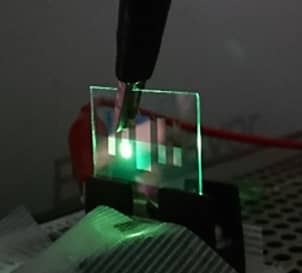
OLED_CD_20260523: A Plain-Language Guide to Hole Transport Materials for OLEDs
キーワード / Keywords
- ホール輸送材料(Hole Transport Materials, HTMs)
OLED内部で正孔(プラスの電荷)を効率よく運ぶ材料です。電流の流れを整え、明るさや効率、寿命を左右する重要な役割を担います。
EN: Materials that transport positive charges efficiently inside OLEDs, strongly influencing brightness, efficiency, and device lifetime. - 電荷バランス(Charge Balance)
正孔と電子が発光層でちょうどよく出会う状態です。バランスが良いほど、無駄なく光が生まれ、発光効率が高まりやすくなります。
EN: A condition in which holes and electrons meet efficiently in the emitting layer, leading to better light generation and efficiency. - エネルギー準位整合(Energy Level Alignment)
材料どうしの電子の入り口・出口の高さを合わせる考え方です。適切に整えると電荷注入がスムーズになり、低電圧駆動にもつながります。
EN: Matching the energy levels between layers so charges can move smoothly, often helping lower operating voltage and improve performance. - 分子設計(Molecular Engineering)
分子の骨格や原子の種類、置換基を工夫して、電荷移動や安定性を最適化する方法です。OLED材料開発の中心的な考え方です。
EN: Designing molecular structure, atoms, and substituents to optimize charge transport and stability, a central strategy in OLED development. - TADF・リン光発光(TADF and Phosphorescence)
励起状態をできるだけ無駄なく光へ変える発光方式です。HTMと組み合わせることで、より高効率なOLED設計が期待されます。
EN: Emission strategies that harvest excited states efficiently as light, often enabling higher-efficiency OLEDs when paired with proper HTMs.
採用した論文 / Paper Used
Recent progress on footsteps of organic light emitting diodes by engineering hole transport materials
Journal: Coordination Chemistry Reviews
Year: 2026
Type: Review
DOI: 10.1016/j.ccr.2026.217961
日本語でのやさしい解説
- この論文は、OLEDの性能を高めるうえで重要なホール輸送材料(HTM) に注目した総説です。
- OLEDでは、電子と正孔が発光層の中でうまく出会う必要がありますが、その流れを支えるのがHTMです。
- 研究では、分子骨格を平らにすること、ヘテロ原子を導入すること、エネルギー準位を調整することなどが、明るさや発光効率の向上に役立つと整理されています。
- また、HTMをTADF材料やリン光材料と組み合わせると、励起子をより無駄なく使える可能性がある点も重要です。
- さらに、材料単体だけでなく、デバイス全体の層構造や界面設計も性能向上に深く関わることが強調されています。
- 一般向けに言えば、「OLEDをより明るく、長持ちにするには、光る材料だけでなく“電気をうまく運ぶ材料”の設計がとても大切だ」と教えてくれる論文です。
Plain-Language English Explanation
- This paper is a review focused on hole transport materials (HTMs), which are essential for improving OLED performance.
- In OLEDs, electrons and holes must meet efficiently in the emitting layer, and HTMs help guide that process.
- The review explains that backbone planarization, heteroatom doping, and energy-level tuning are effective strategies for enhancing brightness and emission efficiency.
- It also highlights the importance of combining HTMs with TADF emitters and phosphorescent emitters to use excited states more efficiently.
- In addition, the paper emphasizes that not only the material itself but also the overall device architecture and interface design strongly affect performance.
- For general readers, the key message is that OLEDs become brighter and longer-lasting not only because of the light-emitting material, but also because of the materials that help electricity move properly.
この論文の見どころ / Why This Paper Matters
日本語
- OLED研究では、発光材料が注目されがちですが、実際には電荷輸送の設計も同じくらい重要です。
- この論文は、HTMの分子設計からデバイス構造までをまとめており、“材料の組み合わせ全体”でOLED性能が決まることを示しています。
- そのため、研究者向けだけでなく、一般の人にとっても「OLEDの進歩は見えない層の工夫に支えられている」と理解しやすい内容です。
English
- In OLED research, the emitting material often receives the most attention, but charge-transport design is just as important.
- This review connects molecular design of HTMs with device-level structure, showing that OLED performance depends on the entire combination of materials and layers.
- It therefore offers a useful message even for general readers: advances in OLEDs are supported by careful engineering of the invisible internal layers.
文献 / Reference
- Palem, R. R.; Lee, S.-H.; Kim, H.-S.; Bathula, C. Recent progress on footsteps of organic light emitting diodes by engineering hole transport materials. Coordination Chemistry Reviews 562 (2026), 217961. DOI: 10.1016/j.ccr.2026.217961.
まとめ / Short Takeaway
日本語
内容からは、OLEDの進歩には発光材料だけでなく、ホール輸送材料の設計と層構造の最適化が欠かせないことがよくわかります。今回の原稿は、その意味を一般の方にもわかりやすく整理したものです。
English
It clearly shows that OLED progress depends not only on emitters but also on the design of hole transport materials and optimization of internal layer structures. This draft explains that importance in a way that general readers can understand.