キーワード / Keywords
- OLED(有機EL) / organic light-emitting diode
- エキシプレックス / exciplex
- エネルギー移動 / energy transfer
- ホスト–ゲスト設計 / host–guest design
- TADF(熱活性化遅延蛍光) / thermally activated delayed fluorescence
- キャリア再結合 / carrier recombination
- トラップ準位 / trap states
- 薄膜形態制御 / thin-film morphology control
- 外部量子効率 / external quantum efficiency
- デバイス寿命 / operational lifetime
日本語版
Exciplex OLEDとは?
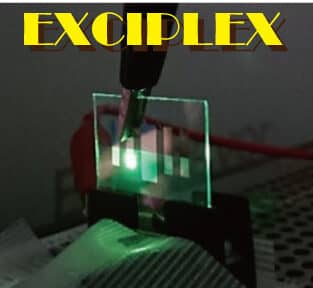
OLED(有機EL)では、電子を受け取りやすい分子と電子を与えやすい分子が出会うことで、界面で特別な励起状態が生まれることがあります。これが exciplex(エキシプレックス) です。
エキシプレックスは、発光色の調整やエネルギー移動、TADF発光、高効率化に深く関わるため、次世代OLEDの重要な設計要素として注目されています。
今回のファイルでは、exciplex を活用するための研究として、
1. 薄膜中の分子混合や形態制御に注目した研究
2. 界面トラップをあえて利用して再結合を改善する研究
の2方向が見られました。
1. 立体障害を使ってエキシプレックス発光を高める研究
論文
Kim N, Lee Y, Kwak H, Kim H, Kwon S, Kim S, Lee S, Park J, Hong CS, Cho MJ, Park S, Kim TG, Choi DH.
Sterically shielded p-type host via dual adamantane-based molecular engineering for high-efficiency exciplex emission
Chemical Engineering Journal (2026)
DOI: 10.1016/j.cej.2026.177126
わかりやすいポイント
– Exciplex OLEDでは、p型ホストとn型ホストが均一によく混ざることが大切です。
– ただし、分子が平たくコンパクトすぎると、蒸着時に分子同士が集まりやすくなり、自己凝集や非発光損失が増えます。
– この研究では、p型ホストに adamantane(アダマンタン) を2つ導入し、分子の周囲に立体的な“ガード”をつくっています。
– その結果、薄膜の中で分子が均一に分散しやすくなり、exciplex 薄膜の発光量子収率が約 50% まで高まりました。
– さらに、この exciplex を使った緑色 TADF-OLED は、外部量子効率(EQE)約 20% を達成しています。
– つまり、電子構造だけでなく、分子の立体形状で薄膜の混ざり方を制御することが、高効率化に効くと示した研究です。
一般向けに言うと…
「分子がダマにならないように工夫して、光りやすい有機EL材料にした研究」 です。
2. 界面トラップを“欠点”ではなく“再結合の味方”に変える研究
論文
Chen GH, Wang T, Yang ZH, Li ZZ, Chen SF, Jiang YC, Chen ZJ, Fu Y, Li MK, Kido J, Su SJ.
Manipulating Carrier Recombination Dynamics Through Rational Dual-Trap Engineering in Exciplex Heterojunction for High-Performance OLEDs
Advanced Materials (2026)
DOI: 10.1002/adma.73443
わかりやすいポイント
– OLEDでは、一般に トラップ準位 はキャリアを滞らせる“欠点”と考えられがちです。
– しかしこの研究では、電子を捕まえるトラップと正孔を捕まえるトラップを、界面に意図的に設計しています。
– これにより、界面近くで電子と正孔が効率よく出会い、放射再結合しやすくなります。
– その結果、黄色 OLED で外部量子効率 33.9%、さらに LT90 = 453.6 時間(1000 cd/m²) という高い性能が示されました。
– 狭帯域ハイパーフルオレッセンス系にも応用され、効率向上と寿命向上の両立が示されています。
– つまり、“欠陥を減らす”のではなく、欠陥の性質をうまく使うという発想が新しい点です。
一般向けに言うと…
「普通ならマイナスと考えられる“落とし穴”を、むしろ発光を助ける仕組みに変えた研究」 です。
まとめ
- 今回のファイルでは、OLED exciplex 関連として 2本 の論文が確認されました。
- 1本目は、分子の立体構造を工夫して薄膜中での混ざり方を改善し、発光効率を上げる研究でした。
- 2本目は、界面トラップを戦略的に利用して、再結合・効率・寿命を同時に改善する研究でした。
- 共通しているのは、単に材料を変えるだけでなく、分子の混ざり方 や 界面でのエネルギー・キャリアの流れ を細かく設計している点です。
- これらは、今後の高効率・長寿命OLED設計にとって重要な考え方といえます。
English Version
What is an exciplex OLED?
In OLEDs, when an electron-donating molecule and an electron-accepting molecule meet, a special excited state can form at their interface. This is called an exciplex.
Exciplexes are important because they strongly influence emission color, energy transfer, TADF behavior, and overall device efficiency. As a result, they are considered key design elements in next-generation OLEDs.
In the uploaded file, two representative directions were found:
1. controlling molecular mixing and film morphology, and
2. strategically using interfacial trap states to improve recombination.
1. Enhancing exciplex emission through steric shielding
Paper
Kim N, Lee Y, Kwak H, Kim H, Kwon S, Kim S, Lee S, Park J, Hong CS, Cho MJ, Park S, Kim TG, Choi DH.
Sterically shielded p-type host via dual adamantane-based molecular engineering for high-efficiency exciplex emission
Chemical Engineering Journal (2026)
DOI: 10.1016/j.cej.2026.177126
Easy-to-understand points
– In exciplex OLEDs, it is essential that the p-type and n-type host molecules mix homogeneously in the thin film.
– If the molecules are too compact or too planar, they tend to aggregate during vacuum deposition, which increases self-aggregation and nonradiative loss.
– In this work, the researchers introduced two adamantane groups into the p-type host, creating steric shielding around the molecule.
– This helped the molecules distribute more uniformly in the film, increasing the photoluminescence quantum yield of the exciplex film to about 50%.
– Green TADF-OLEDs using this exciplex host reached an external quantum efficiency of about 20%.
– In short, the study shows that not only electronic matching, but also three-dimensional molecular shape matters for exciplex efficiency.
In simple words…
This is a study on preventing OLED molecules from clumping together so they can emit light more efficiently.
2. Turning interfacial traps from a weakness into an advantage
Paper
Chen GH, Wang T, Yang ZH, Li ZZ, Chen SF, Jiang YC, Chen ZJ, Fu Y, Li MK, Kido J, Su SJ.
Manipulating Carrier Recombination Dynamics Through Rational Dual-Trap Engineering in Exciplex Heterojunction for High-Performance OLEDs
Advanced Materials (2026)
DOI: 10.1002/adma.73443
Easy-to-understand points
– In OLEDs, trap states are usually considered harmful because they can block charge transport.
– In this work, however, the researchers deliberately introduced one kind of trap for electrons and another kind for holes at the interface.
– This design makes it easier for electrons and holes to meet and undergo radiative recombination right where it is useful.
– As a result, yellow OLEDs achieved an external quantum efficiency of 33.9% and an operational lifetime of LT90 = 453.6 h at 1000 cd/m².
– The concept also improved narrow-band hyperfluorescent systems, showing gains in both efficiency and lifetime.
– The key idea is that instead of simply eliminating defects, one can engineer them to become beneficial recombination centers.
In simple words…
This is a study on turning what is usually considered a defect into a feature that actually helps OLEDs emit light more efficiently and last longer.
Take-home message
- Only two papers related to OLED exciplex systems were found in the uploaded file.
- The first focused on improving molecular mixing in thin films through steric molecular design.
- The second focused on using interfacial trap engineering to simultaneously improve recombination, efficiency, and device lifetime.
- What these two studies share is an emphasis not only on the molecules themselves, but also on how they mix and how charges and energy behave at interfaces.
- These ideas are highly relevant for the future design of high-efficiency and long-lifetime OLEDs.
参考文献 / References
- Chen GH, Wang T, Yang ZH, Li ZZ, Chen SF, Jiang YC, Chen ZJ, Fu Y, Li MK, Kido J, Su SJ. Manipulating Carrier Recombination Dynamics Through Rational Dual-Trap Engineering in Exciplex Heterojunction for High-Performance OLEDs. Advanced Materials. 2026. DOI: 10.1002/adma.73443
- Kim N, Lee Y, Kwak H, Kim H, Kwon S, Kim S, Lee S, Park J, Hong CS, Cho MJ, Park S, Kim TG, Choi DH. Sterically shielded p-type host via dual adamantane-based molecular engineering for high-efficiency exciplex emission. Chemical Engineering Journal. 2026. DOI: 10.1016/j.cej.2026.177126