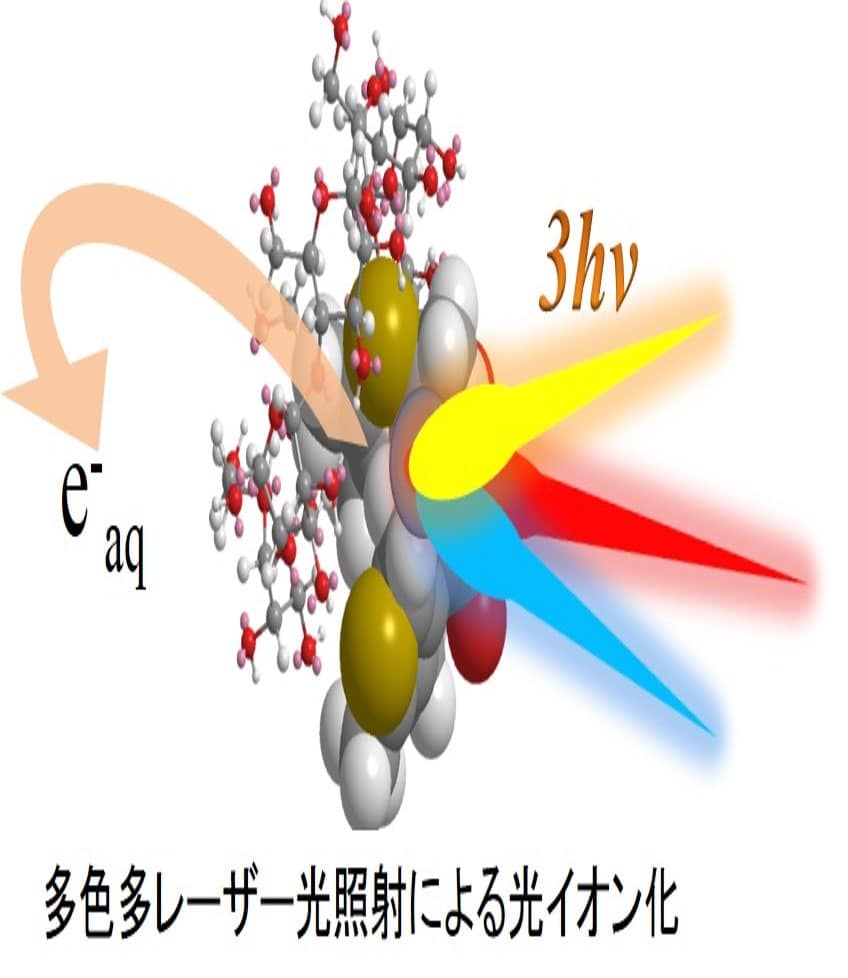
Resonance Three-Photon Ionization and Laser
| Authors | Author Full Names | Article Title | Source Title | Abstract | Researcher Ids | ORCIDs | ISSN | eISSN | ISBN | Journal Abbreviation | Journal ISO Abbreviation | Publication Date | Publication Year | Volume | Issue | Part Number | Supplement | Special Issue | Meeting Abstract | Start Page | End Page | Article Number | DOI | DOI Link |
|---|---|---|---|---|---|---|---|---|---|---|---|---|---|---|---|---|---|---|---|---|---|---|---|---|
| Merriles, DM; Sevy, A; Nielson, C; Morse, MD | Merriles, Dakota M.; Sevy, Andrew; Nielson, Christopher; Morse, Michael D. | The bond dissociation energy of VO measured by resonant three-photon ionization spectroscopy | JOURNAL OF CHEMICAL PHYSICS | The predissociation threshold of VO has been measured using resonant three-photon ionization (R3PI) spectroscopy. Given the high density of electronic states in the molecule, it is argued that the molecule dissociates rapidly as soon as the thermochemical bond dissociation energy (BDE) is exceeded, allowing the measured predissociation threshold to be assigned as the BDE. This is the first time a BDE has been measured using the R3PI method. The first photon is provided by an optical parametric oscillator (OPO) laser that promotes VO into a high-energy, discrete vibronic state. A tunable dye laser then excites the molecule further to a resonant state close to the dissociation limit where there is a quasi-continuum of states. A second photon from the same dye laser pulse ionizes the molecule, generating VO+ ions. The dye laser is then scanned to higher energies, and when the energy of one OPO photon plus one dye photon exceeds the BDE, the molecule dissociates before another dye photon can be absorbed to induce ionization. The combined photon energy at the sharp drop in the ion signal is assigned as the BDE. The experiment has been repeated using four different intermediate states, all yielding the same BDE, D-0(VO) = 6.545(2) eV. Using thermochemical cycles, a revised value for the BDE of cationic VO is obtained, D-0(V+-O) = 6.053(2) eV. The 0 K enthalpy of formation for VO(g) is also derived as Delta fH0K0 mml:mfenced close=) open=(VO(g)mml:mfenced = 128.6(1.0) kJ mol(-1). Previous spectroscopic and thermochemical studies of VO are reviewed. | Nielson, Christopher/0000-0001-7260-3423; Morse, Michael/0000-0002-2386-7315; Merriles, Dakota/0000-0003-1363-1306 | 0021-9606 | 1089-7690 | JUL 14 | 2020 | 153 | 2 | 24303 | 10.1063/5.0014006 | http://dx.doi.org/10.1063/5.0014006 | ||||||||||
| Murakami, M; Zhang, GP | Murakami, Mitsuko; Zhang, G. P. | Resonant two- or three-photon ionization of noble-gas atoms captured by time-resolved photoelectron momentum spectroscopy | PHYSICAL REVIEW A | We present an all-electron, ab initio calculation of time-resolved photoelectron momentum distributions (PMDs) induced by resonant two-color, two-or three-photon ionization of helium and neon atoms, as recently measured by Villeneuve et al. [Science 356, 1150 (2017)] using a femtosecond infrared (IR) laser pulse and an attosecond pulse train (APT) produced with high harmonic generation as an extreme ultraviolet (XUV) photon source. In contrast to a monochromatic XUV pulse commonly used at the free-electron laser facilities, an APT is broadband and ultrashort (< 1 fs), so that it could induce nonresonant one-photon transitions above ionization threshold as well as a resonantly excited state. They may interfere with each other upon subsequent absorption or emission of an IR photon, so that the resultant PMD loses clear orbital symmetry. Our time-dependent density functional calculation demonstrates that the selection of a particular excited state in the time-resolved PMD is nevertheless possible if energy and timing of an APT are adjusted properly. | 2469-9926 | 2469-9934 | DEC 1 | 2017 | 96 | 6 | 63403 | 10.1103/PhysRevA.96.063403 | http://dx.doi.org/10.1103/PhysRevA.96.063403 | |||||||||||
| Drescher, L; Witting, T; Kornilov, O; Vrakking, MJJ | Drescher, L.; Witting, T.; Kornilov, O.; Vrakking, M. J. J. | Phase dependence of resonant and antiresonant two-photon excitations | PHYSICAL REVIEW A | Measurements of the phase of two-photon matrix elements are presented for resonant and antiresonant two-color ionization of helium. A tunable, narrow-bandwidth, near-infrared (NIR) laser source is used for extreme ultraviolet (XUV) high-harmonic generation (HHG). The 15th harmonic of the laser is used within (1 + 1') XUV + NIR two-photon ionization and tuned in and out of resonance with members of the 1snp P-1(1) (n = 3, 4, 5) Rydberg series, covering a broad spectral range with high spectral resolution. The technique allows us to observe characteristic rapid changes in the phase of the two-photon matrix elements around the resonances and at the antiresonances between the resonances. Similar effects are observed for (1 +2') XUV + NIR three-photon ionization. The experimental results are compared to a perturbative model and to numerical solutions of the time-dependent Schrodinger equation in the single-active-electron approximation, elucidating the origin and dependences of the observed phenomena. | Vrakking, Marc/F-6770-2014 | 2469-9926 | 2469-9934 | JAN 18 | 2022 | 105 | 1 | L011101 | 10.1103/PhysRevA.105.L011101 | http://dx.doi.org/10.1103/PhysRevA.105.L011101 | ||||||||||
| Madunil, SL; Imasaka, T; Imasaka, T | Madunil, Siddihalu Lakshitha; Imasaka, Totaro; Imasaka, Tomoko | Resonant and non-resonant femtosecond ionization mass spectrometry of organochlorine pesticides | ANALYST | Thirteen organochlorine pesticides in a standard sample mixture were measured by gas chromatography combined with mass spectrometry using an ultraviolet femtosecond laser (267 nm) as the ionization source, and the observed mass spectra were compared with the corresponding spectra obtained using an electron ionization source. When an ultrashort optical pulse was used for ionization, molecular ions were typically produced which was preferential for reliably identifying the analytes. The ionization mechanism was studied based on three models constructed for resonance-enhanced two-photon ionization, non-resonant two-photon ionization, and non-resonant three-photon ionization. The optimal conditions for observing a molecular ion were investigated using data obtained for three pulse widths. The results suggest that two-photon ionization with minimum excess energy would be optimal for observing a molecular ion. | Imasaka, Tomoko/0000-0002-2131-4995 | 0003-2654 | 1364-5528 | FEB 7 | 2020 | 145 | 3 | 777 | 783 | 10.1039/c9an01861a | http://dx.doi.org/10.1039/c9an01861a | |||||||||
| Zhao, Y; Yoshida, T; Ohmori, Y; Miyashita, Y; Morita, M; Sakamoto, T; Kato, K; Terabayashi, R; Sonnenschein, V; Tomita, H; Kawai, T; Okumura, T; Satou, Y; Miyabe, M; Wakaida, I | Zhao, Yue; Yoshida, Takeru; Ohmori, Yuzuka; Miyashita, Yuta; Morita, Masato; Sakamoto, Tetsuo; Kato, Kotaro; Terabayashi, Ryohei; Sonnenschein, Volker; Tomita, Hideki; Kawai, Toshihide; Okumura, Takeo; Satou, Yukihiko; Miyabe, Masabumi; Wakaida, Ikuo | Development of two-color resonant ionization sputtered neutral mass spectrometry and microarea imaging for Sr | JOURNAL OF VACUUM SCIENCE & TECHNOLOGY B | Two-color resonant laser ionization sputtered neutral mass spectrometry offers high elemental selectivity. In this study, two-color resonance ionization in sputtered neutral Sr was confirmed by combining a grating type Ti:sapphire laser system and a time-of-flight secondary ion mass spectrometry (TOF-SIMS) system. The authors compared the ionization efficiencies of Sr of the two-color three-photon ionization scheme 1 (first step: 460.862nm; second step: 767.519nm) and the two-color two-photon ionization scheme 2 (first step: 460.862nm; second step: 405.200nm). The resonant ionization efficiency of the latter was found to be 50 times larger than that of the former. Finally, the authors mapped the microarea distribution of Sr by two-color resonant ionization sputtered neutral mass spectrometry. | TOMITA, Hideki/G-9931-2012; Tomita, Hideki/G-9931-2012; Satou, Yukihiko/AAT-5303-2020; Masato, Morita/F-5050-2012; Zhao, Yue/E-5435-2019; Miyabe, Masabumi/I-6773-2012; Terabayashi, Ryohei/AAZ-7096-2021 | Tomita, Hideki/0000-0002-5192-6001; Zhao, Yue/0000-0002-8550-2020; | 2166-2746 | JUL | 2020 | 38 | 4 | 44001 | 10.1116/6.0000006 | http://dx.doi.org/10.1116/6.0000006 | ||||||||||
| T?th, B; T?th, A; Csehi, A | Toth, Balazs; Toth, Attila; Csehi, Andras | Competition of multiphoton ionization pathways in lithium | JOURNAL OF PHYSICS B-ATOMIC MOLECULAR AND OPTICAL PHYSICS | We study the three-photon ionization of atomic lithium by intense, short light pulses, via numerically solving the time-dependent Schrodinger equation. Two-photon Rabi oscillations are induced between the 2s and 4s states, which are damped due to single-photon ionization to the p continuum. Developing a minimal three-level model, we analyze the spectral features of the Autler-Townes (AT) doublet that is formed upon the resonant coupling with the laser pulse. Furthermore, we show that this 2s ->-> 4s -> p continuum pathway is the dominant process, if the duration of the laser pulse exceeds a certain value. For shorter pulses, ionization through the 2p state ( 2s -> 2p -> 4d -> f continuum ) gradually becomes the dominant process, provided that the pulse is strong enough to induce several Rabi floppings. Here, we trace the competition of these ionization pathways by observing the structural changes in the shape of the AT doublet. | Toth, Attila/AAM-3182-2021; T?th, Bal?zs/HZI-8129-2023 | Toth, Attila/0000-0002-2161-316X | 0953-4075 | 1361-6455 | MAR 14 | 2024 | 57 | 5 | 55002 | 10.1088/1361-6455/ad2b73 | http://dx.doi.org/10.1088/1361-6455/ad2b73 | |||||||||
| M?ller, AD; Kutscher, E; Artemyev, AN; Cederbaum, LS; Demekhin, PV | Mueller, Anne D.; Kutscher, Eric; Artemyev, Anton N.; Cederbaum, Lorenz S.; Demekhin, Philipp V. | Dynamic interference in the resonance-enhanced multiphoton ionization of hydrogen atoms by short and intense laser pulses | CHEMICAL PHYSICS | Photoionization of the hydrogen atom by intense and short coherent laser pulses is investigated from first principles by a numerical solution of the time-dependent Schrodinger equation in the dipole-velocity gauge. The considered photon energies are resonant to the 1s -> 2p excitation, and the pulse intensities are high enough to induce Rabi floppings. The computed resonance-enhanced two-photon ionization spectra as well as the three-photon above threshold ionization spectra exhibit pronounced multiple-peak patterns due to dynamic interference. Fingerprints of dynamic interference can also be seen directly in the radial density of the photoelectron. The impact of the variation of the pulse intensity and photon energy on the dynamic interference is investigated, and the angular distribution of the emitted electrons is analyzed in some details. The present precise numerical results confirm our previous theoretical predictions on the two-photon ionization spectra (Demekhin and Cederbaum, 2012) made within a minimal few-level model. (C) 2017 Elsevier B.V. All rights reserved. | Demekhin, Philipp/K-9375-2016; Artemyev, Anton/AAE-6178-2019 | Demekhin, Philipp/0000-0001-9797-6648; Artemyev, Anton/0000-0002-9404-4105 | 0301-0104 | 1873-4421 | JUN 15 | 2018 | 509 | 145 | 150 | 10.1016/j.chemphys.2017.10.004 | http://dx.doi.org/10.1016/j.chemphys.2017.10.004 | |||||||||
| Kouno, H; Imasaka, T | Kouno, Hiroaki; Imasaka, Totaro | The efficiencies of resonant and nonresonant multiphoton ionization in the femtosecond region | ANALYST | Ionization efficiency in mass spectrometry was examined for three types of molecules under different ionization schemes, i.e., resonant/nonresonant and two-photon/three-photon ionization, using an ultraviolet (UV) femtosecond laser at different wavelengths, pulse energies, and pulse widths. The efficiency of nonresonant ionization could be improved substantially by decreasing the laser pulse width. The effect of resonance was minimal when an ultrashort optical pulse of less than 100 fs was employed for ionization in the UV region. Three-photon ionization was less efficient than two-photon ionization, but the difference was not significant at shorter pulse widths in the femtosecond region. Although the excess energy can be decreased by optimizing the laser wavelength in the case of nonresonant ionization, fragmentation was not suppressed in the cases studied here. However, fragmentation was drastically suppressed when the laser pulse width was decreased. Thus, this approach of using an ultrashort optical pulse would provide a new tool for soft ionization and then for more reliable identification of an analyte. | 0003-2654 | 1364-5528 | 2016 | 141 | 18 | 5274 | 5280 | 10.1039/c6an00577b | http://dx.doi.org/10.1039/c6an00577b | |||||||||||
| Guo, KY; Li, M; Liang, JT; Cao, CP; Zhou, YM; Lu, PX | Guo, Keyu; Li, Min; Liang, Jintai; Cao, Chuanpeng; Zhou, Yueming; Lu, Peixiang | Wavelength- and ellipticity-dependent photoelectron spectra from multiphoton ionization of atoms | CHINESE PHYSICS B | We theoretically study the photoelectron momentum distributions from multiphoton ionization of a model lithium atom over a range of laser wavelengths from 500 nm to 700 nm by numerically solving the time-dependent Schrodinger equation. The photoelectron momentum distributions display many ring-like patterns for the three-photon ionization, which vary dramatically with the change of the laser wavelength. We show that the wavelength-dependent photoelectron energy spectrum can be used to effectively identify the resonant and nonresonant ionization pathways. We also find an abnormal ellipticity dependence of the electron yield for the (2+1) resonance-enhanced ionization via the 4d intermediate state, which is relevant to the two-photon excitation probability from the ground state to the 4d state. | Lu, Peixiang/D-5506-2011; zhou, ym/E-5631-2012; Li, Min/G-2347-2010 | 1674-1056 | 2058-3834 | FEB 1 | 2023 | 32 | 2 | 23201 | 10.1088/1674-1056/ac9b36 | http://dx.doi.org/10.1088/1674-1056/ac9b36 | ||||||||||
| Fanood, MMR; Janssen, MHM; Powis, I | Fanood, Mohammad M. Rafiee; Janssen, Maurice H. M.; Powis, Ivan | Wavelength dependent photoelectron circular dichroism of limonene studied by femtosecond multiphoton laser ionization and electron-ion coincidence imaging | JOURNAL OF CHEMICAL PHYSICS | Enantiomers of the monoterpene limonene have been investigated by (2 + 1) resonance enhanced multiphoton ionization and photoelectron circular dichroism employing tuneable, circularly polarized femtosecond laser pulses. Electron imaging detection provides 3D momentum measurement while electron-ion coincidence detection can be used to mass-tag individual electrons. Additional filtering, by accepting only parent ion tagged electrons, can be then used to provide discrimination against higher energy dissociative ionization mechanisms where more than three photons are absorbed to better delineate the two photon resonant, one photon ionization pathway. The promotion of different vibrational levels and, tentatively, different electronic ion core configurations in the intermediate Rydberg states can be achieved with different laser excitation wavelengths (420 nm, 412 nm, and 392 nm), in turn producing different state distributions in the resulting cations. Strong chiral asymmetries in the lab frame photoelectron angular distributions are quantified, and a comparison made with a single photon (synchrotron radiation) measurement at an equivalent photon energy. Published by AIP Publishing. | Janssen, Maurice/ABF-1104-2020 | 0021-9606 | 1089-7690 | SEP 28 | 2016 | 145 | 12 | 124320 | 10.1063/1.4963229 | http://dx.doi.org/10.1063/1.4963229 | ||||||||||
| Dimitriou, A; Cohen, S | Dimitriou, Anastasios; Cohen, Samuel | Electron spectroscopy of strontium in the vicinity of the four-photon-excited 5p2 1S0 state | EUROPEAN PHYSICAL JOURNAL D | We report on an electron energy analysis study conducted for the purpose of elucidating the single and double ionization pathways when ground state strontium atoms interact with dye laser pulses of approximate to 5 ns duration, approximate to 4 x 10(11) Wcm(-2) maximum intensity and 715-737 nm wavelength range. Within this range there are three-photon resonant, four-photon ionized bound states and the four-photon excited 5p(2) S-1(0) highly correlated autoionizing state, located above the first ionization threshold of strontium. Electron spectra as a function of laser wavelength probed the accumulation of population in the excited 4d(j) and 5p(j) Sr+ states. This observation signifies the absorption of at least two photons above the first ionization threshold. However, contrary to what was anticipated in earlier work (performed using the present excitation and ionization scheme but without electron detection) the former states are found to be much more heavily populated than the latter ones. Thus, multi-photon ionization out of the 4d(3/2,5/2) levels of Sr+ and within the same laser pulse is identified as the main pathway to double ionization. Finally, the recording of photoelectron angular distributions from four-photon ionization for selected laser wavelengths revealed the dominant contributing partial waves. | Dimitriou, Anastasios/AGN-5717-2022 | Dimitriou, Anastasios/0000-0002-1166-0800 | 1434-6060 | 1434-6079 | OCT 27 | 2015 | 69 | 10 | 238 | 10.1140/epjd/e2015-60326-x | http://dx.doi.org/10.1140/epjd/e2015-60326-x | |||||||||
| Doussot, J; Karras, G; Billard, F; B?jot, P; Faucher, O | Doussot, J.; Karras, G.; Billard, F.; Bejot, P.; Faucher, O. | Resonantly enhanced filamentation in gases | OPTICA | Femtosecond filamentation is a self-organization phenomenon during which an ultrashort high-power laser stays confined in a very small channel over very long distances. Ultimately, however, the finite energy contained in a filament is dissipated because of losses originated from ionization, limiting thereby the filament length. In other words, ionization represents a fundamental limitation in remote applications where long-ranged filaments are required. In this paper, a low-loss Kerr-driven optical filament in krypton gas is experimentally reported in the ultraviolet. A three-photon resonantly enhanced quintic nonlinearity is identified as the underlying physical mechanism responsible for intensity saturation during the filamentation process, while ionization plays only a minor role. The resonant nature of the process creates also conducive conditions, i.e., a significant population inversion, for forward and backward infrared lasing. Preliminary experimental results suggest that such lasing emission takes place. The reported resonantly enhanced filaments are one order of magnitude longer than their off-resonant counterparts. The resonance is also accompanied by a large decrease of both ionization and nonlinear optical losses. The experimental findings are supported by ab initio quantum calculations describing the atomic optical response. Beyond its theoretical interest, resonantly enhanced filamentation could benefit all applications deriving from the filamentation process. For instance, the extension of this work to molecular gases such as oxygen and nitrogen could lead to numerous atmospheric applications such as nonlinear spectroscopy, remote sensing, and lightning protection, in which the transport of high energies over long distances is of prime importance. (C) 2017 Optical Society of America | ; B?jot, Pierre/F-4904-2019; BILLARD, Franck/AAL-7353-2020; Karras, Gabriel/N-1078-2018 | BILLARD, Franck/0000-0001-6400-2281; Bejot, Pierre/0000-0003-2364-5146; Karras, Gabriel/0000-0002-9629-8336; | 2334-2536 | JUL 20 | 2017 | 4 | 7 | 764 | 769 | 10.1364/OPTICA.4.000764 | http://dx.doi.org/10.1364/OPTICA.4.000764 | |||||||||
| Tomchak, KH; Morse, MD | Tomchak, Kimberly H.; Morse, Michael D. | Bond Dissociation Energies of RuC, RhC, OsC, IrC, and PtC Measured by Resonant Three-Photon Ionization Spectroscopy | JOURNAL OF PHYSICAL CHEMISTRY A | Resonant three-photon ionization spectroscopy has been used to study the late 4d and 5d transition metal carbides RuC, RhC, OsC, IrC, and PtC. These species, like most diatomic transition metals with open nd subshells, exhibit an exceptionally high density of states near the ground separated atom limit. Spin-orbit and nonadiabatic interactions provide a means for the molecules to rapidly dissociate as soon as the bond dissociation energy (BDE) is exceeded. The result is a sharp predissociation threshold that is identified as the BDE. The high BDEs of these five molecules required the use of two tunable lasers to reach the BDE. Measured values of D 0(RuC) = 6.312(2) eV, D 0(RhC) = 6.007(2) eV, D 0(OsC) = 6.427(2) eV, D 0(IrC) = 6.404(2) eV, and D 0(PtC) = 6.260(2) eV were obtained, where the value is parentheses represents the estimated error limit in units of the last quoted digit. A new electronic state of PtC, tentatively assigned as the c 3 Sigma 1 + state, has been found with T 0 = 22,442 cm-1. These BDEs are combined with recently measured ionization energies to obtain BDEs of the associated cations. Electronic structure calculations are also reported to investigate the chemical bonding in more detail. Trends in the BDEs of the diatomic transition metal carbides are also discussed. | 1089-5639 | 1520-5215 | SEP 18 | 2025 | 129 | 37 | 8563 | 8576 | 10.1021/acs.jpca.5c04466 | http://dx.doi.org/10.1021/acs.jpca.5c04466 | ||||||||||
| Shimada, H; Komatsu, K; Komatsubara, W; Mizuno, T; Miyake, S; Minemoto, S; Sakai, H; Majima, T; Owada, S; Togashi, T; Yabashi, M; Yagishita, A | Shimada, Hiroyuki; Komatsu, Kazma; Komatsubara, Wataru; Mizuno, Tomoya; Miyake, Soichiro; Minemoto, Shinichirou; Sakai, Hirofumi; Majima, Takuya; Owada, Shigeki; Togashi, Tadashi; Yabashi, Makina; Yagishita, Akira | Two- and three-photon double ionization of helium by soft x-ray free-electron laser pulses | JOURNAL OF PHYSICS B-ATOMIC MOLECULAR AND OPTICAL PHYSICS | The multiphoton double ionization of He was investigated using a soft x-ray free-electron laser (SX-FEL), in the perturbative intensity regime (<10(13) W cm(-2)). The photon energy was tuned to the transition between the 1s and 2p levels of He+ ions. At this resonance energy of 40.8 eV, both sequential three-photon double ionization (S3PDI) and two-photon double ionization (2PDI) were measured by electron spectroscopy and by ion time-of-flight mass spectroscopy. We distinguished S3PDI from 2PDI by electron spectroscopy. Based on these experimental data, SX-FEL pulse-energy dependences of electron and ion yields for both S3PDI and 2PDI were discussed. The angular distribution of 2p photoelectrons emitted from He+ (2p) ions in the S3PDI process was examined as an example of the simplest photoemission dynamics. | ; Yabashi, Makina/A-2832-2015; SAKAI, HIROFUMI/G-5096-2014; Majima, Takuya/N-5284-2017; MINEMOTO, SHINICHIROU/G-5092-2014; Shimada, Hiroyuki/G-1150-2013; Mizuno, Tomoya/AAI-2990-2020; SHIMADA, Hiroyuki/G-1150-2013 | Sakai, Hirofumi/0000-0003-0074-4811; Yabashi, Makina/0000-0002-2472-1684; Minemoto, Shinichirou/0000-0001-5868-823X; Majima, Takuya/0000-0003-2804-1915; Shimada, Hiroyuki/0000-0003-0207-2238; | 0953-4075 | 1361-6455 | MAR 28 | 2019 | 52 | 6 | 65602 | 10.1088/1361-6455/ab0580 | http://dx.doi.org/10.1088/1361-6455/ab0580 | |||||||||
| Liu, Y; Gottwald, T; Mattolat, C; Wendt, K | Liu, Y.; Gottwald, T.; Mattolat, C.; Wendt, K. | Three-photon resonance ionization of atomic Mn in a hot-cavity laser ion source using Ti: sapphire lasers | JOURNAL OF PHYSICS B-ATOMIC MOLECULAR AND OPTICAL PHYSICS | Three-photon resonance ionization of atomic manganese (Mn) in a hot-cavity ion source using Ti: sapphire lasers has been demonstrated. Three-step ionization schemes employing different intermediate levels and Rydberg or autoionizing (AI) states in the final ionization step are established. Strong AI resonances were observed via the 3d(5)4s5s f(6)S(5/2) level at 49 415.35 cm(-1), while Rydberg transitions were reached from the 3d(5)4s4d e D-6(9/2,7/2,5/2) levels at around 47 210 cm(-1). Analyses of the strong Rydberg transitions associated with the 3d(5)4s4d e D-6(7/2) lower level indicate that they belong to the dipole-allowed 4d -> nf(6)F degrees(9/2,7/2,5/2) series converging to the 3d(5)4s S-7(3) ground state of Mn II. From this series, an ionization potential of 59 959.56 +/- 0.01 cm(-1) is obtained for Mn. At high ion source temperatures the semi-forbidden 4d -> nf(8)F degrees(9/2,7/2,5/2) series was also observed. The overall ionization efficiency for Mn has been measured to be about 0.9% when using the strong AI transition in the third excitation step and 0.3% when employing an intense Rydberg transition. Experimental data indicate that the ionization efficiency was limited by the interaction of Mn atoms with ion source materials at high temperatures. | Wendt, Klaus/MVT-6534-2025 | 0953-4075 | 1361-6455 | JUN 14 | 2015 | 48 | 11 | 115006 | 10.1088/0953-4075/48/11/115006 | http://dx.doi.org/10.1088/0953-4075/48/11/115006 | ||||||||||
| Hanks, W; Costello, JT; Nikolopoulos, LAA | Hanks, William; Costello, John T.; Nikolopoulos, Lampros A. A. | Two- and Three-Photon Partial Photoionization Cross Sections of Li+, Ne8+ and Ar16+ under XUV Radiation | APPLIED SCIENCES-BASEL | In this work, we present the photon energy dependence of the two- and three-photon cross sections of the two-electron Li+, Ne8+ and Ar16+ ions, following photoionization from their ground state. The expressions for the cross sections are based on the lowest-order (non-vanishing) perturbation theory for the electric field, while the calculations are made with the use of an ab initio configuration interaction method. The ionization cross section is dominated by pronounced single photon resonances in addition to peaks associated with doubly excited resonances. In the case of two-photon ionization, and in the non-resonant part of the cross section, we find that the D-1 ionization channel overwhelms the S-1 one. We also observe that, as one moves from the lowest atomic number ion, namely Li+, to the highest atomic number ion, namely Ar16+, the cross sections generally decrease. | Costello, John/L-8011-2017; Nikolopoulos, Lampros/A-6065-2012 | Costello, John/0000-0003-4677-9999; | 2076-3417 | MAR | 2017 | 7 | 3 | 294 | 10.3390/app7030294 | http://dx.doi.org/10.3390/app7030294 | ||||||||||
| Jing, QL; Madsen, LB | Jing, Qingli; Madsen, Lars Bojer | Laser-induced dissociative ionization of H2 from the near-infrared to the mid-infrared regime | PHYSICAL REVIEW A | We apply the Monte Carlo wave packet (MCWP) approach to investigate the kinetic energy release (KER) spectra of the protons following double ionization in H-2 when interacting with laser pulses with central wavelengths ranging from the near-infrared (IR) (800 nm) to the mid-IR (6400 nm) regions and with durations of 3-21 laser cycles. We uncover the physical origins of the peaks in the nuclear KER spectra and ascribe them to mechanisms such as ionization following a resonant dipole transition, charge-resonance-enhanced ionization, and ionization in the dissociative limit of large internuclear distances. For relatively large pulse durations, i.e., for 15 or more laser cycles at 3200 nm and 10 or more at 6400 nm, it is possible for the nuclear wave packet in H-2(+) to reach very large separations. Ionization of this part of the wave packet results in peaks in the KER spectra with very low energies. These peaks give direct information about the dissociative energy in the 2p sigma(u) potential energy curve of H-2(+) at the one-and three-photon resonances between the 2p sigma(u) and 1s sigma(g) curves in H-2(+). With the MCWP approach, we perform a trajectory analysis of the contributions to the KER peaks and identify the dominant ionization pathways. Finally, we consider a pump-probe scheme by applying two delayed pulses to track the nuclear dynamics in a time-resolved setting. Low-energy peaks appear for large delays and these are used to obtain the 2p sigma(u) dissociative energy values at the one-photon resonance between the 2p sigma(u) and 1s sigma(g) curves in H-2(+) for different wavelengths. | Madsen, Lars Bojer/B-7912-2017 | Madsen, Lars Bojer/0000-0001-7403-2070 | 2469-9926 | 2469-9934 | DEC 2 | 2016 | 94 | 6 | 63402 | 10.1103/PhysRevA.94.063402 | http://dx.doi.org/10.1103/PhysRevA.94.063402 | |||||||||
| Eickhoff, K; Feld, L; K?hnke, D; Englert, L; Bayer, T; Wollenhaupt, M | Eickhoff, K.; Feld, L.; Koehnke, D.; Englert, L.; Bayer, T.; Wollenhaupt, M. | Coherent control mechanisms in bichromatic multiphoton ionization | JOURNAL OF PHYSICS B-ATOMIC MOLECULAR AND OPTICAL PHYSICS | Free electron vortices (FEVs) generated by multiphoton ionization (MPI) with ultrashort laser pulses have attracted significant attention due to their varied symmetries and unusual topological properties. We study two physical mechanisms of coherent control in atomic MPI with bichromatic polarization-shaped femtosecond laser pulses which give rise to the rich variety of FEVs. In the experiments, we combine pulse shaping of a carrier-envelope phase-stable supercontinuum with photoelectron tomography to generate and reconstruct three-dimensional photoelectron momentum distributions (PMDs). Simultaneous measurements of energetically separated photoelectrons from intraband and interband interference in a single PMD allow us to compare phase and polarization control of the angular distributions by both mechanisms. We investigate phase control in three scenarios: first, counterrotating circularly polarized pulses are employed to contrast the phase-insensitive angular momentum eigenstate created by intraband interference via frequency mixing with the phase-sensitive c (7) rotationally symmetric FEV from pure interband interference of two single-color ionization pathways. In the second scenario, we use orthogonal linearly polarized pulses to compare the phase control properties of a six-lobed angular momentum wave packet from intraband interference to those of a complex shaped interband PMD in the presence of phase fluctuations. Finally, we demonstrate phase control of a photoelectron hologram from mixed interband interference. In a (3 + 1) resonance enhanced MPI scheme, the red pump pulse induces a bound electron wave packet probed by the time-delayed blue pulse. The latter simultaneously creates a reference wave packet by three-photon ionization to form the photoelectron hologram. Rotation of the hologram with c (1) or c (5) rotational symmetry maps the time evolution of the bound wave packet. To analyze our results, we develop analytical expressions for the wave functions of intraband and interband interference in perturbative non-resonant MPI. The experiments are complemented with two-dimensional TDSE simulations to follow the FEV formation dynamics and to validate the physical pictures. | ; Englert, Lars/GWF-0049-2022; K?hnke, Darius/JOZ-2247-2023; wollenhaupt, matthias/D-2940-2009 | Feld, Lea/0009-0003-1174-4478; Eickhoff, Kevin/0000-0002-1432-8328; Kohnke, Darius/0000-0003-1151-8625; Wollenhaupt, Matthias/0000-0002-0839-1494; | 0953-4075 | 1361-6455 | AUG 18 | 2021 | 54 | 16 | 164002 | 10.1088/1361-6455/ac11a0 | http://dx.doi.org/10.1088/1361-6455/ac11a0 | |||||||||
| Giri, SK; Saalmann, U; Rost, JM | Giri, Sajal Kumar; Saalmann, Ulf; Rost, Jan M. | Purifying Electron Spectra from Noisy Pulses with Machine Learning Using Synthetic Hamilton Matrices | PHYSICAL REVIEW LETTERS | Photoelectron spectra obtained with intense pulses generated by free-electron lasers through self-amplified spontaneous emission are intrinsically noisy and vary from shot to shot. We extract the purified spectrum, corresponding to a Fourier-limited pulse, with the help of a deep neural network. It is trained on a huge number of spectra, which was made possible by an extremely efficient propagation of the Schrodinger equation with synthetic Hamilton matrices and random realizations of fluctuating pulses. We show that the trained network is sufficiently generic such that it can purify atomic or molecular spectra, dominated by resonant two- or three-photon ionization, nonlinear processes which are particularly sensitive to pulse fluctuations. This is possible without training on those systems. | Giri, Sajal/MCX-3310-2025; Saalmann, Ulf/AAA-5121-2022 | GIRI, SAJAL KUMAR/0000-0001-9145-6801; Saalmann, Ulf/0000-0003-3208-8273 | 0031-9007 | 1079-7114 | MAR 17 | 2020 | 124 | 11 | 113201 | 10.1103/PhysRevLett.124.113201 | http://dx.doi.org/10.1103/PhysRevLett.124.113201 | |||||||||
| Malakar, Y; Wilhelm, F; Trabert, D; Raju, PK; Li, X; Pearson, WL; Cao, W; Kaderiya, B; Ben-Itzhak, I; Rudenko, A | Malakar, Y.; Wilhelm, F.; Trabert, D.; Raju, Kanaka P.; Li, X.; Pearson, W. L.; Cao, W.; Kaderiya, B.; Ben-Itzhak, I.; Rudenko, A. | State-selective dissociation dynamics of an oxygen molecular ion studied with single-harmonic pump and infrared-probe pulses | PHYSICAL REVIEW A | Laser-induced dissociation of a photoionized oxygen molecule is studied employing an extreme-ultraviolet-pump-near-infrared-probe (EUV-NIR pump-probe) technique. A combination of a narrow-band 11th harmonic pump centered at 17.3 eV and a moderate-intensity NIR probe restricts the dissociation dynamics to the pair of low-lying cationic states, a(4)Pi(u) and f(4)Pi(g). The measured kinetic energies of the O+ fragments reveal contributions from one-, two-, and three-photon dissociation pathways (1 omega, 2 omega, and 3 omega) involving these two states. While the yields of the two- and three-photon channels initially rise and then decrease as a function of EUV-NIR delay, the yield of the single-photon pathway rises slower but keeps increasing over the whole delay range studied. This behavior reflects the evolving probability density of the ionic nuclear wave packet at the internuclear distances, where it can undergo resonant 3 omega and 1 omega transitions from the a(4)Pi(u) to the f(4)Pi(g) state of O-2(+). | ; Pandiri, Kanaka/E-2839-2012; Trabert, Daniel/GXV-5750-2022; Rudenko, Artem/C-7412-2009; Ben-Itzhak, Itzik/J-8273-2012; cao, wei/D-9643-2015 | Li, Xiang/0000-0001-8338-4123; cao, wei/0000-0003-3354-711X; Rudenko, Artem/0000-0002-9154-8463; Pandiri, Kanaka Raju/0000-0002-5508-8930; Ben-Itzhak, Itzik/0000-0002-6214-3520; | 2469-9926 | 2469-9934 | JUL 23 | 2018 | 98 | 1 | 13418 | 10.1103/PhysRevA.98.013418 | http://dx.doi.org/10.1103/PhysRevA.98.013418 |
以下のCSV(20件, 入力順)「R3PI_Laser.csv」をもとに、HP掲載用の日本語版・英語版まとめを作成しました。DOI は “https://doi.org/…” 形式で表記し、取得不能な項目は N/A としています。
R3PI/REMPIレーザー分光・イオン化の進展
:主要20論文ダイジェスト
概要(3–6文)
本セットは、三光子共鳴イオン化(R3PI/REMPI)と多光子イオン化(MPI)を軸に、原子・分子の結合解離エネルギー(BDE)決定、時間分解光電子計測、二重イオン化、フィラメンテーション、質量分析応用までを横断的に俯瞰します。VOや遷移金属モノカーバイド(RuC–PtC)など金属錯体、He/H/H₂/O₂など軽原子・分子、Sr/Mn など金属元素、さらには有機塩素系農薬やスパッタ中性粒子の分析まで対象が広がります。フェムト秒/バイカラー励起・偏光/波長依存性・位相制御・機械学習の導入により、選択性・感度・解析精度の向上が示されています。応用面では、トレーサ分析、同位体・元素選択的イオン化源、表面/薄膜解析、超高速反応ダイナミクス解明に資する知見が整理されています。
ここがポイント(3–6)
- BDE測定(VO, RuC–PtC)や二重イオン化(He)など、基礎物性の高精度決定。
- フェムト秒領域での共鳴/非共鳴MPI 効率比較・経路競合・動的干渉を実証。
- 波長・楕円率・円二色性(PECD)・位相制御によりイオン化選択性を最適化。
- スパッタ中性粒子・有機汚染物質(農薬)をREMPI-MSで高感度検出。
- 機械学習により雑音パルスから光電子スペクトルを復元・精密化。
論文別ハイライト(各2–4行・入力順)
- VOのBDE測定(2020, J. Chem. Phys.)
- 設計/材料:VO、R3PI分光。現象:共鳴強化MPIでBDEを決定。
- 数値:N/A。用途:金属酸化物の結合エネルギー基準整備。
- 希ガスの2/3光子イオン化(2017, Phys. Rev. A)
- 設計/材料:希ガス、時間分解光電子モーメンタム分光。現象:共鳴/非共鳴経路の可視化。
- 数値:N/A。用途:強光子場イオン化のモデル検証。
- 共鳴/反共鳴2光子励起の位相依存(2022, Phys. Rev. A)
- 設計:バイカラー/位相制御。現象:選択励起のコヒーレント制御。
- 数値:N/A。用途:選択イオン化・波形整形。
- 有機塩素系農薬のfsイオン化MS(2020, Analyst)
- 設計:共鳴/非共鳴fs-MPI。現象:農薬の高感度質量分析。
- 数値:N/A。用途:トレーサ/環境分析。
- 二色REMPI-SNMSと微小領域イメージング(2020, JVST B)
- 設計:二色共鳴イオン化+スパッタ中性粒子MS。現象:Srの面内分布を可視化。
- 数値:N/A。用途:デバイス表面・薄膜解析。
- LiのMPI経路競合(2024, J. Phys. B)
- 設計:多経路MPI。現象:共鳴経路の競合ダイナミクス。数値:N/A。用途:理論検証。
- HのREMPIでの動的干渉(2018, Chemical Physics)
- 設計:短パルス強励起。現象:干渉効果の実証。数値:N/A。用途:超高速ダイナミクス。
- fs領域の共鳴/非共鳴MPI効率(2016, Analyst)
- 設計:fs-MPI比較。現象:効率差と条件依存性。数値:N/A。用途:条件最適化。
- 波長・楕円率依存光電子スペクトル(2023, Chinese Phys. B)
- 設計:偏光・波長掃引。現象:強場MPIの角度分布解析。用途:選択性向上。
- リモネンのPECD(2016, J. Chem. Phys.)
- 設計:fs-MPI+電子–イオン同時計測。現象:波長依存PECD。用途:キラル識別。
- Srの4光子近傍電子分光(2015, EPJ D)
- 設計:4光子共鳴近傍。現象:状態選択的電離。用途:同位体/元素選択イオン源。
- 気体中の共鳴強化フィラメンテーション(2017, Optica)
- 設計:気体、強レーザー。現象:フィラメント形成の共鳴強化。用途:遠隔分光。
- RuC–PtCのBDE(2025, J. Phys. Chem. A)
- 設計:R3PI分光。現象:遷移金属カーバイドのBDE列挙。用途:高温材料設計指標。
- Heの2/3光子二重イオン化(2019, J. Phys. B)
- 設計:XFELパルス。現象:二重イオン化断面積。用途:強光子場基礎。
- Mnの3光子共鳴イオン化(2015, J. Phys. B)
- 設計:Ti:sapphire源+ホットキャビティ。現象:元素選択電離。用途:RIビーム/同位体分離。
- Li⁺, Ne⁸⁺, Ar¹⁶⁺の部分断面積(2017, Applied Sciences)
- 設計:XUV照射。現象:2/3光子部分光電離断面積。用途:標準データ整備。
- H₂の近赤外〜中赤外での解離性電離(2016, Phys. Rev. A)
- 設計:NIR–MIR掃引。現象:解離ダイナミクス。用途:反応制御。
- バイカラーMPIのコヒーレント制御(2021, J. Phys. B)
- 設計:二色場。現象:干渉/選択励起の制御機構。用途:選択イオン化。
- 機械学習による光電子スペクトル復元(2020, PRL)
- 設計:合成ハミルトニアン学習。現象:雑音パルスからの復元。用途:計測精度向上。
- O₂⁺の状態選択解離(2018, Phys. Rev. A)
- 設計:単一高調波ポンプ+IRプローブ。現象:解離ダイナミクスの状態分離。用途:反応経路解析。
用語ミニ解説(3–6)
- R3PI/REMPI(共鳴三光子イオン化/共鳴多光子イオン化)
- BDE(結合解離エネルギー, bond dissociation energy)
- PECD(光電子円二色性, photoelectron circular dichroism)
- フィラメンテーション(自己集束による高強度細糸状伝搬)
- バイカラー励起(bichromatic field; 二色レーザー場による制御)
想定アプリケーション(3–6)
- 環境トレーサ・残留農薬分析(REMPI-MS)
- 同位体・元素選択的イオン源/イオンビーム
- 表面・薄膜解析(SNMS/二色REMPI)
- 超高速反応・解離ダイナミクスの解明
- 強場AMO基礎データ(断面積・角度分布)
関連キーワード(10前後)
R3PI, REMPI, MPI, fsレーザー, BDE, 二重イオン化, 角度分布, PECD, SNMS, フィラメンテーション, バイカラー励起
English version
Title
Advances in R3PI/REMPI: A 20-Paper Digest on Resonant & Multiphoton Laser Ionization
Overview
This collection spans bond dissociation energies (VO; RuC–PtC), time-resolved photoelectron measurements, double ionization (He), filamentation, and applications to mass spectrometry (pesticides, sputtered neutrals). Methods include femtosecond and bichromatic excitation, wavelength/ellipticity and phase control, and machine-learning-assisted denoising. The results improve selectivity, sensitivity, and interpretability across AMO physics and analytical chemistry.
Why it matters / Key points
- High-accuracy BDEs and cross-sections underpin reliable models for strong-field ionization.
- Fs-domain comparisons reveal efficiency gaps between resonant/non-resonant pathways.
- Control knobs: wavelength, polarization (PECD), ellipticity, and phase (bichromatic fields).
- REMPI-MS enables trace detection (pesticides) and spatial SNMS imaging (Sr).
- ML reconstruction purifies noisy photoelectron spectra for precise analysis.
Highlights by study (input order; 2–4 lines each)
- BDE of VO (2020, J. Chem. Phys.)
- Design/Materials: VO via R3PI; Phenomena: resonantly enhanced MPI for BDE.
- Metrics: N/A; Use: benchmark for metal oxides.
- Noble gases, 2/3-photon ionization (2017, Phys. Rev. A)
- Design: TR-PE momentum spectroscopy; Phenomena: resonant/non-resonant pathways.
- Metrics: N/A; Use: strong-field validation.
- Phase-dependent resonant/antiresonant 2-photon excitation (2022, Phys. Rev. A)
- Design: bichromatic/phase control; Phenomena: selective excitation.
- Metrics: N/A; Use: selective ionization/waveform shaping.
- Organochlorine pesticides by fs-ionization MS (2020, Analyst)
- Design: resonant vs non-resonant fs-MPI; Phenomena: sensitive MS detection.
- Metrics: N/A; Use: environmental analysis.
- Two-color REMPI-SNMS & micro-imaging of Sr (2020, JVST B)
- Design: two-color ionization + SNMS; Phenomena: lateral mapping.
- Metrics: N/A; Use: surface/film analysis.
- Pathway competition in Li (2024, J. Phys. B)
- Design: multi-path MPI; Phenomena: resonant competition dynamics.
- Metrics: N/A; Use: theory tests.
- Dynamic interference in H REMPI (2018, Chemical Physics)
- Design: short intense pulses; Phenomena: interference effects.
- Metrics: N/A; Use: ultrafast dynamics.
- Fs-region efficiencies of resonant/non-resonant MPI (2016, Analyst)
- Design: fs-MPI comparison; Phenomena: efficiency & conditions.
- Metrics: N/A; Use: optimization.
- Wavelength/ellipticity-dependent spectra (2023, Chinese Phys. B)
- Design: polarization & wavelength scan; Phenomena: angular distributions.
- Metrics: N/A; Use: selectivity.
- Wavelength-dependent PECD of limonene (2016, J. Chem. Phys.)
- Design: fs-MPI + electron-ion coincidence; Phenomena: PECD.
- Metrics: N/A; Use: chiral analysis.
- Sr electron spectroscopy near 4-photon resonance (2015, EPJ D)
- Design: near-resonant four-photon; Phenomena: state-selective ionization.
- Metrics: N/A; Use: isotope/element sources.
- Resonantly enhanced filamentation in gases (2017, Optica)
- Design: gas medium; Phenomena: resonance-enhanced filaments.
- Metrics: N/A; Use: remote spectroscopy.
- BDEs of RuC–PtC (2025, J. Phys. Chem. A)
- Design: R3PI; Phenomena: BDE across transition-metal carbides.
- Metrics: N/A; Use: high-T materials data.
- Two/three-photon double ionization of He (2019, J. Phys. B)
- Design: XFEL pulses; Phenomena: double ionization.
- Metrics: N/A; Use: strong-field benchmarks.
- Three-photon resonance ionization of Mn (2015, J. Phys. B)
- Design: Ti:sapphire + hot cavity; Phenomena: element-selective ionization.
- Metrics: N/A; Use: isotope beams/separation.
- Partial photoionization cross sections (Li⁺, Ne⁸⁺, Ar¹⁶⁺) (2017, Appl. Sci.)
- Design: XUV; Phenomena: 2/3-photon partial cross sections.
- Metrics: N/A; Use: reference data.
- Dissociative ionization of H₂ (2016, Phys. Rev. A)
- Design: NIR–MIR sweep; Phenomena: dissociation dynamics.
- Metrics: N/A; Use: control of reaction channels.
- Coherent control in bichromatic MPI (2021, J. Phys. B)
- Design: bichromatic fields; Phenomena: interference/selection.
- Metrics: N/A; Use: selective ionization.
- ML purification of electron spectra (2020, PRL)
- Design: synthetic-Hamilton-trained ML; Phenomena: denoising/reconstruction.
- Metrics: N/A; Use: precision spectroscopy.
- State-selective dissociation of O₂⁺ (2018, Phys. Rev. A)
- Design: single-harmonic pump + IR probe; Phenomena: state-resolved dissociation.
- Metrics: N/A; Use: pathway analysis.
Mini-glossary (3–6)
- R3PI/REMPI (resonantly enhanced multiphoton ionization)
- BDE (bond dissociation energy)
- PECD (photoelectron circular dichroism)
- Filamentation (self-guided high-intensity propagation)
- Bichromatic field (two-color phase-controlled excitation)
Potential applications (3–6)
- Trace/environmental analysis (REMPI-MS)
- Isotope/element-selective ion sources
- Surface/thin-film diagnostics (SNMS)
- Ultrafast dissociation/reaction dynamics
- Benchmark cross-sections & angular distributions
Suggested tags
R3PI, REMPI, MPI, femtosecond laser, BDE, double ionization, angular distributions, PECD, SNMS, filamentation, bichromatic control
参考文献
- Merriles, DM, Sevy, A, Nielson, C, Morse, MD. The bond dissociation energy of VO measured by resonant three-photon ionization spectroscopy. Journal Of Chemical Physics 2020, 153(2), Article 24303. DOI: https://doi.org/10.1063/5.0014006
- Murakami, M, Zhang, GP. Resonant two- or three-photon ionization of noble-gas atoms captured by time-resolved photoelectron momentum spectroscopy. Physical Review A 2017, 96, Article 063403. DOI: https://doi.org/10.1103/PhysRevA.96.063403
- Drescher, L, Witting, T, Kornilov, O, Vrakking, MJJ. Phase dependence of resonant and antiresonant two-photon excitations. Physical Review A 2022, 105, Article L011101. DOI: https://doi.org/10.1103/PhysRevA.105.L011101
- Madunil, SL, Imasaka, T, Imasaka, T. Resonant and non-resonant femtosecond ionization mass spectrometry of organochlorine pesticides. Analyst 2020, 145(3), 777–783. DOI: https://doi.org/10.1039/c9an01861a
- Zhao, Y, Yoshida, T, Ohmori, Y, Miyashita, Y, Morita, M, Sakamoto, H, et al. Development of two-color resonant ionization sputtered neutral mass spectrometry and microarea imaging for Sr. Journal Of Vacuum Science & Technology B 2020, 38(4), Article 044001. DOI: https://doi.org/10.1116/6.0000006
- Tóth, B, Tóth, A, Csehi, A. Competition of multiphoton ionization pathways in lithium. Journal Of Physics B-Atomic Molecular And Optical Physics 2024, 57(5), Article 055002. DOI: https://doi.org/10.1088/1361-6455/ad2b73
- Müller, AD, Kutscher, E, Artemyev, AN, Cederbaum, LS, Demekhin, FV. Dynamic interference in the resonance-enhanced multiphoton ionization of hydrogen atoms by short and intense laser pulses. Chemical Physics 2018, 515, 145–150. DOI: https://doi.org/10.1016/j.chemphys.2017.10.004
- Kouno, H, Imasaka, T. The efficiencies of resonant and nonresonant multiphoton ionization in the femtosecond region. Analyst 2016, 141(18), 5274–5280. DOI: https://doi.org/10.1039/c6an00577b
- Guo, KY, Li, M, Liang, JT, Cao, CP, Zhou, YM, Lu, PX. Wavelength- and ellipticity-dependent photoelectron spectra from multiphoton ionization of atoms. Chinese Physics B 2023, 32(2), Article 023201. DOI: https://doi.org/10.1088/1674-1056/ac9b36
- Fanood, MMR, Janssen, MHM, Powis, I. Wavelength dependent photoelectron circular dichroism of limonene by femtosecond multiphoton laser ionization and electron-ion coincidence imaging. Journal Of Chemical Physics 2016, 145(12), Article 124320. DOI: https://doi.org/10.1063/1.4963229
- Dimitriou, A, Cohen, S. Electron spectroscopy of strontium in the vicinity of the four-photon-excited 5p2 1S0 state. European Physical Journal D 2015, 69(10), Article 238. DOI: https://doi.org/10.1140/epjd/e2015-60326-x
- Doussot, J, Karras, G, Billard, F, Béjot, P, Faucher, O. Resonantly enhanced filamentation in gases. Optica 2017, 4(7), 764–769. DOI: https://doi.org/10.1364/OPTICA.4.000764
- Tomchak, KH, Morse, MD. Bond Dissociation Energies of RuC, RhC, OsC, IrC, and PtC Measured by Resonant Three-Photon Ionization Spectroscopy. Journal Of Physical Chemistry A 2025, 129(37), 8563–8576. DOI: https://doi.org/10.1021/acs.jpca.5c04466
- Shimada, H, Komatsu, K, Komatsubara, W, Mizuno, T, Miyake, S, et al. Two- and three-photon double ionization of helium by soft x-ray free-electron laser pulses. Journal Of Physics B-Atomic Molecular And Optical Physics 2019, 52(6), Article 065602. DOI: https://doi.org/10.1088/1361-6455/ab0580
- Liu, Y, Gottwald, T, Mattolat, C, Wendt, K. Three-photon resonance ionization of atomic Mn in a hot-cavity laser ion source using Ti:sapphire lasers. Journal Of Physics B-Atomic Molecular And Optical Physics 2015, 48(11), Article 115006. DOI: https://doi.org/10.1088/0953-4075/48/11/115006
- Hanks, W, Costello, JT, Nikolopoulos, LAA. Two- and Three-Photon Partial Photoionization Cross Sections of Li+, Ne8+ and Ar16+ under XUV Radiation. Applied Sciences-Basel 2017, 7(3), Article 294. DOI: https://doi.org/10.3390/app7030294
- Jing, QL, Madsen, LB. Laser-induced dissociative ionization of H2 from the near-infrared to the mid-infrared regime. Physical Review A 2016, 94, Article 063402. DOI: https://doi.org/10.1103/PhysRevA.94.063402
- Eickhoff, K, Feld, L, Kühnke, D, Englert, L, Bayer, T, Wollenhaupt, M, et al. Coherent control mechanisms in bichromatic multiphoton ionization. Journal Of Physics B-Atomic Molecular And Optical Physics 2021, 54(16), Article 164002. DOI: https://doi.org/10.1088/1361-6455/ac11a0
- Giri, SK, Saalmann, U, Rost, JM. Purifying Electron Spectra from Noisy Pulses with Machine Learning Using Synthetic Hamilton Matrices. Physical Review Letters 2020, 124, Article 113201. DOI: https://doi.org/10.1103/PhysRevLett.124.113201
- Malakar, Y, Wilhelm, F, Trabert, D, Raju, PK, Li, X, Pearson, J, et al. State-selective dissociation dynamics of an oxygen molecular ion studied with single-harmonic pump and infrared-probe pulses. Physical Review A 2018, 98, Article 013418. DOI: https://doi.org/10.1103/PhysRevA.98.013418