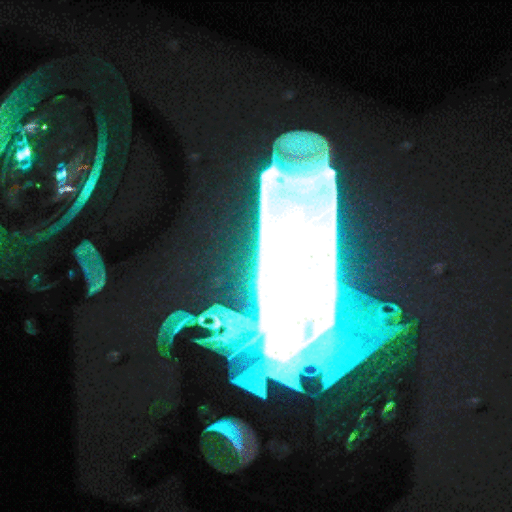
過渡吸収分光でひらくフロンティア
Frontier Studies Using Transient Absorption Spectroscopy
日本語版(Japanese)
1. 過渡吸収分光とは?
過渡吸収分光(Transient Absorption Spectroscopy, TAS) は、
「光を吸った“その後”」に起こる超高速の変化を観測する方法です。
- フェムト秒(10⁻¹⁵秒)レーザーパルスで試料を励起(ポンプ光)
- 少し時間をおいて、別の光で吸収の変化を測定(プローブ光)
- 待ち時間(遅延時間)をフェムト秒〜ナノ秒〜マイクロ秒まで変えながら
吸光度の変化 ΔA(波長, 時間) を記録
これにより、
- 励起子(光で生まれた電子+正孔のペア)の生成と消滅
- 電荷移動・エネルギー移動の速さ
- 熱としてエネルギーが逃げる「無放射過程」
などを、時間軸つきの「スローモーション動画」として読み解くことができます。
2. 研究例①:CdSeナノプレートレットのバイ励起子を見分ける
Roda et al., Nano Letters, 2025:contentReference[oaicite:1]{index=1}
2-1. 何を調べた研究?
対象は CdSe ナノプレートレット(NPL) という 2次元ナノ結晶です。
- 1〜数 nm 程度の 「板状の量子ドット」
- 2次元的に広がった構造のため、励起子の束縛エネルギーが大きく、
光増幅やレーザー発振の材料として注目されています。
この論文では、バイ励起子(biexciton) に注目しています。
- 励起子:電子+正孔 1組
- バイ励起子:励起子が 2組入った状態(2つ分ぎゅっと詰まった状態)
バイ励起子の束縛エネルギーが大きいと、室温でも壊れにくく、
光増幅・光レーザー材料として有利になります。
2-2. 過渡吸収で何がわかる?
Roda らは 過渡吸収分光 を使って、
励起子とバイ励起子のシグナルを時間分解で観測しました。
- 強い光で NPL を励起すると、
励起子だけでなくバイ励起子も生成 - バイ励起子が関係する特有の吸収バンド(バイ励起子吸収)を
時間とともに追跡することで、 - バイ励起子の束縛エネルギー ΔBX
- 励起子の束縛エネルギー ΔX
を分離して評価
その結果、
- ΔBX は 40〜55 meV の範囲
- ナノプレートレットの「幅」を 9 nm → 3 nm に小さくすると、
約 30% 増加(側面方向に閉じ込めるとバイ励起子がより強く束縛される) - 単純な 2次元系の経験則(Haynes の法則:ΔBX = 0.228×ΔX)よりも
実際の ΔBX/ΔX はかなり小さい
ことが分かりました。
過渡吸収を用いることで、
「光を当てた直後に、励起子が1個なのか2個なのか」
を時間軸つきで見分け、
バイ励起子が室温でも安定であることを実験的に証明しています。
3. 研究例②:太陽熱海水淡水化を支えるフォトサーマル材料
Wang et al., J. Am. Chem. Soc., 2025:contentReference[oaicite:2]{index=2}
3-1. 目標:太陽光で海水を真水に
この論文は、太陽光だけで海水を淡水に変える「太陽熱蒸発(solar desalination)」 の研究です。
材料は、
- 2D 材料 FePS₃ ナノシート(鉄リン三カルコゲナイド)
- 0D 材料 カーボンナノドット(CNDs)
を組み合わせた 2D/0D ナノヘテロ接合。
これを 3D 構造の「フォトサーマル蒸発器」に組み込み、
- 紫外〜近赤外まで平均 90.6% の光を吸収
- 太陽光 1サン(1 kW/m²)照射 300秒で 42 ℃ の温度上昇
- 水蒸発速度 1.68 kg m⁻² h⁻¹
という高い性能を示しました。
3-2. 過渡吸収の役割
では なぜ そんなに効率よく熱に変換できるのでしょうか?
ここで登場するのが フェムト秒過渡吸収分光(fs-TAS) です。
Wang らは、
- fs-TAS
- フォトルミネッセンス(PL)
- FDTD シミュレーション
を組み合わせて、光を吸った後のエネルギーの行き先を解析しました。
結論として、
- CND を加えて 2D/0D ヘテロ接合を作ると、
- 局所的な電場が強まり、光の捕捉効率が向上
- 励起状態のエネルギーが光として出るのではなく、効率よく熱として逃げる
(無放射遷移が最適化される) - fs-TAS から、励起状態が非常に短時間で失活することが分かり、
それが高いフォトサーマル変換の要因であると示されました。
過渡吸収は、
「太陽光のエネルギーが、どれくらいの速さで“熱”に変わっているか」
を定量的に探るための“時間分解温度計”のような役割を果たしています。
4. 研究例③:がん治療用 NIR-II 色素の“熱への変換”をデザイン
Dai et al., Angew. Chem. Int. Ed., 2025:contentReference[oaicite:3]{index=3}
4-1. NIR-II 光熱療法とは?
がん治療の一つに、
近赤外光を照射して局所的に腫瘍を加熱する「光熱療法(photothermal therapy)」 があります。
その中でも NIR-II 領域(1000–1700 nm) で励起できる色素は、
- 組織透過性が高い(深いところまで光が届く)
- 安全に照射できる最大出力が高い
といった利点があり、期待されています。
Dai らは、
- ボロンジフルオリド・フォルマザネート(BDF)に
デンドリマー構造を導入した小分子色素 BDF-8OMe - これをナノ粒子化した BDF-8OMe NPs
を開発し、NIR-II 光熱療法+フォトアコースティックイメージングに応用しました。
4-2. 「光→熱」変換をどう最適化したか?
BDF-8OMe は、
- 分岐の多いデンドリマー構造
- π共役の拡張
によって、905 nm 付近に広い吸収を持ち、1300 nm まで吸収の裾が伸びています。
ここで重要なのが 無放射失活(光らずに熱になる過程) です。
Dai らは、
- 再配置エネルギー計算
- 分子動力学シミュレーション
- フェムト秒過渡吸収分光(fs-TAS)
を使い、BDF-8OMe NPs の励起状態が
- 非常に活発な分子運動を伴い
- 11.7 ps という短時間で 94.4% の励起エネルギーを熱として放出
していることを明らかにしました。
その結果、
- 1064 nm 照射で 62.5% の光熱変換効率
- NIR-II 光熱療法で高い治療効果
を達成しています。
ここでも fs-TAS は、
「光を吸ったエネルギーが、どれくらいの速さで“熱”に変わっているか」
を評価し、がん治療用色素の分子設計指針を与えるツールになっています。
5. まとめ(日本語)
Transient Absorbance_Frontier.txt に含まれる3本の論文からは、:contentReference[oaicite:4]{index=4}
- CdSe ナノプレートレット
→ 励起子とバイ励起子の挙動を過渡吸収で見分け、
光デバイス用ナノ材料の設計に活かす研究 - 2D/0D ヘテロ接合 FePS₃/CND
→ 太陽光を効率よく熱に変えて海水淡水化に利用する材料を、
fs-TAS で“エネルギーの流れ”から解析した研究 - BDF デンドリマー色素 BDF-8OMe
→ NIR-II 光熱療法用色素の無放射失活を fs-TAS で定量化し、
高効率な光熱変換を分子レベルで設計した研究
が紹介されています。
一言でまとめると、
過渡吸収分光は「光を吸ったあと、エネルギーと電子がどこへ、どのくらいの速さで動くか」を ナノ材料から医療用色素まで幅広い分野で“見える化”する技術です。
English Version
1. What is transient absorption spectroscopy?
Transient absorption spectroscopy (TAS) is a powerful technique to monitor
what happens after a material absorbs light, on time scales from
femtoseconds (10⁻¹⁵ s) to microseconds (10⁻⁶ s).
Basic idea:
- A short pump pulse excites the sample.
- A weaker probe pulse measures the absorption after a certain delay.
- By scanning the delay, we obtain the time-dependent absorbance change
ΔA(wavelength, time).
From ΔA we can extract:
- formation and decay of excitons and biexcitons,
- charge and energy transfer rates,
- nonradiative decay pathways (conversion of light energy into heat).
2. Example 1 – Biexcitons in CdSe Nanoplatelets
Roda et al., Nano Letters, 2025:contentReference[oaicite:5]{index=5}
2-1. System: CdSe nanoplatelets
CdSe nanoplatelets (NPLs) are quasi-2D semiconductor nanocrystals:
- a few monolayers thick,
- extended laterally in two dimensions.
They exhibit large exciton binding energies and are highly attractive for
optical gain and lasing.
This work focuses on biexcitons:
- exciton: one electron–hole pair,
- biexciton: two excitons bound together.
A large biexciton binding energy (ΔBX) makes biexcitons stable at room temperature,
which is beneficial for optical amplification.
2-2. What TAS reveals
Roda and co-workers use transient absorption spectroscopy to identify and quantify
photoinduced biexciton absorption in CdSe NPLs.
From the time-resolved spectra they extract:
- ΔBX values in the range 40–55 meV,
- ≈ 30% increase of ΔBX when the lateral width is reduced from 9 to 3 nm,
- only ≈10% increase when going from 4.5 to 3.5 monolayers in thickness.
They also find that the ratio ΔBX/ΔX (X = exciton binding energy)
is substantially lower than the commonly used 2D Haynes factor (0.228).
In short, TAS allows the authors to distinguish exciton and biexciton signals in time,
demonstrating that biexcitons in CdSe NPLs are stable at room temperature
and are strongly influenced by lateral confinement.
3. Example 2 – Photothermal Materials for Solar Desalination
Wang et al., J. Am. Chem. Soc., 2025:contentReference[oaicite:6]{index=6}
3-1. Goal: solar-driven desalination
This work targets solar desalination—using sunlight to evaporate seawater
and obtain fresh water.
The authors design 2D/0D nano-heterojunctions based on:
- 2D FePS₃ nanosheets (metal phosphorus trichalcogenide),
- 0D carbon nanodots (CNDs),
and integrate them into a 3D photothermal evaporator.
Key performance:
- broadband absorbance of 90.6% from UV to NIR,
- temperature increase of 42 °C under 1 sun for 300 s,
- water evaporation rate of 1.68 kg m⁻² h⁻¹.
3-2. Role of femtosecond TAS
To understand why the hybrid is so efficient,
they combine:
- femtosecond transient absorption spectroscopy (fs-TAS),
- photoluminescence (PL) analysis,
- FDTD simulations.
They find that:
- the 2D/0D heterojunction with CNDs
- enhances local heating and light absorption,
- improves carrier trapping efficiency,
- and optimizes nonradiative decay pathways,
- fs-TAS shows that excited states relax very quickly without emitting light,
efficiently converting photon energy into heat.
Here, TAS acts as a time-resolved thermometer,
revealing how fast absorbed light energy is converted into heat,
and guiding the rational design of photothermal materials for desalination.
4. Example 3 – NIR-II Dyes for Photothermal Cancer Therapy
Dai et al., Angew. Chem. Int. Ed., 2025:contentReference[oaicite:7]{index=7}
4-1. NIR-II photothermal theranostics
In photothermal cancer therapy, near-infrared light heats tumors locally.
Dyes that absorb in the second NIR window (NIR-II, 1000–1700 nm) are especially attractive because:
- they allow deeper tissue penetration,
- they can be used at higher permissible exposure levels.
Dai et al. develop a boron difluoride formazanate (BDF) dye, BDF-8OMe,
with a dendrimer architecture.
- BDF-8OMe shows a broad absorption band peaked at 905 nm,
with a tail extending to 1300 nm. - In nanoparticle form (BDF-8OMe NPs), it is used for
photoacoustic imaging–guided NIR-II photothermal therapy.
4-2. Designing efficient nonradiative decay
The key design concept is to boost nonradiative decay of the excited state,
so that most of the absorbed energy becomes heat, not light.
Using:
- reorganization energy calculations,
- molecular dynamics simulations,
- fs-TAS,
the authors show that:
- the multiple identical dendritic units greatly enhance molecular motions,
- BDF-8OMe NPs can release 94.4% of their excited-state energy
through nonradiative decay with a time constant of 11.7 ps, - the photothermal conversion efficiency reaches 62.5% under 1064 nm irradiation.
fs-TAS thus provides direct evidence that the molecular design indeed
funnels almost all the absorbed energy into heat on a picosecond time scale,
enabling highly efficient NIR-II photothermal theranostics.
5. Overall summary (English)
From the papers listed in Transient Absorbance_Frontier.txt,:contentReference[oaicite:8]{index=8}
- CdSe nanoplatelets – TAS disentangles exciton and biexciton dynamics
and quantifies biexciton binding in laterally confined 2D nanomaterials. - FePS₃/CND 2D/0D heterojunctions – fs-TAS clarifies how absorbed solar energy
is rapidly converted to heat, enabling high-performance solar desalination. - BDF-8OMe dendrimer dyes – fs-TAS proves that a dendrimer strategy
can boost nonradiative decay to >94%, achieving efficient NIR-II photothermal therapy.
In all three cases, transient absorption spectroscopy serves as a
time-resolved probe of “where the energy goes” after photoexcitation,
helping scientists design better materials for photonics, energy, and medicine.
参考文献 / References
- Roda, C.; Macias-Pinilla, D. F.; Di Giacomo, A.; Planelles, J.; Climente, J. I.; Moreels, I.
“Enhancement of the Biexciton Binding Energy in Laterally Confined CdSe Nanoplatelets.”
Nano Letters 2025, 25 (35), 13251–13257.
DOI: 10.1021/acs.nanolett.5c03251.:contentReference[oaicite:9]{index=9} - Wang, H.; Bo, Y.; Wang, H.; Klingenhof, M.; Tao, Z.; Wang, D.; et al.
“Enhanced Photothermal Conversion through 2D/0D Nano-Heterojunction Engineering for Highly Efficient Solar Desalination.”
Journal of the American Chemical Society 2025, 147 (29), 25750–25760.
DOI: 10.1021/jacs.5c07491.:contentReference[oaicite:10]{index=10} - Dai, H.; Pan, J.; Shao, J.; Xu, K.; Ruan, X.; Mei, A.; Chen, P.; Qu, L.; Dong, X.
“Boosting Nonradiative Decay of Boron Difluoride Formazanate Dendrimers for NIR-II Photothermal Theranostics.”
Angewandte Chemie International Edition 2025, 64 (21), e202503718.
DOI: 10.1002/anie.202503718.:contentReference[oaicite:11]{index=11}