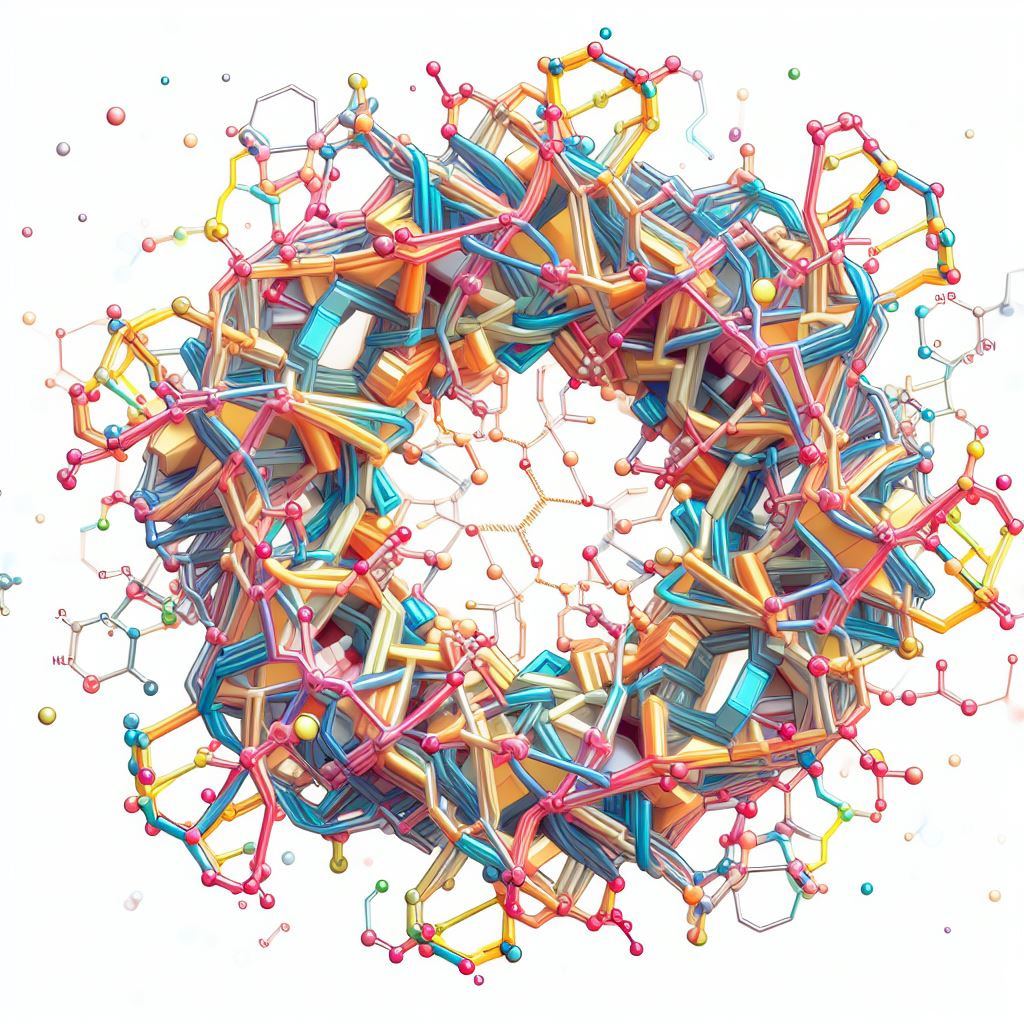
γ‑Cyclodextrin — A friendly 3‑paper guide for the general audience
キーワード(Keywords)
- 包接(Inclusion):γ-CDは“かご”のような空洞で分子を包み、溶けにくい薬などを扱いやすくします。
EN: γ‑CD acts like a molecular “cage,” helping host molecules (e.g., poorly soluble drugs) behave better in water. - 多孔質材料(Porous materials):スポンジ状のすき間をもつ材料は、薬をたくさん入れたり、ゆっくり放出したりできます。
EN: Sponge‑like pores enable high loading and controlled release by tuning how molecules enter and exit. - MOF(Metal–Organic Framework):金属イオンと有機分子でできた結晶性の“多孔質”材料。γ-CD由来のMOFは生体適合性が注目点。
EN: MOFs are crystalline porous frameworks; γ‑CD‑based MOFs attract attention for biocompatibility. - ホスト–ゲスト相互作用(Host–guest interaction):分子同士の「はまり方」を設計し、狙った分子だけを結合・運搬する考え方。
EN: Designing “fit” between host and guest enables selective binding, transport, and function. - ドラッグデリバリー(Drug delivery):薬を「必要な場所・タイミング」で効かせる技術。担体(ナノ粒子・ゲル・MOF等)が鍵です。
EN: Delivering drugs to the right place/time relies on carriers (nanogels, particles, MOFs) as key enablers.
1) ステロイド(ホルモン等)を「水中でつかまえる」人工受容体:γ-CD誘導体の臨床例(スガマデクス)にも言及
Synthetic receptors for steroids: from molecular recognition to biomedical functions
- Journal: Chemical Society Reviews(Review)
- DOI: https://doi.org/10.1039/d5cs01092f
日本語
- ステロイド(コレステロール、ステロイドホルモン、医薬品など)は水に溶けにくく、分子認識の対象として難しいことを整理しています。
- その解決策として「人工受容体(合成ホスト分子)」が水中でステロイドを結合する仕組みを、代表例でまとめています。
- 歴史的背景として、シクロデキストリンがステロイドを疎水性包接で結合できること、さらにγ-CD誘導体スガマデクスが臨床応用された例に触れています。
- 応用面では、センシング、溶解性改善、拮抗(作用を打ち消す)、治療介入など、分子認識が医療機能に直結する流れを俯瞰します。
English (Plain-language points)
- Steroids (cholesterol, hormones, drugs) are difficult targets for recognition in water; the review explains why.
- It surveys synthetic “receptors” (host molecules) that bind steroids in aqueous environments.
- The authors highlight cyclodextrin inclusion of steroids and mention the clinical example of sugammadex, a γ‑CD derivative.
- Applications span sensing, solubilization, antagonism, and therapeutic intervention.
2) “食べられる”γ-CDで作るMOF(多孔質結晶):薬をたくさん入れて、放出を調整する
γ-Cyclodextrin Metal-Organic Frameworks for Drug Delivery: Current Advances in Synthesis, Activation, Encapsulation and Applications
- Journal: Pharmaceutics(Review)
- DOI: https://doi.org/10.3390/pharmaceutics18040502
日本語
- γ-CDを「配位子」として金属イオンと組み合わせ、多孔質の結晶(γ‑CD‑MOF)を作る研究を総覧します。
- γ‑CD‑MOFは、由来が“グリーン”で生分解性・生体適合性が期待される点が強調されています。
- 構造的には多孔性を持ち、薬を内部に入れる(カプセル化)ことで、高い搭載量や放出の調整につながる、と述べています。
- 合成法、粒子サイズ・形の制御、乾燥/活性化、薬の入れ方、計算による相互作用予測、安定化の工夫などを整理しています。
English (Plain-language points)
- Reviews γ‑CD‑MOFs: porous crystalline frameworks made from γ‑CD ligands and biocompatible metal ions.
- Emphasizes “green” origin plus biodegradability and biocompatibility as key motivations.
- Dual‑mode porosity supports encapsulating drugs and tuning release behavior (high loading / controllable release).
- Summarizes synthesis, size/morphology control, activation/drying, encapsulation methods, modeling, and post‑synthetic modifications.
3) 皮膚用ナノゲルで「どのCDが効くか」を計算で選ぶ:候補にγ-CDも含めて比較
In silico prioritization and in vivo assessment of a cyclodextrin-functionalized dermal nanogel: Analgesic and anti-inflammatory effects
- Journal: Journal of Drug Delivery Science and Technology(Article)
- DOI: https://doi.org/10.1016/j.jddst.2026.108297
日本語
- 皮膚から薬を届けるナノゲルにおいて、「どのシクロデキストリン(CD)が薬と相性がよいか」を計算(in silico)で比較し、実験結果とつなげた研究です。
- 候補として α‑CD / β‑CD / γ‑CD / 2‑HP‑β‑CD を並べ、薬(フルルビプロフェン)との結合しやすさを指標にランキングしています。
- 選ばれた系を使ったゲルは、炎症モデルで腫れを抑える、痛みモデルで鎮痛反応が見られる、という形で“効き方”の評価につなげています。
- ポイントは「経験則だけでなく、計算でCDを選ぶ」ことで、溶けにくい薬の経皮製剤設計を合理化できる可能性がある点です。
English (Plain-language points)
- Compares which cyclodextrin host works best in a dermal nanogel using an in‑silico workflow, then links it to in‑vivo outcomes.
- Evaluates α‑CD, β‑CD, γ‑CD, and 2‑HP‑β‑CD as candidate hosts for flurbiprofen.
- The prioritized formulation is tested in inflammation and pain models, showing measurable pharmacodynamic effects.
- Key takeaway: computational support can rationalize host selection for dermal delivery of poorly soluble drugs.
文献(References)
- Liu, Y.; Zhao, Q‑Y.; Guo, S‑D.; Cai, K. Synthetic receptors for steroids: from molecular recognition to biomedical functions. Chemical Society Reviews (2026). DOI: 10.1039/d5cs01092f
- Ashri, L. Y. γ‑Cyclodextrin Metal‑Organic Frameworks for Drug Delivery: Current Advances in Synthesis, Activation, Encapsulation and Applications. Pharmaceutics (2026). DOI: 10.3390/pharmaceutics18040502
- Oktay, A. N.; Véliz‑Otani, D.; Han, S.; Celebi, N. In silico prioritization and in vivo assessment of a cyclodextrin‑functionalized dermal nanogel: Analgesic and anti‑inflammatory effects. Journal of Drug Delivery Science and Technology (2026). DOI: 10.1016/j.jddst.2026.108297