DSSC_20260523_merged: A Plain-Language Guide to Recent Dye-Sensitized Solar Cell Research
キーワード / Keywords
- DSSC(色素増感太陽電池) / Dye-Sensitized Solar Cell
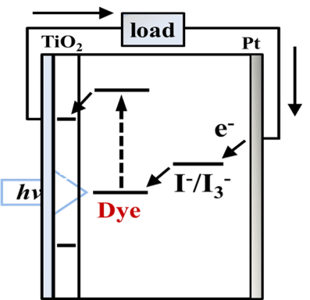
色素で光を集め、半導体で電気に変える太陽電池です。低コスト・柔軟性・室内光でも働きやすい点が注目されています。
EN: A solar cell that captures light with dyes and converts it to electricity using semiconductors, known for low cost, flexibility, and good indoor-light performance. - カウンター電極 / Counter Electrode
発電後の電子の流れを支える重要部品です。白金の代わりに安価で高性能な材料を探す研究が進んでいます。
EN: A key DSSC component that supports electron return flow; many studies seek cheaper, high-performance alternatives to platinum. - 光電変換効率(PCE) / Power Conversion Efficiency
太陽光をどれだけ電気へ変えられたかを示す代表的な指標です。数値が高いほど、より効率よく発電できます。
EN: The main measure of how efficiently sunlight is converted into electricity; higher values indicate better device performance. - 電荷再結合 / Charge Recombination
発電に使うはずの電子が途中で失われる現象です。これを抑えることが、高効率なDSSC設計の大切なポイントです。
EN: A loss process in which electrons are wasted before useful power generation; suppressing it is essential for efficient DSSCs. - 材料設計 / Materials Engineering
色素、電極、電解質などの組み合わせを工夫し、性能と安定性を高める考え方です。DSSC研究の中心テーマの一つです。
EN: The strategy of optimizing dyes, electrodes, and electrolytes to improve both performance and stability in DSSCs.
1. DSSC研究はいま、どこまで進んでいるのか
Progress in highly efficient and stable dye-sensitized solar cells: state-of-the-art materials and device fabrication
Journal: Coordination Chemistry Reviews
Year: 2026
DOI: 10.1016/j.ccr.2026.218020
日本語でのやさしい解説
- この論文は、DSSC研究全体の流れをまとめた「総合レビュー」です。
- DSSCは、低コスト、やわらかさ、半透明性などの特徴を持つ次世代太陽電池として注目されています。
- 研究の進展により、材料や構造の工夫で効率と安定性が大きく伸びてきました。
- 特に、新しい色素分子、コバルト・銅系の電解質、ナノ構造の電極などが重要な改善点として整理されています。
- 室内光で高性能を出しやすいことから、IoT機器や小型電子機器の電源としても期待されています。
- 一般向けに言えば、「DSSCが実験室の技術から、実用品へ近づいていることを示すまとめ論文」です。
Plain-Language English Explanation
- This paper is a broad review of where DSSC research stands today.
- DSSCs are attractive because they can be low-cost, flexible, and semi-transparent.
- Their efficiency and durability have improved through better materials and device design.
- The review highlights key advances such as new sensitizer molecules, cobalt- and copper-based redox systems, and nanostructured electrodes.
- Because DSSCs perform especially well under indoor lighting, they are promising for IoT devices and small electronics.
- In simple terms, this paper shows how DSSCs are moving closer to practical real-world use.
2. 汚れを分解しながら、太陽電池にも使える多機能材料
Integrated dye degradation and solar energy harnessing using multifunctional M1M2FeCO3 [M1M2-Ni/Zn/Co] ternary layered double hydroxides catalysts
Journal: Electrochimica Acta
Year: 2026
DOI: 10.1016/j.electacta.2026.148954
日本語でのやさしい解説
- この研究では、Ni・Zn・Coを組み合わせた層状複水酸化物(LDH)をつくり、環境浄化と発電の両方に役立てています。
- とくに ZnCoFe-LDH は、コンゴーレッド染料を99.04%分解し、さらにDSSCの光電極として使ったとき 2.68%の効率 を示しました。
- つまり、1つの材料が「汚れを分解する触媒」と「太陽電池材料」の両方の役割を持つ点が大きな特長です。
- ナノシート状の形、高い表面積、調整可能なバンドギャップが、性能向上のポイントと考えられています。
- 一般向けには、「環境にやさしい多機能材料を使って、浄化と発電を両立しようとする研究」と理解できます。
Plain-Language English Explanation
- This study developed layered double hydroxide (LDH) materials containing Ni, Zn, and Co for both environmental cleanup and solar-energy use.
- The best material, ZnCoFe-LDH, degraded 99.04% of Congo red dye and also worked as a DSSC photoanode with 2.68% efficiency.
- The key idea is that one material can serve as both a pollutant-removal catalyst and a solar-cell component.
- Its nanosheet structure, large surface area, and tunable bandgap are believed to support this performance.
- For general readers, this is a good example of a green material designed to support both purification and electricity generation.
3. 白金なしでも高性能、しかも曲げられるDSSCへ
Tailoring electrocatalytic activity and mechanical endurance in flexible dye-sensitized solar cells (FDSSCs) via PANI/CoP composite counter electrodes
Journal: Inorganic Chemistry Communications
Year: 2026
DOI: 10.1016/j.inoche.2026.116729
日本語でのやさしい解説
- この研究では、白金(Pt)の代わりに、CoPナノシートとポリアニリン(PANI)を組み合わせた複合カウンター電極を作っています。
- その結果、柔らかく曲げられるDSSCで 8.28%の効率 を達成し、Pt電極(7.42%)やPANI単独(5.56%) を上回りました。
- さらに、500回曲げても初期性能の91.18%を維持し、8週間での低下も11.5%にとどまりました。
- これは「高性能」「柔軟性」「長持ち」を同時に目指した研究で、ウェアラブル機器や曲面デバイスへの応用も想像しやすい成果です。
- 一般向けには、「高価な白金を使わず、曲げても壊れにくい太陽電池を目指した研究」といえます。
Plain-Language English Explanation
- This study replaced platinum with a composite counter electrode made of CoP nanosheets and polyaniline (PANI).
- In flexible DSSCs, this electrode reached 8.28% efficiency, outperforming both Pt (7.42%) and pure PANI (5.56%).
- It also showed strong durability, retaining 91.18% of its initial efficiency after 500 bending cycles, with only an 11.5% drop over 8 weeks.
- This means the research addresses three goals at once: high performance, flexibility, and stability.
- For general readers, it can be seen as progress toward bendable solar cells that do not rely on expensive platinum.
まとめ / Overall Takeaway
日本語
DSSC研究が単に「発電効率を上げる」だけでなく、安定性、低コスト化、柔軟性、そして環境対応まで含めて進化していることです。
総合レビューは分野全体の到達点を示し、LDH材料の研究は環境浄化との両立を示し、PANI/CoP電極の研究は実用的な柔軟デバイスへの近さを示しています。
つまりDSSCは、未来の太陽電池候補として、今も着実に可能性を広げています。
English
The three selected papers show that DSSC research is no longer focused only on boosting efficiency. It is also advancing in stability, cost reduction, flexibility, and environmental compatibility.
The review paper maps the overall progress of the field, the LDH study demonstrates multifunctionality for remediation and solar use, and the PANI/CoP work points toward practical flexible devices.
In short, DSSCs continue to expand their promise as a future-friendly solar-cell technology.
文献 / References
- Aftabuzzaman, M.; Zhou, H. R.; Masud; Akman, E.; Boruah, B. D.; Al-Ahmed, A.; Kim, H. K. Progress in highly efficient and stable dye-sensitized solar cells: state-of-the-art materials and device fabrication. Coordination Chemistry Reviews 563 (2026), 218020. DOI: 10.1016/j.ccr.2026.218020.
- Kumari, A.; Bhatia, S. K.; Singh, R.; Sharma, A. Integrated dye degradation and solar energy harnessing using multifunctional M1M2FeCO3 [M1M2–Ni/Zn/Co] ternary layered double hydroxides catalysts. Electrochimica Acta 566 (2026), 148954. DOI: 10.1016/j.electacta.2026.148954.
- Badawy, A. S.; Abbood, R. S.; Jabbarova, A.; Sapaev, I.; Sohal, H. S.; Hussien, S.; Neha, K.; Iqbal, M. S.; Smerat, A. Tailoring electrocatalytic activity and mechanical endurance in flexible dye-sensitized solar cells (FDSSCs) via PANI/CoP composite counter electrodes. Inorganic Chemistry Communications 189 (2026), 116729. DOI: 10.1016/j.inoche.2026.116729.