Diarylethene: Light-Controlled Molecular Switches in Water, Materials, and Adaptive Photochemistry
キーワード / Keywords
-
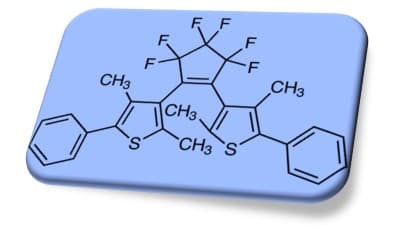
ジアリールエテン / Diarylethene
光で開環体と閉環体を行き来できる分子です。色、pH、発光、反応速度などを切り替え、光メモリや生体材料制御に応用できます。
EN: A molecule that switches between open and closed forms under light, enabling control of color, pH, emission, and reaction behavior. -
フォトスイッチ / Photoswitch
光を入力として分子の形や性質を変える仕組みです。紫外光と可視光を使い分けることで、オン・オフや多段階制御が可能になります。
EN: A system in which light changes molecular shape or properties. Different wavelengths can enable on/off or multistate control. -
光pH制御 / Light-Controlled pH Modulation
光で分子の酸・塩基性を変え、水溶液のpHを動かす技術です。タンパク質集合や生体模倣材料を、光で可逆的に制御できます。
EN: A method for changing solution pH by light-induced changes in molecular acidity or basicity, useful for controlling protein assembly and bioinspired materials. -
時間ゲート光化学 / Temporally Gated Photochemistry
同じ光を当てても、化学状態の時間変化により結果が変わる仕組みです。生物の視覚疲労のような適応応答を分子で再現します。
EN: Photochemistry in which the result depends on when light is applied during chemical evolution, enabling adaptive responses similar to biological fatigue. -
光メモリ材料 / Optical Memory Material
光で安定な分子状態を作り、情報として残す材料です。熱に戻りにくく、繰り返し光応答する分子は高性能メモリ候補になります。
EN: Materials that store information in light-generated molecular states. Thermally stable and fatigue-resistant switches are promising for optical memory.
採用した3本 / Three Selected Papers
-
Angewandte Chemie International Edition(2025 JIF: 17.6)
Transient Activation Windows Program Adaptive Photochemical Responses
DOI: 10.1002/anie.4081888 -
Journal of the American Chemical Society(2025 JIF: 16.6)
A Water-Soluble Diarylethene Base for Light-Controlled pH Modulation in Biological Systems
DOI: 10.1021/jacs.6c04470 -
Materials Chemistry Frontiers(2025 JIF: 8.1)
Design of robust photochromic silole-fused dithienylethenes and computational insights into excited-state reaction pathways for controllable photoswitchable materials
DOI: 10.1039/d6qm00356g
日本語版
1. 光を当てる“タイミング”で結果が変わる、適応型フォトスイッチ
論文: Transient Activation Windows Program Adaptive Photochemical Responses
掲載誌: Angewandte Chemie International Edition
DOI: 10.1002/anie.4081888
- この研究は、ジアリールエテンの光反応を、単に光の有無だけでなく「いつ光を当てるか」で制御する分子システムです。
- 生物は、瞬間的に現れる活性状態を使って、同じ刺激でも状況に応じて応答を変えます。
- 研究では、pHに応答する電荷移動錯体とジアリールエテン光スイッチを組み合わせています。
- 電荷移動錯体のプロトン化状態が変わることで、三重項増感によるジアリールエテンの光反応が化学的にオン・オフされます。
- さらに、消費型のpH制御ネットワークと組み合わせることで、光反応が起こりやすい時間帯、つまり“活性化ウィンドウ”が一時的に開きます。
- 同じ光刺激でも、化学状態が変化している早い段階と遅い段階では、生成する応答が変わります。
- 一般向けに言えば、「光スイッチに体内時計のような時間条件を持たせ、光への反応をだんだん弱める」研究です。
2. 水中でpHを光で動かし、タンパク質集合を制御する
論文: A Water-Soluble Diarylethene Base for Light-Controlled pH Modulation in Biological Systems
掲載誌: Journal of the American Chemical Society
DOI: 10.1021/jacs.6c04470
- この研究は、水によく溶けるジアリールエテン型の光応答性塩基を設計し、光でpHを可逆的に変えるものです。
- 従来の光pH制御分子は、水への溶けやすさが十分でなく、生体環境で大きく長く続くpH変化を作りにくい課題がありました。
- 開環体と閉環体の間で、N-ヘテロ環カルベン様イミン部位の酸塩基性が変わるため、光でpHを調節できます。
- この分子は、pH 6から11では光酸のように、pH 3から6では光塩基のように働くという、二つの機能を示します。
- UV光と可視光を交互に照射することで、緩衝液中でも非緩衝水溶液中でも、1.7 pH単位を超える可逆的なpH変化が得られました。
- pH応答性のリフレクチンタンパク質の集合を光で制御する実験にも応用されています。
- 一般向けに言えば、「水の中で光を使って酸性・塩基性を動かし、タンパク質の集まり方まで操る」研究です。
3. 熱に強く、繰り返し使えるジチエニルエテン型光メモリ材料
論文: Design of robust photochromic silole-fused dithienylethenes and computational insights into excited-state reaction pathways for controllable photoswitchable materials
掲載誌: Materials Chemistry Frontiers
DOI: 10.1039/d6qm00356g
- この研究は、シロール骨格を融合したジチエニルエテンを設計し、高性能な光応答材料としての性質を調べたものです。
- ジアリールエテン系分子は、光メモリや分子デバイスに有望ですが、実用には熱安定性と繰り返し耐久性が重要です。
- 合成された分子は、高い光スイッチング効率、優れた熱不可逆性、強い光疲労耐性を示しました。
- 閉環体から熱で自然に戻る反応は非常に小さく、100℃でもほとんど進まないことが示されています。
- 推定半減期は約776日とされ、光で作った状態を長く保てる可能性があります。
- 計算化学により、励起状態でどの経路を通って開環・閉環が進むかが解析され、分子設計の指針が示されています。
- PMMA薄膜中でもフォトクロミズムが実証され、光メモリデバイスなどへの展開が期待されます。
- 一般向けに言えば、「光で書き込み、熱では消えにくく、何度も使える分子メモリ材料」をめざす研究です。
まとめ
今回の3本は、ジアリールエテンが「色が変わる分子」を超えて、水中pH制御、時間応答型光化学、光メモリ材料へ発展していることを示しています。共通する鍵は、光で分子構造を変え、その変化をpH、反応性、材料の記録状態という実用的な機能へ変換する設計です。
English Version
1. A photoswitch whose response depends on timing
Paper: Transient Activation Windows Program Adaptive Photochemical Responses
Journal: Angewandte Chemie International Edition
DOI: 10.1002/anie.4081888
- This study controls diarylethene photochemistry not only by light input, but also by the timing of that input.
- Biological systems often use transient activation states, so the same stimulus can produce different outcomes depending on when it arrives.
- The system combines a proton-responsive charge-transfer complex sensitizer with a diarylethene photoswitch.
- Protonation of the charge-transfer complex chemically gates triplet-sensitized photochromism.
- Coupling this process to a dissipative pH-regulation network creates a temporary activation window.
- The same optical stimulus therefore produces different photochemical results at different stages of chemical evolution.
- In simple terms, this work gives a molecular photoswitch a time-dependent response, somewhat like light adaptation in biological vision.
2. A water-soluble diarylethene base for light-controlled pH modulation
Paper: A Water-Soluble Diarylethene Base for Light-Controlled pH Modulation in Biological Systems
Journal: Journal of the American Chemical Society
DOI: 10.1021/jacs.6c04470
- This study develops a highly water-soluble diarylethene base that reversibly changes pH under light.
- Many molecular photoswitches designed for pH control suffer from poor solubility in water, limiting their use in biological systems.
- The molecule changes the basicity of an N-heterocyclic imine unit when it switches between open and closed forms.
- It behaves as a photoacid over pH 6 to 11 and as a photobase over pH 3 to 6.
- Alternating UV and visible light produces reversible pH shifts greater than 1.7 pH units in buffered and unbuffered aqueous solutions.
- The photoswitch was used to reversibly control assembly of a pH-responsive reflectin protein.
- In simple terms, this molecule uses light to move pH in water and control how proteins assemble.
3. Robust silole-fused dithienylethenes for optical memory materials
Paper: Design of robust photochromic silole-fused dithienylethenes and computational insights into excited-state reaction pathways for controllable photoswitchable materials
Journal: Materials Chemistry Frontiers
DOI: 10.1039/d6qm00356g
- This study designs silole-fused dithienylethenes and evaluates them as robust photochromic materials.
- Diarylethene-related compounds are promising for optical memory and molecular devices, but practical use requires thermal stability and fatigue resistance.
- The compounds show high photoswitching efficiency, excellent thermal irreversibility, and strong resistance to photofatigue.
- The thermal backward reaction is negligible even at 100 °C.
- The estimated half-life of the switched state is around 776 days, indicating long-term memory potential.
- Computational analysis clarifies excited-state reaction pathways and provides design guidance for high-performance photoswitches.
- Photochromism is also demonstrated in a PMMA thin film, supporting possible device applications.
- In simple terms, this research aims at molecular memory materials that can be written by light, resist heat-driven erasure, and be reused.
Overall Takeaway
The selected studies show diarylethene chemistry expanding beyond color switching. These molecules can regulate pH in water, produce time-dependent photochemical responses, and support thermally stable optical memory materials. Across all three examples, the central design principle is the same: light changes molecular structure, and that structural change is translated into practical functions such as pH control, adaptive response, or information storage.
文献 / References
- Dai, J.; Zhang, Z.; Wang, W.; Ding, M.; Pan, F.; Zhang, J.; Tian, H. Transient Activation Windows Program Adaptive Photochemical Responses. Angewandte Chemie International Edition (2026). DOI: 10.1002/anie.4081888.
- Tobin, C. M.; Schuerlein, M.; Yee, R.; Nett, Z.; Beyer, M.; Bowser, A.; Chmelka, B. F.; Morse, D. E.; Read de Alaniz, J. A Water-Soluble Diarylethene Base for Light-Controlled pH Modulation in Biological Systems. Journal of the American Chemical Society 148 (2026), 25934-25944. DOI: 10.1021/jacs.6c04470.
- Chan, J. C.-H.; Chen, Z.; Fung, T. H.-C.; Hong, E. Y.-H.; Poon, C.-T.; Wong, H.-L.; Yam, V. W.-W. Design of robust photochromic silole-fused dithienylethenes and computational insights into excited-state reaction pathways for controllable photoswitchable materials. Materials Chemistry Frontiers (2026). DOI: 10.1039/d6qm00356g.
選定メモ / Selection Note
- Angewandte Chemie International Edition:2025 JIF 17.6。
- Journal of the American Chemical Society:2025 JIF 16.6。
- Materials Chemistry Frontiers:2025 JIF 8.1。
- 添付ファイル内には、Journal of Molecular Structure、European Journal of Organic Chemistry、ACS Macro Letters、ChemPhotoChemなどの関連論文も含まれていました。本稿では、添付ファイル内限定を守りつつ、Diaryletheneとの関連性が明確で、かつジャーナルIFが高い3本を優先しました。