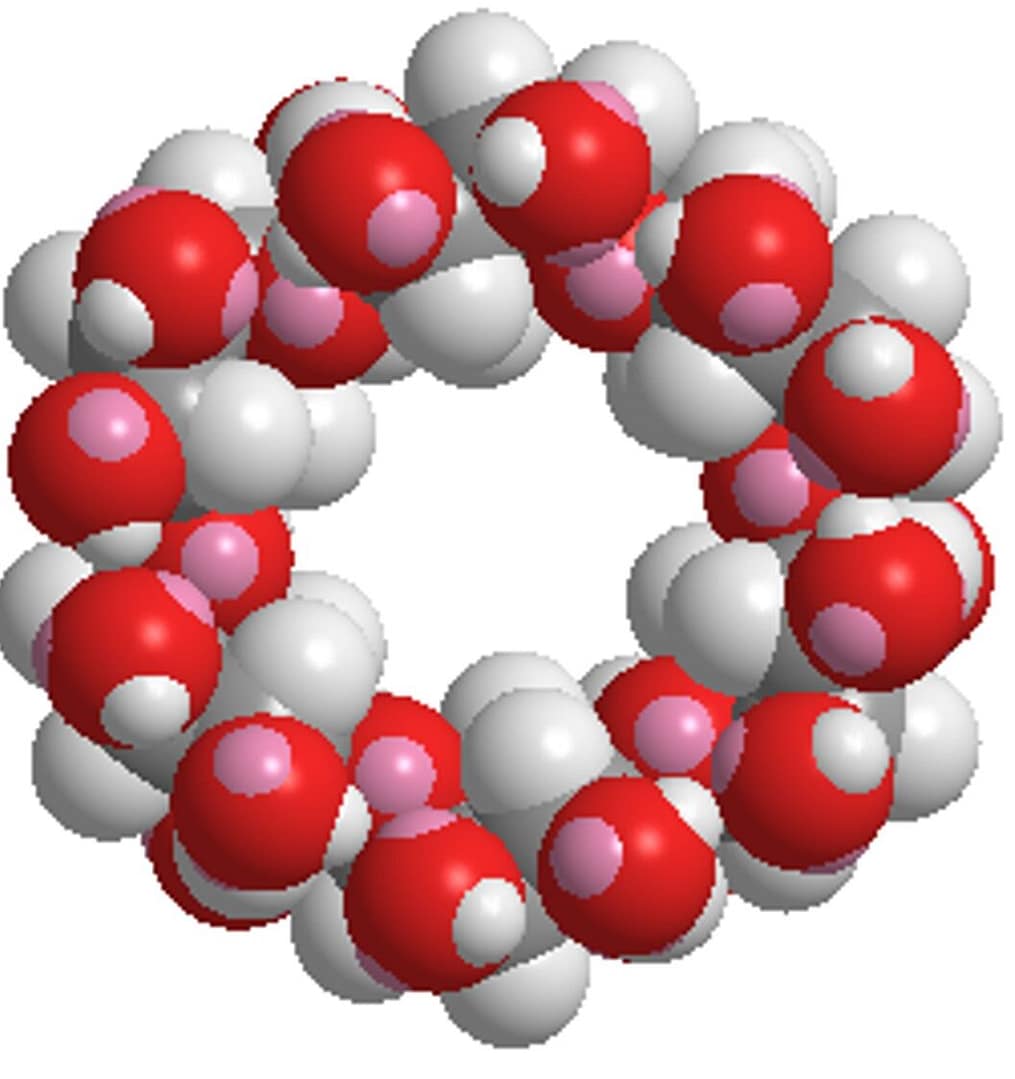
α-シクロデキストリン研究の現在地:分子を見分ける「糖の輪」から医療応用へ
キーワード / Keywords
-
α-シクロデキストリン(Alpha-cyclodextrin)
日本語: ブドウ糖が環状につながった分子で、中央に小さな空洞をもちます。その形を利用して、ほかの分子と一時的に組み合わさる「分子の入れ物」として研究されています。
English: A ring-shaped molecule made of glucose units. Its small central cavity allows it to associate temporarily with other molecules, so it is often studied as a molecular container. -
ホスト–ゲスト相互作用(Host–guest interaction)
日本語: 空洞をもつ分子を「ホスト」、そこに近づいたり入り込んだりする分子を「ゲスト」と呼びます。両者がどの向きで、どの程度強く結びつくかを調べる考え方です。
English: A molecule with a cavity is called the host, while the molecule that approaches or enters it is the guest. Researchers examine their orientation, fit, and binding strength. -
水素結合(Hydrogen bonding)
日本語: 分子どうしを引き合わせる比較的弱い力の一つです。一つひとつは強固でなくても、複数が適切な位置で働くと、分子の結びつき方や安定性を左右します。
English: Hydrogen bonding is a relatively weak attraction between molecular groups. Several well-positioned hydrogen bonds can strongly influence how molecules associate and how stable the resulting structure becomes. -
疎水性相互作用(Hydrophobic interaction)
日本語: 水になじみにくい部分どうしが、水中で集まりやすくなる現象です。シクロデキストリンの空洞とゲスト分子の組み合わせを理解するうえで重要な要素です。
English: Hydrophobic interaction describes the tendency of water-repelling molecular regions to come together in water. It is important for understanding how guest molecules associate with cyclodextrin cavities. -
コレステロール結晶(Cholesterol crystals)
日本語: コレステロールが規則的に集まって固体状になったものです。添付資料には、α-シクロデキストリンを基盤とする方法で、その溶解と糖尿病網膜症への応用を検討した研究が収録されています。
English: Cholesterol crystals are solid, ordered assemblies of cholesterol. The attached record includes a study exploring their dissolution with an alpha-cyclodextrin-based strategy in relation to diabetic retinopathy.
はじめに
シクロデキストリンは、ブドウ糖が輪のようにつながった分子です。外側は水となじみやすく、中央には別の分子を受け入れられる空間があります。この特徴から、分子を選んで取り込む仕組みの解明や、物質の性質を調整する方法への応用が研究されています。
添付資料に収録された研究記録からは、α-シクロデキストリンに関する二つの異なる方向性が見えてきます。一つは、分子がシクロデキストリンの縁や空洞にどのように結びつくかを、実験と計算の両面から調べる基礎研究です。もう一つは、コレステロール結晶と腸内細菌叢に着目し、糖尿病網膜症から目を守る方法を探る医療応用研究です。
1. 分子はシクロデキストリンのどこに、なぜ結びつくのか
Sasiらの研究は、ピロメリット酸ジイミド(PMDI)誘導体とシクロデキストリンの結びつきを調べています。焦点となったのは、水を避けようとする作用と水素結合が、それぞれ結合にどの程度寄与するかという問題です。
- 研究の目的: PMDI誘導体がα-およびβ-シクロデキストリンのどの部分に、どの向きで結びつくのかを明らかにすること。
- 用いられた方法: NMR、ROESY、誘起円二色性(ICD)、温度依存性の等温滴定型熱量測定(ITC)に加え、DFT計算や分子間相互作用の計算解析が組み合わされました。
- 主な知見: β-シクロデキストリンでは、PMDIのアルキル部分が空洞に入り、発色団は外側に残る配置が示されました。一方、α-シクロデキストリンでは、より浅い結びつきが示されました。
- 結合を支える力: β-シクロデキストリンでは水素結合が比較的強く、置換基が大きくなると、弱い分散力やファンデルワールス力も協調して働くことが示されました。α-シクロデキストリンでは、溶媒である水の放出と弱い疎水性相互作用が中心となる、エントロピー駆動型の浅い会合が示されました。
- 研究の意義: ゲスト分子の置換基の大きさと、シクロデキストリン空洞の違いを利用することで、分子の結びつきを調整できる可能性が示されています。
一般向けにたとえるなら、シクロデキストリンは「大きさの異なる輪」、PMDI誘導体は「持ち手の大きさが異なる鍵」のようなものです。鍵が輪の奥まで入るか、入口に浅く留まるかによって、働く力の組み合わせが変わります。研究は、この目に見えない違いを、分光測定、熱測定、計算化学によって具体的に描き出しています。
2. コレステロール結晶の溶解と糖尿病網膜症への応用
Grantらの研究記録は、α-シクロデキストリンを基盤とする方法により、コレステロール結晶の溶解とマイクロバイオームの回復を図り、糖尿病網膜症から保護する可能性を扱っています。対象はdb/dbマウスで、2026年のARVO年次会議におけるミーティング抄録として収録されています。
- 研究の焦点: コレステロール結晶の溶解とマイクロバイオームの回復を組み合わせ、糖尿病網膜症に対する保護戦略を検討すること。
- 研究対象: 糖尿病研究で用いられるdb/dbマウス。
- 資料から確認できる位置づけ: α-シクロデキストリンを基盤とする新しい戦略として提示されています。
- 詳細情報: 添付資料には本文要旨、実験方法、数値結果、結論の記載がないため、具体的な効果の大きさや作用機序は確認できません。
この研究記録は、α-シクロデキストリン研究が、単純な「分子の入れ物」という理解を越え、病気に関係する物質の状態や生体内環境に働きかける可能性へ広がっていることを示しています。ただし、添付資料で確認できるのは研究課題と発表情報までであり、治療効果を確定する情報ではありません。
研究全体から見えること
二つの研究は扱う分野が異なりますが、共通するのは、α-シクロデキストリンが周囲の分子とどのように関わるかという視点です。基礎研究では、空洞の大きさ、結合の深さ、水素結合、疎水性相互作用などが詳細に分析されています。応用研究では、その分子認識の特徴を、コレステロール結晶や生体環境に関係する課題へつなげようとしています。
シクロデキストリンの働きを理解するには、「何を取り込むか」だけでなく、「どこまで入り込むか」「どの向きで接するか」「水素結合と疎水性相互作用がどう組み合わさるか」を見ることが重要です。こうした基礎的な理解は、将来の材料設計や生物医学的な利用を考える際の土台になります。
Alpha-Cyclodextrin Research Today: From a Molecular “Sugar Ring” to Biomedical Applications
Introduction
Cyclodextrins are ring-shaped molecules composed of glucose units. Their outer surface interacts well with water, while the central cavity can accommodate parts of other molecules. This architecture has made cyclodextrins important subjects in studies of molecular recognition and in attempts to control the behavior of selected compounds.
The records in the attached file show two distinct directions in alpha-cyclodextrin research. One is a fundamental investigation of how molecules associate with the rim and cavity of a cyclodextrin, using both experiments and computational analysis. The other explores a biomedical strategy involving cholesterol crystal dissolution, microbiome restoration, and protection against diabetic retinopathy.
1. Where and Why Do Molecules Bind to Cyclodextrins?
The study by Sasi and colleagues investigates the association of pyromellitic diimide (PMDI) derivatives with cyclodextrins. Its central question is how hydrophobic effects and hydrogen bonding contribute to binding.
- Aim: To determine where and in what orientation PMDI derivatives associate with alpha- and beta-cyclodextrins.
- Approach: The researchers combined NMR, ROESY, induced circular dichroism, temperature-dependent isothermal titration calorimetry, DFT calculations, and several computational analyses of intermolecular interactions.
- Main finding: In beta-cyclodextrin, the alkyl substituents of the PMDI derivatives entered the cavity while the PMDI chromophore remained outside. Alpha-cyclodextrin, in contrast, formed a shallower association through its wider rim.
- Forces involved: The beta-cyclodextrin complexes displayed comparatively stronger hydrogen bonding. As the alkyl substituent became larger, weak dispersive and van der Waals contacts increasingly cooperated with hydrogen-bond stabilization. The alpha-cyclodextrin complexes showed shallow, strongly entropy-driven association, consistent with solvent release and weaker hydrophobic interactions.
- Why it matters: The results indicate that binding behavior can be adjusted through the size of the guest molecule’s substituent and the dimensions of the cyclodextrin cavity.
For a non-specialist, the system can be imagined as rings of different sizes interacting with keys that have differently sized handles. Whether a key goes deeper into a ring or remains near its entrance changes the combination of forces holding the two together. Spectroscopic measurements, calorimetry, and computational chemistry allow these otherwise invisible differences to be examined.
2. Dissolving Cholesterol Crystals and Exploring Protection Against Diabetic Retinopathy
The record by Grant and colleagues describes an alpha-cyclodextrin-based strategy involving cholesterol crystal dissolution and microbiome restoration, with the goal of protecting against diabetic retinopathy. The work used db/db mice and was reported as a meeting abstract at the 2026 ARVO Annual Meeting.
- Research focus: To examine a strategy combining cholesterol crystal dissolution and microbiome restoration in relation to diabetic retinopathy.
- Study subject: db/db mice, a model used in diabetes research.
- Positioning in the attached record: The work is presented as a novel alpha-cyclodextrin-based strategy.
- Available detail: The attached file does not provide an abstract body, experimental procedures, numerical results, or a detailed conclusion. The magnitude of any effect and the underlying mechanism therefore cannot be assessed from this record.
This record illustrates how alpha-cyclodextrin research may extend beyond the simple idea of a molecular container toward approaches that address disease-related substances and biological environments. However, the attached information identifies the research topic and conference presentation only; it does not establish clinical effectiveness.
Overall Significance
Although the two studies address different fields, both concern how alpha-cyclodextrin interacts with surrounding molecules. The fundamental study analyzes cavity size, binding depth, hydrogen bonding, and hydrophobic interactions. The application-oriented study connects an alpha-cyclodextrin-based approach with cholesterol crystals, the microbiome, and diabetic retinopathy.
Understanding cyclodextrins requires more than asking which molecule is captured. It is also necessary to ask how deeply the molecule enters, how it is oriented, and how hydrogen bonding, solvent release, and hydrophobic effects work together. Such fundamental knowledge provides an important basis for future molecular design and biomedical investigation.
文献 / References
- Sasi, S. C.; Sunny, S. A.; Sivan, A. K.; Thomas, R.; Krishnan, R. “Dissecting Hydrophobic and Hydrogen-Bonding Contributions in the Rim Binding of Pyromellitic Diimides to β-Cyclodextrin.” Journal of Physical Chemistry B, 2026, Early Access. DOI: 10.1021/acs.jpcb.6c04529.
- Grant, M. B.; Adu-Rutledge, Y.; Prasad, R.; Li Calzi, S.; Sohel, M.; Abela, G.; Pikuleva, I. A.; Busik, J. V. “Cholesterol Crystal Dissolution and Microbiome Restoration: A Novel Alpha-Cyclodextrin-Base Strategy to Protect Against Diabetic Retinopathy (DR) in db/db Mice.” Investigative Ophthalmology & Visual Science, 2026, 67(7), 4417. Meeting Abstract, Annual Meeting of the Association for Research in Vision and Ophthalmology (ARVO), Denver, May 3–7, 2026. DOI/URL: 記載なし / Not provided.