キーワード / Keywords
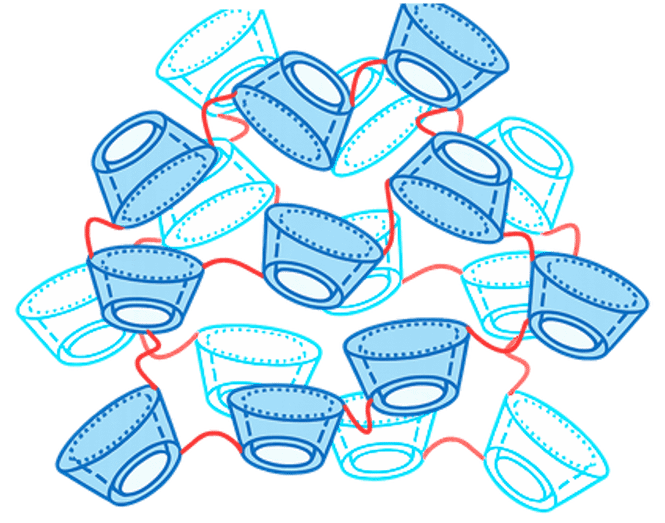
1. βCDP(β-シクロデキストリンポリマー)
日本語:β-シクロデキストリンの分子を取り込む空洞と、高分子の丈夫さや加工性を組み合わせた材料です。分離、検出、環境浄化などに応用できます。
English: A polymer platform combining the molecular cavities of β-cyclodextrin with the durability and processability of polymer materials.
2. ホスト・ゲスト相互作用(Host–Guest Interaction)
日本語:空洞を持つ「ホスト」が、形や性質の合う「ゲスト」分子を選択的に取り込む仕組みです。目的物質を見分けて捕捉する機能の基盤になります。
English: A selective interaction in which a host cavity captures a compatible guest molecule, enabling molecular recognition and separation.
3. 分子インプリントポリマー(Molecularly Imprinted Polymer)
日本語:標的分子の形を鋳型として記憶させた高分子です。鍵穴のような認識部位を持ち、似た分子が混在する中から目的物質を選び出します。
English: A polymer molded around a target molecule to create selective, lock-and-key-like recognition sites.
4. 多孔質材料(Porous Material)
日本語:内部に微細な孔を多数持つ材料です。広い表面積を利用して、汚染物質の吸着や有用成分の回収を効率よく進めることができます。
English: A material containing many microscopic pores that provide a large surface area for adsorption, capture, and separation.
5. デュアル認識(Dual Recognition)
日本語:異なる二つの認識機構を組み合わせて標的を測る方法です。一つの仕組みだけの場合より、選択性や測定の信頼性を高められる可能性があります。
English: A sensing strategy that combines two recognition mechanisms to improve selectivity and analytical reliability.
日本語版
研究背景
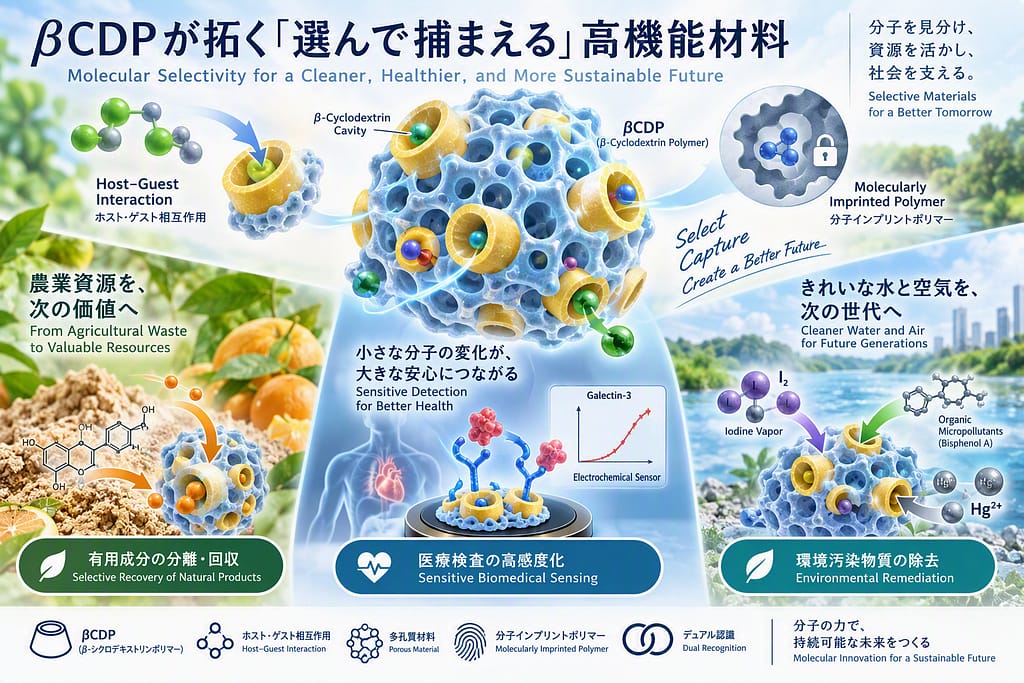
βCDPは、β-シクロデキストリンの環状空洞を高分子材料の中に組み込んだ機能性プラットフォームです。β-シクロデキストリンは、形や親水性・疎水性が合う分子を空洞へ取り込むことができます。この性質を高分子の網目や多孔質構造と組み合わせると、混合物の中から目的成分を選び、捕まえ、必要に応じて回収する材料を設計できます。
こうした材料は、農業副産物から有用成分を取り出す分離技術、病気に関係する物質を測るセンサー、水や空気中の汚染物質を除去する吸着材などへ展開されています。共通する目的は、単に多くの物質を吸着することではなく、分子の違いを見分けながら働くことです。
研究内容
1. 農業廃棄物からフラボノイドを選択的に回収
Construction of high affinity imprinted polymers interconnected with polyHIPEs for specific separation of flavonoids
- 農業廃棄物の複雑な混合物から、フラボノイドの一種であるナリンギンを選択的に分離する多孔質材料を開発しました。
- アクリロイル化β-シクロデキストリンと分子インプリントポリマーのホスト・ゲスト相互作用を利用し、認識部位を多孔質構造へ配置しました。
- 最大吸着量は40.63 μmol/gで、似た構造の物質よりナリンギンを優先して取り込みました。
- 6回使用した後も91.06%の性能を保ち、粗ナリンギンの純度を60%から93.45%へ高めました。
- 廃棄資源から有用な天然成分を回収する、再利用可能な分離材料としての可能性を示しています。
2. 心不全バイオマーカーを高感度に測定
Highly sensitive galectin-3 electrochemical sensor based on a dual-recognition interface of cyclodextrin-integrated molecularly imprinted polymers (MIPs) and an aptamer
- 心不全の進行評価に関係するガレクチン3を測定する電気化学センサーを開発しました。
- β-シクロデキストリンを組み込んだ分子インプリント材料と、標的に結合するアプタマーを組み合わせた二重認識方式です。
- 0.1~80 ng/mLの範囲で測定でき、検出限界は0.1 ng/mLでした。
- 他の成分による妨害を抑え、処理した血清試料でもガレクチン3を検出しました。
- 将来、心不全の重症度評価や治療経過の確認を支える分析技術へ発展する可能性があります。
3. 複数の環境汚染物質を一つの材料で除去
Thioether Cyclodextrin-Incorporated Triazine-Based Porous Organic Polymer for Uptake of Iodine Vapor and Adsorption of Organic Micropollutants and Hg2+ from Water
- チオエーテル修飾シクロデキストリンとトリアジンから、多機能な多孔質有機ポリマーを合成しました。
- シクロデキストリン空洞は有機微量汚染物質を捕捉し、硫黄を含む部位は水銀イオンとの結合に働きます。
- ヨウ素蒸気を1.70 g/g取り込み、ビスフェノールAには最大181.16 mg/g、水銀イオンには最大45.25 mg/gの吸着量を示しました。
- 河川水を想定した条件でも、低濃度のビスフェノールAと水銀イオンを同時に除去する可能性が示されました。
- 再利用性も確認され、異なる種類の汚染物質に対応する吸着材として期待されます。
期待される応用
三つの研究は、βCDPが「高分子の中に分子サイズの選別機能を組み込む」ための有力な基盤であることを示しています。多孔質構造で接触面積を増やし、分子インプリントで標的の形を記憶し、アプタマーや硫黄含有部位を加えることで、目的に応じた選択性を設計できます。
この考え方は、食品・農業資源からの有用成分回収、医療検査の高感度化、水や空気の浄化に共通して利用できます。今後は、実際の試料に含まれる多様な成分への対応、長期間使用した際の安定性、量産方法や安全性の検証が進むことで、循環型生産、身近な健康管理、環境負荷低減を支える材料へ発展することが期待されます。
English Version
βCDP as a Selective Platform for Separation, Sensing, and Environmental Remediation
Research Background
βCDP integrates the molecular cavities of β-cyclodextrin into functional polymer structures. These cavities can capture guest molecules according to their size and chemical character. When combined with porous networks, molecular imprinting, or additional recognition groups, the resulting materials can distinguish targets within complex mixtures rather than simply adsorbing everything around them.
This molecular selectivity is being explored in resource recovery, biomedical sensing, and environmental cleanup. The three studies below demonstrate how a common cyclodextrin-based concept can be adapted to very different practical challenges.
Research Highlights
1. Selective Recovery of a Flavonoid from Agricultural Waste
- A porous molecularly imprinted material was developed to separate naringin from complex agricultural-waste mixtures.
- Host–guest interactions involving acryloyl-β-cyclodextrin helped organize selective recognition sites throughout the porous structure.
- The material achieved a maximum adsorption capacity of 40.63 μmol/g and preferentially captured naringin over related compounds.
- It retained 91.06% performance after six cycles and increased crude naringin purity from 60% to 93.45%.
- The system offers a reusable approach for recovering valuable natural products from waste resources.
2. Sensitive Detection of a Heart-Failure Biomarker
- An electrochemical sensor was designed for galectin-3, a biomarker associated with heart-failure progression.
- The sensing interface combined a cyclodextrin-integrated molecularly imprinted polymer with an aptamer signal probe.
- The dual-recognition system measured 0.1–80 ng/mL and reached a detection limit of 0.1 ng/mL.
- Galectin-3 was detected in processed serum samples with high selectivity and limited interference.
- The platform may support future tools for prognosis assessment and treatment monitoring.
3. One Porous Polymer for Multiple Environmental Pollutants
- A thioether cyclodextrin-containing triazine porous organic polymer was prepared as a multifunctional adsorbent.
- Cyclodextrin cavities captured organic micropollutants, while sulfur-containing groups coordinated mercury ions.
- The material adsorbed 1.70 g/g of iodine vapor, up to 181.16 mg/g of bisphenol A, and up to 45.25 mg/g of Hg2+.
- It showed potential for simultaneous removal of low concentrations of bisphenol A and mercury from river water.
- Reusability further supports its potential as a versatile environmental adsorbent.
Potential Applications
These studies show that βCDP is a flexible platform for placing molecular-scale recognition inside robust polymer materials. Porosity increases contact area, imprinting introduces shape-selective sites, and complementary components such as aptamers or sulfur groups add further specificity.
The same design principle may support sustainable recovery of useful food and agricultural compounds, sensitive medical testing, and removal of pollutants from water and air. Future development will require validation in diverse real-world samples, long-term durability testing, scalable manufacturing, and appropriate safety assessment.
References / 文献
- Zhang, X.; Wang, B.; Bai, B.; Lu, R.; Liu, S. Construction of high affinity imprinted polymers interconnected with polyHIPEs for specific separation of flavonoids. Chemical Engineering Science 338 (2027), 124932. DOI: 10.1016/j.ces.2026.124932
- Liu, J.; Duan, X.; Wu, Z.; et al. Thioether Cyclodextrin-Incorporated Triazine-Based Porous Organic Polymer for Uptake of Iodine Vapor and Adsorption of Organic Micropollutants and Hg2+ from Water. ACS Applied Polymer Materials (2026). DOI: 10.1021/acsapm.6c02450
- Longsompurana, P.; Poo-arporn, Y.; Rungrotmongkol, T.; Wolschann, P.; Poo-arporn, R. P. Highly sensitive galectin-3 electrochemical sensor based on a dual-recognition interface of cyclodextrin-integrated molecularly imprinted polymers (MIPs) and an aptamer. Biosensors and Bioelectronics 313 (2026), 119157. DOI: 10.1016/j.bios.2026.119157