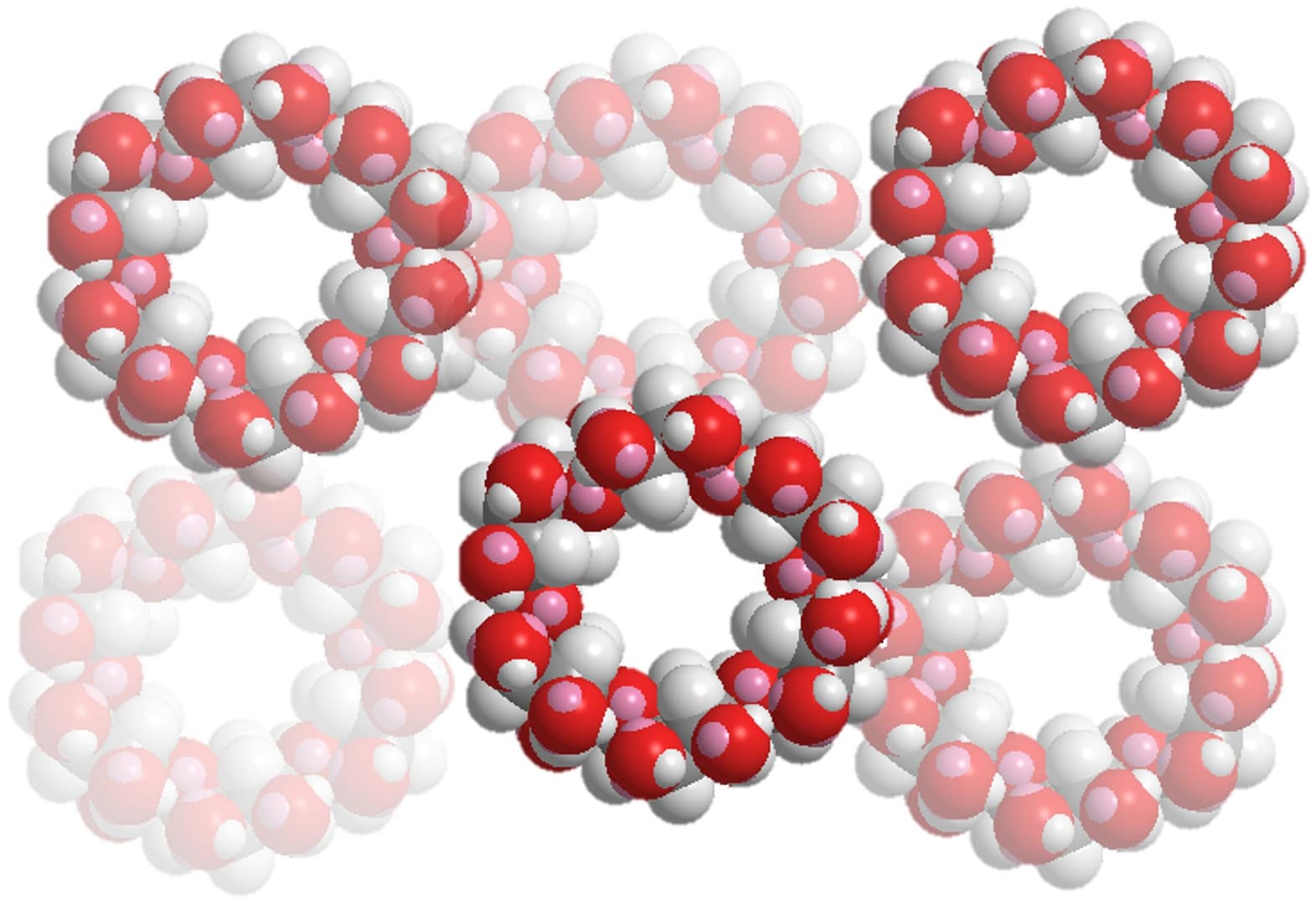
α-Cyclodextrin Polymer: Ring-Shaped Molecules Opening New Possibilities in Adsorption, Separation, and Materials Design
キーワード / Keywords
-
α-シクロデキストリンポリマー / α-Cyclodextrin Polymer
α-シクロデキストリンを含む、または関連する環状糖を高分子化した材料です。分子を包み込む空洞をもち、水浄化や分離、機能材料に応用されます。
EN: A polymeric material containing α-cyclodextrin or related cyclic sugars. Its molecular cavities can capture guest molecules for water purification, separation, and functional materials. -
包接複合体 / Inclusion Complex
シクロデキストリンの空洞に、別の分子が入り込んだ状態です。これにより、におい、薬、汚染物質、分析用分子などの性質を変えられます。
EN: A state in which another molecule enters a cyclodextrin cavity. This can change the behavior of odors, drugs, pollutants, and analytical probe molecules. -
ポリシクロデキストリンナノファイバー / Polycyclodextrin Nanofiber
シクロデキストリンを高分子状に組み上げた細い繊維材料です。分子を選んで捕まえる吸着材や、分離膜のような界面材料として期待されます。
EN: A fiber-like polymer material made from cyclodextrins. It is promising as a size-selective adsorbent and functional interface for molecular separation. -
ポリロタキサン / Polyrotaxane
ひも状高分子に多数の環状分子が通った構造です。輪の位置や動きが変わることで、ゲルや固体材料の高次構造と性質を調整できます。
EN: A structure in which many ring molecules are threaded onto a polymer chain. Ring position and mobility can tune the higher-order structure and properties of gels and solids. -
ESR分光法 / ESR Spectroscopy
電子スピンをもつ分子を目印にして、分子の周囲の環境や動きを調べる方法です。包接のしやすさや空洞内の状態を知る手がかりになります。
EN: A method that uses spin-labeled molecules to probe local environments and motion. It helps reveal how guest molecules behave inside cyclodextrin cavities.
採用した3本 / Three Selected Papers
-
Progress in Polymer Science(JIF 32.8)
Cyclodextrin-based polymer materials and their applications – A review covering a 20-year period
DOI: 10.1016/j.progpolymsci.2026.102149 -
Journal of Physical Chemistry B(JIF 3.2)
Probing Inclusion Complexation Mechanisms in Polycyclodextrin Nanofibers via ESR Spectroscopy
DOI: 10.1021/acs.jpcb.6c02249 -
New Journal of Chemistry(JIF 2.6)
Hierarchical effects of cyclodextrin ring positioning in triblock-copolymer polyrotaxanes on microphase-separated structures
DOI: 10.1039/d6nj01334a
日本語版
1. シクロデキストリンポリマー材料の20年を見渡す総説
論文: Cyclodextrin-based polymer materials and their applications – A review covering a 20-year period
掲載誌: Progress in Polymer Science
DOI: 10.1016/j.progpolymsci.2026.102149
- この総説は、シクロデキストリンを使った高分子材料の発展を、約20年の研究動向として整理しています。
- シクロデキストリンは、かつては水に溶けにくい分子を溶かす補助剤として使われることが多い材料でした。
- 現在では、包接複合体をつくる能力を活かし、高分子、ハイドロゲル、ナノスポンジ、繊維、金属有機構造体など、多様な材料へ広がっています。
- この総説では、化学設計だけでなく、物理化学的性質、形態、力学特性、最終的な材料性能までつなげて解説しています。
- 応用先は、医薬、環境浄化、材料工学、食品、分析化学など幅広く、シクロデキストリンが単なる添加剤ではなく“機能をもつ材料部品”になっていることが示されています。
- また、持続可能性、ライフサイクル評価、AIを使った材料設計、産業化や規制面の課題も取り上げられています。
- 一般向けに言えば、「分子を包む小さな輪を、高分子材料としてどう社会に役立てるか」を大きく見渡す総説です。
2. ポリシクロデキストリンナノファイバーの“分子を捕まえる仕組み”をESRで見る
論文: Probing Inclusion Complexation Mechanisms in Polycyclodextrin Nanofibers via ESR Spectroscopy
掲載誌: Journal of Physical Chemistry B
DOI: 10.1021/acs.jpcb.6c02249
- この研究は、ポリシクロデキストリンナノファイバーがゲスト分子をどのように包接するかを、電子スピン共鳴(ESR)分光法で調べたものです。
- 対象には、ヒドロキシプロピル化されたα、β、γシクロデキストリン由来のナノファイバーが含まれています。
- TEMPOとDTBNというスピンラベル分子を使い、シクロデキストリン空洞の大きさが包接のしやすさにどう影響するかを比較しました。
- β-CD系ナノファイバーは2種類のプローブをよく取り込み、γ-CD系がそれに続きました。
- 一方、α-CD系ナノファイバーではTEMPOの取り込みはごく少なく、DTBNの取り込みも比較的限られていました。
- つまり、シクロデキストリンの“穴の大きさ”が、どの分子を捕まえやすいかを大きく左右することが示されています。
- 一般向けに言えば、「分子サイズに合う穴を持つ材料ほど、目的分子をうまく捕まえられる」ことを、精密な分光法で確かめた研究です。
3. ポリロタキサンの輪の位置が、固体材料の並び方を変える
論文: Hierarchical effects of cyclodextrin ring positioning in triblock-copolymer polyrotaxanes on microphase-separated structures
掲載誌: New Journal of Chemistry
DOI: 10.1039/d6nj01334a
- この研究では、トリブロック共重合体にシクロデキストリン環が通ったポリロタキサンを合成し、環の位置が固体中の構造形成にどう影響するかを調べています。
- ポリロタキサンでは、環状分子が高分子軸の上を動くため、分子レベルの配置が高次構造に波及します。
- 溶液中で水を加えると、シクロデキストリン環が高分子鎖上のどこに集まるかが変化しました。
- 疎水性部分を十分に覆える場合は、環がその部分を選んで集まりました。
- すべてを覆えない場合は、疎水性部分がミセル状に集まり、環は周辺の親水性鎖へ移動しました。
- この溶液中の環の位置の違いが、乾かしてできる固体中の規則構造にも影響しました。
- 一般向けに言えば、「分子の輪がどこにいるか」が、最終的な材料の並び方や性質まで変えることを示した研究です。
まとめ
今回の3本から、α-cyclodextrin polymerというテーマは、単一の材料を指すだけでなく、シクロデキストリンの環状構造を高分子材料に組み込む考え方全体へ広がっていることがわかります。総説は分野全体の地図を示し、ESR研究はナノファイバーの包接機構を分子レベルで明らかにし、ポリロタキサン研究は環の位置が高次構造へ波及することを示しています。共通する鍵は、“分子を包む小さな輪”を材料設計にどう活かすかです。
English Version
1. A 20-year overview of cyclodextrin-based polymer materials
Paper: Cyclodextrin-based polymer materials and their applications – A review covering a 20-year period
Journal: Progress in Polymer Science
DOI: 10.1016/j.progpolymsci.2026.102149
- This review summarizes about two decades of research on cyclodextrin-based polymer materials.
- Cyclodextrins were once mainly used as solubilizing agents for poorly soluble molecules.
- They are now used as functional building blocks in polymers, hydrogels, nanosponges, fibers, and newer materials such as metal-organic frameworks.
- The review connects chemical design with physicochemical, morphological, mechanical, and performance-related properties.
- Applications span pharmaceutics, environmental engineering, materials science, food technology, and analytical chemistry.
- The review also discusses sustainability, life-cycle assessment, AI-assisted material design, regulatory issues, and industrial scalability.
- In simple terms, this paper shows how small molecular rings can become active components of practical polymer materials.
2. Probing how polycyclodextrin nanofibers capture guest molecules
Paper: Probing Inclusion Complexation Mechanisms in Polycyclodextrin Nanofibers via ESR Spectroscopy
Journal: Journal of Physical Chemistry B
DOI: 10.1021/acs.jpcb.6c02249
- This study uses electron spin resonance spectroscopy to investigate host-guest interactions in polycyclodextrin nanofibers.
- Nanofibers based on hydroxypropyl α-, β-, and γ-cyclodextrins were compared.
- TEMPO and DTBN spin probes were used to test how cyclodextrin cavity size affects inclusion behavior.
- β-CD-based nanofibers accommodated both probes most effectively, followed by γ-CD systems.
- α-CD-based nanofibers showed negligible TEMPO uptake and relatively low DTBN uptake.
- The results show that cavity size strongly influences binding affinity and molecular retention.
- For general readers, this means that the “hole size” of cyclodextrin-based materials helps determine which molecules they can capture.
3. How ring positioning in polyrotaxanes affects higher-order structure
Paper: Hierarchical effects of cyclodextrin ring positioning in triblock-copolymer polyrotaxanes on microphase-separated structures
Journal: New Journal of Chemistry
DOI: 10.1039/d6nj01334a
- This study examines triblock-copolymer polyrotaxanes in which cyclodextrin rings are threaded onto polymer chains.
- In polyrotaxanes, ring molecules can move along the polymer axis, so molecular-scale positioning can influence larger structures.
- Adding water to the solution changed where cyclodextrin rings were located along the polymer chain.
- When the rings could fully cover the hydrophobic PPO segment, they preferentially occupied that region.
- When full coverage was not possible, the PPO segments formed micelles and the rings shifted toward neighboring PEO chains.
- These solution-state ring positions influenced the ordered structures formed after solvent casting.
- In simple terms, where molecular rings sit on a polymer chain can affect how the final solid material organizes.
Overall Takeaway
The three selected papers show α-cyclodextrin polymer-related science at different scales. The review provides a broad map of cyclodextrin polymer materials and their applications. The ESR study reveals how nanofiber cavities capture molecules at the nanoscale. The polyrotaxane study shows how ring mobility and positioning can influence larger self-assembled structures. Across all cases, the central idea is the same: small molecular rings become powerful tools for designing functional polymer materials.
文献 / References
- Crini, G.; Lacalamita, D.; Liu, C.; Fourmentin, M.; Kfoury, M.; Mongioví, C.; Fourmentin, S.; Morin-Crini, N. Cyclodextrin-based polymer materials and their applications – A review covering a 20-year period. Progress in Polymer Science 179 (2026), 102149. DOI: 10.1016/j.progpolymsci.2026.102149.
- Aboelkheir, M.; Dzikovski, B.; Uyar, T. Probing Inclusion Complexation Mechanisms in Polycyclodextrin Nanofibers via ESR Spectroscopy. Journal of Physical Chemistry B 130 (2026), 6996–7007. DOI: 10.1021/acs.jpcb.6c02249.
- Uenuma, S.; Yokoyama, H.; Ito, K. Hierarchical effects of cyclodextrin ring positioning in triblock-copolymer polyrotaxanes on microphase-separated structures. New Journal of Chemistry 50 (2026). DOI: 10.1039/d6nj01334a.
選定メモ / Selection Note
- Progress in Polymer Science:JIF 32.8(2025データ、2026更新値)
- Journal of Physical Chemistry B:JIF 3.2(2025データ、2026更新値)
- New Journal of Chemistry:JIF 2.6(2025データ、2026更新値)
本稿では、添付ファイル内に含まれる3本を、ジャーナル指標の高い順に並べました。なお3本目はβ-シクロデキストリンを用いたポリロタキサン研究ですが、添付ファイル名の「α-cyclodextrin polymer」に関連する広義のシクロデキストリンポリマー材料として扱いました。