キーワード / Keywords
1. エネルギー移動(Energy Transfer)
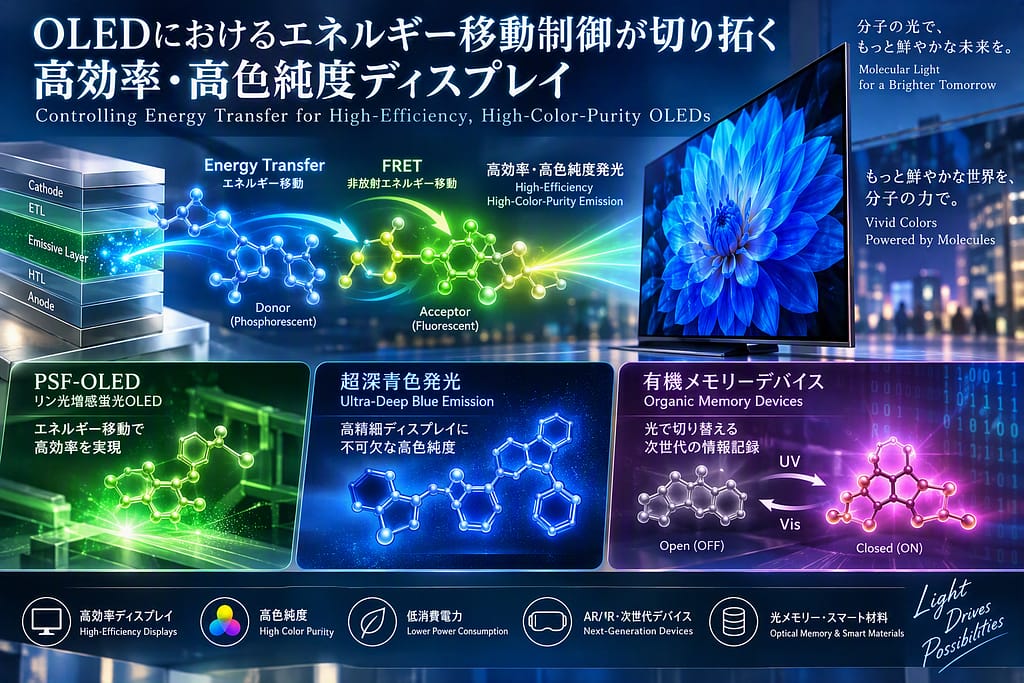
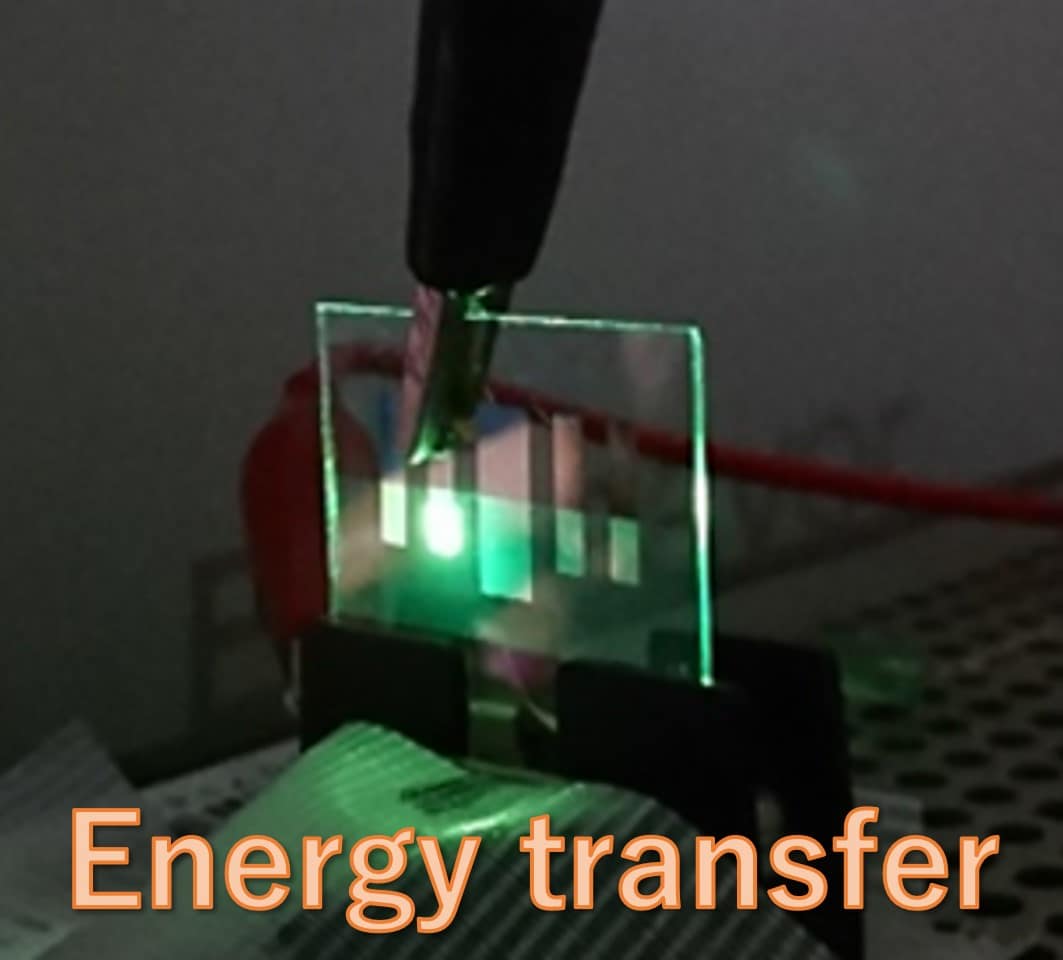
日本語: OLED内部で発生した励起エネルギーを発光分子へ効率よく運ぶ仕組みです。発光効率や寿命を左右する重要な要素です。
English: A process that transfers excitonic energy to emissive molecules, strongly influencing OLED efficiency and stability.
2. FRET(Förster Resonance Energy Transfer)
日本語: 分子間で非接触にエネルギーを受け渡す現象です。高効率OLEDやセンシング技術の基盤として利用されています。
English: A non-radiative energy transfer mechanism widely used to improve device performance.
3. PSF-OLED
日本語: リン光増感蛍光OLEDです。リン光材料から蛍光材料へエネルギー移動を行い、高色純度発光を実現します。
English: Phosphorescence-sensitized fluorescence OLEDs utilize phosphors to sensitize fluorescent emitters.
4. 超深青色発光(Ultra-Deep Blue Emission)
日本語: 高精細ディスプレイに不可欠な発光技術です。鮮やかな青色表現と低消費電力化が期待されています。
English: A critical technology for advanced displays requiring high color purity and efficiency.
5. 有機メモリーデバイス(Organic Memory Devices)
日本語: 光による分子状態変化を利用して情報を記録する技術です。次世代分子エレクトロニクスとして注目されています。
English: Devices that use molecular switching phenomena for optical information storage.
日本語版
研究背景
OLED(有機発光ダイオード)の高性能化には、分子間でどのようにエネルギーが移動するかを精密に制御することが重要です。近年は高色純度発光、高効率化、長寿命化を実現するために、発光分子・増感剤・ホスト材料の相互作用が活発に研究されています。
研究内容
1. PSF-OLEDにおける高効率化戦略
Strategies for Enhancing Efficiency and Operational Stability in Green Phosphorescence-Sensitized Fluorescence (PSF) Organic Light-Emitting Diode (OLED) Technology
- PSF-OLEDの発光効率向上メカニズムを整理した総説。
- FRET効率を高める分子設計やスペクトル重なりの重要性を解説。
- 励起子利用効率向上のための二重エネルギー移動経路を紹介。
- 高効率化と長寿命化を両立する設計指針を提示。
2. 超深青色OLED発光体の開発
Locked phenocarbazole/oxadiazole emitters for ultra-deep-blue OLEDs with CIEy below 0.05
- 剛直なフェノカルバゾール骨格を利用した新規発光体を設計。
- 超深青色発光と高い色純度を実現。
- 分子間凝集や不要な電荷移動を抑制。
- 高精細ディスプレイ向け発光材料として期待される。
3. 光応答型有機メモリーデバイス
Unsymmetric Benzo[b]phosphole-Fused Diarylethenes: From Enhanced Photochromic Behavior to Solution-Processable Photoswitchable Organic Resistive Memory Devices
- 光によって状態を切り替えられるジアリールエテン誘導体を開発。
- 発光特性と電気特性を同時に制御可能。
- 有機抵抗メモリーデバイスへの応用を実証。
- 光情報記録や分子電子デバイスへの展開が期待される。
期待される応用
これらの研究は、OLEDにおけるエネルギー移動の理解と制御が、高効率ディスプレイだけでなく、光メモリーやスマート材料開発にもつながることを示しています。今後はAR/VR、高精細ディスプレイ、低消費電力デバイスなど幅広い分野での応用が期待されます。
English Version
Energy Transfer Strategies for High-Performance OLED Technologies
Research Background
Precise control of energy transfer is essential for improving OLED efficiency, color purity, and operational lifetime. Recent studies focus on optimizing interactions among hosts, sensitizers, and emitters.
Research Highlights
1. High-Efficiency PSF OLEDs
- Reviewed key design strategies for phosphorescence-sensitized fluorescence OLEDs.
- Highlighted the importance of efficient FRET processes.
- Proposed approaches for improved exciton utilization and device stability.
2. Ultra-Deep Blue OLED Emitters
- Developed rigid donor–acceptor emitters with ultra-deep-blue emission.
- Achieved excellent color purity and thermal stability.
- Demonstrated suitability for next-generation display applications.
3. Photoswitchable Organic Memory Devices
- Designed diarylethene-based photoswitchable materials.
- Enabled optical control of electronic states.
- Demonstrated potential for optical memory and molecular electronics.
Overall Significance
Together, these studies demonstrate how energy-transfer engineering can improve OLED performance while enabling new optoelectronic functions. Their impact extends beyond displays into information storage and smart materials.
References / 文献
- Kumar OP et al. Strategies for Enhancing Efficiency and Operational Stability in Green Phosphorescence-Sensitized Fluorescence (PSF) Organic Light-Emitting Diode (OLED) Technology. Small (2026).
- Zhang D et al. Locked phenocarbazole/oxadiazole emitters for ultra-deep-blue OLEDs with CIEy below 0.05. Dyes and Pigments (2027). DOI: 10.1016/j.dyepig.2026.114118
- Jia K et al. Unsymmetric Benzo[b]phosphole-Fused Diarylethenes: From Enhanced Photochromic Behavior to Solution-Processable Photoswitchable Organic Resistive Memory Devices. Journal of the American Chemical Society (2026). DOI: 10.1021/jacs.6c10849