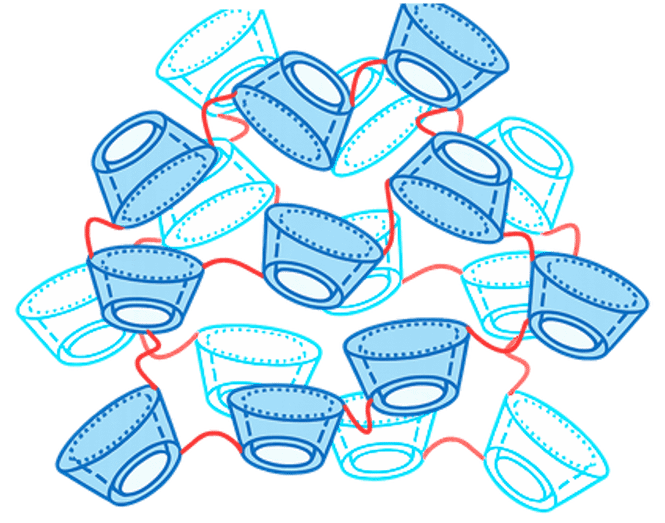
キーワード / Keywords
1. β-シクロデキストリンポリマー(β-Cyclodextrin Polymer)
日本語: 分子を取り込む環状構造を高分子材料に組み込んだ機能性素材です。イオン移動、分子放出、接着など、用途に応じた働きを材料へ与えられます。
English: A functional material that incorporates molecular cavities into a polymer network to control ion transport, molecular release, adhesion, and related properties.
2. ホスト・ゲスト相互作用(Host–Guest Interaction)
日本語: シクロデキストリンの空洞が、形や性質の合う分子を選択的に取り込む仕組みです。可逆的な結合を利用して、材料の強度や放出速度を調整できます。
English: A reversible interaction in which a cyclodextrin cavity accommodates a compatible guest molecule, enabling control of strength, stability, and release.
3. 固体亜鉛イオン電池(Solid-State Zinc-Ion Battery)
日本語: 固体電解質中を亜鉛イオンが移動する蓄電池です。安全性が期待される一方、イオン伝導と亜鉛の樹枝状析出を適切に制御する必要があります。
English: A battery in which zinc ions move through a solid electrolyte, requiring efficient ion conduction and suppression of dendritic zinc growth.
4. 超分子バインダー(Supramolecular Binder)
日本語: 可逆的な分子間相互作用で電極粒子を結び付ける材料です。充放電で膨張するシリコンを支え、電極構造の崩れを抑える働きが期待されます。
English: A binder using reversible molecular interactions to hold electrode particles together and accommodate expansion during battery cycling.
5. 生分解性アクティブ包装(Biodegradable Active Packaging)
日本語: 使用後に分解しやすい高分子へ、抗酸化成分などの機能を加えた包装材料です。内容物を保護しながら、環境負荷の低減を目指します。
English: Packaging that combines biodegradable polymers with active functions such as antioxidant release to protect products and reduce environmental impact.
日本語版
研究背景
β-シクロデキストリンは、中央に分子サイズの空洞を持つ環状オリゴ糖です。この空洞へ特定の分子を取り込む性質を高分子材料と組み合わせると、分子やイオンの移動、材料同士の結び付き、有効成分の放出を調整できます。こうしたβ-シクロデキストリンポリマーは、単に成分を包むだけでなく、材料全体の構造と機能を設計するための要素として研究されています。
ここでは、固体亜鉛イオン電池の電解質、シリコン負極を支えるバインダー、生分解性のアクティブ包装材を紹介します。三つの研究に共通するのは、分子レベルの相互作用を、電池の安定性や包装材の放出特性といった目に見える性能へつなげている点です。
研究内容
1. 多孔質ポリマーで亜鉛イオンを効率よく運ぶ
Cyclodextrin-derived porous polymer enables efficient zinc-ion conduction toward stable solid-state zinc-ion batteries
- β-シクロデキストリンとテトラフルオロテレフタロニトリルを架橋し、三次元多孔質ポリマーCN-CDPを合成しました。
- CN-CDPをポリフッ化ビニリデンへ混合し、固体高分子電解質を作製しました。
- 多孔質構造と化学的な相互作用により、亜鉛イオンが移動するときの障壁を低減しました。
- 室温で6.7 × 10⁻⁴ S/cmのイオン伝導度と、0.80の亜鉛イオン輸率を示しました。
- 亜鉛を特定の結晶面に沿って均一に析出させ、短絡の原因となる樹枝状成長を抑えました。
- 対称電池は2 mA/cm²で2000時間、5 mA/cm²で1400時間の安定した充放電を示しました。
- 計算化学と分子シミュレーションを用いて、イオン輸送と析出制御の仕組みを解析しました。
2. わずかな分子構造の違いでシリコン負極の寿命を改善
Enhancing the stability of silicon anodes using polymer binders based on host-guest and hydrogen-bonding interactions: Do small changes in guest tether length matter?
- 充放電時に大きく膨張するシリコン負極を支えるため、β-シクロデキストリンポリマーを含む超分子バインダーを設計しました。
- アダマンタンを持つ二種類の高分子を用い、β-シクロデキストリンとのホスト・ゲスト結合と水素結合を組み合わせました。
- アダマンタンをつなぐ部分がエチル基かプロピル基かという小さな違いを比較しました。
- プロピル鎖を持つ材料は、シクロデキストリン空洞の近くでより安定した相互作用を形成しました。
- 200回の充放電後、プロピル型バインダーの負極は2575 mAh/gの容量と69%の容量維持率を示しました。
- エチル型では1007 mAh/g、29%、比較用材料では624 mAh/g、18%でした。
- 小さな分子設計の違いが、電極全体の機械的安定性と充放電寿命を大きく左右することが示されました。
3. 抗酸化成分をゆっくり放出する生分解性発泡材料
Supercritical CO₂-assisted processing of PLA/PBAT blends with β-cyclodextrin/caffeic acid inclusion complexes: Mass transport modeling and disintegration
- 生分解性高分子PLAとPBATを用い、超臨界二酸化炭素による含浸と発泡を順番に行いました。
- 抗酸化成分のカフェ酸をβ-シクロデキストリンへ包接し、複合発泡体へ組み込みました。
- ペレットから発泡体までの工程で高分子が劣化していないかを、固有粘度や機械試験で確認しました。
- 発泡体内部の細胞構造と曲がりくねった移動経路が、カフェ酸の拡散を遅らせました。
- 大きな包接複合体も移動の障壁となり、平衡に達するまでの時間を約200時間まで延長しました。
- 三次元の多孔構造にも既存の物質移動モデルを適用でき、放出挙動を説明できました。
- 材料は抗酸化活性を示し、管理された堆肥化条件では構造とPBAT量に応じた崩壊挙動を示しました。
研究全体の意義
これらの研究は、β-シクロデキストリンポリマーが、異なるスケールの材料課題を解決できることを示しています。固体電解質ではナノメートル規模の孔と官能基が亜鉛イオンを導きます。電極バインダーでは可逆的な分子結合が、シリコンの大きな体積変化を受け止めます。包装材料では包接複合体と発泡構造が、有効成分の移動速度を調節します。
今後は、電池セルや包装材を大型化した際の均一性、長期間使用したときの劣化、製造工程の再現性、使用後の回収や分解挙動を確認することが重要です。分子の空洞、結合、孔構造を一体的に設計する考え方は、エネルギー貯蔵と持続可能な材料の両分野で応用の広がりが期待されます。
English Version
β-Cyclodextrin Polymers in Materials Design: Applications in Batteries and Sustainable Packaging
Introduction
β-Cyclodextrin is a cyclic oligosaccharide containing a molecular-scale cavity. When this host cavity is incorporated into a polymer, it can regulate molecular and ionic transport, reversible bonding, and release of active compounds. β-Cyclodextrin polymers are therefore being developed not simply as encapsulating materials, but as structural components that connect molecular interactions with macroscopic performance.
The studies highlighted here address a solid electrolyte for zinc-ion batteries, a supramolecular binder for silicon anodes, and a biodegradable active-packaging foam. Each study translates molecular-level recognition or transport into improved stability, controlled release, or mechanical durability.
Research Highlights
1. A Porous Polymer for Efficient Zinc-Ion Conduction
- A three-dimensional porous polymer, CN-CDP, was synthesized by cross-linking β-cyclodextrin with tetrafluoroterephthalonitrile.
- CN-CDP was incorporated into polyvinylidene fluoride to form a solid polymer electrolyte.
- Its porous structure and chemical interactions lowered the barrier to zinc-ion migration.
- The electrolyte achieved an ionic conductivity of 6.7 × 10⁻⁴ S/cm and a zinc-ion transference number of 0.80 at room temperature.
- It guided uniform zinc deposition along a preferred crystal plane and suppressed dendritic growth.
- Symmetric cells cycled stably for 2000 hours at 2 mA/cm² and 1400 hours at 5 mA/cm².
- Computational calculations and molecular simulations were used to clarify the transport and deposition mechanisms.
2. Small Molecular Changes Improve Silicon-Anode Stability
- A supramolecular binder containing a β-cyclodextrin polymer was designed to support silicon anodes during large volume changes.
- Two adamantane-bearing polymers combined host–guest association with hydrogen bonding.
- The study compared a small structural difference: an ethyl or propyl tether connecting the guest group.
- The propyl-tethered material formed more effective interactions near the cyclodextrin cavity.
- After 200 charge–discharge cycles, the propyl system delivered 2575 mAh/g with 69% capacity retention.
- The ethyl system delivered 1007 mAh/g with 29% retention, while the comparison binder delivered 624 mAh/g with 18% retention.
- The results show that a minimal difference in molecular architecture can strongly influence electrode durability.
3. Biodegradable Foams with Controlled Antioxidant Release
- Biodegradable PLA/PBAT blends were processed by sequential supercritical-carbon-dioxide impregnation and foaming.
- Caffeic acid was included within β-cyclodextrin and incorporated as an active antioxidant component.
- Intrinsic viscosity and mechanical testing were used to monitor polymer integrity during processing.
- Cellular morphology and tortuous transport pathways slowed caffeic-acid diffusion through the foam.
- The bulky inclusion complex also acted as a transport barrier, extending equilibrium times to approximately 200 hours.
- A mass-transport model originally developed for dense materials successfully described release in the three-dimensional porous structures.
- The foams showed antioxidant activity and disintegration behavior under controlled composting conditions that depended on cellular morphology and PBAT content.
Overall Significance
Together, these studies demonstrate how β-cyclodextrin polymers can address material challenges across different length scales. In solid electrolytes, nanoscale pores and chemical groups guide zinc ions. In electrode binders, reversible molecular associations accommodate silicon expansion. In active packaging, inclusion complexes and porous architecture regulate the migration of an antioxidant molecule.
Further development should evaluate uniformity during scale-up, long-term degradation, manufacturing reproducibility, and end-of-life recovery or disintegration. The integrated design of molecular cavities, reversible bonds, and porous structures offers a versatile route toward advanced energy-storage and sustainable-material systems.
References / 文献
- Li, Y.; Zhao, J.; Guo, H.; et al. Cyclodextrin-derived porous polymer enables efficient zinc-ion conduction toward stable solid-state zinc-ion batteries. Chemical Engineering Journal 547 (2026), 181226. DOI: 10.1016/j.cej.2026.181226
- Rivera, P.; Torres, A.; Pacheco, M.; et al. Supercritical CO₂-assisted processing of PLA/PBAT blends with β-cyclodextrin/caffeic acid inclusion complexes: Mass transport modeling and disintegration. Journal of CO₂ Utilization 112 (2026), 103549. DOI: 10.1016/j.jcou.2026.103549
- Martin-Trasancos, R.; Montero-Alejo, A. L.; Ortiz, M. G.; et al. Enhancing the stability of silicon anodes using polymer binders based on host-guest and hydrogen-bonding interactions: Do small changes in guest tether length matter? European Polymer Journal 257 (2026), 115056. DOI: 10.1016/j.eurpolymj.2026.115056