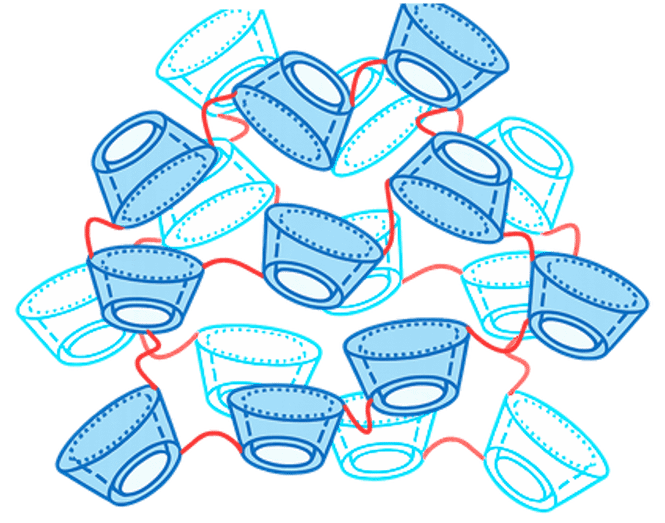
β-Cyclodextrin Polymers — A 3‑paper guide to what’s happening now
キーワード(Keywords)
- 包接(Inclusion):β-CDの“空洞”が分子を抱え込み、溶けにくい物質を扱いやすくする基本原理。
- EN: β‑CD’s cavity hosts guest molecules, improving handling of poorly soluble or unstable compounds.
- ホスト–ゲスト相互作用(Host–Guest):鍵と鍵穴のような結合で、選択的な捕捉・放出を設計できる。
- EN: Selective binding like a “lock‑and‑key” enables designed capture and release.
- 多孔質・吸着(Porosity/Adsorption):汚染物質を“くっつけて取る”技術。表面積と相互作用が性能を左右。
- EN: Pollutants are removed by adsorption; surface area and interactions control performance.
- ハイドロゲル(Hydrogel):水を多く含む柔らかい材料。生体に近い質感で医療・センサに向く。
- EN: Water‑rich soft materials; tissue‑like mechanics suit biomedical devices and sensors.
- 刺激応答(Stimuli‑responsive):光・pH・力などで性質が変わる材料設計。必要な時だけ働かせられる。
- EN: Properties change with light/pH/force, enabling function only when and where needed.
選定した論文
1) 水中汚染物質を“選んで吸着”する材料設計:分子ホストから多孔質フレームワークへ
Porous materials for adsorption of aqueous pollutants: from discrete macrocyclic hosts to extended porous frameworks
- 掲載誌: Coordination Chemistry Reviews(Review)
- DOI: https://doi.org/10.1016/j.ccr.2026.217944
日本語(やさしい要点)
- β-シクロデキストリン等の「分子ホスト」は、汚染物質を“分子レベルで選んで”捕まえられる。
- MOF/COF/HOFのような“多孔質材料”は、表面積で大量に吸着できる。
- 本レビューは「容量(どれだけ取れるか)」と「選択性(何を取るか)」を両立する設計思想を整理。
- 重金属、有機汚染物質、PFASなど幅広い対象に対し、結合機構・速度・再生(繰り返し使用)を俯瞰。
English (Plain‑language points)
- Macrocyclic hosts (including cyclodextrins) add molecular selectivity for capturing pollutants.
- Porous frameworks (MOFs/COFs/HOFs) provide high capacity via large surface area and pores.
- The review organizes how capacity and binding affinity/selectivity can be co‑designed.
- Covers mechanisms, kinetics, and regeneration across heavy metals, organics, and PFAS.
2) 傷を“見守り・刺激し・薬を放つ”多機能ハイドロゲル:β-CD誘導体×相互貫入網目(IPN)
An anti-swelling ionic multifunctional hydrogel via interpenetrating network for wound monitoring, electrical electrostimulation, and drug release
- 掲載誌: Applied Materials Today(Article)
- DOI: https://doi.org/10.1016/j.apmt.2026.103222
日本語(やさしい要点)
- スマート創傷材で問題になりやすい「膨潤(ふくらみすぎ)」を抑えるため、IPN(網目を重ねる)を採用。
- β-CD誘導体を使い、イオン伝導性と“機能統合(見守る・刺激する・薬を放つ)”を同時に狙う。
- 形状保持と高い伸びを両立し、変形やpH変化を電気信号へ変換して創傷状態をモニタ。
- 動物試験で創傷閉鎖の促進が示され、医療デバイスとしての可能性を提示。
English (Plain‑language points)
- Uses an interpenetrating polymer network (IPN) to reduce excessive swelling in smart wound dressings.
- β‑CD derivatives help integrate ionic conductivity with sensing, stimulation, and drug release.
- Converts deformation and pH changes into electrical signals for real‑time wound monitoring.
- Animal studies suggest faster healing with combined stimulation and controlled release.
3) 光でNOを放出し、蛍光で“効いたか”を見える化:β-CD分岐ポリマー×抗がん剤の組合せ
Phototherapeutic β-Cyclodextrin-Branched Polymer Releasing Nitric Oxide with Fluorescent Self-Reporting and Its Combination with Doxorubicin
- 掲載誌: Biomacromolecules(Article / Early Access)
- DOI: https://doi.org/10.1021/acs.biomac.6c00462
日本語(やさしい要点)
- β-CD分岐ポリマーに、光で一酸化窒素(NO)を出す部位と、蛍光で状態を知らせる部位を組み込む。
- 青色光でNOが発生し、同時に蛍光が“回復”する仕組みで、細胞内での放出をその場観察。
- 抗がん剤ドキソルビシン(低用量)をポリマーに取り込み、光照射下で効果が高まる可能性を示す。
- 暗所では毒性が小さく、光でスイッチが入る“狙って効かせる”発想。
English (Plain‑language points)
- A β‑CD branched polymer integrates a light‑triggered NO donor and a fluorescent self‑reporter.
- Blue light releases NO while restoring fluorescence, enabling real‑time tracking in cells.
- Doxorubicin is entrapped; under irradiation, combined action can enhance cell killing.
- Low dark toxicity suggests an on‑demand phototherapy concept.
文献(References)
- Hou, B. et al. Coordination Chemistry Reviews (2026). Porous materials for adsorption of aqueous pollutants: from discrete macrocyclic hosts to extended porous frameworks. DOI: 10.1016/j.ccr.2026.217944
- Shen, J. et al. Applied Materials Today (2026). An anti-swelling ionic multifunctional hydrogel via interpenetrating network for wound monitoring, electrical electrostimulation, and drug release. DOI: 10.1016/j.apmt.2026.103222
- Perez‑Lloret, M. et al. Biomacromolecules (2026). Phototherapeutic β‑Cyclodextrin‑Branched Polymer Releasing Nitric Oxide with Fluorescent Self‑Reporting and Its Combination with Doxorubicin. DOI: 10.1021/acs.biomac.6c00462