キーワード / Keywords
1. γ-シクロデキストリン(γ-Cyclodextrin)
日本語: ブドウ糖が環状につながった分子で、比較的大きな空洞を持ちます。香気成分や発光分子などを取り込み、安定性や放出、分子集合を調整できます。
English: A cyclic glucose molecule with a relatively large cavity that can encapsulate aroma compounds, luminophores, and other guest molecules.
2. ホスト・ゲスト包接(Host–Guest Encapsulation)
日本語: 空洞を持つホスト分子が、形や性質の合うゲスト分子を取り込む仕組みです。分子を外部環境から守り、発光や香り、味の働きを制御します。
English: A molecular-recognition process in which a host cavity captures a compatible guest, protecting it and controlling emission, aroma, or taste-related behavior.
3. 室温リン光(Room-Temperature Phosphorescence)
日本語: 光を止めた後も残光が続く発光現象です。分子の動きや酸素による失活を抑えることが重要で、情報表示やセンサーへの応用が研究されています。
English: Persistent light emission after excitation has stopped, enabled by suppressing molecular motion and excited-state deactivation.
4. 甘味知覚調節(Sweetness Perception Regulation)
日本語: 香気成分や分子構造によって、同じ糖濃度でも甘さの感じ方を変える考え方です。砂糖を減らしつつ満足感を保つ食品設計に役立ちます。
English: Regulation of perceived sweetness through aroma compounds and molecular interactions, supporting reduced-sugar food design.
5. イオン移動度質量分析(Ion Mobility–Mass Spectrometry)
日本語: イオンが気体中を移動する速さと質量情報を組み合わせ、構造がよく似た分子を見分ける分析法です。食品成分の異性体分析に利用できます。
English: An analytical method combining gas-phase ion mobility and mass information to distinguish structurally similar molecules.
日本語版
研究背景
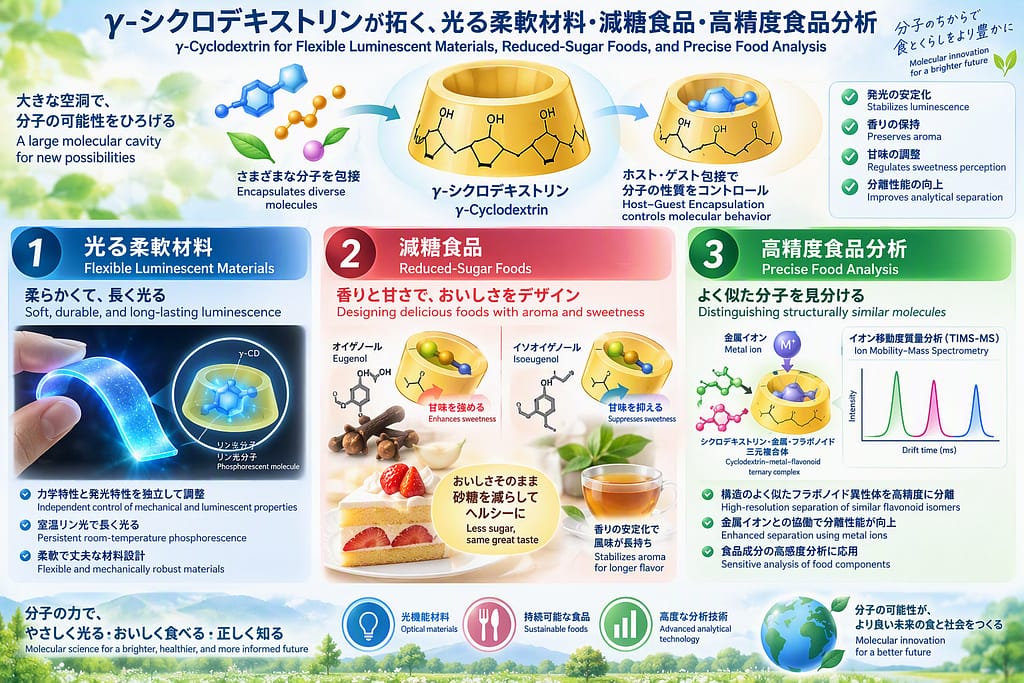
γ-シクロデキストリンは、シクロデキストリンの中でも大きな空洞を持ち、さまざまな分子を内部へ取り込めます。この包接によって、ゲスト分子の動きや周囲の環境が変わり、発光の持続、香りの安定性、味覚受容体との相互作用、分析時の分離性能などが調整されます。
今回紹介する研究は、柔軟で長く光る材料、香りと甘味を組み合わせた減糖食品設計、構造のよく似たフラボノイド異性体の分析を扱っています。分野は異なりますが、いずれもγ-シクロデキストリンの空洞を、分子の状態を整える微小な機能空間として利用しています。
研究内容
1. 力学特性とリン光を独立して調整できる柔軟発光材料
Flexible Room-Temperature Phosphorescent Materials With Matrix-Independent Luminescence Enabled by Host-Guest Encapsulation
- γ-シクロデキストリンの空洞へリン光分子を包接し、三重項励起子を安定化しました。
- 材料組成を変えることで、発光特性を大きく変えずに機械特性を広範囲に調整しました。
- 引張強度は4.0~30.7 MPa、破断伸びは402~1501%、靭性は11.1~193.6 MJ/m³でした。
- これほど力学特性が変化しても、リン光寿命は1109~1234 msの範囲でほぼ一定でした。
- リン光分子を交換すると発光は変化しましたが、機械特性への影響は小さく抑えられました。
- 発光設計と柔軟性設計を分けて考えられる、新しい材料構築法を示しました。
2. 香り成分の安定化と甘味知覚を同時に制御
Application of γ-cyclodextrin encapsulation of eugenol and isoeugenol: Characterization, stability, and taste impact
- 香り成分であるオイゲノールとイソオイゲノールをγ-シクロデキストリンへ包接しました。
- 1対2のモル比、60℃、7時間の条件で複合体を調製し、分光法、熱分析、計算科学などで構造を調べました。
- 包接によって熱安定性が高まり、香り成分の揮発が遅くなりました。
- オイゲノール複合体は126℃、イソオイゲノール複合体は95℃に吸熱ピークを示し、前者がより高い熱安定性を示しました。
- オイゲノールは低濃度で甘味を強め、イソオイゲノールは甘味を抑える傾向を示しました。
- 二つの異性体は甘味受容体T1R2/T1R3への結合様式が異なり、香りと甘味の精密な調整に役立つ可能性が示されました。
3. シクロデキストリンと金属イオンでフラボノイド異性体を分離
TIMS-MS combined with theoretical modeling for flavonoid isomer separation using cyclodextrin-metal ion ternary complexes
- 質量や断片情報がよく似ているフラボノイド異性体を、イオン移動度質量分析で識別する方法を検討しました。
- シクロデキストリンだけでも分離は改善しましたが、ピークの分離度には限界がありました。
- 金属イオンを加えてシクロデキストリン・金属・フラボノイドの三元複合体を作ると、分離性能が大きく向上しました。
- β-シクロデキストリンとバリウムイオンの系では、ピーク間分離度が2.574に達しました。
- 理論計算から、金属イオンが空洞構造と結合位置を変え、異性体ごとに異なる立体構造を生じさせることが示されました。
- 検出限界は1.31 ng/mLで、4種類の食品試料では回収率83.51%以上、相対標準偏差4.90%以下でした。
研究全体の意義
三つの研究は、γ-シクロデキストリンの空洞が分子を単に保持するだけでなく、励起状態、香味特性、分析時の立体構造を調整できることを示しています。柔軟発光材料では、光る機能と力学特性を独立して設計できます。食品分野では、香りの持続と甘味知覚を組み合わせ、砂糖を減らした食品の満足感を補う可能性があります。分析分野では、金属イオンとの協働により、通常は見分けにくい異性体を高感度に分離できます。
今後は、発光材料の長期耐久性、食品中での香味変化と安全性、さまざまな実試料に対する分析法の再現性を確認する必要があります。γ-シクロデキストリンは、光機能材料、食品設計、分析科学をつなぐ分子プラットフォームとして、さらなる応用が期待されます。
English Version
γ-Cyclodextrin for Flexible Luminescent Materials, Reduced-Sugar Foods, and Precise Food Analysis
Introduction
γ-Cyclodextrin has a relatively large molecular cavity capable of hosting diverse guest molecules. Encapsulation changes molecular motion and the local environment, allowing control over phosphorescence lifetime, aroma stability, taste-receptor interactions, and analytical separation.
The studies highlighted here address flexible persistent-luminescent materials, reduced-sugar food design through aroma–sweetness regulation, and separation of structurally similar flavonoid isomers. In each case, the γ-cyclodextrin cavity serves as a nanoscale functional environment rather than a passive container.
Research Highlights
1. Flexible Phosphorescent Materials with Independently Tunable Mechanics
- Phosphorescent molecules were encapsulated within γ-cyclodextrin cavities to stabilize triplet excitons.
- Material composition was adjusted to tune mechanical properties over a wide range while largely preserving luminescence.
- Tensile strength ranged from 4.0 to 30.7 MPa, elongation at break from 402% to 1501%, and toughness from 11.1 to 193.6 MJ/m³.
- Despite these mechanical changes, phosphorescence lifetime remained nearly constant at 1109–1234 ms.
- Replacing the phosphor changed emission performance but had little effect on the mechanical properties.
- The strategy separates luminescence design from mechanical-property design.
2. Encapsulation Controls Aroma Stability and Sweetness Perception
- Eugenol and isoeugenol were encapsulated with γ-cyclodextrin.
- Complexes were prepared at a 1:2 molar ratio, 60°C, and seven hours, then characterized by spectroscopy, thermal analysis, and molecular modeling.
- Encapsulation improved thermal stability and delayed aroma volatilization.
- The eugenol complex showed an endothermic peak at 126°C, compared with 95°C for the isoeugenol complex.
- Eugenol enhanced sweetness at low concentrations, whereas isoeugenol tended to inhibit sweetness perception.
- Different binding modes with the T1R2/T1R3 sweet-taste receptor suggest a route toward precise aroma–sweetness control in reduced-sugar foods.
3. Cyclodextrin–Metal Complexes Separate Flavonoid Isomers
- Ion mobility–mass spectrometry was used to distinguish flavonoid isomers with similar mass and fragmentation behavior.
- Cyclodextrins improved separation, but resolution remained limited without additional coordination.
- Addition of metal ions generated cyclodextrin–metal–flavonoid ternary complexes and substantially enhanced mobility separation.
- A β-cyclodextrin–barium system reached a peak-to-peak resolution of 2.574.
- Theoretical modeling showed that metal ions altered the cyclodextrin cavity and produced isomer-dependent complex structures.
- The method achieved a detection limit of 1.31 ng/mL and recoveries of at least 83.51% in four food samples, with relative standard deviations of 4.90% or less.
Overall Significance
Together, these studies show that the γ-cyclodextrin cavity can regulate excited states, flavor perception, and analytical complex geometry. In flexible luminescent materials, it enables mechanical tuning without sacrificing persistent emission. In food design, it combines aroma stabilization with sweetness modulation. In analysis, cooperation between cyclodextrins and metal ions improves the separation of otherwise difficult isomers.
Further development should evaluate long-term durability of luminescent materials, flavor behavior and safety in complete food systems, and reproducibility across diverse real-world samples. γ-Cyclodextrin therefore represents a versatile molecular platform connecting optical materials, food science, and analytical chemistry.
References / 文献
- Chen, M.; Zhang, C.; Wang, Y.; Lian, Y.; Ren, Z.-H.; Guan, Z.-H. Flexible Room-Temperature Phosphorescent Materials With Matrix-Independent Luminescence Enabled by Host-Guest Encapsulation. Angewandte Chemie International Edition (2026), Early Access. DOI: 10.1002/anie.8735110
- Lu, M.; Miao, Z.; Niu, Y.; Xiao, Z.; Zhao, D. Application of γ-cyclodextrin encapsulation of eugenol and isoeugenol: Characterization, stability, and taste impact. Journal of Advanced Research 87 (2026), 73–92. DOI: 10.1016/j.jare.2025.12.033
- Wang, J.; Wang, J.; Chi, C.; Wu, F.; Ding, C.-F. TIMS-MS combined with theoretical modeling for flavonoid isomer separation using cyclodextrin-metal ion ternary complexes. Food Chemistry 527 (2026), 150949. DOI: 10.1016/j.foodchem.2026.150949